股强债弱

Search documents
【笔记20260225— 赢伟达】
债券笔记· 2026-02-25 10:26
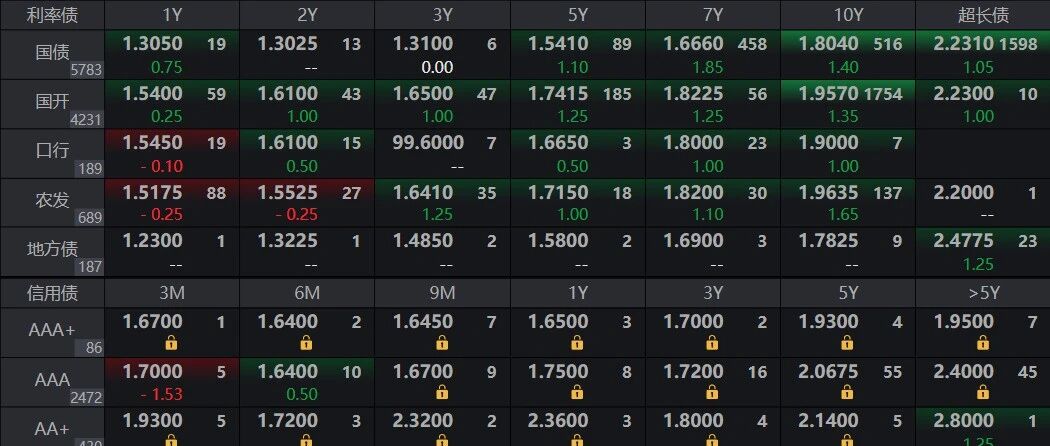
Group 1 - The stock market continues to show strength, supported by Shanghai's further relaxation of housing purchase restrictions, while interest rates have slightly increased [5] - The overnight overseas risk assets have seen a slight rise, indicating a positive sentiment in the market [5] - The 10-year government bond yield opened at 1.788% and experienced narrow fluctuations throughout the morning [5] Group 2 - The central bank conducted a net injection of 159.5 billion yuan through reverse repos and MLF operations, indicating a balanced and slightly loose liquidity environment [3] - The interbank funding rates showed a slight decline, with DR001 around 1.38% and DR007 around 1.51% [3] - The weighted average rates for various repo agreements were reported, with R001 at 1.47% and R007 at 1.59%, reflecting minor changes in the market [4]

全球秩序重构下的“慢牛”与配置主线 | 策马点金
Qi Huo Ri Bao· 2026-02-17 23:45
Core Viewpoint - The global financial market is at a critical juncture, with the long-term debt cycle under pressure and a restructuring of global order and reserve assets expected to influence market trends in 2026 [1][2]. Macro Context - The current global economy is at the tail end of a long-term debt cycle, with government debt as a percentage of GDP at historically high levels and diminishing marginal effects of traditional monetary policy [2][3]. - The international monetary system dominated by the US dollar faces challenges, with international trade shifting from globalization to regionalization and increased protectionism of key technologies and resources [2]. Commodity Market Outlook - The downward pressure on the commodity market is expected to ease, with prices gradually rising, although sector differentiation will continue [2][4]. - Gold is anticipated to maintain a strong oscillating pattern due to ongoing diversified purchases by central banks and geopolitical uncertainties [4]. - Copper and aluminum are seen as leading indicators of structural market trends, driven by demand from infrastructure upgrades related to electric grids and new energy vehicles [4]. - The oversupply pressure in the oil market is gradually being digested, with OPEC's production increase slowing down, which may push oil prices higher [4]. Agricultural Products - Agricultural prices are likely to continue a pattern of oscillation, with current prices at low levels and cost support gradually emerging [5]. A-Share Market - The A-share market is expected to exhibit a "low volatility, slow bull" characteristic in 2026, with opportunities arising from three main lines: upstream resource companies benefiting from fiscal expansion, companies achieving breakthroughs in key technologies, and undervalued defensive sectors [6][8]. Investment Strategy - The asset allocation strategy for 2026 should focus on flexibility and structure, moving from traditional balanced approaches to more aggressive strategies [10]. - Long-term opportunities in the commodity market, particularly in gold, copper, and aluminum, are highlighted as core investment options [10]. Differentiated Investment Strategies - Conservative investors should focus on high-grade bonds, deposits, and money market funds, with limited exposure to equities and commodities [12]. - Moderate investors are advised to balance their portfolios with a tilt towards equities, while aggressive investors should increase their allocations to stocks and commodities [12].

美股前瞻 | 三大股指期货齐跌,“软件股末日”论甚嚣尘上,亚马逊(AMZN.US)盘后公布财报
Zhi Tong Cai Jing· 2026-02-05 13:15
Market Overview - US stock index futures are all down, with Dow futures down 0.30%, S&P 500 futures down 0.52%, and Nasdaq futures down 0.68% [1] - European indices also show declines, with Germany's DAX down 0.63%, UK's FTSE 100 down 0.40%, France's CAC40 down 0.06%, and the Euro Stoxx 50 down 0.41% [2][3] - WTI crude oil prices fell by 2.15% to $63.74 per barrel, while Brent crude oil dropped by 2.06% to $68.03 per barrel [3][4] Software Sector - The software sector is experiencing a significant downturn, with Goldman Sachs' software index declining for the seventh consecutive day, down 19% year-to-date, impacting the Nasdaq 100 index which is down 1.4% [5] - Major software companies like Microsoft, Oracle, Salesforce, and Palantir have seen declines exceeding 10%, with Adobe's stock plummeting by 20% [5] - The software sector has lost $2 trillion in market value since last year's peak, with hedge fund net positions dropping to a historical low of 4.2% [5] Trade and Geopolitical Developments - The US is planning to establish a protected trade zone for rare earths, using tariffs to set price floors, as announced by Vice President Vance [6] - A recent survey indicates that most investors believe stock returns will outperform bonds due to international policy dynamics, with a majority expecting an increase in 10-year US Treasury yields [6] Company-Specific News - Amazon faces scrutiny from German antitrust authorities, resulting in a seizure of $70 million in earnings due to price control practices [8] - Barrick Gold reported a 64% increase in Q4 revenue and a 140% increase in dividends, announcing plans for an IPO to spin off its North American gold assets [9] - SiTime's Q4 revenue reached $113.3 million, a 66% year-over-year increase, with a strong performance in its communication and data center business [10] - Alphabet (Google) reported Q4 revenue growth of 18% to $113.8 billion, driven by its services and cloud business, although it faces concerns over high capital expenditures [11] - Qualcomm's weak Q2 guidance led to a pre-market drop of over 12%, raising concerns about the smartphone market's stability [12] - Arm Holdings' revenue forecast fell short of expectations, leading to a pre-market decline of over 7% [13] - BBVA's profits were impacted by increased provisions in emerging markets, despite a 4.1% increase in net profit [14] - Shell's Q4 adjusted profit fell to $3.26 billion, below market expectations, amid declining oil prices and weak chemical performance [15] - Vodafone's stock saw a significant drop despite revenue growth, due to underperformance in the German market [16] - NIO forecasts adjusted operating profit of RMB 700 million to 1.2 billion for Q4 2025, marking its first anticipated quarterly profit [17]

任职一年半,中加基金总经理李莹因个人原因离任
2 1 Shi Ji Jing Ji Bao Dao· 2025-12-22 07:49
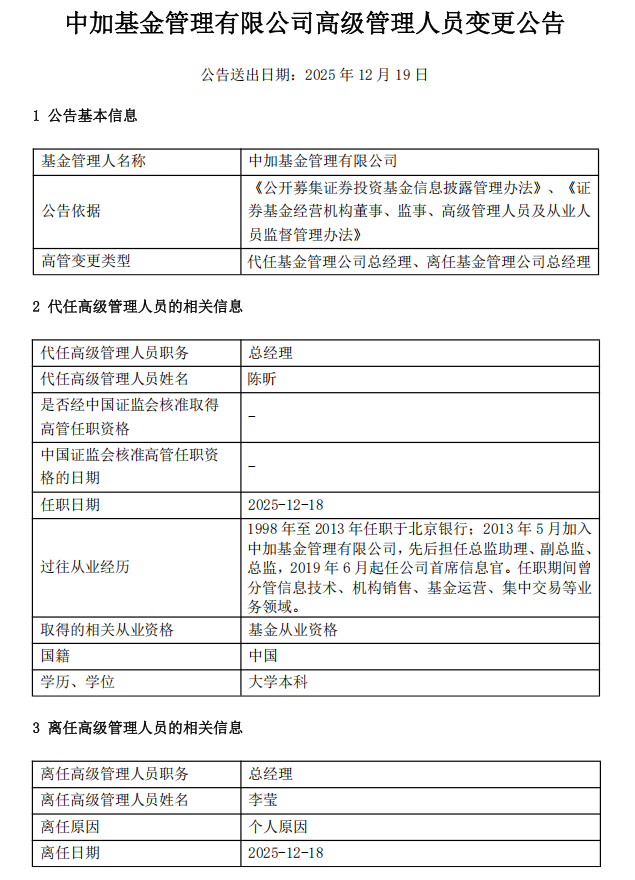
Core Viewpoint - The recent executive changes at Zhongjia Fund, including the resignation of General Manager Li Ying and the appointment of Chief Information Officer Chen Xin as the new General Manager, may pose challenges to the company's operational continuity and growth [1][6][7]. Group 1: Executive Changes - Li Ying has resigned as General Manager due to personal reasons, effective December 18, 2025 [4][6]. - Chen Xin, who has been with Zhongjia Fund since May 2013 and served as Chief Information Officer since June 2019, will take over as General Manager [3][6]. - This change follows the recent departure of the company's Chairman, Xia Yuanyang, in July 2025, indicating a trend of frequent leadership changes within the company [6][7]. Group 2: Company Background - Zhongjia Fund Management Co., Ltd. was established in March 2013 and is the first fund company approved in the third batch of "bank-affiliated" pilot programs, with Beijing Bank as the largest shareholder holding 44% and Canada's Scotiabank holding 28% [6]. - As of the end of Q3 2024, Zhongjia Fund managed a total of 77 funds with 18 fund managers, and the total management scale was 136.36 billion yuan, a decrease from 138.53 billion yuan at the end of 2024 [7]. Group 3: Business Performance - The company has a strong focus on fixed-income products, with bond funds accounting for 84.13% of its total assets under management [7]. - Despite the challenges, Zhongjia Fund has been exploring new business lines, particularly in equity investments, with a focus on technology sectors [7]. - The company has launched new passive index products this year, including those linked to the CSI A500 Index and the CSI 300 Dividend Low Volatility Index [7]. Group 4: Industry Context - In the broader industry, 161 public fund managers have experienced executive changes this year, involving 454 instances, with 40 companies undergoing General Manager changes [8].
近期波动溯源,跨年行情如何演绎?
ZHONGTAI SECURITIES· 2025-12-21 11:00
Report Industry Investment Rating - The industry rating of this report is "Overweight", indicating an expected increase of over 10% compared to the benchmark index in the next 6 - 12 months [24] Core Viewpoints - Since December 2025, although market volatility has increased, the upward trend remains unchanged. The A - share market showed a "V - shaped" reversal last week, and the sentiment for long - positions is still strong [2][6] - This year has seen a significant "stock - strong, bond - weak" trend, but at the year - end, bonds may have a greater reverse impact on stocks. The year - end is a buying opportunity for stocks, following the principle of "buying on small dips, buying more on large dips, and not buying without dips" [2][6] - There will likely be a spring rally. After the year - end, with reduced institutional indicator constraints, funds will form a synergy, and the technology growth sector will have the greatest elasticity [3][6] Summary by Directory Why is December 2025 a "Buy - on - Dip" Opportunity for Stocks? - Extreme stock - bond market conditions at the year - end have increased institutional behavioral differentiation. Bond fluctuations directly affect stocks. Institutions with increased bond investment durations may reduce equity exposure due to solvency and volatility requirements [8] - Banks need to sell long - term bonds due to exceeding EVE indicators, while insurance companies buy long - term bonds. Since Q4 2025, insurance companies have net - bought 313 billion yuan of 10 - year + treasury bonds, and joint - stock banks have net - sold 479 billion yuan. Large bond price fluctuations have led to floating losses for bond buyers [8] - The "Fixed - Income +" strategy has become a negative feedback. The scale of "Fixed - Income +" products expanded significantly in the second half of this year. As of now, new funds in October have not yet made floating profits and have weaker volatility - bearing capacity. In Q3, the scale of "Fixed - Income +" strategy products increased by about 422.5 billion yuan, while the scale of pure - bond funds decreased by 1.6 trillion yuan [9] - The supply and demand of long - term bonds are worrying, and the potential risk of bonds lies in the pressure on the liability side. Even after a sharp decline, the rebound of long - term bonds is weak. The median return of "Fixed - Income +" public funds from October to now is 0.2%, and the maximum loss is - 10.1% [11] Every Decline at the Year - End is a New Opportunity for Stocks - The "relocation" of residents' deposits this round is carried out through institutions. Institutions are responsible for their liability sides, and the liability side has gradually shifted to equity. Asset allocation needs to match the liability side, which requires a slow - bull market [13] - Insurance companies have increased the number of dividend - insurance products since the second half of this year. In November, dividend - insurance products accounted for 48% of new insurance products, and future product layouts will also focus on them, increasing the need to boost investment - end returns [13] - The reinvestment of matured insurance investments is a new variable. The traditional life - insurance products, which account for 55% of the on - sale stock, have a liability - end duration of over 15 years. The 5 - 10Y bonds they hold are due for reinvestment, facing lower yields and thinner capital gains. This may force the asset side to shorten the duration or invest in equity [15] - From the perspective of boosting returns, technology is a necessary choice. The correlation coefficient between the China Bond Index and the CSI Dividend Total Return Index is as high as 0.95, while other broad - based equity indices are negatively correlated with the 10 - year treasury bond index [17] From "Buy - on - Dip" to "Spring Rally" - It is estimated that the incremental funds flowing into the stock market in 2026 will reach 3.1 trillion yuan, and the scale of "Fixed - Income +" will double. If the market adjusts in December, incremental funds are likely to enter the market in advance [19] - At the year - end, stock price movements are affected by bonds and may be more volatile, but it is a buying opportunity for well - capitalized institutions. In the spring rally next year, technology will still be the most worthy sector to focus on [19] - The importance of industry portfolio research is increasing. A "Fixed - Income + Technology" or a combination of technology and other weakly - correlated industries can meet the requirements of the liability side. For "Fixed - Income +" funds, adding 5% technology is better than adding 10% dividends [19]
当下债市热点问题探讨
ZHONGTAI SECURITIES· 2025-12-21 10:13
Group 1: Report Industry Investment Rating - The report does not mention the industry investment rating [1][2][3] Group 2: Core Viewpoints of the Report - The current main logic of the bond market is the lack of incremental funds, and there is also a "debt repayment theory" that the bond market is repaying the over - drawn "debt" since December last year. The "debt repayment" in terms of bond yields is almost done, and the second stage is the return of the bond's duration through secondary - market influence on primary issuance [3][4][32] - There is short - term allocation value in the bond market, but it needs to be considered separately from the perspectives of banks and insurance. The bank's bond allocation value is weakened due to possible over - limit constraints of interest - sensitive assets, while the allocation value of local bonds is prominent from the insurance perspective [3][19][20] - The anti - reflexivity in the bond market supply - demand framework exists. The EVE indicator can adjust assumptions, and the urgency of the indicator decreases in the second year. The issuance structure of interest - rate bonds is not fixed, and the steepening market may reverse [3][13] - The "stock - strong and bond - weak" consensus expectation needs to be vigilant against the anti - reflexivity caused by over - concentrated expectations in the first quarter [4][37][39] Group 3: Summary According to Related Catalogs 1. Behind the Framework of Bond Market Supply and Demand: Where is the Reflexivity? - The impact of bond market supply and demand on the market mainly has two paths: the rise of equities leads to the decline of the bond market, the withdrawal of trading funds with unstable liabilities, and the over - limit of the bank's EVE indicator after long - term bonds are taken back to the balance sheet; the rise of equities leads to insurance institutions rebalancing to more stocks and less bonds, resulting in a change in the insurance product structure and a decrease in the demand for long - term bonds [8] - If the treasury bond issuance structure is determined by plans such as stable growth and the proportion of ultra - long bonds remains unchanged, the long - term bond supply and demand will face an annual - level "imbalance" logic [8] - The anti - reflexivity of bond market supply and demand lies in that problems that can be deduced perfectly may not have a large impact. The EVE indicator can be adjusted, and the issuance structure of interest - rate bonds is variable [3][13] 2. Abuse of the Concept of "Allocation Disk": Measuring the Current Allocation Value of Bonds - The insurance allocation disk's buying rhythm has been relatively stable, and it mainly has trading demand for 30 - year treasury bonds, while large - account allocation or amortized product accounts still use local bonds of the same term as allocation varieties [3][15][17] - From the bank's perspective, the EVA cost - performance of 30 - year treasury bonds is better than that of mortgage loan interest rates, but the bank's bond allocation value is weakened due to possible over - limit constraints of interest - sensitive assets. From the insurance perspective, the allocation value of local bonds is prominent [3][19][20] - The seasonal "red - start" market of bonds has been advancing year by year, resulting in the anti - reflexivity of seasonal failure this year [3][23] 3. Why Does the Stock - Bond Correlation Fail? - Since October, the rapid expansion of fixed - income + strategy products has not produced a strong profit - making effect. Under the recent market consensus expectation of "stock - strong and bond - weak", the hedging effect of the fixed - income + strategy is average [25][27] - The relationship between liquidity and assets is like that between flour and water. The increase in risk preference may have led to an increase in "flour" with little marginal change in "water", resulting in unstable trading liquidity, and more precise liquidity injection is needed to break the situation [28] 4. How to Quantitatively Understand the Widening of the Yield Spread? - The market generally agrees on the widening of the term spread, with differences mainly in quantification and duration. In December, the 30 - year to 10 - year spread has reached over 40BP, returning to the level at the end of 2022. The market may have over - drawn the rhythm of next year [29] - There may be new factors for the spread to widen further, such as the widening of the bond yield curve in other countries, the possible inadequacy of using the 2022 bull - market term spread to measure in case of a bull - bear conversion, and the possible inadequacy of the current priced term spread in case of re - inflation. However, if the long - term bond issuance term is adjusted from over 20 years to under 10 years, the spread may change from widening to narrowing [31] 5. Summary: The Current Main Line of the Bond Market - The main line of the current bond market is the lack of incremental funds, and the "debt repayment theory" also has a certain basis. The "debt repayment" in terms of bond yields is almost done, and the second stage is the return of the bond's duration [32][34] - In terms of strategy, the 30 - year bond has the highest short - term over - sold betting odds, but the space for one - sided direction betting is limited. The spread between special 6 and special 2 still has room for betting on regression. Medium - and short - term credit bonds and interest - rate bonds with a term of 5 years or less are relatively stable choices [4][37]
公募冲刺年末布局 被动指数产品或成“胜负手”
Shang Hai Zheng Quan Bao· 2025-11-09 15:26
Core Insights - The number and proportion of passive index funds being launched by fund companies are significantly higher than other types of funds as the year-end approaches, indicating a strategic shift in the market [1][2] - Despite strong performance, the share of actively managed equity funds is decreasing, leading to increased net redemption pressure on existing funds [1][2] Group 1: Fund Issuance Trends - As of November 5, 2023, a total of 1,333 new funds have been launched this year, surpassing previous years and nearing the 2022 total of 1,546 [2] - Equity and mixed funds account for over 50% of the new fund issuance, with equity funds making up 37.69%, the highest since 2020 [2] - The proportion of bond funds has sharply decreased from over 65% in the past three years to 41.13%, highlighting a "strong equity, weak bond" trend [2] Group 2: Performance of Passive Index Funds - In Q3, 361 new equity funds were established, with a total scale of 203.608 billion yuan, of which 258 were index equity funds, accounting for over 70% of the total issuance [2] - The total share of actively managed equity and mixed funds decreased by 230.961 billion yuan in Q3, indicating a shift in investor preference towards passive products [2] Group 3: Strategic Focus of Fund Companies - Fund companies are increasingly focusing on passive index products, with 44 new products awaiting issuance, half of which are passive index funds [3] - These new products include enhanced versions of major indices and thematic funds in popular sectors such as technology and renewable energy [3] - Market analysts suggest that while there may be profit-taking at year-end, the dividend strategy could benefit from lower competition and better valuation compared to the technology sector [3]
“固收+”基金研究:25Q3,绩优“固收+”盘点
Tianfeng Securities· 2025-11-08 12:29
1. Report Industry Investment Rating - Not provided in the given content 2. Core Viewpoints of the Report - In 2025Q3, the performance of major asset classes showed a "strong stocks, weak bonds" characteristic. Equity and convertible bond funds led the market, while pure bond funds and first - and second - tier bond funds underperformed. The scale of "fixed income +" funds rebounded, and the convertible bond strategy was advantageous. Convertible bond - enhanced funds performed brightly, but with relatively high volatility [11][23][42]. 3. Summary According to the Table of Contents 3.1 2025Q3, How Did "Fixed Income +" Funds Perform? 3.1.1 Stock - Strong, Bond - Weak, Equity Funds Led the Market - In 2025Q3, major asset classes showed a "strong stocks, weak bonds" characteristic. The equity market rose from July to August and entered a shock - adjustment period in September, while the bond market oscillated and corrected. The Wande All A, ChiNext Index, and Science and Technology Composite Index rose by 19.46%, 50.40%, and 39.61% respectively. The CSI Convertible Bond Index rose by about 9.43%. Equity and convertible bond funds led the market, with median returns of stock - type and partial - stock hybrid funds generally over 20% and that of convertible bond funds reaching 13%. Pure bond funds and first - and second - tier bond funds underperformed. Passive index - type stock funds and second - tier bond funds saw an increase in net asset value and shares, while pure bond funds were redeemed [11]. 3.1.2 "Fixed Income +" Scale Rebounded, Convertible Bond Strategy was Advantageous - After re - defining "fixed income +" funds based on post - event asset allocation, 1424 funds were selected for analysis. As of 2025Q3, the total share of these funds was 151.5461 billion, a 32.22% increase from the end of Q2, and the total net asset value was 2.0363 trillion yuan, a 36.5% increase. The convertible bond positions of "fixed income +" funds generally decreased at the end of Q3. Over 93% of "fixed income +" funds had positive returns in 2025Q3, and convertible bond - enhanced funds performed brightly but with relatively high volatility [23][24][31]. 3.2 Which High - Performing "Fixed Income +" Funds Led the Market? 3.2.1 Performance Review of Existing "Fixed Income +" Funds - Among the top 30 "fixed income +" funds with the highest returns in 2025Q3, convertible bond - enhanced funds dominated. Southern Changyuan Convertible Bond, Huashang Shuangyi, etc. had nearly 29% positive returns, and Huashang Shuangyi had a maximum drawdown within 4%. In the top 30 stock - enhanced funds, Huaxia Fund had multiple products on the list. The top 30 ordinary "fixed income +" funds were more scattered [47][52]. 3.2.2 Performance Review of Newly - Issued "Fixed Income +" Funds - Among the potential "fixed income +" funds newly established since 2024, Shangzheng Zhengtai Balanced Allocation and Quanguo Research Selection had over 11% positive returns in 2025Q3 and a maximum drawdown of about 2%. The remaining top 30 were mostly second - tier bond funds, with over 80% bond positions and about 10% equity positions, and their Q2 returns were mostly within 5% and the maximum drawdowns were mostly within 2% [56]. 3.3 What Were the Characteristics of the Holdings of High - Performing "Fixed Income +" Funds? 3.3.1 History: Which Directions Did High - Performing Funds Invest in? - At the end of 2025Q2, top "fixed income +" funds and convertible bond - enhanced funds significantly over - allocated manufacturing - chain convertible bonds and under - allocated financial convertible bonds. They also over - allocated partial - stock and high - price convertible bonds and under - allocated high - rated convertible bonds. In terms of stock industry allocation, they over - allocated metals, steel, power equipment, electronics, and computers [4]. 3.3.2 Present: Which Directions Are High - Performing Funds Investing in? - High - performing "fixed income +" funds continued to significantly over - allocate convertible bonds in metals, mid - stream manufacturing, and TMT sectors and under - allocate bank convertible bonds. They over - allocated high - price convertible bonds above 130 yuan and partial - stock convertible bonds and under - allocated medium - price convertible bonds between 110 - 130 yuan. They also over - allocated stocks in metals and electronics and under - allocated cyclical and financial stocks. Seventeen convertible bonds such as Haoyuan Convertible Bond were held by over 15 top "fixed income +" funds, and 17 convertible bonds such as Yunji Convertible Bond and Daotong Convertible Bond were held by over 20% of top "fixed income +" funds [4].
策略日报:关前蓄势-20251028
Tai Ping Yang Zheng Quan· 2025-10-28 15:24
Group 1: Macro Economic Overview - The report indicates that the 30-year government bonds are expected to stabilize and rebound within one quarter, but will continue to decline in the long term, targeting the low point from September 30, 2024 [3][17]. - The A-share market has seen the Shanghai Composite Index reach 4000 points for the first time in ten years, providing a solid foundation for future highs, with any pullback seen as a buying opportunity [4][19]. - The technology sector has shown significant gains, with many leading tech stocks reaching new highs, while sectors like coal, banking, and military remain undervalued, suggesting a strategy of buying in less popular areas [4][19]. Group 2: Stock Market Insights - The report highlights that the military equipment sector has led the market with gains exceeding 2%, while precious metals have underperformed [4][19]. - The technology sector's absorption rate remains high, above 35%, indicating limited room for a pullback, and suggests that lower volatility sectors may yield better returns in the fourth quarter [4][19]. - The report advises against chasing high-volatility tech stocks at elevated levels and recommends focusing on traditional sectors for potential excess returns [4][19]. Group 3: Foreign Market Analysis - The U.S. stock market is expected to perform strongly due to anticipated agreements on trade at the APEC meeting and positive earnings reports, although it may experience low volatility leading up to key meetings [5][24]. - The report notes that the U.S. dollar is likely to maintain its strength, with the euro expected to weaken against the dollar, while the Chinese yuan is projected to remain stable against the dollar [6][28]. - The report emphasizes that the market's perception of the U.S. economy may shift positively in the fourth quarter, correcting overly pessimistic expectations [7][28]. Group 4: Commodity Market Trends - The report indicates a slight decline in the Wenhua Commodity Index, with steel and construction materials leading gains, while precious metals are advised to be approached with caution due to recent volatility [8][32]. - Oil prices have surged due to sanctions on Russian oil, although the overall trend remains weak, suggesting a potential for stabilization in the short term [8][32]. - The report highlights that various commodities, including copper, aluminum, and lithium carbonate, are showing strength, with several domestic products indicating signs of recovery [8][32]. Group 5: Policy and Regulatory Developments - The report outlines key domestic policies, including the release of the 15th Five-Year Plan, which aims to improve income distribution and increase the proportion of labor income in national income [9][35]. - The report also mentions the 11th batch of national drug procurement, which includes 55 commonly used drugs, aiming to stabilize clinical needs and ensure quality [9][35]. - The 28th China-ASEAN Leaders' Meeting is noted, emphasizing cooperation and unity as essential for mutual benefits [9][36].
“贫富差距”拉大!多只“固收+”,凭借权益领跑
券商中国· 2025-10-27 23:30
Core Viewpoint - The "fixed income +" products have shown diverse net value curves in the context of a strong stock market and weak bond market, with some products achieving outstanding performance through high elasticity allocations in stocks and convertible bonds, while others focusing on long-duration bonds performed relatively poorly [1][2]. Group 1: Performance of "Fixed Income +" Products - The average increase of "fixed income +" products this year is approximately 4.8%, with top performers like Huazhong Zhili rising by 47.77% and Huashang Shuangyi by 44.4% [4]. - The leading products have significant allocations in equity assets, with over 40% of assets in stocks for top performers, benefiting from high-elasticity technology stocks [4]. - The performance of other high-ranking products, such as Fuguo Jiuli and Minsheng Jiayin, also shows a strong focus on convertible bonds, with allocations exceeding 70% [4]. Group 2: Risk Level Adjustments - Several public funds and distribution channels have raised the risk levels of their "fixed income +" products, with many being upgraded from R2 (medium-low risk) to R3 (medium risk) [8]. - The adjustments in risk levels are influenced by regulatory requirements, market conditions, and changes in target customer profiles [8][9]. Group 3: Market Outlook - The bond market is expected to maintain a stable operation, while the equity market is anticipated to continue with structural trends, leading to a consensus on seeking higher risk-return ratios through "fixed income +" products [2][12]. - The overall scale of "fixed income +" funds reached 1.48 trillion yuan by the end of the second quarter, with a significant increase of over 100 billion yuan in a single quarter [11]. - The current economic indicators suggest a weak recovery, providing a stable foundation for the bond market, while also presenting new challenges [12].