
八个坚持

Search documents
视频丨2026经济工作怎么干?“八个坚持”释放哪些信号?专家解读
Yang Shi Xin Wen Ke Hu Duan· 2025-12-12 10:34
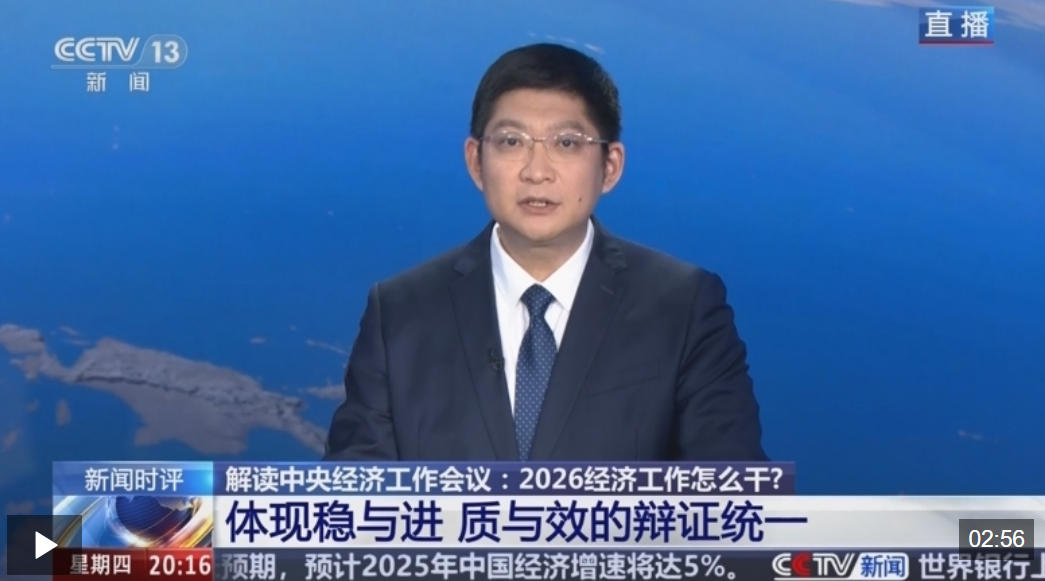
Group 1 - The core policy direction of "seeking progress while maintaining stability, improving quality and efficiency" reflects a dialectical unity between stability and progress, as well as quality and efficiency [2][4] - The relationship between stability and progress indicates that China's economic growth remains among the top in the world, emphasizing the need for both qualitative improvement and reasonable quantitative growth [4] - The relationship between quality and efficiency highlights the importance of developing new productive forces and achieving successful industrial transformation and green low-carbon transitions [6] Group 2 - The "Eight Persistences" signal the key tasks for 2026, emphasizing a systematic perspective in economic work, which requires viewing various development tasks from a holistic standpoint [8][10] - The focus on a clear goal orientation in the proposed tasks aims to align short-term objectives with the medium- and long-term plans of the 14th Five-Year Plan [10] - The commitment to prioritizing people's livelihoods reflects a strong emphasis on addressing issues that directly impact the public, ensuring that investments in both physical and human capital are closely integrated [12][14]

主播说联播丨做好明年经济工作,“八个坚持”划出重点任务!
Yang Shi Xin Wen Ke Hu Duan· 2025-12-12 10:28
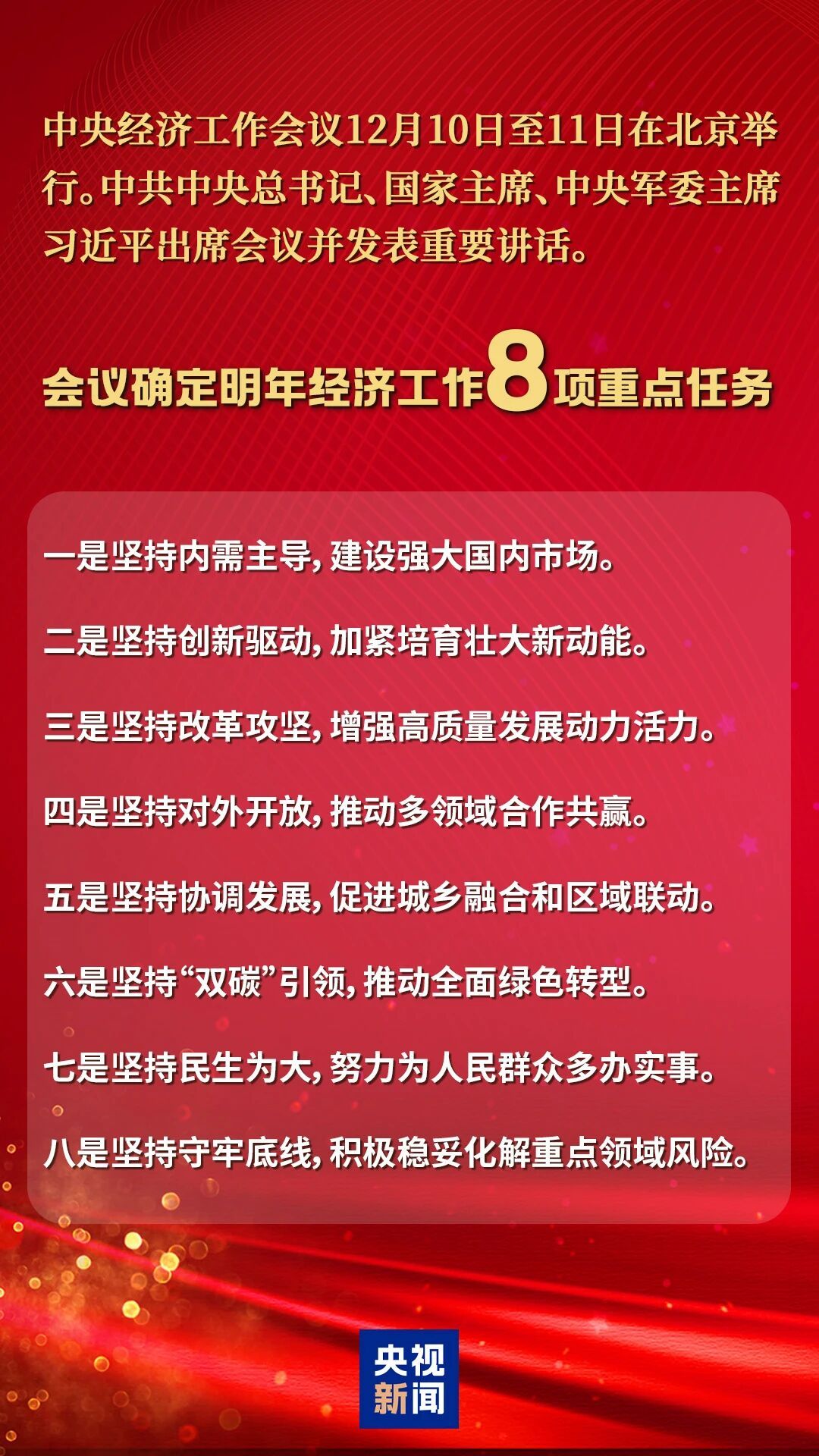
Core Viewpoint - The Central Economic Work Conference held on December 10-11 in Beijing outlined the economic work for 2025 and analyzed the current economic situation, setting the agenda for 2026 [1][3]. Summary by Relevant Sections Economic Potential and Policy Direction - The conference emphasized the need to fully tap into economic potential, combining policy support with reform and innovation, ensuring both flexibility and effective management [3]. - It highlighted the importance of investing in both physical assets and human capital, and strengthening internal capabilities to face external challenges [3]. Goals and Tasks for 2026 - The meeting confirmed that the main goals for economic and social development this year will be successfully achieved, and outlined the approach for next year's economic work [3]. - The policy direction for 2026 focuses on stability and progress, quality improvement, and efficiency enhancement, with a commitment to a more proactive fiscal policy and moderately loose monetary policy [3]. Key Tasks - The conference introduced "Eight Persistences" as key tasks, which include: - Prioritizing domestic demand and innovation-driven growth - Committing to reform and opening up - Ensuring coordinated development and leading with "dual carbon" goals - Prioritizing people's livelihoods and maintaining bottom-line stability [3]. Implementation - The conference stressed the importance of practical implementation of the outlined strategies, urging unity in thought and action to ensure a strong start for the 14th Five-Year Plan [6].
华夏时评:以“积极宽松”政策锚定“八个坚持”
Hua Xia Shi Bao· 2025-12-11 11:16
Core Viewpoint - The central economic work conference held on December 10-11, 2023, emphasized the importance of utilizing fiscal and monetary policies effectively to achieve the goals set for 2026, marking the beginning of the "15th Five-Year Plan" [2][4]. Group 1: Economic Policy Direction - The conference reiterated the implementation of a more proactive fiscal policy and moderately loose monetary policy, aiming to enhance macroeconomic governance effectiveness [2][4]. - The "Eight Persistences" were highlighted as key strategies for economic work in 2026, focusing on domestic demand, innovation, reform, openness, coordinated development, carbon neutrality, people's livelihood, and risk management [3][4]. Group 2: Implementation Strategies - Fiscal and monetary policies are expected to work in tandem to support the "Eight Persistences," with fiscal funds directed towards infrastructure and innovation, while monetary policy aims to provide low-cost funding to high-tech enterprises [4][5]. - Specific measures include fiscal support for necessary reforms, maintaining a stable financial environment, and promoting regional balance and rural revitalization through targeted fiscal transfers [5][6]. Group 3: Long-term Goals - The success of China's economic development in 2026 will not solely be measured by GDP growth but also by the integration of macro policy resources with the strategic layout of the "Eight Persistences" [6]. - The proactive policies are seen as essential for navigating complex challenges and ensuring a strong start to the "15th Five-Year Plan" [6].

新华社:从中央政治局会议看2026年经济工作方向
Xin Hua She· 2025-12-09 06:21
Group 1 - The core viewpoint of the articles emphasizes the achievements during the "14th Five-Year Plan" period and the solid foundation laid for the "15th Five-Year Plan," highlighting the importance of economic stability and growth in the face of challenges [1][3] - The meeting noted that China's GDP grew by 5.2% year-on-year in the first three quarters, maintaining a leading position among major global economies, showcasing resilience and vitality [2] - The meeting outlined the need for a proactive macroeconomic policy to ensure economic stability, emphasizing the importance of fiscal and monetary policies in guiding development expectations and enhancing economic governance [5] Group 2 - The meeting identified eight key principles for economic work in 2026, focusing on domestic demand, innovation, reform, openness, coordinated development, green transformation, improving people's livelihoods, and risk management [6][9] - It was highlighted that local governments should align with national strategies while tailoring their economic plans to their specific circumstances, ensuring effective contributions to national development [9] - The emphasis on enhancing people's sense of gain, happiness, and security through effective livelihood policies is seen as crucial for supporting high-quality economic development [10]