公司控制权之争

Search documents
科兴生物收到纳斯达克退市决定函,拟申请听证暂缓程序
2 1 Shi Ji Jing Ji Bao Dao· 2025-11-20 04:02
Core Viewpoint - Sinovac Biotech Ltd. faces delisting from NASDAQ due to failure to submit its 2024 annual report by the extended deadline of November 11, 2025, and plans to appeal the decision to delay the delisting process [1][3] Group 1: Delisting and Financial Reporting - The company received a delisting notice from NASDAQ on November 12, 2023, for not submitting the required annual report [1] - Sinovac intends to file an appeal with the NASDAQ hearing committee by November 19, 2023, which will temporarily halt the delisting process for 15 days [1] - The delay in submitting the annual report is attributed to a change in the auditing firm, with the previous auditor resigning on April 15, 2025, and UHY LLP being appointed as the new auditor [1][3] Group 2: Control Struggles - Sinovac has been embroiled in a control struggle for nearly a decade, beginning in 2016 when the founders proposed privatization and return to mainland listing [3][4] - The conflict has involved extreme actions, including seizing company seals and occupying production facilities, leading to temporary disruptions in vaccine production [4] - The UK Judicial Committee's ruling in January 2025 further escalated the control dispute by replacing four board members, intensifying the conflict between factions [4] Group 3: Dividend Strategy and Market Reaction - In 2025, Sinovac announced significant dividend payouts, including a cash dividend of $55 per share and additional special dividends, which have drawn market attention [5] - Experts suggest that while these dividends may boost short-term shareholder confidence, they could limit the company's ability to invest in R&D and operational expansion in the long term [5] Group 4: Financial Performance - Sinovac's sales surged to $19.4 billion in 2021 due to the approval of its COVID-19 vaccine, a significant increase from $510.6 million in 2020 [6] - However, the company reported a 13.6% decline in sales to $121.3 million in the first half of 2024, with a net loss of $68.6 million [6] - As of June 2024, the company had $1.1 billion in cash and cash equivalents, indicating a stable core business despite ongoing internal control deficiencies [6]

股东会激烈冲突后 吴世春人马上位董事长 ST路通控制权之争走向何方?
Di Yi Cai Jing· 2025-11-11 00:09
Core Viewpoint - The control struggle at ST Luton (300555.SZ) escalated during the shareholders' meeting on November 7, where the former chairman was removed after a heated debate among shareholders, leading to a significant shift in the company's management structure [1][2][5]. Group 1: Shareholder Meeting Events - The shareholders' meeting was initially announced to be postponed by former chairman Qiu Jingwei, citing a board decision, which was met with strong opposition from shareholders including Wu Shichun [1][3]. - After a chaotic exchange, shareholders led by Wu Shichun successfully reconvened the meeting, resulting in the dismissal of Qiu Jingwei and former deputy general manager Fu Xinyue [1][4][5]. - The meeting concluded with three out of twelve proposed resolutions being passed, including the election of Tan Wenshu as a non-independent director and the appointment of Tan as the new chairman [6][8]. Group 2: Background of Control Dispute - The conflict originated in March when Wu Shichun acquired a 7.44% stake in ST Luton through a judicial auction, becoming the largest shareholder [2][9]. - Disagreements arose over the legitimacy of Wu's acquisition agreements, leading to multiple failed attempts to reorganize the board by Wu [9][10]. - The original management accused Wu of violating regulations regarding shareholding and board control, claiming that his actions were not compliant with legal requirements [10][11]. Group 3: Management Changes and Implications - Following the shareholders' meeting, the newly formed board held an emergency meeting to elect Tan Wenshu as chairman and made significant changes to the management team, including the dismissal of three executives [6][7]. - The company faced scrutiny from the Jiangsu Securities Regulatory Bureau for non-compliance in financial management, which contributed to the management shake-up [7]. - The original management issued a statement contesting the legitimacy of the shareholders' meeting and the decisions made, claiming procedural violations [8][12].

股东会激烈冲突后,吴世春人马上位董事长,ST路通控制权之争走向何方?
第一财经· 2025-11-10 15:56
Core Viewpoint - The article discusses the intense power struggle at ST Luton (300555.SZ) following a chaotic shareholders' meeting on November 7, where the former chairman was ousted and a new chairman was appointed amidst disputes over the legitimacy of the meeting and the control of the company [3][4][9]. Group 1: Shareholder Meeting Events - The shareholders' meeting on November 7 was initially postponed by former chairman Qiu Jingwei, leading to strong opposition from shareholders including Wu Shichun, resulting in a chaotic scene [3][6]. - After a heated debate, Wu Shichun and other shareholders successfully reconvened the meeting, which led to the dismissal of Qiu Jingwei and former deputy general manager Fu Xinyue, while Tan Wenshu was elected as a non-independent director [3][9]. - The meeting's agenda included 12 proposals, of which only 3 were approved, indicating a significant shift in the company's governance [9][10]. Group 2: Control Struggle Background - The conflict originated in March when Wu Shichun acquired a 7.44% stake in ST Luton through a judicial auction, becoming the largest shareholder [4][12]. - Disagreements arose over whether Wu's acquisition agreement was terminated, leading to multiple failed attempts to reorganize the board by Wu [4][12]. - The power struggle intensified after the board's refusal to approve Wu's proposals, culminating in legal actions initiated by the original management against Wu [14][15]. Group 3: Management Changes and Implications - Following the shareholders' meeting, an emergency board meeting was held where Tan Wenshu was elected as chairman, and several executives were dismissed due to regulatory issues faced by the company [10][11]. - The company faced scrutiny from the Jiangsu Securities Regulatory Bureau for non-compliance in financial management, which contributed to the management shake-up [10][11]. - The legitimacy of the shareholders' meeting and the decisions made were contested by the original management, who claimed the meeting was improperly convened [11][12]. Group 4: Future Outlook - The outcome of the recent shareholders' meeting and board changes may determine the future direction of ST Luton and its governance structure [18]. - The ongoing disputes and legal challenges suggest that the control struggle may not be resolved quickly, and further developments are anticipated [18].
股东会激烈冲突后,吴世春人马上位董事长,ST路通控制权之争走向何方?
Di Yi Cai Jing· 2025-11-10 14:48
Core Viewpoint - The recent shareholder meeting and board decisions at ST Luton (300555.SZ) have led to significant changes in control, with the original chairman being removed and a new chairman appointed amid ongoing disputes between shareholders [1][5][8]. Group 1: Shareholder Meeting Developments - The shareholder meeting on November 7 was initially postponed by the original chairman, Qiu Jingwei, which faced strong opposition from shareholders including Wu Shichun, leading to a chaotic scene [1][3]. - After a heated debate, Wu Shichun and other shareholders successfully reconvened the meeting, resulting in the dismissal of Qiu Jingwei and former deputy general manager Fu Xinyue, while Wu's nominee, Tan Wenshu, was elected as a non-independent director [1][5]. - The board convened immediately after the meeting to elect Tan Wenshu as the new chairman and made significant changes to the board's committee structure, dismissing three senior executives [5][6]. Group 2: Control Dispute Background - The conflict originated in March when Wu Shichun acquired a 7.44% stake in ST Luton through a judicial auction, becoming the largest shareholder, which led to disagreements over the validity of his acquisition agreements [2][8]. - Wu Shichun's attempts to reorganize the board were repeatedly blocked by the original management, escalating tensions between the two parties [2][8]. - The original management, led by Qiu Jingwei, has claimed that Wu's acquisition and subsequent actions were not compliant with regulations, asserting that he must prove the legality of his funding sources and the legitimacy of his agreements [8][11]. Group 3: Legal and Regulatory Issues - The original management has raised concerns about the legality of Wu Shichun's actions, including allegations of unauthorized increases in voting rights and failure to disclose necessary information [10][11]. - The board's decision to dismiss the lawsuit against Wu Shichun was based on the conclusion that the agreements related to share transfers did not meet regulatory requirements and were therefore invalid [12]. - The ongoing disputes have led to a complex legal landscape, with both sides asserting their positions regarding the legitimacy of the shareholder meeting and the decisions made therein [7][12].
莫晓宇等解散控股股东再审申请被驳回 振芯科技:公司实控人认定不变
Zheng Quan Shi Bao Wang· 2025-10-20 14:11
Core Viewpoint - The ongoing legal dispute regarding the dissolution of Guoteng Electronics, the controlling shareholder of Zhenxin Technology, has seen a recent development with the Sichuan High People's Court rejecting the shareholders' request for a retrial, affirming the company's current governance structure and control [1][3][5]. Group 1: Legal Proceedings - The Sichuan High People's Court has dismissed the retrial application from four shareholders of Guoteng Electronics, confirming the previous ruling that the company should not be dissolved [1][2]. - The legal battle began in February 2018 when the four shareholders filed a lawsuit seeking the dissolution of Guoteng Electronics, which led to a series of court rulings, including a first-instance judgment in September 2018 and a retrial decision in November 2021 [2][4]. - Following the dismissal of the retrial application, the four shareholders expressed their intention to continue pursuing the dissolution based on new facts [3][5]. Group 2: Company Control and Governance - The dispute is rooted in a control struggle over Zhenxin Technology, with the four shareholders claiming that Guoteng Electronics is in a governance deadlock and lacks an actual controller [4][5]. - The court ruled that there was insufficient evidence to prove that Guoteng Electronics was in a state of deadlock as defined by company law, allowing the company to continue operating under the control of He Yan, who holds a 51% stake [5]. - Despite the court's ruling, the current management of Zhenxin Technology maintains control over the board, leading to conflicts over governance proposals, including a rejected board expansion proposal from Guoteng Electronics [5][6].

罢免案被否!688373,将迎“久违”实控人
Shang Hai Zheng Quan Bao· 2025-10-09 14:11
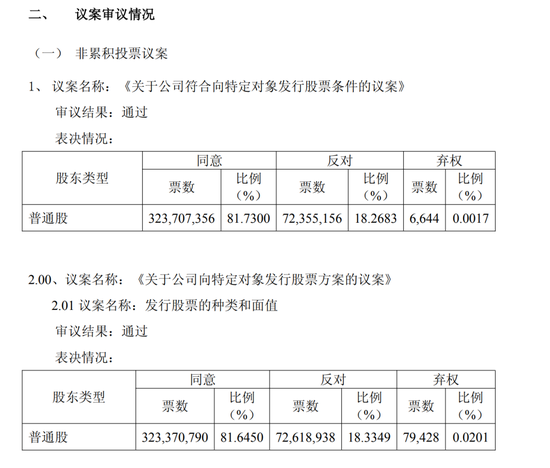
Core Viewpoint - The control dispute over Mengke Pharmaceutical has been resolved with the approval of a capital increase plan, allowing Hai Jing Pharmaceutical to become the controlling shareholder, ending the company's three-year period without a controlling entity [1][2]. Group 1: Capital Increase Plan - On October 9, Mengke Pharmaceutical held its second extraordinary general meeting of shareholders in 2025, where the approximately 1.033 billion yuan capital increase plan was approved with a high voting rate [2][6]. - Key proposals, including the issuance plan and the introduction of strategic investors, received over 81% approval, with the proposal for issuing shares to specific targets achieving a 81.73% approval rate [2][4]. Group 2: Shareholder Dynamics - The proposal to dismiss the chairman and three directors put forth by the largest shareholder, Genie Pharma, was rejected, with nearly 80% voting against it [4][6]. - The meeting saw a high participation rate, with 438 shareholders and proxies representing 60.41% of the total shares [6]. Group 3: Company Financials and Future Prospects - Mengke Pharmaceutical has been in a state of loss, with cumulative losses exceeding 1.3 billion yuan from 2021 to 2024, although revenue increased by 10.26% in the first half of 2025 [7]. - The introduction of Hai Jing Pharmaceutical is expected to provide financial support and enhance the company's development capabilities, particularly in commercializing its core product, Kangti Zuoan tablets [12]. Group 4: Hai Jing Pharmaceutical Overview - Hai Jing Pharmaceutical is a research-driven modern pharmaceutical company, with steady revenue growth from 486 million yuan in 2022 to 648 million yuan in 2024, and a net profit of 104 million yuan in 2024 [8][9]. - The strategic partnership aims to leverage Hai Jing's established sales network and production capabilities to enhance Mengke's market penetration and production efficiency [12].

中国式重要企业控制权之争最终起决定性作用的,都不大可能是资本与市场的力量
Sou Hu Cai Jing· 2025-10-06 07:30
Group 1 - The investigation of core executives from a well-known mixed-ownership enterprise in Hangzhou has attracted significant attention from various sectors [3] - Control disputes in important Chinese enterprises are primarily determined by factors beyond capital and market forces, focusing instead on the resources and strategies employed by the parties involved [3] - The essence of control disputes is a comprehensive game of resources, strategies, and the resulting distribution of interests among the parties [3] Group 2 - The current era is characterized as a time of great transformation and profound change, with historical business battles often revealing clear trends even before their outcomes are finalized [4] - Company governance is viewed as a microstructure of national governance, emphasizing the importance of actively participating in the protection of rights [4] - The concept of "legal intelligence" is introduced as a critical dimension of life, alongside emotional and financial intelligence, highlighting the integration of civic legal awareness and self-regulation [6]
梦洁股份三年控制权博弈落幕,姜天武重获表决权却遇新局
Xi Niu Cai Jing· 2025-09-22 07:39
Core Viewpoint - The control dispute of Mengjie Co., Ltd. has reached a significant turning point as founder Jiang Tianwu regains voting rights and becomes the largest shareholder, yet the company enters a state of having no actual controller, indicating ongoing internal conflicts despite the change in shareholding structure [2][3]. Group 1: Control Change - The control change stems from a debt crisis in 2022, where Jiang Tianwu and other shareholders transferred a total of 77 million shares to Jin Sen New Energy, while Jiang Tianwu relinquished voting rights for 13.36% of his shares for three years [3]. - Following the termination of the voting rights delegation agreement, Jin Sen New Energy's voting rights share dropped to 10.30%, losing its status as the largest shareholder, while Jiang Tianwu and his concerted parties hold a total of 13.53% of shares, becoming the new largest shareholder [3]. - The company is now in a state of having no controlling shareholder or actual controller due to the dispersed shareholding [3]. Group 2: Governance Issues - Jin Sen New Energy, which entered as a "white knight" in 2022, has been a focal point of controversy in Mengjie Co., Ltd.'s governance, with its recommended director voting against or abstaining from multiple proposals, raising concerns about the company's financial data disclosure and lack of control over key operations [3]. - Jin Sen New Energy is facing its own challenges, including a warning letter from the Hunan Securities Regulatory Bureau and a judicial freeze on its 77 million shares, preventing it from exercising voting rights until rectification is completed [3]. Group 3: Shareholding Dynamics - The entry of Wu Shichun, a prominent figure in the venture capital circle, adds complexity to the shareholding structure, as Wu's company Qingyun Data Science is set to acquire 10.65% of shares from Jiang Tianwu's ex-wife, potentially leading to a "tripartite" shareholding structure among Jiang Tianwu (13.52%), Qingyun Data Science (10.65%), and Jin Sen New Energy (10.30%) [4]. - This new shareholding dynamic suggests that no single party can dominate the company, leaving the control dispute unresolved [4]. Group 4: Financial Performance - Mengjie Co., Ltd. reported a revenue of 734 million yuan in the first half of 2025, a year-on-year decrease of 14.83%, while the net profit attributable to shareholders increased by 26.27% to 25.415 million yuan, and the net profit after deducting non-recurring gains and losses rose by 53.46% to 23.9754 million yuan [4].