增值税优惠政策

Search documents
两部门发文延续增值税优惠政策
Jin Rong Shi Bao· 2026-02-03 00:58
Core Viewpoint - The implementation of the new VAT law and its accompanying regulations starting January 1, 2026, aims to stabilize tax burdens while optimizing the existing VAT preferential policy system, responding to societal concerns and demands [1][2]. Group 1: VAT Policy Adjustments - The announcement clarifies that from January 1, 2026, to December 31, 2027, the threshold for small-scale taxpayers will be set at a monthly sales amount of 100,000 yuan or a quarterly sales amount of 300,000 yuan, with a per-transaction threshold of 1,000 yuan [1][2]. - The announcement systematically organizes and optimizes existing preferential policies, making the objectives clearer and the system more standardized, which is expected to enhance the efficiency of tax resource allocation [2]. Group 2: Taxpayer Guidelines - The new regulations specify that the threshold for individual taxpayers under the per-transaction tax system will increase from 500 yuan to 1,000 yuan, while maintaining certain exceptions for specific types of taxable transactions [3][4]. - Individual taxpayers are allowed to apply for tax declarations through invoice issuance or withholding by payers, which reduces the burden of self-declaration [4][5]. Group 3: Small-scale Taxpayer Flexibility - Small-scale taxpayers can choose to waive tax exemptions for certain taxable transactions to meet the needs of downstream clients for VAT special invoices, which is crucial for input tax deductions [5][6]. - The regulations allow small-scale taxpayers to flexibly decide whether to waive tax exemptions for specific transactions without affecting the preferential treatment of other taxable transactions [6].
财政部 税务总局关于增值税法施行后增值税优惠政策衔接事项的公告财政部 税务总局公告2026年第10号
蓝色柳林财税室· 2026-02-02 14:28
Core Viewpoint - The announcement outlines the transition of VAT preferential policies following the implementation of the VAT Law in China, effective from January 1, 2026, to December 31, 2027, detailing the VAT exemption projects and the applicable thresholds for small-scale taxpayers [2][4]. VAT Threshold Standards - For small-scale taxpayers, the VAT threshold is set at CNY 100,000 monthly or CNY 300,000 quarterly for taxable transactions [2]. - For single-instance taxation, the threshold is CNY 1,000 per day for sales [3]. VAT Exemption Projects - Agricultural producers selling self-produced agricultural products are exempt from VAT starting January 1, 2026 [5]. - Agricultural services such as tillage, irrigation, pest control, and related training are also exempt [7]. - Medical services provided by healthcare institutions are exempt from VAT [8]. - Services provided by individuals with disabilities are exempt from VAT [9]. - Childcare services provided by nurseries and kindergartens are exempt from VAT [11]. - Funeral services are exempt from VAT [12]. - Educational services provided by schools are exempt from VAT, including various levels of education [13][14][15][16][17]. - Land used for agricultural production is exempt from VAT [19]. - Income from the transfer of financial products by individuals is exempt from VAT [20]. - Certain services provided by shipping and airline companies from Taiwan are exempt from VAT [21][22]. - Income from the transfer of land use rights is exempt from VAT [24]. - Local governments' transactions regarding natural resource use rights are exempt from VAT [25]. - Income from stock and fund trading by Hong Kong investors is exempt from VAT [26][27][28]. Simplified Tax Calculation Methods - From January 1, 2026, to December 31, 2027, general taxpayers can opt for a simplified tax calculation method at a rate of 3% for specific taxable transactions, including sales of self-extracted construction materials and small hydropower generation [122][123][124][125][126]. - A 5% rate applies to certain transactions, including real estate leasing and sales of properties acquired before April 30, 2016 [137][138][139][140][141][142].

个人增值税按次纳税起征点提至千元
Xin Lang Cai Jing· 2026-02-01 19:22
Core Viewpoint - The National Taxation Administration has issued the "Announcement on Value-Added Tax Administration Matters such as the Standard for the Starting Point" to clarify and optimize the value-added tax (VAT) management, particularly regarding the starting point standards and tax incentives for individuals and small-scale taxpayers [1][2]. Group 1: Starting Point Standards - The starting point for individual taxpayers under the VAT system has been raised from 500 yuan to 1000 yuan per transaction starting from this year [1]. - Specific scenarios such as renting real estate and selling scrap products through "reverse invoicing" will not be subject to the 1000 yuan starting point but will instead follow a monthly sales threshold of 100,000 yuan [1]. Group 2: Tax Filing and Reporting - Individual taxpayers are required to report their taxes from the date the tax obligation arises until June 30 of the following year, providing ample time for compliance [2]. - For convenience, if individual taxpayers reach the starting point, applying for invoice issuance or having withholding agents deduct taxes will be considered as fulfilling the tax reporting requirement [2]. Group 3: Small-Scale Taxpayer Benefits - Small-scale taxpayers can choose to waive VAT exemptions for all or part of their taxable transactions even if their sales do not reach the starting point [3]. - This flexibility allows small-scale taxpayers to issue VAT special invoices to meet the needs of downstream clients for input tax deductions [3].
中国两部门发文延续增值税优惠政策
Zhong Guo Xin Wen Wang· 2026-01-31 14:02
Group 1 - The Ministry of Finance and the State Taxation Administration of China announced the alignment of VAT preferential policies following the implementation of the VAT law, aiming to standardize and optimize the existing VAT preferential policy system while maintaining a stable tax burden [1] - Starting from January 1, 2026, 21 items, including self-produced agricultural products sold by agricultural producers and medical services provided by medical institutions, will be exempt from VAT [1] - Exemptions also include transportation income from cross-strait maritime and air services by Taiwanese shipping and airline companies, as well as income from stock and fund trading by Hong Kong investors through the Stock Connect programs [1] Group 2 - From January 1, 2026, to December 31, 2027, 26 items, including agricultural production materials and personal transfer of copyright, will be exempt from VAT [2] - For small-scale taxpayers, the threshold for taxable transactions will be set at a monthly sales amount of 100,000 RMB or a quarterly sales amount of 300,000 RMB, with a per-transaction threshold of 1,000 RMB [2] - The announcement also clarifies projects eligible for simplified tax calculation methods and other VAT preferential projects [2]
2026年起,这些项目免征增值税
Xin Lang Cai Jing· 2026-01-31 11:12
Core Points - The announcement outlines the transition of VAT preferential policies following the implementation of the VAT Law in China, effective from January 1, 2026, to December 31, 2027 Group 1: VAT Threshold Standards - For small-scale taxpayers, the VAT threshold is set at a monthly sales amount of 100,000 yuan or a quarterly sales amount of 300,000 yuan [1] - For single-instance taxation, the threshold is 1,000 yuan per transaction [1] Group 2: Exemptions from VAT - Agricultural producers selling self-produced agricultural products are exempt from VAT [3] - Agricultural services such as plowing, irrigation, pest control, and related training are also exempt [4] - Medical services provided by healthcare institutions are exempt from VAT [5][6] - Services provided by individuals with disabilities are exempt from VAT [7][8] - Childcare services provided by nurseries and kindergartens are exempt from VAT [9] - Funeral services are exempt from VAT [10] - Educational services provided by schools are exempt from VAT, including various levels of education [11][12][13][14] - Agricultural land used for production is exempt from VAT [15][16][17] - Income from the transfer of financial products by individuals is exempt from VAT [18] - Certain services provided by foreign entities and specific transportation services are exempt from VAT [18] - Income from the sale of self-built residential housing by individuals is exempt from VAT [23] - Income from the transfer of property during family asset division is exempt from VAT [24] - Income from penalties and confiscated property disposed of by authorities is exempt from VAT [25] Group 3: Simplified Tax Calculation Methods - General taxpayers can opt for a simplified tax calculation method at a rate of 3% for specific taxable transactions from January 1, 2026, to December 31, 2027 [71] - Transactions eligible for this method include sales of self-extracted construction materials and small hydropower generation [72][73]
这类人不得按“工资薪金”申报个税,赶紧自查!
蓝色柳林财税室· 2026-01-10 05:13
Tax Regulations for Individual Business Owners - Individual business owners must calculate their income based on operating income and cannot declare salary income [5] - According to the tax regulations, reasonable salary expenses paid to employees can be deducted, but the salary of the business owner cannot be deducted before tax [6] Tax Incentives for Small-scale Taxpayers - From January 1, 2023, to December 31, 2027, small-scale taxpayers with monthly sales not exceeding 100,000 yuan (or quarterly sales not exceeding 300,000 yuan) are exempt from value-added tax [8] - Small-scale taxpayers are subject to a 3% tax rate on taxable sales during the same period [8]

今年起单位代扣代缴增值税,个人偷税将变难
Di Yi Cai Jing· 2026-01-07 09:11
Core Viewpoint - The implementation of the new VAT law and regulations requires domestic units to withhold and pay VAT on behalf of individuals, which aims to strengthen tax collection and reduce tax evasion among individuals [1][2]. Group 1: Changes in VAT Collection - Previously, individuals were responsible for declaring and paying VAT, but now the paying units are designated as withholding agents for VAT [1]. - The new regulations are expected to significantly reduce the administrative burden on individuals regarding VAT invoicing, as they no longer need to navigate the complex invoicing process [2]. - This change is part of a broader effort to enhance tax compliance and streamline the VAT collection process for services provided by individuals [2]. Group 2: Supportive VAT Policies - The government has introduced various VAT exemption policies to support individual development, such as exempting small-scale taxpayers from VAT if their monthly sales do not exceed certain thresholds [3]. - For small-scale taxpayers, the VAT exemption threshold is set at a monthly sales amount of 100,000 yuan or less, and a reduced tax rate of 1% applies to eligible sales [3]. - The VAT exemption aims to alleviate the tax burden on individual entrepreneurs and small businesses, encouraging economic activity [3].
三部门负责人就《中华人民共和国增值税法实施条例》答记者问
Xin Lang Cai Jing· 2025-12-30 11:32
Core Viewpoint - The Ministry of Justice, Ministry of Finance, and State Taxation Administration have provided clarifications on the implementation regulations of the Value-Added Tax (VAT) Law in China, detailing the scope of VAT taxation and the standardization of VAT preferential policies [1] Group 1: VAT Taxation Scope - The regulations specify that "goods" include tangible movable property, electricity, heat, gas, etc. [1] - "Services" encompass transportation, postal, telecommunications, construction, financial services, as well as IT, cultural, sports, and consulting services [1] - "Intangible assets" refer to non-physical assets that generate economic benefits, including technology, trademarks, copyrights, goodwill, and natural resource usage rights [1] - "Real estate" is defined as assets that cannot be moved or whose nature and shape would change if moved, including buildings and structures [1] Group 2: VAT Preferential Policies - The regulations clarify specific standards for VAT exemption for agricultural producers, agricultural products, and medical institutions [1] - It is mandated that the applicable scope, standards, and conditions of VAT preferential policies should be publicly disclosed in a timely manner [1] - The Ministry of Finance and State Taxation Administration are required to periodically assess the effectiveness of VAT preferential policies and propose adjustments to the State Council for those that no longer meet the needs of national economic and social development [1]
李强签署国务院令!
证券时报· 2025-12-30 09:56
Core Viewpoint - The article discusses the implementation of the "Regulations on the Implementation of the Value-Added Tax Law of the People's Republic of China," which will take effect on January 1, 2026, aiming to clarify taxpayer categories, tax rates, tax calculation methods, tax incentives, and management measures [2][49]. Group 1: Taxpayer and Tax Scope - The regulations detail the scope of taxable transactions, including goods, services, intangible assets, and real estate, and clarify the standards for different types of taxpayers, including general and small-scale taxpayers [2][6][12]. - It specifies the conditions under which services and intangible assets consumed domestically are taxable [11][13]. Group 2: Tax Rate Application - The regulations clarify the zero tax rate applicable to certain exported goods and specific conditions for cross-border sales of services and intangible assets [15]. - It outlines principles for applying different tax rates when a taxable transaction involves multiple rates [16] . Group 3: Tax Amount Calculation - The regulations define the types of VAT deduction certificates and the methods for calculating deductible input tax [17][18]. - It specifies how to determine the sales amount for VAT purposes, including methods for handling sales returns and discounts [20][21]. Group 4: Tax Incentives - The regulations outline specific standards for various VAT exemption projects and require timely public disclosure of VAT incentive policies [29][32]. - It mandates that the relevant authorities assess the effectiveness of VAT incentive policies and report necessary adjustments to the State Council [32]. Group 5: Management Measures - The regulations clarify the registration requirements for general taxpayers and the conditions for issuing VAT special invoices [3][34]. - It establishes rules for tax obligations, including the timing of tax obligations and the conditions for consolidated tax declarations [36][39].

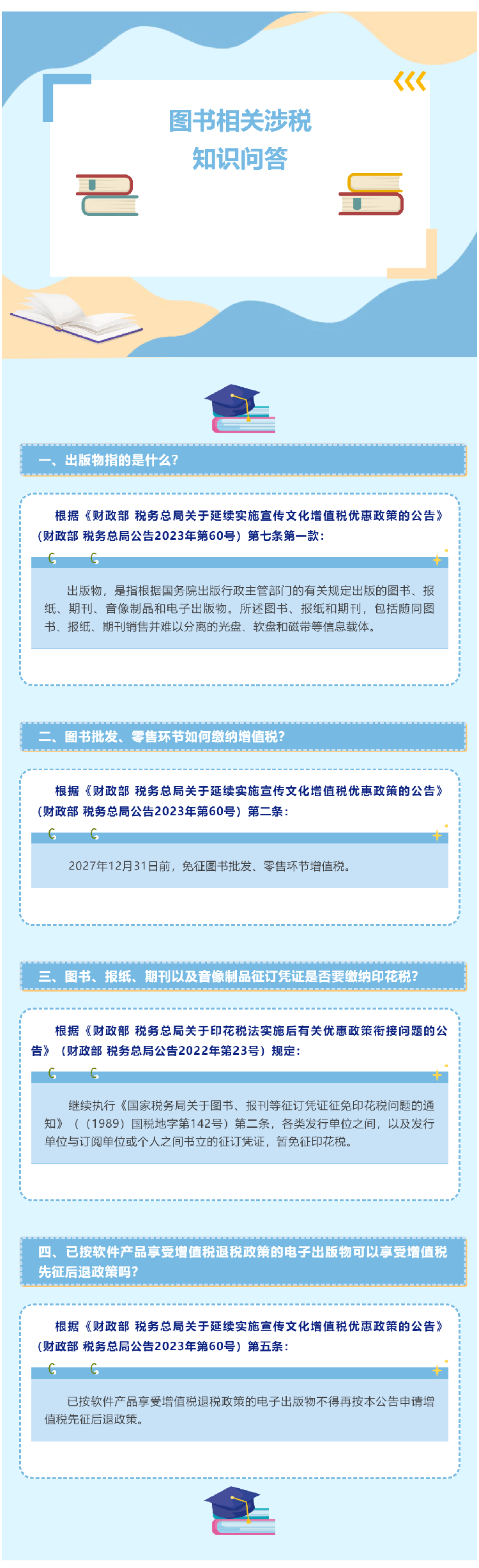
一问一答 | 图书相关涉税知识问答
Xin Lang Cai Jing· 2025-12-24 12:42
Group 1 - The Ministry of Finance and the State Taxation Administration announced the continuation of VAT preferential policies for the cultural sector until December 31, 2027, specifically for the wholesale and retail of books [2] - The announcement clarifies that subscription certificates for books, newspapers, journals, and audio-visual products are exempt from stamp duty, following previous regulations [2] - Electronic publications that have already benefited from VAT refund policies for software products can also enjoy the VAT collection and refund policy [2]