太空AI算力

Search documents
工信部重磅引爆!太空AI算力在路上!卫星产业ETF(159218)爆量成交近9000万领跑同类
Sou Hu Cai Jing· 2025-11-28 03:00
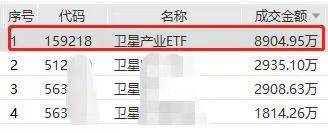
Core Insights - The satellite sector is experiencing significant activity, with the satellite industry ETF (159218) rising by 1.92% and major stocks like Aerospace Electronics and China Satellite seeing increases of 2.24% and 3.54% respectively, indicating a robust trading environment [1] - The Ministry of Industry and Information Technology has officially issued a notice to conduct commercial trials for satellite IoT services, positioning satellite IoT as a key driver for the development of new productive forces and commercial space [1] - The market for satellite communication is expected to rapidly exceed 100 billion in the next two years during the commercial trial period, with explosive growth anticipated across all segments from satellite constellation construction to terminal equipment development and operational services [1] - Beijing Municipal Science and Technology Commission and Zhongguancun Science City Management Committee have released a plan for the construction of a space data center, aiming to establish a large-scale data center system in low Earth orbit to support AI computing power in space [1] Trading Activity - The satellite industry ETF recorded a trading volume of approximately 89 million, with a turnover rate of 14.41%, reflecting a 91.92% increase compared to the previous day [1] - The top trading amounts for other satellite-related stocks include 29.35 million for stock 18512 and 29.09 million for stock 563, indicating strong investor interest [2]

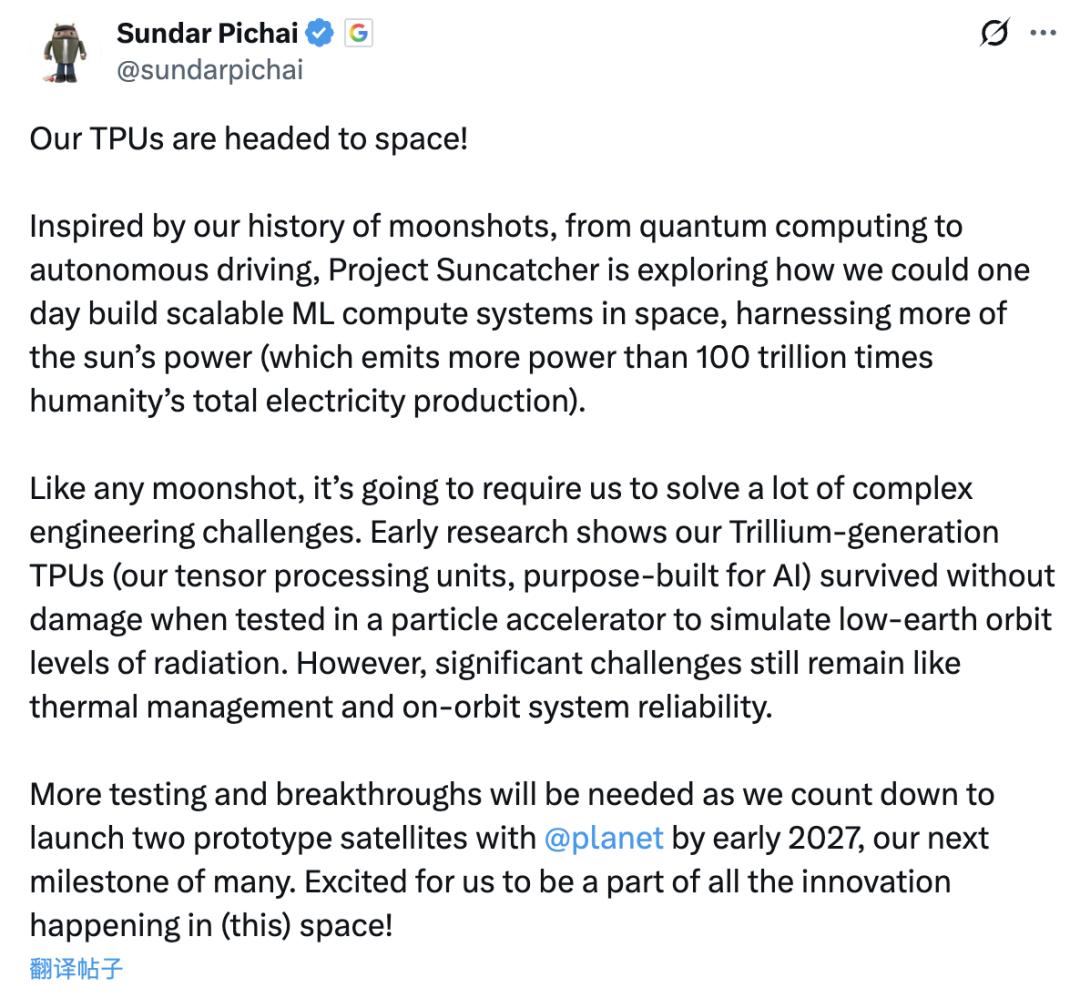
AI算力大战打到太空,英伟达前脚H100入轨,谷歌TPU后脚上天,中国玩家笑而不语
3 6 Ke· 2025-11-05 04:52
Core Viewpoint - The competition between Nvidia and Google in deploying AI computing capabilities in space is intensifying, with both companies planning to establish gigawatt-level data centers in orbit, while a Chinese company, Starcloud, has already made significant advancements in this area [1][2][3]. Group 1: Company Initiatives - Nvidia has successfully launched the Starcloud-1 satellite equipped with the H100 chip, which weighs 60 kg and is comparable in size to a small refrigerator [4]. - Starcloud aims to process data from synthetic aperture radar (SAR) satellites in real-time in space and plans to start commercial services next year [6]. - Google plans to send its Tensor Processing Units (TPUs) into space by early 2027 as part of its "Project Suncatcher," which will also test solar-powered communication links [8][10]. Group 2: Technical Advantages - Starcloud claims that the energy cost in space is only one-tenth of that on Earth, with potential annual costs for satellite power dropping to $810 per kilowatt if launch costs decrease to $200 per kilogram [12]. - The efficiency of solar panels in space can be up to eight times higher than on Earth, allowing for continuous power generation [12]. - Starcloud's satellites utilize a vacuum for cooling, which is more efficient than traditional water-based cooling systems on Earth [12][13]. Group 3: Competitive Landscape - Starcloud's computing capabilities have already been operational for six months with its "Three-body Computing Constellation," which consists of 12 satellites capable of P-level computing, significantly enhancing performance compared to traditional satellites [17]. - The constellation can achieve a computing capacity of 5 Peta Operations Per Second (POPS) and utilizes laser communication for inter-satellite connectivity at speeds up to 100 Gbps [17]. - The entry of Nvidia and Google into the space AI race is expected to further enhance competition and innovation in this emerging sector [18].