卫星产业ETF

Search documents
2.11盘前速览 | AI应用与版权保护领涨,市场静待节前红包行情
Sou Hu Cai Jing· 2026-02-11 01:20
Macro - Federal Reserve official Harmack stated that current interest rates are close to neutral levels and may remain unchanged for a long time [1] Central Bank - The central bank announced plans to lower bank liability costs to promote low comprehensive financing costs in society and will normalize government bond trading operations [2] Artificial Intelligence - The sell-side believes that AI safety and identification sectors are entering the early stages of regulatory catalysts, with the National Copyright Administration launching a special action for film copyright protection [2] - AI applications such as Doubao and Qianwen are launching Spring Festival activities and new features, including movie ticket purchases and red envelope distribution [2] - New image generation model Seedream 5.0 has been launched by Jianying [2] - A legendary programmer proposed the idea of using ultra-long optical fibers to replace memory; Amazon plans to launch an AI content trading market; Google intends to issue a century bond [2] Robotics - Alibaba's Damo Academy has open-sourced the embodied brain model RynnBrain, granting robots the ability to have spatiotemporal memory [2] Satellite - Zhejiang Province proposed exploring the construction of a multi-dimensional computing power integration system and forward-looking layout of spatiotemporal intelligence and space computing infrastructure [3] Semiconductor - IPO progress: Shenghe Jingwei's Sci-Tech Innovation Board IPO will be reviewed on February 24 [3] - Price increase dynamics: LianYade has raised prices for most LED display products; the latest performance guidance from SMIC and TSMC indicates stable industry demand [3] Future Industries - Qiushi Network published an article outlining six major directions for future industries, covering metaverse, brain-computer interfaces, quantum information, humanoid robots, generative artificial intelligence, biomanufacturing, future networks, and new energy storage [4] Strategy Observation - On Tuesday, trading volume was 2.11 trillion, further shrinking; the index is in a shrinking oscillation pattern before the holiday, with clear pressure above and support below [5] - The media sector (AI applications, copyright, film), home appliances, and coal led the gains, showing a mixed rotation characteristic [5] - After a broad market rally, funds quickly focused on the most short-term attention-grabbing ByteDance AI applications and computing power sectors, driving the entire media sector [5] - However, there is internal logic differentiation within the media sector, and caution is advised regarding chasing high [5] - Other sectors that surged yesterday, such as optical modules and space photovoltaics, mostly adjusted moderately, but the trend remains intact [5] - Robotics and other sectors are experiencing a rebound in the rotation [5] - The market lacks unexpected catalysts before the holiday, maintaining structural rotation; the strategy should focus on familiar main lines or seize low-buy opportunities during rotation [5]
量化择时周报:趋势指标进入边缘位置,由重仓位到重结构
ZHONGTAI SECURITIES· 2026-02-01 13:30
Investment Rating - The industry rating is "Overweight," indicating an expected increase of over 10% relative to the benchmark index in the next 6 to 12 months [16]. Core Insights - The market is currently in an upward trend, with the core observation being whether the profit-making effect is positive. The market trend line is near 6800 points, and the profit-making effect is at the zero value edge, suggesting the potential for a halt in the upward trend [5][8]. - The short-term outlook indicates continued outflows from broad-based ETFs, particularly the CSI 300 ETF, which is exerting pressure on the index. A significant drop in non-ferrous metals has also dampened short-term risk appetite [7][8]. - The industry trend configuration model suggests waiting for reversal signals in the liquor and real estate sectors, while the TWO BETA model continues to recommend the technology sector, focusing on rebound opportunities in commercial aerospace [6][8]. Summary by Sections Market Overview - The WIND All A index is in an upward trend, with a significant distance of 6.77% between the short-term (20-day) and long-term (120-day) moving averages, indicating a continued upward trend [5][9]. - The market experienced a decline of 1.59% last week, with small-cap stocks (CSI 1000) down 2.55% and mid-cap stocks (CSI 500) down 2.56%. The CSI 300 saw a slight increase of 0.08%, while the SSE 50 rose by 1.13% [2][7]. Valuation Metrics - The PE ratio of the WIND All A index is at the 90th percentile, indicating a high valuation level, while the PB ratio is at the 50th percentile, suggesting a moderate valuation level [9][11]. Positioning Recommendations - The report recommends a 70% allocation to absolute return products based on the WIND All A index, reflecting a cautious but optimistic stance on market conditions [9][10]. - The performance trend model highlights the importance of focusing on the computing power-related industry chain and suggests waiting for significant volume reductions in high-performing cyclical sectors such as industrial non-ferrous metals and chemicals [6][14].
量化择时周报:趋势指标进入边缘位置,由重仓位到重结构-20260201
ZHONGTAI SECURITIES· 2026-02-01 11:51
Quantitative Models and Construction Methods 1. Model Name: Timing System Signal - **Model Construction Idea**: The model uses the distance between the short-term and long-term moving averages of the WIND All A Index to determine the market trend. A significant positive distance indicates an upward trend, while a negative distance suggests a downward trend [2][7][13] - **Model Construction Process**: 1. Define the short-term moving average (20-day) and long-term moving average (120-day) of the WIND All A Index 2. Calculate the distance between the two moving averages: $ Distance = \frac{Short\text{-}term\ MA - Long\text{-}term\ MA}{Long\text{-}term\ MA} $ Where: - Short-term MA = 20-day moving average - Long-term MA = 120-day moving average 3. If the absolute value of the distance exceeds 3%, the market is considered to be in a trend (upward or downward depending on the sign of the distance) [2][7][13] - **Model Evaluation**: The model effectively captures market trends and provides a clear signal for timing decisions. However, it may be sensitive to short-term market fluctuations [2][7][13] 2. Model Name: Industry Trend Allocation Model - **Model Construction Idea**: This model identifies industry allocation opportunities based on medium-term reversal expectations and performance trends [6][8][14] - **Model Construction Process**: 1. Monitor industries with potential for medium-term reversal, such as real estate and liquor, and wait for reversal signals 2. Use the "TWO BETA" framework to recommend high-growth sectors like technology and commercial aerospace 3. Focus on performance trends in industries with high growth potential, such as computing power-related industries and upstream cyclical sectors like industrial metals and chemicals [6][8][14] - **Model Evaluation**: The model provides a structured approach to industry allocation, balancing medium-term reversal opportunities with high-growth sectors. However, its reliance on reversal signals may delay entry into emerging trends [6][8][14] 3. Model Name: Position Management Model - **Model Construction Idea**: This model determines the optimal equity allocation for absolute return products based on valuation and market trends [9] - **Model Construction Process**: 1. Assess the valuation of the WIND All A Index using PE and PB ratios 2. Combine valuation levels with short-term trend signals to recommend equity allocation levels 3. Current recommendation: 70% equity allocation for absolute return products, as the WIND All A Index PE is at the 90th percentile (high level) and PB is at the 50th percentile (medium level) [9] - **Model Evaluation**: The model provides a systematic approach to position management, balancing valuation and trend considerations. However, it may not fully account for sudden market shocks [9] --- Model Backtesting Results 1. Timing System Signal - Distance between 20-day and 120-day moving averages: 6.77% (absolute value significantly greater than 3%, indicating an upward trend) [2][7][13] 2. Industry Trend Allocation Model - No specific numerical backtesting results provided in the report [6][8][14] 3. Position Management Model - WIND All A Index PE: 90th percentile (high level) - WIND All A Index PB: 50th percentile (medium level) - Recommended equity allocation: 70% [9] --- Quantitative Factors and Construction Methods 1. Factor Name: Moving Average Distance Factor - **Factor Construction Idea**: Measures the distance between short-term and long-term moving averages to capture market trends [2][7][13] - **Factor Construction Process**: 1. Define short-term (20-day) and long-term (120-day) moving averages 2. Calculate the distance using the formula: $ Distance = \frac{Short\text{-}term\ MA - Long\text{-}term\ MA}{Long\text{-}term\ MA} $ 3. Use the absolute value of the distance to determine the trend strength [2][7][13] - **Factor Evaluation**: The factor is simple and intuitive, effectively capturing market trends. However, it may lag during rapid market reversals [2][7][13] --- Factor Backtesting Results 1. Moving Average Distance Factor - Distance: 6.77% (indicating a strong upward trend) [2][7][13]
ETF收评 | 金价站上5100美元,黄金股票ETF、黄金股票ETF基金飙涨8%
Ge Long Hui· 2026-01-26 08:43
Market Overview - The A-share market experienced a collective adjustment, with the Shanghai Composite Index down 0.09%, the Shenzhen Component Index down 0.85%, the ChiNext Index down 0.91%, and the Beijing Stock Exchange 50 Index down 1.45% [1] - The total trading volume in the three markets reached 32,806 billion yuan, an increase of 1,625 billion yuan compared to the previous day, with over 3,700 stocks in decline [1] Sector Performance - The sectors that saw gains included gold, non-ferrous metals, animal vaccines, insurance, oil and gas extraction and services, chemicals, and pork, with significant increases [1] - Conversely, sectors that faced declines included commercial aerospace, large aircraft, military equipment, photolithography machines, semiconductors, robotics, and quantum technology, with notable losses [1] ETF Performance - International gold prices surpassed 5,100 USD per ounce, leading to a surge in gold and non-ferrous resource stocks, with several gold stock ETFs, including Huaan Fund Gold Stock ETF and Ping An Fund Gold Stock ETF, rising over 8% [1] - The non-ferrous sector also saw a strong performance, with the non-ferrous mining ETFs from China Merchants and Guotai Fund increasing by 6.31% and 6.23%, respectively [1] - Oil and gas stocks performed robustly, with the energy ETF from GF rising by 4.39% [1] - The commercial aerospace sector experienced a significant downturn, with satellite ETFs and related funds declining by approximately 8% [1] - The semiconductor equipment sector also faced a decline, with the semiconductor equipment ETF dropping by 4% [1]
ETF午评 | 金价历史首次突破5000美元,黄金股票ETF基金、黄金股ETF工银飙涨7%
Ge Long Hui· 2026-01-26 05:04
Market Overview - The three major A-share indices showed mixed performance in the morning session, with the Shanghai Composite Index up by 0.12%, while the Shenzhen Component Index, ChiNext Index, and North Star 50 Index fell by 0.74%, 0.86%, and 0.97% respectively [1] - The total trading volume in the Shanghai and Shenzhen markets reached 22,631 billion yuan, an increase of 3,495 billion yuan compared to the previous day [1] - Over 3,700 stocks in the market experienced declines [1] Sector Performance - The sectors that saw the most significant gains included gold, non-ferrous metals, avian influenza, oil and gas, insurance, chemicals, securities, and port shipping [1] - Conversely, the sectors that faced the largest declines were commercial aerospace, military equipment, gaming, photolithography, semiconductors, humanoid robots, and AI mobile phone concepts [1] ETF Performance - International gold prices surpassed $5,000 per ounce for the first time, leading to a surge in gold and non-ferrous resource stocks [1] - The following ETFs saw notable increases: Ping An Fund Gold Stock ETF rose by 7.34%, ICBC Gold Stock ETF by 7.33%, and Guotai Fund Gold Stock ETF by 6.95% [1] - Oil and gas stocks also performed strongly, with Huatai Bairui Oil and Gas ETF increasing by 6% [1] Declines in Specific Sectors - The commercial aerospace sector experienced a widespread decline, with satellite ETFs and related funds dropping significantly: Satellite ETF fell by 6.85%, Satellite Industry ETF by 6.77%, and Guangfa Satellite ETF by 6.6% [1] - The semiconductor equipment sector also saw a downturn, with the E Fund Semiconductor Equipment ETF decreasing by 4% [1]
万亿赛道巨震,卫星产业ETF(159218)盘中跌超8%!发生了什么?
Sou Hu Cai Jing· 2026-01-26 04:32
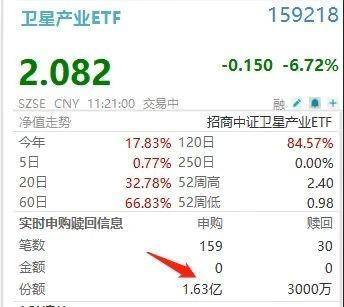
Core Viewpoint - The satellite sector experienced significant volatility, with the satellite industry ETF (159218) dropping by 6.99% and reaching a low of 8.06%, despite a net inflow of over 280 million during the downturn [1][2]. Group 1: Market Performance - The satellite industry ETF (159218) showed a decline of 6.72% as of 11:21 AM, with a trading value of 2.082 [2]. - The ETF's performance over various periods includes a 17.83% increase over the past year, a 32.78% increase over 20 days, and a 66.83% increase over 60 days, indicating prior strong growth [2]. Group 2: Market Dynamics - The recent adjustment in the satellite sector is attributed to previous excessive gains, overvaluation, and the release of "good news" sentiment, leading to profit-taking by investors [1][3]. - Analysts believe that the core drivers of the commercial space industry remain intact, including national satellite internet construction plans and advancements in reusable rocket technology [3]. Group 3: Future Outlook - The current market correction is seen as an opportunity for a "truth-seeking" phase, where funds are expected to focus on leading companies with core technologies, confirmed orders, and stable performance [3]. - The sector is anticipated to experience healthier differentiation and upward movement supported by performance as key technologies undergo validation by 2026, alongside the substantial progress of national satellite constellation tenders and construction [3].

两融标的卫星产业ETF(159218)重挫近8%,信科移动-U、国科微跌超10%!2.8亿大单逆势狂扫
Sou Hu Cai Jing· 2026-01-26 03:53
Core Viewpoint - The satellite and commercial aerospace sector experienced a significant downturn, with the satellite industry ETF (159218) dropping by 8.06% amid a cooling market sentiment, despite over 280 million CNY flowing into the ETF during the decline, indicating a "buy the dip" mentality [1][3]. Group 1: Market Performance - The satellite industry ETF (159218) saw a decline of 6.72%, with a net value of 2.082 CNY [2]. - Key stocks in the sector, such as Xinke Mobile-U, China Satellite, and CASIC Star Map, were among the largest decliners, reflecting a notable drop in market enthusiasm [1]. - The ETF's performance over various periods includes a 120-day increase of 17.83% and a 52-week high of 2.40 CNY [2]. Group 2: Factors Behind the Adjustment - The sharp adjustment is attributed to multiple factors, including the realization of previously anticipated benefits from the listing of the "first commercial aerospace stock" and the overextension of short-term valuations [2]. - As positive news began to materialize, the market entered a phase of rebalancing between "long-term certainty" and "short-term valuation," prompting some investors to take profits [2]. Group 3: Long-term Outlook - Despite the recent volatility, significant capital is still being invested, driven by a strong belief in the long-term potential of the industry, often referred to as the "golden decade" for the sector [3]. - Key drivers for industry growth remain intact, including national satellite internet strategies, cost reductions from reusable rockets, and expansive commercial prospects [3]. - The current market adjustment is viewed as an opportunity for investors to identify and focus on leading companies with core technologies and confirmed orders, with expectations of a healthier upward trend supported by performance as critical technologies reach validation by 2026 [3].

重磅规划发布!卫星产业ETF(159218)10CM涨停!中国卫星、航天电子涨停封板
Sou Hu Cai Jing· 2026-01-23 07:27
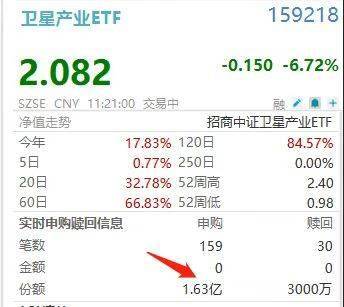
Core Viewpoint - The satellite sector is experiencing strong performance, with the Satellite Industry ETF (159218) rising by 10.00% on January 23, 2023, and significant gains in major stocks within the sector [1][2]. Group 1: Market Performance - The Satellite Industry ETF closed at ¥2.232, reflecting an increase of ¥0.203 or 10.00% [2]. - Major stocks such as China Satellite and Aerospace Electronics reached their daily limit, while China Satcom rose by 9.65% and Zhongke Star Map increased by 16.03% [1][2]. - The total trading volume for the ETF was approximately 671.7 million shares, with a transaction value of about ¥14.5 billion [2]. Group 2: Industry Development Plans - The recently released "Jiuquan Commercial Aerospace Industry Development Plan (2026-2035)" aims to establish Jiuquan as a national commercial aerospace hub, focusing on various strategic bases [1][3]. - The plan outlines seven key industries: aerospace launch and testing, rocket manufacturing and testing, satellite manufacturing and application, aerospace data backup and application, aerospace technical support, aerospace logistics, and aerospace tourism [3]. - This plan is expected to provide guidance and an action framework for the high-quality development of the commercial aerospace industry in Jiuquan [3].

金融工程日报:a股高开低走,AI应用题材全线回落、存储器概念股爆发-20260117
Guoxin Securities· 2026-01-17 09:25
- The report does not contain any quantitative models or factors, so there are no specific models or factors to summarize - The report primarily focuses on market performance, market sentiment, capital flows, premium and discount rates, institutional attention, and leaderboard data - Market performance: The CSI 500 index performed well among scale indices, while the STAR 100 index performed well among sector indices, and the CSI 500 Growth index performed well among style indices[2][6][7] - Market sentiment: On January 16, 2026, 66 stocks hit the daily limit up, and 61 stocks hit the daily limit down. The closing return of stocks that hit the daily limit yesterday was -0.35%, and the closing return of stocks that hit the daily limit down yesterday was -6.30%. The sealing rate was 56%, and the continuous board rate was 12%[2][13][14][17] - Capital flows: As of January 15, 2026, the balance of margin trading and securities lending was 2.7188 trillion yuan, accounting for 2.6% of the market's circulating market value, and the proportion of margin trading and securities lending transactions in the market's transaction volume was 10.8%[2][19][22] - Premium and discount rates: On January 15, 2026, the ETF with the highest premium was the Semiconductor Equipment ETF Huaxia, with a premium of 1.88%, and the ETF with the highest discount was the Satellite Industry ETF, with a discount of 2.31%. The median annualized discount rates of the main contracts of the SSE 50, CSI 300, CSI 500, and CSI 1000 stock index futures over the past year were 0.70%, 3.79%, 11.11%, and 13.61%, respectively[3][23][26][28] - Institutional attention and leaderboard: The stocks with the most institutional research in the past week were Haitian Ruisheng, Dikang Holdings, Leo Group, Kaisheng Technology, Boying Special Welding, SF Express, Yunnan Germanium Industry, and Shengda Resources. The top ten stocks with net inflows from institutional seats on the leaderboard were Xue Ren Group, Tongyu Communications, Hongxiang Holdings, Yongxi Electronics, Shaanxi Tourism, Taili Technology, Jintaiyang, Hualing Cable, Shenguang Group, and Hengkun New Materials[4][30][32][36][37][39][41]
剧情大反转!两融标的卫星产业ETF(159218)获资金盘中追涨杀入!马斯克再为星舰火箭设定时间表
Sou Hu Cai Jing· 2026-01-16 06:00
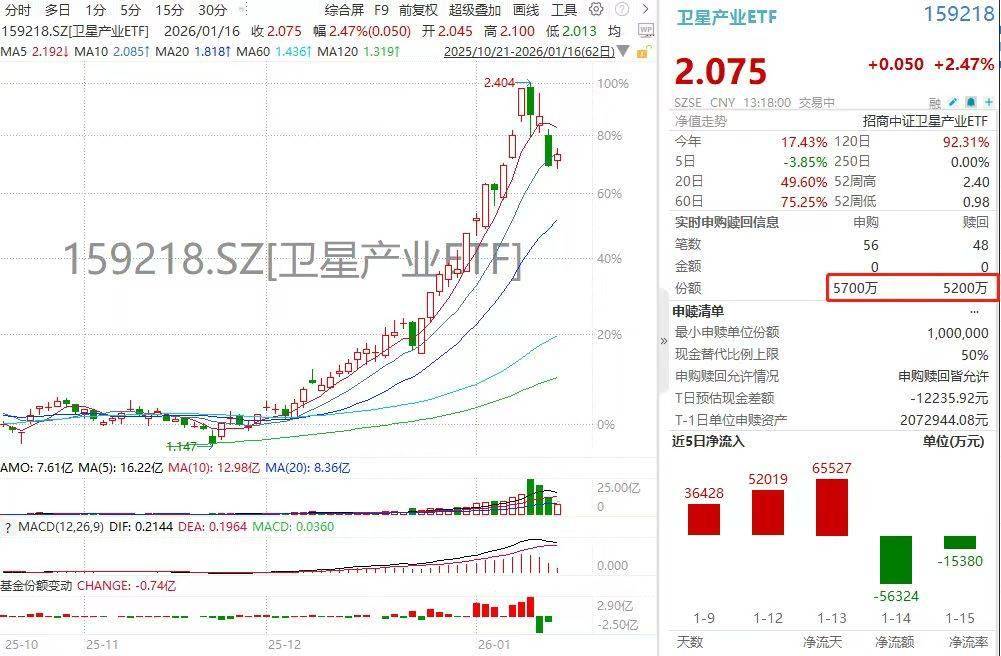
Core Viewpoint - The satellite industry sector experienced a significant intraday reversal on January 16, with market confidence rebounding after early fluctuations, indicating a positive shift in sentiment and capital flow towards leading stocks like China Satcom and CASIC [1][2]. Market Analysis - The reversal in capital flow is attributed to a combination of short-term risk release and reinforcement of long-term logic, as profit pressures from previous trading days were effectively alleviated [1]. - The reaffirmation of the national mission by the domestic aerospace group, alongside aggressive launch targets from overseas giants and local policy support, has strengthened the consensus on commercial aerospace as a long-term strategic sector [1]. - The satellite industry ETF (159218), which covers the entire industry chain, serves as an important indicator of market confidence in the long-term prospects of commercial aerospace [2]. Capital Flow - The satellite industry ETF saw a shift from outflows to inflows, reflecting a market transition from short-term speculation to a focus on industry leaders with core technologies and real orders [1].