谷歌开源模型Gemma

Search documents
太空算力叠加可回收火箭,商业航天热度不减,航空航天ETF(159227)午后持续拉升
Mei Ri Jing Ji Xin Wen· 2025-12-16 07:05
Group 1 - The A-share market experienced a collective pullback on December 16, with the aerospace sector showing significant fluctuations, particularly the Aerospace ETF (159227), which narrowed its decline to 0.25% by 14:39, with a trading volume of 273 million yuan [1] - The Aerospace ETF has recently surpassed 2.1 billion yuan in scale, making it the largest of its index, with key holdings such as Aerospace Development and Aerospace Electronics reaching their daily limit [1] - The commercial aerospace sector has been gaining momentum, highlighted by the successful launch of Blue Arrow Aerospace's "Zhuque-3" rocket, marking China's first successful orbit of a reusable liquid oxygen-methane rocket [1] Group 2 - CITIC Securities reports that OpenAI is seeking to establish, invest in, or acquire a rocket company to compete in the space computing sector, indicating a growing recognition of the commercial value in space computing [2] - The commercial aerospace industry is entering a new era with the mass launch phases of China StarNet and G60 Qianfan Constellation, alongside the operationalization of Hainan's commercial launch site and rockets, leading to trends of high capacity and low cost [2] - The Aerospace ETF (159227) tracks the National Aerospace Index, with a significant 96.6% allocation to the military industry, focusing on aerospace capabilities and covering a full industry chain from fighter jets to satellites [2]




太空算力+可回收火箭,商业航天主线叙事继续!卫星ETF(159206)走强,近五日资金流入超5.5亿元!
Sou Hu Cai Jing· 2025-12-12 02:48
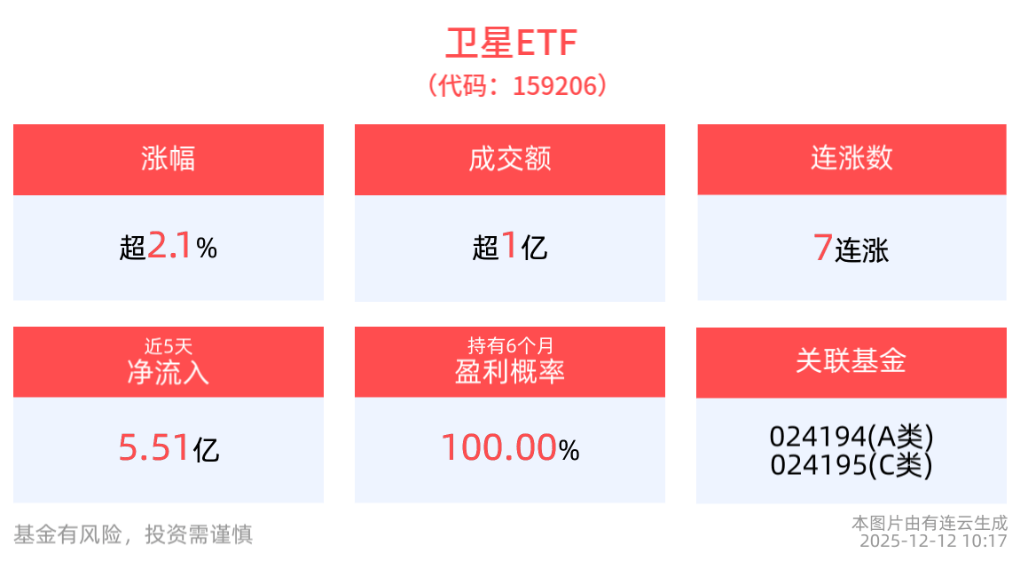
Group 1 - The Satellite ETF (159206) has seen a 2.18% increase, marking its seventh consecutive rise, with significant gains in constituent stocks such as Qianzhao Optoelectronics (300102) up 8.24%, and Shaanxi Huada (301517) up 7.91% [3] - Over the past five trading days, the Satellite ETF has experienced net inflows on four occasions, totaling 551 million yuan, with an average daily net inflow of 110 million yuan [3] - The Long March 12甲 rocket, developed by the 8th Academy of Aerospace, is set for a test at the Jiuquan launch base, which, if successful, will make China the second country globally to possess reusable rocket technology, significantly reducing commercial space transportation costs [3] Group 2 - Space computing technology, which deploys data centers and computational capabilities in orbit, is gaining commercial value, with projects already underway and a methodological foundation established [4] - The Satellite ETF (159206) focuses on commercial aerospace and satellite communications, expected to thrive under the "Aerospace Power" backdrop, and is the first of its kind in the market [4] - The Satellite ETF was established on March 6, 2025, prior to similar products, and tracks the National Certificate Commercial Satellite Communication Industry Index [4]

格林大华期货早盘提示-20251212
Ge Lin Qi Huo· 2025-12-12 00:45
Report Summary 1. Report Industry Investment Rating - There is no specific industry investment rating provided in the reports. 2. Core View of the Report - The global economy is turning weak. The Fed's actions, such as rate - cuts and short - term bond purchases, along with various economic indicators in the US and other countries, suggest a complex economic situation. The US's policy adjustments and economic trends, including consumer K - type differentiation, employment data, and retail sales, indicate potential economic challenges. Additionally, the AI - driven investment boom and the supply - demand imbalances in some industries are also significant factors affecting the global economic landscape [1][2] 3. Summary by Related Catalog Global Economic News - The Fed will start buying short - term Treasury bonds as needed to maintain sufficient reserve supply, with the New York Fed planning to buy $40 billion in short - term Treasury bonds in the next 30 days and expecting high - scale purchases in the coming months [1] - If SpaceX goes public at a $1.5 trillion valuation, Elon Musk's stake in the company could increase from $136 billion to over $625 billion [1] - Starcloud, an orbital data center startup, has achieved the first attempt to train a large - language model in space, with a satellite carrying NVIDIA's H100 GPU running an application based on Google's open - source model Gemma [1] - GE Vernova, one of the three oligarchs in the global gas turbine market, expects to sign 80 gigawatts of combined - cycle gas turbine contracts by the end of the year, and its gas turbine production capacity is almost sold out until 2029 [1] - The storage industry is facing unprecedented supply - demand tensions. DRAM shortages are expected to last until Q1 2027, with DDR demand growing 20.7% far exceeding supply growth, and NAND shortages expected to continue until Q3 2026 [1] - US AI five giants' capital expenditure in Q3 increased by 72.9% year - on - year, and except for Microsoft, the other four have negative free cash flows, with potential capital expenditure vulnerability worsening next year [1] - The former executive director of the Bank of Japan predicts that Governor Kazuo Ueda may raise interest rates up to four times before 2027, indicating a more aggressive tightening cycle [1] - There is an unprecedented surplus in crude oil supply, but Brent oil prices remain stable at $61 - 66 due to uncertainty about the effective supply from sanctioned countries. If sea - borne inventories move to land, oil prices may drop significantly [1] Global Economic Logic - The Fed cut interest rates by 25 basis points and resumed expanding its balance sheet by buying $40 billion in short - term bonds monthly [2] - Las Vegas gambling revenue decline shows a consumption trend similar to the early warning signs before the 2008 financial crisis [2] - The US issued a new National Security Strategy, adjusting its economic relations with China and aiming to revive its economic autonomy [2] - The Fed's Beige Book shows increased K - type differentiation among consumers, with high - income consumers maintaining spending while middle - and low - income families cut back [2] - ADP employment data shows that private companies cut 32,000 jobs in November, the largest decline since March 2023, with small businesses being the hardest - hit [2] - Japan's 10 - year government bond yield reached 1.96%, the highest since July 2007 [2] - Morgan Stanley expects AI - driven investment to expand the credit market, with the total issuance of investment - grade bonds surging to $2.25 trillion [2] - Google aims to double AI computing power every six months and achieve a 1000 - fold increase in the next 4 - 5 years [2] - NVIDIA CEO Jensen Huang believes China will win the AI competition due to a more favorable regulatory environment and lower energy costs [2] - Morgan Stanley strategists estimate that at least $5 trillion is needed for the AI data center construction boom in the next five years [2] - US data center planned capacity has soared to 245 gigawatts, with a 45 - gigawatt increase in Q3 alone [2] - US retail sales in September increased only 0.2%, far below expectations, indicating a consumer spending cut [2] - Economists worry that large - scale corporate layoffs in the US are an economic warning signal [2] - The US's return to the Monroe Doctrine and global contraction will have a profound impact on major global assets, and the global economy is turning weak [2]
半导体早参丨美联储如期降息25个基点;SpaceX正在推进首次IPO计划,有望实现史上最大上市规模
Mei Ri Jing Ji Xin Wen· 2025-12-11 02:10
Market Overview - As of December 10, the Shanghai Composite Index fell by 0.23% to close at 3900.50 points, while the Shenzhen Component Index rose by 0.29% to 13316.42 points. The ChiNext Index decreased by 0.02% to 3209.00 points [1] - In the overnight U.S. market, the Dow Jones Industrial Average increased by 1.05%, the Nasdaq Composite rose by 0.33%, and the S&P 500 gained 0.67%. The Philadelphia Semiconductor Index climbed by 1.29%, with notable gains from NXP Semiconductors (up 1.65%) and Micron Technology (up 4.47%) [1] Federal Reserve Decision - The Federal Open Market Committee (FOMC) announced a 25 basis point interest rate cut, lowering the federal funds rate target range to 3.50%-3.75%, aligning with market expectations. Additionally, the Fed will begin expanding its balance sheet by purchasing $40 billion in short-term Treasury bonds, with high purchase levels expected to continue for several months before a significant reduction [2] SpaceX IPO Plans - SpaceX is advancing its IPO plans, aiming to raise over $30 billion, potentially making it the largest IPO in history. The company targets a valuation of approximately $1.5 trillion, significantly surpassing Saudi Aramco's record from 2019 [2] Semiconductor Industry Insights - A storage module manufacturer reported that the shortage of NAND is more severe than in previous years, with several companies' inventories expected to last only until Q1 2026. Starting in March, some manufacturers may face supply shortages, leading to a widespread lack of availability in Q2. NAND prices have surged, with Micron's recent price increase approaching 50% month-over-month [3] - Guotai Junan Securities indicated that the resonance between assets and liabilities is just beginning. Since 2025, there has been a noticeable shift of residents towards lower-risk fixed-income products, with pension and insurance funds expected to continue increasing their equity market allocations. The outlook for China's equity market in 2026 appears optimistic, focusing on opportunities from profit recovery rather than relying on global financial expansion as in 2025 [3] Semiconductor ETFs - The Sci-Tech Semiconductor ETF (588170) and its linked funds track the Sci-Tech Board Semiconductor Materials and Equipment Index, which includes 61% semiconductor equipment and 23% semiconductor materials. This sector is crucial for domestic substitution, benefiting from low domestic replacement rates and high ceilings for domestic alternatives, driven by the AI revolution and technological advancements in lithography [3] - The Semiconductor Materials ETF (562590) and its linked funds also focus on semiconductor equipment (61%) and materials (21%), emphasizing the upstream semiconductor industry [4]

AI算力大战打到太空,英伟达前脚H100入轨,谷歌TPU后脚上天,中国玩家笑而不语
3 6 Ke· 2025-11-05 04:52
Core Viewpoint - The competition between Nvidia and Google in deploying AI computing capabilities in space is intensifying, with both companies planning to establish gigawatt-level data centers in orbit, while a Chinese company, Starcloud, has already made significant advancements in this area [1][2][3]. Group 1: Company Initiatives - Nvidia has successfully launched the Starcloud-1 satellite equipped with the H100 chip, which weighs 60 kg and is comparable in size to a small refrigerator [4]. - Starcloud aims to process data from synthetic aperture radar (SAR) satellites in real-time in space and plans to start commercial services next year [6]. - Google plans to send its Tensor Processing Units (TPUs) into space by early 2027 as part of its "Project Suncatcher," which will also test solar-powered communication links [8][10]. Group 2: Technical Advantages - Starcloud claims that the energy cost in space is only one-tenth of that on Earth, with potential annual costs for satellite power dropping to $810 per kilowatt if launch costs decrease to $200 per kilogram [12]. - The efficiency of solar panels in space can be up to eight times higher than on Earth, allowing for continuous power generation [12]. - Starcloud's satellites utilize a vacuum for cooling, which is more efficient than traditional water-based cooling systems on Earth [12][13]. Group 3: Competitive Landscape - Starcloud's computing capabilities have already been operational for six months with its "Three-body Computing Constellation," which consists of 12 satellites capable of P-level computing, significantly enhancing performance compared to traditional satellites [17]. - The constellation can achieve a computing capacity of 5 Peta Operations Per Second (POPS) and utilizes laser communication for inter-satellite connectivity at speeds up to 100 Gbps [17]. - The entry of Nvidia and Google into the space AI race is expected to further enhance competition and innovation in this emerging sector [18].

AI算力大战打到太空!英伟达前脚H100入轨,谷歌TPU后脚上天,中国玩家笑而不语
量子位· 2025-11-05 02:08
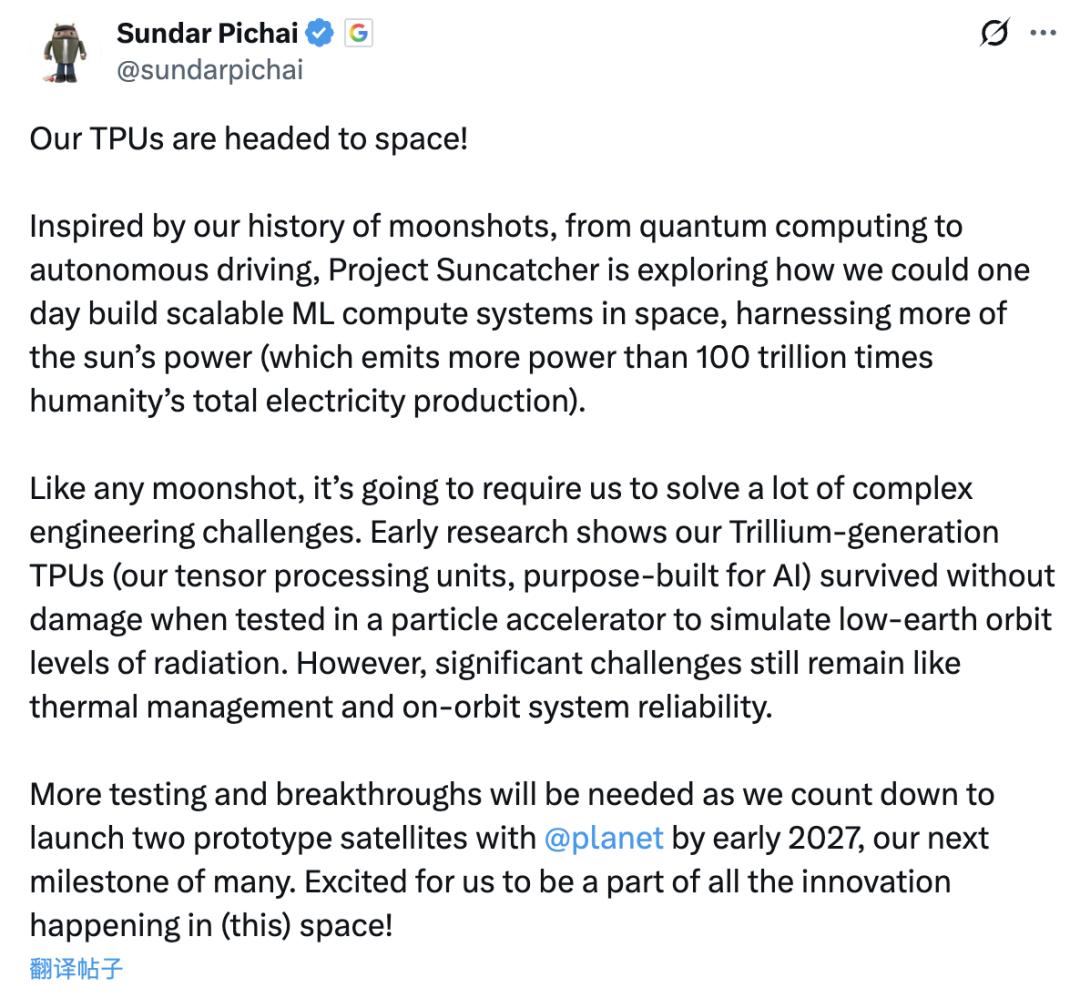
Core Viewpoint - The article discusses the competition between Nvidia and Google in deploying AI computing capabilities in space, highlighting the advancements made by a Chinese company, Starcloud, which has already launched its satellite for this purpose [1][5][31]. Group 1: Company Initiatives - Nvidia has successfully launched the Starcloud-1 satellite equipped with the H100 chip, which weighs 60 kg and is comparable in size to a small refrigerator [7][8]. - Starcloud aims to establish a 5-gigawatt space data center, with plans to start commercial services next year and to send additional satellites into orbit [11][12]. - Google plans to launch its TPU satellites under the "Project Suncatcher," with the first two prototype satellites expected to be launched in early 2027 [14][15]. Group 2: Advantages of Space Deployment - Starcloud claims that the energy cost in space is only one-tenth of that on Earth, even when accounting for launch expenses [21]. - Google estimates that if the cost of launching to Low Earth Orbit (LEO) drops to $200 per kilogram, the annual cost of power per kilowatt could be reduced to $810, comparable to current U.S. data center costs [22]. - Solar energy in space can be harnessed more efficiently, with solar panels potentially generating eight times more energy than on Earth, thus reducing reliance on batteries [24]. Group 3: Technical Challenges and Solutions - Starcloud has developed a vacuum cooling architecture to manage heat from the H100 chip, utilizing high thermal conductivity materials [25]. - Google has successfully tested high-speed optical communication links for satellite clusters, achieving 800 Gbps unidirectional and 1.6 Tbps bidirectional communication [27]. - Both companies acknowledge significant engineering challenges remain, such as thermal management and high-bandwidth ground communication [30]. Group 4: Competitive Landscape - Starcloud's "Three-body Computing Constellation" has already been operational for six months, featuring 12 satellites capable of space computing and interconnectivity, achieving a total in-orbit computing power of 5 Peta Operations Per Second (POPS) [32][34]. - The entry of Nvidia and Google into the space AI race is expected to intensify competition in this emerging sector [35].