
差异化监管

Search documents
深交所发行上市审核问答汇总(最新)
Sou Hu Cai Jing· 2025-10-30 06:07
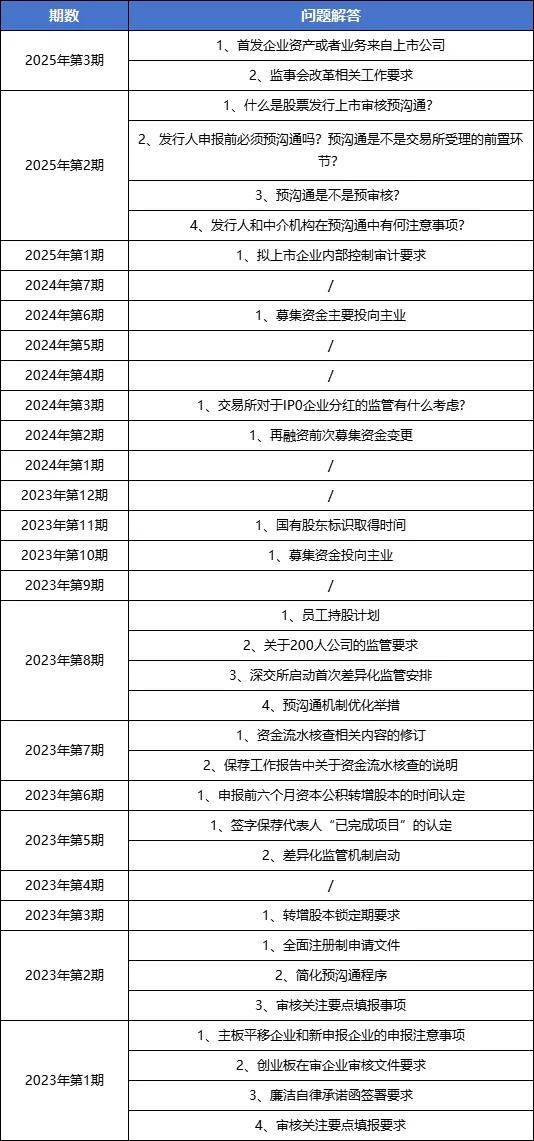
Core Points - The Shenzhen Stock Exchange has issued the 2025 3rd edition of the "Shenzhen Stock Exchange Issuance and Listing Review Dynamics," which has transitioned from the previous "ChiNext Registration System Issuance and Listing Review Dynamics" following the implementation of the comprehensive registration system in February 2023 [1] Group 1: Issuance and Listing Review Dynamics - The document has published 22 editions since 2023, addressing 29 common business issues [1] - Key issues addressed include the requirements for companies whose assets or business originate from listed companies and the reform requirements for supervisory boards [4][7] - The document emphasizes the importance of pre-communication before submitting IPO applications, clarifying that it is not a prerequisite for project acceptance [12][13] Group 2: Key Issues in Review - For companies with assets or business from listed companies, transactions must be legal and fair, ensuring no harm to the rights of listed companies and minority shareholders [5][6] - The supervisory board reform requires companies to adjust their internal supervisory structures by January 1, 2026, ensuring compliance with governance requirements [7][8] - The document outlines the necessity for companies to provide internal control audit reports when submitting their applications, enhancing the quality of internal control systems [17][18] Group 3: Fundraising and Investment - Companies must ensure that the funds raised are primarily directed towards their main business, with clear definitions of existing main businesses and the rationale for any new projects [19][27] - The document specifies that any fundraising projects involving new products must demonstrate a clear connection to existing business operations to avoid being classified as cross-industry investments [21][27] Group 4: Regulatory Compliance - The document highlights the need for companies to avoid "clearing-style" dividends before listing, with specific thresholds set for cumulative dividends relative to net profits [24] - Companies must disclose any changes in the use of previously raised funds, ensuring compliance with relevant regulations [25] Group 5: Pre-communication Mechanism - The pre-communication mechanism has been optimized to enhance transparency and efficiency, allowing for direct communication with the review center [32][40] - The document encourages companies to focus on significant issues during pre-communication to improve the quality of consultations [16][32]

涉企检查不越位,也不能缺位(金台锐评)
Ren Min Ri Bao· 2025-08-30 23:20
Group 1 - The core viewpoint of the articles emphasizes the need for a balanced approach in administrative inspections, ensuring that while the number of inspections decreases, the effectiveness and precision of those inspections improve [1][2][3] - In the first half of the year, the number of administrative inspections nationwide decreased by over 30% compared to the same period last year, with 483,000 fewer inspections conducted [1] - The implementation of the "Opinions" from the State Council has stabilized market expectations and boosted business confidence, creating a favorable environment for enterprises [1] Group 2 - The reduction in inspections has raised concerns about potential laxity in law enforcement, highlighting the need to maintain a balance between reducing inspections and ensuring necessary oversight [1][2] - Some regions have reported significant improvements in inspection accuracy, with Beijing seeing a 72% decrease in inspections but a 26% increase in problem detection, and Ningxia experiencing a 31% decrease with a 35% increase in problem detection [2] - The use of digital tools such as "scan to enter" and remote inspections is being promoted to enhance inspection quality while reducing on-site visits [2] Group 3 - Differentiated regulation is suggested as a method to avoid a one-size-fits-all approach, with various departments implementing tiered inspection systems based on enterprise credit risk classifications [3] - The principle of "strict when necessary, lenient when possible" is emphasized to create a law-based business environment, ensuring that inspections are effective without being overly burdensome [3] - Effective supervision is crucial, particularly for inspections related to public safety and health, to ensure that necessary checks are conducted thoroughly [3]
司法部:行政检查应坚持“该严则严、当宽则宽”
Xin Hua She· 2025-08-13 13:57
Group 1 - The core viewpoint of the news is that the Ministry of Justice is actively implementing a special action to standardize administrative inspections related to enterprises, significantly reducing the frequency of inspections and alleviating the burden on businesses [1][2] - In the first half of this year, the number of administrative inspections nationwide decreased by over 30% compared to the same period last year, with 483,000 fewer on-site inspections, greatly reducing the burden on enterprises [1] - The special action aims to optimize the business environment, stabilize market expectations, and boost development confidence by addressing issues such as excessive inspection frequency and numerous inspection items [1][2] Group 2 - Local governments are promoting "scan to enter enterprises" and conducting non-on-site inspections to reduce the frequency of on-site checks while enhancing the quality and effectiveness of inspections [2] - The use of artificial intelligence, big data, and remote smart supervision is being emphasized to ensure necessary inspections are conducted without disrupting normal business operations [2] - Differentiated regulation is being explored, where inspection frequency and sampling ratios are dynamically adjusted based on the credit risk classification of enterprises, enhancing the precision of inspections [2]
反洗钱监管加码 10万元现金买黄金要报告
Sou Hu Cai Jing· 2025-07-04 06:21
Core Viewpoint - The implementation of the "Management Measures for Anti-Money Laundering and Anti-Terrorist Financing in the Precious Metals and Gemstone Industry" by the People's Bank of China signifies an enhancement in the regulatory framework for anti-money laundering (AML) within the precious metals and gemstones sector, addressing potential vulnerabilities previously exploited by criminals [1][4][10]. Regulatory Framework - The new management measures expand the scope of AML obligations to include the entire precious metals and gemstones industry, defining the entities subject to these regulations as those legally engaged in the spot trading of precious metals and gemstones within China [1][4]. - The threshold for reporting large transactions has been raised from 50,000 RMB to 100,000 RMB, requiring institutions to report cash transactions at or above this amount within five working days [4][5]. Risk Mitigation - The precious metals and gemstones sector is identified as a high-risk area for money laundering and terrorist financing due to the high value, liquidity, and relative anonymity of transactions [5][10]. - Institutions are mandated to conduct customer due diligence for cash transactions equal to or exceeding 100,000 RMB, which serves as a critical checkpoint to identify potential risks [5][6]. Compliance and Accountability - The management measures require institutions to maintain customer identity information for at least ten years, extending the previous five-year requirement, thereby enhancing record-keeping practices [6]. - Institutions are held accountable for their AML responsibilities, with legal repercussions for negligence or failure to comply, including criminal liability for serious offenses [6][7]. Collaborative Oversight - The measures advocate for a collaborative regulatory framework involving self-regulation within the industry, encouraging information sharing among trading venues and industry organizations under the guidance of the People's Bank of China [7]. - Internal training programs are emphasized to improve employees' understanding and execution of AML regulations, fostering a culture of compliance within the industry [7][10]. Industry Preparedness - The management measures are set to take effect on August 1, 2023, and are expected to elevate the compliance standards within the precious metals and gemstones industry, necessitating proactive measures from institutions to align with the new regulations [10].

盾博:特朗普金融棋局落子!美联储监管换帅,资本新规或大幅松动
Sou Hu Cai Jing· 2025-06-05 02:25
Core Viewpoint - The appointment of Michelle Bowman as Vice Chair for Supervision at the Federal Reserve marks a significant shift towards a more lenient regulatory environment, reflecting the ongoing trend during President Trump's administration, which is expected to have profound implications for both the U.S. and global financial markets [1][3]. Group 1: Background and Context - Michelle Bowman comes from a family of bankers and has been a strong advocate for "differentiated regulation," indicating a potential shift in regulatory priorities once she assumes her role [3]. - Bowman's relationship with the banking sector is closer compared to her predecessor, Michael Barr, who had significant disagreements with her on key regulatory issues [3]. Group 2: Regulatory Approach and Initiatives - Bowman's regulatory philosophy emphasizes collaboration among regulatory bodies to streamline the financial system's objectives for more efficient oversight [4]. - She plans to work with the FDIC and OCC to revise the Basel III capital proposal, criticizing the original requirement for large banks to increase capital by 19% as overly stringent, potentially hindering lending activities and economic growth [5]. - Bowman is also focused on revising the Supplementary Leverage Ratio (SLR) rules, which have been criticized for limiting banks' ability to purchase safe assets like U.S. Treasury bonds, thereby affecting their asset allocation flexibility and risk management [5]. Group 3: Reactions and Perspectives - Bowman's approach has faced criticism from consumer advocacy groups, which argue that her policies may undermine consumer interests and increase market instability [6]. - Conversely, the Independent Community Bankers of America supports Bowman, believing her practical experience will help address the shortcomings of a one-size-fits-all regulatory approach, which often overlooks the unique needs of different banks [6].

民营银行下个十年如何续写精彩?
Zheng Quan Shi Bao· 2025-05-20 19:36
Core Viewpoint - The performance comparison between leading and lagging private banks in 2024 highlights a significant disparity, with leading banks achieving net profits exceeding 10 billion yuan, while lagging banks struggle to break even or even incur losses [1][2]. Group 1: Performance of Private Banks - Leading private banks have shown remarkable results over the past decade, with WeBank's "Weilidai" serving over 70 million customers and MYbank providing comprehensive financial services to over 68 million small and micro enterprises [1]. - In contrast, the asset scale of leading banks accounts for half of the total assets of 19 private banks, while lagging banks are experiencing a significant reduction in assets, with declines exceeding double digits [1][2]. Group 2: Development Models and Challenges - The disparity in performance is attributed to fundamental differences in development models, with leading banks leveraging technological advantages and internet ecosystems, while mid-tier banks focus on regional economic development [2]. - Lagging banks face three main challenges: a technology gap with leading banks, reliance on a single business model with low income from intermediary services, and capital constraints leading to pressure on capital adequacy ratios [2]. Group 3: Future Directions and Innovations - The next decade for private banks requires a shift from merely existing to excelling, with many institutions exploring innovative paths [3]. - Leading banks are already experimenting with new models, such as wealth management transformations and international expansion, while mid-tier and lagging banks are focusing on niche markets and enhancing customer acquisition capabilities [3]. - Regulatory approaches will also need to adapt to the unique characteristics of private banks, with differentiated supervision to guide industry development [3].