贵金属交易业

Search documents
黄金信仰永不灭! 狂飙70%的金价仍在翱翔 华尔街奏响5000美元狂想曲
智通财经网· 2026-01-15 03:05
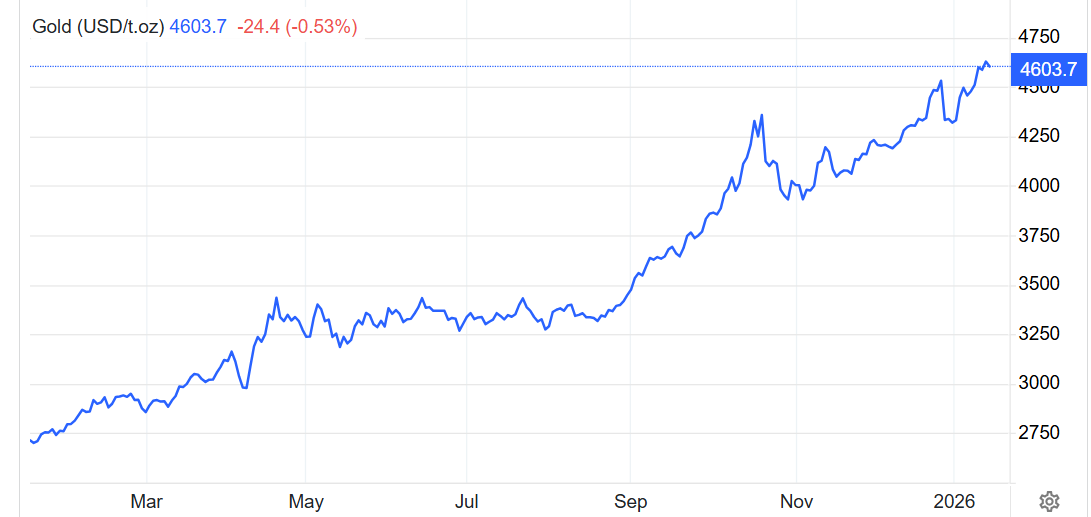
Core Viewpoint - Gold and silver futures prices have reached new historical highs due to escalating geopolitical tensions, particularly in Venezuela, Cuba, and Iran, alongside concerns over the independence of the Federal Reserve's monetary policy and the depreciation of the US dollar [1][2][3]. Group 1: Geopolitical Factors - The ongoing unrest in Iran and threats from the Trump administration regarding military intervention have heightened geopolitical risks, driving investors towards gold as a safe-haven asset [1][2]. - Analysts from ANZ Bank suggest that geopolitical instability and concerns over monetary policy will continue to boost global demand for gold, with expectations for prices to exceed $5,000 per ounce in the latter half of the year [2][3]. Group 2: Federal Reserve Independence - The Federal Reserve's independence is facing unprecedented political pressure, with Chairman Jerome Powell stating that threats of criminal charges are aimed at undermining the Fed's ability to set interest rates based on economic data rather than political preferences [2][3]. - Concerns over the Fed's independence have led to increased demand for gold, as investors seek to diversify their reserves amid uncertainty [3][7]. Group 3: Market Predictions - Citigroup has raised its price forecasts for gold and silver, predicting gold could reach $5,000 per ounce and silver could rise to $100 per ounce within three months due to ongoing geopolitical risks and supply shortages [3][6]. - HSBC's analysis indicates that the combination of geopolitical risks and rising fiscal deficits is likely to support gold prices, with expectations for prices to surpass $5,000 per ounce in the first half of 2026 [6][7]. Group 4: Demand Dynamics - Emerging market central banks are accelerating their gold purchases as part of a "de-dollarization" trend, indicating a significant shift in global reserve management from US Treasuries to gold [7][8]. - Goldman Sachs and JPMorgan have projected that gold prices could reach approximately $4,900 to $5,055 per ounce by late 2026, driven by structural demand from central banks and potential shifts in private sector investments [8].

美联储降息引发金价暴跌,金价从3700美元高点回落
Sou Hu Cai Jing· 2025-09-22 00:07
Core Insights - The gold market experienced significant volatility, with prices dropping from a peak of $3707.40 per ounce to $3658.25 within a day, reflecting market fragility and uncertainty [1][3] - The Federal Reserve's recent decision to lower the benchmark interest rate by 25 basis points to a target range of 4.00-4.25% was expected to support gold prices, yet the market reacted with a short-term decline, indicating a complex interplay of investor sentiment and policy expectations [3][10] - Despite the recent price drop, gold has seen a cumulative increase of approximately 39% since the beginning of 2025, supported by ongoing central bank purchases and geopolitical risks [7][10] Market Dynamics - The dollar index rose by about 0.25% to 96.87 points during the same period, which negatively impacted gold prices as a stronger dollar increases the cost of gold for non-dollar holders [5][10] - Central banks' consistent accumulation of gold reserves serves as a long-term support for gold prices, contrasting with the short-term trading behaviors of retail investors [7][10] - Geopolitical uncertainties, such as trade tensions and regional conflicts, have heightened demand for gold as a safe-haven asset, contributing to a more optimistic outlook for the gold market despite short-term fluctuations [7][10] Technical Analysis - The $3550 level is identified as a critical short-term support for gold prices; breaching this level could trigger further selling pressure, while maintaining it could indicate a temporary correction [10][12] - The market's reaction to interest rate changes is layered; short-term expectations may lead to a rebalancing of funds between risk assets and safe havens, while long-term trends suggest that lower rates will enhance gold's relative attractiveness [10][15] Trading Behavior - During periods of high volatility, trading platforms experienced delays in price updates, highlighting the imperfect functioning of markets under stress and amplifying investor caution [8][12] - Opinions within the market are divided on whether the recent price drop presents a buying opportunity or if it is prudent to wait for clearer policy signals, reflecting a complex market sentiment [12][15] - Hedge funds often adjust their positions using options strategies to mitigate downside risks, indicating a sophisticated approach to managing market exposure [13]
反洗钱监管加码 10万元现金买黄金要报告
Sou Hu Cai Jing· 2025-07-04 06:21
Core Viewpoint - The implementation of the "Management Measures for Anti-Money Laundering and Anti-Terrorist Financing in the Precious Metals and Gemstone Industry" by the People's Bank of China signifies an enhancement in the regulatory framework for anti-money laundering (AML) within the precious metals and gemstones sector, addressing potential vulnerabilities previously exploited by criminals [1][4][10]. Regulatory Framework - The new management measures expand the scope of AML obligations to include the entire precious metals and gemstones industry, defining the entities subject to these regulations as those legally engaged in the spot trading of precious metals and gemstones within China [1][4]. - The threshold for reporting large transactions has been raised from 50,000 RMB to 100,000 RMB, requiring institutions to report cash transactions at or above this amount within five working days [4][5]. Risk Mitigation - The precious metals and gemstones sector is identified as a high-risk area for money laundering and terrorist financing due to the high value, liquidity, and relative anonymity of transactions [5][10]. - Institutions are mandated to conduct customer due diligence for cash transactions equal to or exceeding 100,000 RMB, which serves as a critical checkpoint to identify potential risks [5][6]. Compliance and Accountability - The management measures require institutions to maintain customer identity information for at least ten years, extending the previous five-year requirement, thereby enhancing record-keeping practices [6]. - Institutions are held accountable for their AML responsibilities, with legal repercussions for negligence or failure to comply, including criminal liability for serious offenses [6][7]. Collaborative Oversight - The measures advocate for a collaborative regulatory framework involving self-regulation within the industry, encouraging information sharing among trading venues and industry organizations under the guidance of the People's Bank of China [7]. - Internal training programs are emphasized to improve employees' understanding and execution of AML regulations, fostering a culture of compliance within the industry [7][10]. Industry Preparedness - The management measures are set to take effect on August 1, 2023, and are expected to elevate the compliance standards within the precious metals and gemstones industry, necessitating proactive measures from institutions to align with the new regulations [10].