快递包装绿色转型

Search documents
快递大省如何让绿色包裹“触手可及”?
Zhong Guo Qing Nian Bao· 2025-05-21 15:11
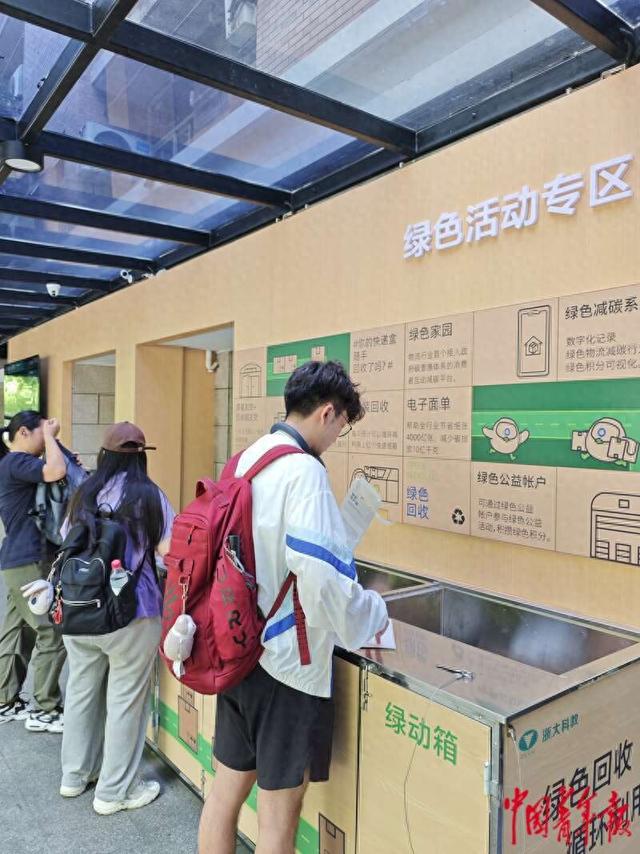
Core Viewpoint - The handling of used cardboard boxes after unpacking is crucial for the green transformation of the express delivery industry, with initiatives like recycling programs being implemented in universities and supported by new regulations [1][3][4]. Group 1: Industry Development - The express delivery industry in China has seen rapid growth, with the volume expected to reach 175 billion packages in 2024, maintaining its position as the world's largest market for 11 consecutive years [1]. - The revised "Express Delivery Temporary Regulations" effective from June 1 aims to address packaging issues by clarifying responsibilities across various stakeholders, including businesses and government [1][3]. Group 2: Recycling Initiatives - Zhejiang University has implemented a "green box" program for nearly a decade, recycling cardboard boxes and significantly reducing carbon emissions [1][4]. - The university's postal service stations handle over 820 million packages annually, with a daily recycling capacity of over 200 boxes at a single station [4][11]. Group 3: Policy and Regulation - The "Zhejiang Province Express Industry Promotion Regulations," effective from March 1, 2022, encourages the use of recyclable packaging and aims to reduce excessive packaging [3][4]. - Future policies will promote the establishment of recycling facilities in various locations and incentivize users to reuse packaging through rewards [5][12]. Group 4: Corporate Practices - Companies like Jingxing Packaging Materials focus on recycling waste cardboard, with a closed-loop system that transforms waste into new packaging materials, significantly reducing resource waste [8][9]. - Jingxing Paper has achieved a recycling rate of over 200 million tons of waste paper annually, contributing to a green and low-carbon development model [9][11]. Group 5: Market Impact - In 2024, Zhejiang's express delivery business volume surpassed 30 billion packages, with a year-on-year growth of 10.4%, and a significant increase in the reuse of old cardboard boxes [11][12]. - The proportion of e-commerce packages without secondary packaging reached 95.83%, indicating a shift towards more sustainable practices [11].

快递包装瘦身增绿
Jing Ji Ri Bao· 2025-05-19 22:06
Core Viewpoint - The express delivery industry is crucial for China's economic development, but the rapid growth in packaging usage has raised environmental concerns. The newly revised "Express Delivery Interim Regulations" will take effect on June 1, aiming to promote green packaging practices in the industry [1]. Group 1: Green Packaging Innovations - The trend of "slimming" packages is emerging, with companies like SF Express using "Feng Tiao" boxes that reduce the weight of fruit shipments by about 1 kg, leading to a 30% reduction in logistics costs for merchants [2]. - Zhongtong's cloud warehouse has implemented an intelligent packaging recommendation system, reducing packaging material usage by approximately 20% and promoting original packaging direct shipping to minimize secondary packaging [3][4]. - The use of biodegradable packaging materials is increasing, with Hainan being a pioneer in adopting fully biodegradable express packaging bags [6][7]. Group 2: Recycling and Circular Economy - Recycling initiatives are gaining traction, with universities like Zhejiang University encouraging students to recycle packaging materials, achieving a 90% reuse rate for boxes used by students [5]. - The use of reusable express boxes in Hainan has been reported to allow for over 50 uses per box, significantly lowering packaging costs [6]. - In the first quarter of this year, Hainan's express delivery companies utilized nearly 1 million reusable packaging, showcasing the effectiveness of recycling efforts [7]. Group 3: Regulatory and Market Trends - The national postal authority has reported that over 95% of e-commerce packages no longer require secondary packaging, and the application of smart packaging technology has led to a 20% reduction in material usage [4]. - The market for fully biodegradable express packaging bags has seen significant growth, with sales expected to exceed 20 million units this year [9]. - The revised regulations emphasize a comprehensive approach to green packaging, establishing clear responsibilities and standards for all stakeholders involved in the express delivery supply chain [9].
新规6月1日起施行 全链条治理助推快递包装绿色转型
Ke Ji Ri Bao· 2025-05-06 02:55
Core Viewpoint - The newly revised "Interim Regulations on Express Delivery" will take effect on June 1, focusing on improving the governance of express packaging, aiming for a comprehensive governance approach involving various stakeholders [1][2]. Group 1: Strengthening Corporate Responsibility - The express delivery industry is a crucial part of modern services, with a projected business volume of 1.75 trillion pieces by 2024, maintaining its position as the world's largest for 11 consecutive years [2]. - The revised regulations emphasize the responsibility of express delivery companies in packaging governance, mandating optimization of packaging methods and structures while ensuring safety [2]. - Companies are required to establish and implement recycling management systems for packaging materials, enhancing the recycling rate [2]. Group 2: Promoting Collaborative Governance - The regulations clarify the responsibilities of various stakeholders, including government departments, express companies, industry organizations, and consumers, in the entire lifecycle of packaging [3]. - The establishment of a new governance model is anticipated, characterized by government guidance, corporate accountability, industry self-regulation, and public participation [3]. - Industry organizations are expected to play a significant role in creating green packaging innovation alliances and developing standards for sustainable packaging [3]. Group 3: Enhancing Public Participation - The regulations encourage government and media to conduct educational campaigns to raise public awareness about eco-friendly packaging [4]. - Express companies are incentivized to promote the reuse of packaging through rewards and discounts, highlighting the importance of public involvement in achieving green transformation [4]. Group 4: Improving Governance Standards - The regulations are expected to foster a positive interaction between legal frameworks and standard systems, enhancing the effectiveness of packaging governance [5][6]. - Two mandatory national standards have been established to limit excessive packaging and regulate hazardous substances in packaging materials, contributing to initial successes in packaging governance [6]. - The regulations stipulate penalties for companies that fail to comply with mandatory standards, ensuring accountability and effective implementation [6][7].
国常会重磅部署!紧抓快干、靠前发力
证券时报· 2025-03-12 13:32
Core Viewpoint - The article discusses the recent State Council meeting led by Premier Li Qiang, focusing on the approval of the "2025 Key Work Division Plan" and amendments to the "Interim Regulations on Express Delivery" to promote green packaging in the express delivery industry [1][3]. Group 1: Economic Policy and Measures - The meeting emphasized the need for various departments to actively implement measures to achieve the economic and social development goals set for the year, especially in light of uncertainties [1][3]. - The fiscal deficit rate for this year is set at 4%, indicating a significant fiscal expansion to stabilize the economy, with expectations of increased fiscal spending [4]. - The government is committed to a proactive fiscal policy that balances supply optimization and demand expansion, aiming to boost consumption and improve livelihoods [4]. Group 2: Green Transformation in Express Delivery - The amendments to the express delivery regulations aim to enhance the green transformation of packaging, reducing resource consumption and environmental pressure [6][7]. - The government plans to establish a comprehensive support policy for the green transformation of express packaging, which includes reducing operational costs related to packaging, recycling, and cleaning [6][7]. - By the end of 2025, a complete green packaging standard system is expected to be established, with a ban on toxic and harmful packaging materials [7].