
村镇银行改革重组

Search documents
浦发银行再出手!
券商中国· 2025-12-03 03:53
Core Viewpoint - The recent dissolution of Zezhou Pudong Rural Bank and its assets being taken over by Shanghai Pudong Development Bank reflects a broader trend of restructuring and consolidation within China's rural banking sector, aimed at enhancing financial stability and optimizing market structure [1][4][5]. Group 1: Dissolution and Consolidation of Rural Banks - The approval for the dissolution of Zezhou Pudong Rural Bank was issued by the Shanxi Regulatory Bureau of the National Financial Supervision Administration, mandating the bank to cease operations and return its license within 15 working days [1][2]. - This is not an isolated case; on November 26, the Dalian Regulatory Bureau approved the dissolution of Dalian Ganjingzi Pudong Rural Bank, with its assets also being taken over by Shanghai Pudong Development Bank [4]. - The National Financial Supervision Administration has been actively approving the acquisition and establishment of branches by Shanghai Pudong Development Bank, including the acquisition of Chongqing Tongliang Pudong Rural Bank [4]. Group 2: Accelerated Reform and Restructuring - The restructuring of rural banks has accelerated, with several banks being absorbed and converted into branches of their parent banks, indicating a shift towards a more market-oriented and legal framework for the exit and integration of small financial institutions [6][10]. - In 2023, multiple provinces, including Guangdong, Liaoning, Heilongjiang, and Hainan, have initiated market-driven exit and consolidation processes for rural banks [7]. - The trend of merging smaller rural banks into larger institutions is seen as a way to enhance operational efficiency and reduce costs, as many of these banks face challenges such as unclear positioning and inadequate capital [9][10]. Group 3: Financial Resource Optimization - Financial regulatory authorities are working to optimize the allocation of financial resources while maintaining systemic risk stability through market-oriented and legal methods [8]. - The consolidation of high-risk small financial institutions is viewed as a means to purify the financial ecosystem and redirect resources to more efficient areas [10]. - The restructuring process has established standardized operational pathways, including absorption and merger or equity acquisition, to achieve centralized management and better integration into the parent bank's service and risk control network [10].



这家村镇银行解散!浦发银行承接全部资产、负债
券商中国· 2025-11-28 15:03
Core Viewpoint - The recent dissolution of Dalian Ganjingzi Pudong Development Village Bank reflects the ongoing reform and optimization of China's financial system, indicating a shift towards a more market-oriented and legal framework for the exit and integration of small financial institutions [1][4]. Summary by Sections Dissolution and Transition - The Dalian Financial Supervision Administration approved the dissolution of Dalian Ganjingzi Pudong Development Village Bank, with all assets, liabilities, and operations to be taken over by Shanghai Pudong Development Bank. The bank must cease operations immediately and return its financial license within 15 working days [2][4]. Integration of Village Banks - The integration of village banks has accelerated, with many being absorbed and restructured into branches of their parent banks. This year, several provinces, including Guangdong, Liaoning, Heilongjiang, and Hainan, have initiated market-oriented exits and integrations of village banks [6][9]. Risk Mitigation - Village banks, originally established to fill service gaps left by larger financial institutions, now face challenges such as unclear positioning, single business models, insufficient capital, and declining asset quality. The regulatory approach aims to mitigate risks by facilitating the exit of high-risk institutions, thereby purifying the financial ecosystem [9][10]. Standardized Restructuring Practices - Current practices for restructuring village banks have become standardized, involving absorption and merger or equity acquisition for centralized management. Existing institutions may be upgraded or converted into branches, allowing for deeper integration into the parent bank's service and risk management systems [10].

江门农商行收购广州一村行获批,年内广东超十家村行获批重组
Nan Fang Du Shi Bao· 2025-11-28 11:11
Core Insights - The Guangdong Financial Regulatory Bureau approved the merger of Jiangmen Rural Commercial Bank with Guangzhou Huangpu Ronghe Village Bank, marking the third consolidation of the "Ronghe system" village banks by Jiangmen Rural Commercial Bank in 2025 [2][3] - This merger will allow Jiangmen Rural Commercial Bank to establish its first branch in Guangzhou, expanding its service network across regions [2][5] - The consolidation trend among village banks in Guangdong has accelerated, with 12 banks approved for dissolution or merger since 2025, significantly higher than the previous year [2][7] Summary by Sections Merger Details - The Guangzhou Huangpu Ronghe Village Bank, established in April 2014, has faced financial difficulties, reporting a total asset of 445 million yuan and a net loss of 8.14 million yuan by the end of 2021 [3] - Jiangmen Rural Commercial Bank has previously merged with other Ronghe village banks, including Raoping and Longchuan, which also reported losses [4] Strategic Expansion - Jiangmen Rural Commercial Bank, founded in 2018, has been actively integrating its village banks to break the geographical concentration in Jiangmen, aiming to enhance its presence in the Pearl River Delta [5] - The bank has established seven village banks across Guangdong, Hebei, and Shandong, with the recent merger filling gaps in its city network [5] Financial Performance - As of June 2025, Jiangmen Rural Commercial Bank reported total assets of 156.66 billion yuan, a 5.1% increase year-on-year, but a decline in revenue and net profit by 10.8% and 29.8%, respectively [6] - The bank's non-performing loan ratio increased to 1.35%, with a significant drop in the provision coverage ratio, raising concerns about asset quality [6] Industry Trends - The restructuring of village banks in Guangdong is gaining momentum, with a shift towards a model where leading banks drive mergers, as seen with Jiangmen Rural Commercial Bank and others like Guangzhou Rural Commercial Bank [7][8] - The challenge for these banks lies in maintaining asset quality while expanding their operations and managing risks effectively [8]

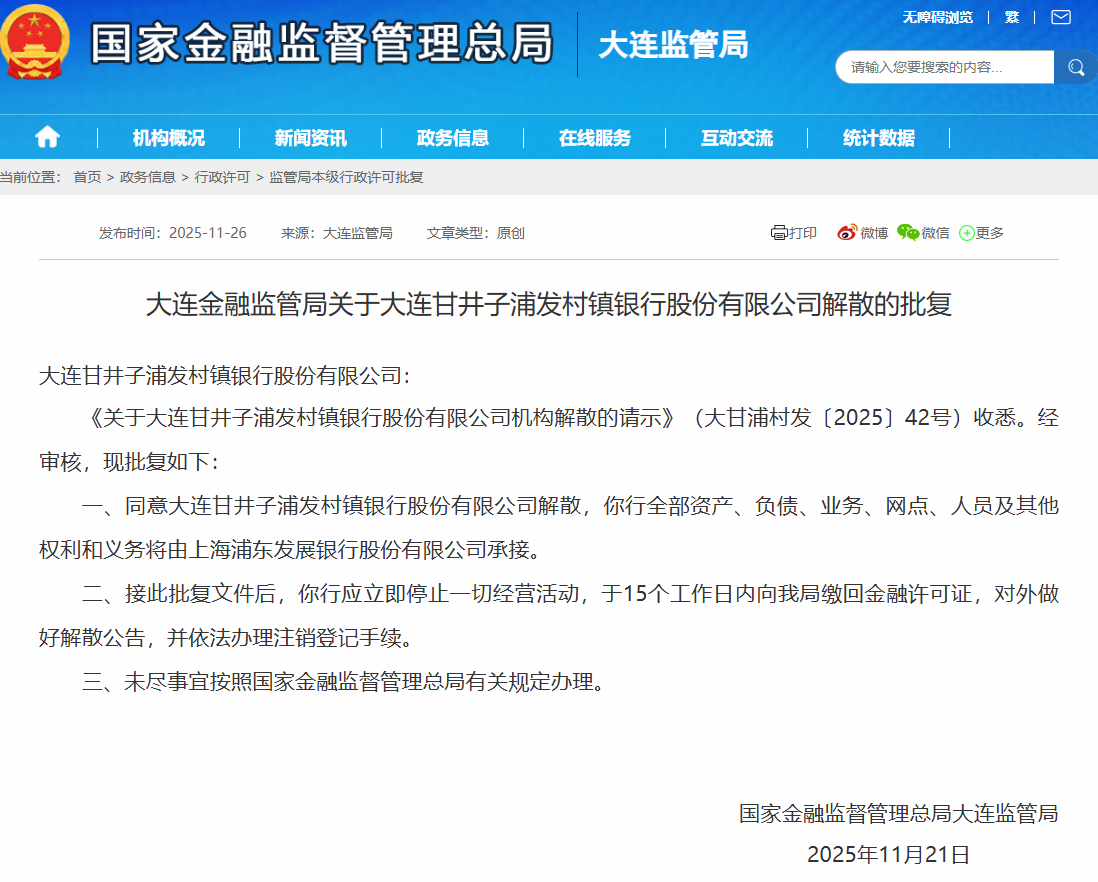
大连一银行获批解散,全部业务由浦发银行承接
Guan Cha Zhe Wang· 2025-11-26 06:35
Core Viewpoint - The Dalian Ganjingzi Pudong Development Village Bank has been approved for dissolution, with all its assets, liabilities, and operations to be taken over by Shanghai Pudong Development Bank [1][5]. Group 1: Company Actions - The Dalian Financial Regulatory Bureau has approved the dissolution of Dalian Ganjingzi Pudong Development Village Bank, which will cease all operations and return its financial license within 15 working days [5]. - Shanghai Pudong Development Bank has been authorized to acquire Dalian Ganjingzi Pudong Development Village Bank and establish a new branch in Dalian, inheriting the bank's assets, liabilities, and employees after asset verification [4][7]. Group 2: Company Background - Dalian Ganjingzi Pudong Development Village Bank was established on August 25, 2010, with a registered capital of 50 million RMB and an actual capital of 50 million RMB, focusing on public deposit acceptance and loan issuance [4]. - As of December 31, 2024, the major shareholder of Dalian Ganjingzi Pudong Development Village Bank is Shanghai Pudong Development Bank, holding a 51% stake, while other shareholders include several local investment groups [4][6]. Group 3: Industry Context - The reform of village banks is accelerating, with 100 village banks having completed mergers and restructurings by August 15, surpassing the total of 94 for the entire year of 2024 [7]. - The central government's recent policy emphasizes the need for rural banks to support agriculture and small enterprises, promoting a structured reform of village banks [7].
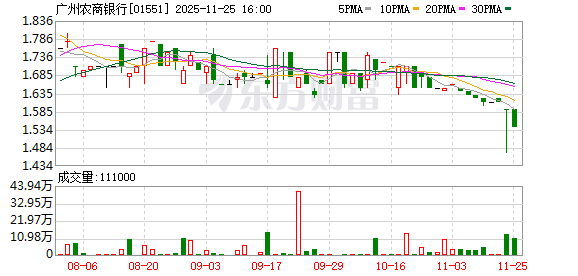
业绩承压 广州农商银行推进吸收两家村镇银行,如何开新局
Nan Fang Du Shi Bao· 2025-11-25 12:13
Core Viewpoint - Guangzhou Rural Commercial Bank plans to absorb and merge two village banks, furthering its integration strategy within the province, despite facing significant operational challenges and legal disputes related to its financial products [2][6]. Group 1: Merger and Integration - The absorption and merger of Shenzhen Pingshan Zhujiang Village Bank and Heshan Zhujiang Village Bank will convert them into branches of Guangzhou Rural Commercial Bank, enhancing its regional coverage [4][5]. - Guangzhou Rural Commercial Bank holds a 35% and 34% stake in the two village banks, making it the largest shareholder [3]. - Since 2024, the bank has announced the absorption of five village banks in the province, with three already approved by regulatory authorities [4]. Group 2: Financial Performance - For the first three quarters of 2025, Guangzhou Rural Commercial Bank reported revenues of 11.02 billion yuan, a decrease of 2.35% year-on-year, and a net profit of 1.722 billion yuan, down 18.73% [6]. - The bank's non-performing loan ratio rose to 1.98% by mid-2025, an increase of 0.32 percentage points from the previous year [6]. - The bank has been selling off significant assets, with a potential sale of approximately 18.928 billion yuan in debt assets, which have incurred substantial losses in recent fiscal years [6]. Group 3: Legal and Operational Challenges - The bank is facing lawsuits related to its financial product "Anxin Return No. 262," with a total claim amounting to 126 million yuan from three external rural banks [6]. - The profitability of the absorbed village banks is under scrutiny, particularly Heshan Zhujiang Village Bank, which reported a 50.8% decline in net profit year-on-year [3][5]. - The integration process raises concerns about whether the bank can effectively leverage the geographical advantages of the village banks to achieve sustainable growth [7].
业绩承压,广州农商银行推进吸收两家村镇银行,如何开新局
Nan Fang Du Shi Bao· 2025-11-25 12:05
Core Viewpoint - Guangzhou Rural Commercial Bank plans to absorb and merge two village banks, furthering its integration strategy within the province, despite facing operational challenges and legal disputes related to its financial products [2][6]. Group 1: Merger and Integration - The absorption and merger of Shenzhen Pingshan Zhujiang Village Bank and Heshan Zhujiang Village Bank will convert them into branches of Guangzhou Rural Commercial Bank, enhancing its regional coverage [4][5]. - Guangzhou Rural Commercial Bank holds a 35% and 34% stake in the two village banks, making it the largest shareholder [3]. - Since 2024, the bank has announced the absorption of five village banks, with three already approved by regulatory authorities [4]. Group 2: Financial Performance - For the first three quarters of 2025, Guangzhou Rural Commercial Bank reported revenues of 11.02 billion yuan, a decrease of 2.35% year-on-year, and a net profit of 1.722 billion yuan, down 18.73% [6]. - The bank's non-performing loan ratio rose to 1.98% by mid-2025, an increase of 0.32 percentage points from the previous year [6]. - The bank has been selling off significant assets, with a potential sale of approximately 18.928 billion yuan in debt assets, which have incurred substantial losses in recent fiscal years [6]. Group 3: Legal and Operational Challenges - The bank is facing lawsuits related to its financial product "Anxin Return No. 262," with a total claim amounting to 126 million yuan from three external rural commercial banks [6]. - The profitability of the absorbed village banks is under scrutiny, particularly Heshan Zhujiang Village Bank, which reported a 50.8% decline in net profit in 2024 [3][5]. - The integration process poses risks, as the bank must address legacy issues from the village banks while managing its own operational pressures [7].
【新华财经调查】村镇银行改革重组加速推进 “村改支”效果如何?
Xin Hua Cai Jing· 2025-09-30 06:04
Core Viewpoint - The reform and restructuring of village banks in China are accelerating, with over 100 banks completing mergers and reorganizations in 2023, primarily through the "village to branch" model, which optimizes financial resource allocation and enhances service quality [1][2][5]. Group 1: Reform and Restructuring Progress - In 2023, significant cases of village bank mergers and acquisitions have been reported, including Guangzhou Rural Commercial Bank absorbing Xingning Pearl River Village Bank and Hengfeng Bank acquiring Guang'an Hengfeng Village Bank [2]. - By August 15, 2023, 100 village banks had completed mergers and restructurings, with 10 banks exiting the market in August alone [2]. - The trend indicates that nearly 100 village banks are expected to dissolve by 2024, with a continued acceleration of restructuring into 2025 [2][3]. Group 2: Challenges Faced by Village Banks - Village banks generally have smaller asset scales compared to city commercial banks and rural commercial banks, facing issues such as limited business scope and insufficient profitability [3]. - The People's Bank of China reported that out of 4,364 banking institutions, 132 village banks were classified as high-risk [3]. - The need for reform is driven by the necessity to enhance risk resistance and sustainable development capabilities, which will improve resource allocation and service to agriculture and the real economy [3]. Group 3: Policy Support for Reforms - The 2025 Central Document No. 1 emphasizes a "one province, one policy" approach to accelerate rural credit cooperative reforms and orderly promote village bank restructuring [4]. - The National Financial Regulatory Administration has identified the reform of small and medium-sized financial institutions as one of its six key tasks for 2025 [4]. - Local governments, particularly in Shandong, are actively implementing reforms by reducing the number of village banks and optimizing their layout through mergers and acquisitions [4]. Group 4: Benefits of "Village to Branch" Model - The "village to branch" model has become the primary path for restructuring, allowing for improved efficiency in financial services and a broader range of products available to customers [5][6]. - Following the merger of Linyi Agricultural Commercial Bank and Linyi Le'an Village Bank, the number of operating outlets increased from 32 to 36, with total deposits and loans reaching 12.05 billion and 8.21 billion respectively [5][6]. - Customers have reported enhanced convenience and efficiency in banking services post-reform, with improved access to a wider array of financial products [6]. Group 5: Overall Impact of Reforms - The restructuring of village banks has resulted in a win-win situation for both agricultural commercial banks and customers, enhancing the banks' capacity to serve the agricultural sector and the real economy [7]. - Customers benefit from personalized and efficient financial products, leading to increased satisfaction and improved service quality [7]. - The ongoing reforms are expected to further optimize the financial landscape, enhancing the resilience and focus of rural financial services on local economic development [7].
再现“村并村”!年内已有百余起村镇银行整合
券商中国· 2025-09-12 06:11
Core Viewpoint - The article discusses the increasing trend of "village merging village" cases in the restructuring of rural banks in China, highlighting the recent merger proposal by Tai'an Hunan Commercial Village Bank to absorb two other village banks under the same parent bank, Shanghai Rural Commercial Bank [2][4]. Group 1: Recent Developments in Rural Bank Mergers - Tai'an Hunan Commercial Village Bank plans to hold a temporary shareholders' meeting on September 29 to review a merger proposal with Dongping Hunan Commercial Village Bank and Ningyang Hunan Commercial Village Bank [2]. - Over a hundred rural bank integration cases have occurred this year, with a notable increase in "village merging village" cases, particularly within the same parent bank [2][5]. - Shanghai Rural Commercial Bank, as a pioneer in establishing rural banks, has initiated this merger as part of a broader trend in the restructuring of rural banks [3][4]. Group 2: Background of Shanghai Rural Commercial Bank - Shanghai Rural Commercial Bank is the first provincial-level joint-stock commercial bank established on the basis of rural credit and has set up numerous rural banks since 2009 [3]. - The bank has established a total of 35 rural banks with a registered capital of 2.904 billion yuan and total assets of 34.132 billion yuan, with a significant portion of loans directed towards farmers and small enterprises [4]. Group 3: Implications of Mergers - The recent mergers reflect a shift in the role of parent banks, which are now acting as backup forces rather than just participants in the restructuring process [5][6]. - The merger of Jiangsu Shuyang Dongwu Village Bank with three other Dongwu banks illustrates this trend, as it will assume all assets, liabilities, and operations of the absorbed banks [6][7]. - In Guizhou, a similar merger involving Guiyang Yunyan Fumin Village Bank absorbing four other Fumin banks has been approved, expanding its operational area [8][9].

村改支!又注销36家!全国村镇银行改革重组加速
Da Zhong Ri Bao· 2025-08-20 02:07
Core Viewpoint - The restructuring and reform of rural banks in China, including those in Qingdao, are accelerating, with significant actions such as mergers and dissolutions being undertaken to enhance financial stability and service quality [1][6][9]. Group 1: Mergers and Acquisitions - Qingnong Commercial Bank plans to absorb and merge Jinxiang Blue Ocean Rural Bank, Pingyin Blue Ocean Rural Bank, and Rizhao Blue Ocean Rural Bank, converting them into branch institutions [2][3]. - As of March 2025, the total asset scale of the three rural banks is approximately 5.432 billion yuan, with Jinxiang Blue Ocean Rural Bank holding assets of 3.798 billion yuan, Pingyin Blue Ocean Rural Bank 0.835 billion yuan, and Rizhao Blue Ocean Rural Bank 0.799 billion yuan [3][12]. - The merger will result in the cancellation of the legal status of the three rural banks, with all their business, assets, and liabilities being inherited by Qingnong Commercial Bank [3][12]. Group 2: Regulatory Environment - Since June 1, 2024, a total of 36 rural banks have canceled their financial licenses, a significant increase compared to only one cancellation during the same period last year [1][6]. - The regulatory authorities have emphasized the need for a steady advancement of rural bank reforms, encouraging mergers to optimize regional financial layouts [6][13]. Group 3: Impact on Financial Services - The restructuring is expected to enhance the risk resistance capabilities of rural financial institutions, as they will be integrated into larger financial entities [9][15]. - Analysts believe that merging rural banks into larger institutions will improve the quality and efficiency of rural financial services, allowing for better support of local economic development [9][15][16]. - The transformation of rural banks into branches will facilitate the establishment of more comprehensive information systems and risk control frameworks, thereby improving operational efficiency and risk management [16].


改革重组促村镇银行整合提质
Jing Ji Ri Bao· 2025-08-08 07:19
Core Viewpoint - The recent approval by the National Financial Regulatory Administration for a state-owned bank to convert a rural bank into a branch indicates a significant trend of consolidation and quality improvement in the rural banking sector in China [1][2]. Group 1: Industry Trends - Over 50 rural banks have been absorbed and merged into branches as of the first half of this year, highlighting a clear trend of industry consolidation [1]. - The number of rural commercial banks, rural credit cooperatives, and rural banks has decreased by 44, 41, and 98 respectively compared to the previous year, with rural banks seeing the most significant reduction [1]. Group 2: Reform and Restructuring - The reform and restructuring of rural banks are being driven by the need to address financial service gaps in rural areas and enhance financial supply to support local economic development [1]. - Major banks are actively participating in the reform of rural banks, reflecting a coordinated approach to risk management and reform [2]. Group 3: Implementation Considerations - The restructuring of rural banks should be approached cautiously, considering the risk levels and available resources of the initiating banks and local governments [3]. - The integration of rural banks into branches requires careful planning regarding the optimization of branch networks and the consolidation of business operations, as these entities differ significantly in structure and processes [3].