沪深股通

Search documents
数据看盘机构活跃度连续两日下降 外资、一线游资联手抢筹常山北明
Xin Lang Cai Jing· 2025-10-16 09:50
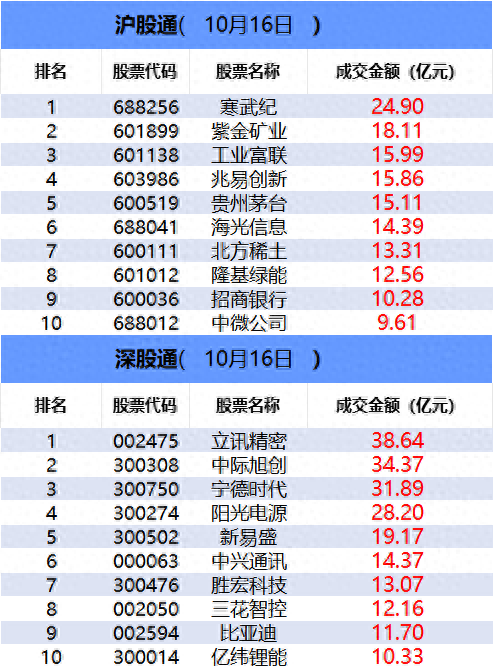
Core Insights - The total trading volume of the Shanghai and Shenzhen Stock Connect reached 260.56 billion, with Cambricon and Luxshare Precision leading in trading volume for the Shanghai and Shenzhen stock connect respectively [1][2] - The banking sector saw the highest net inflow of funds, while the ETF trading volume for the Hang Seng Consumption ETF increased by 155% compared to the previous trading day [1][4] - The IM contract saw a greater reduction in short positions compared to long positions [1][11] Trading Volume Summary - The total trading amount for the Shanghai Stock Connect was 129.49 billion, while the Shenzhen Stock Connect was 131.07 billion [2] - Cambricon had a trading volume of 2.49 billion, ranking first in the Shanghai Stock Connect, while Luxshare Precision led the Shenzhen Stock Connect with 3.86 billion [3] Sector Performance - The banking sector had a net inflow of 8.43 billion, representing a net inflow rate of 2.00% [4] - The coal, insurance, and port shipping sectors showed positive performance, while precious metals, semiconductors, and wind power sectors experienced declines [3][4] ETF Trading Summary - The top ETF by trading volume was the Hong Kong Securities ETF with 20.47 billion, followed by the Gold ETF with 9.63 billion [8] - The Hang Seng Consumption ETF saw a remarkable increase in trading volume by 155% compared to the previous trading day [9] Futures Position Summary - In the futures market, both the IH and IF contracts saw an increase in both long and short positions, while the IC and IM contracts experienced a decrease in both [11] Stock Performance on the Dragon and Tiger List - Long-term institutional activity decreased significantly, with notable purchases in stocks like Yunhan Chip City, which saw a 20% increase and received 95.6 million from three institutions [12][13] - The top net inflow stocks included Chang'an Automobile with 1.12 billion and Zhongxing Communication with 1.09 billion [6][14]






数据看盘IM期指多头连续两日大幅加仓 机构、量化甩卖多只芯片股
Sou Hu Cai Jing· 2025-10-14 10:37
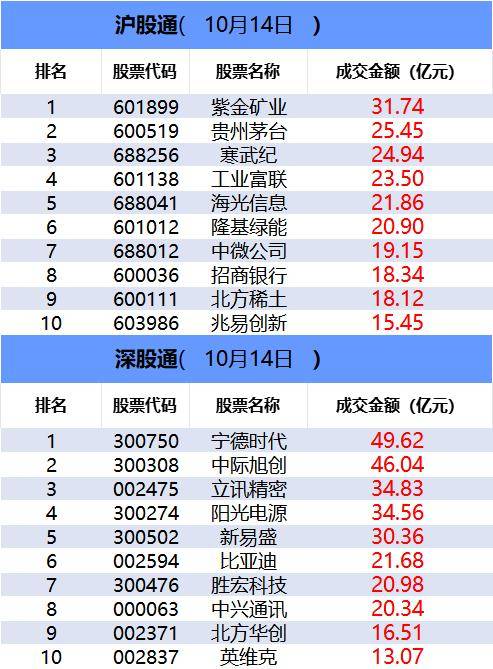
Summary of Key Points Core Viewpoint - The trading volume of the Shanghai and Shenzhen Stock Connect reached a total of 347.5 billion, with Zijin Mining and CATL leading in trading volume for the Shanghai and Shenzhen markets respectively. The banking sector saw the highest net inflow of funds, while several semiconductor stocks faced significant sell-offs [1]. Trading Volume - The total trading amount for the Shanghai Stock Connect was 171.29 billion, while the Shenzhen Stock Connect totaled 176.21 billion [2]. Top Trading Stocks - In the Shanghai Stock Connect, the top traded stocks included: - Zijin Mining: 31.74 billion - Kweichow Moutai: 25.45 billion - Cambricon Technologies: 24.94 billion [3] - In the Shenzhen Stock Connect, the top traded stocks included: - CATL: 49.62 billion - Zhongji Xuchuang: 46.04 billion - Luxshare Precision: 34.83 billion [4]. Sector Performance - The banking, insurance, coal, and port shipping sectors showed the highest gains, while the semiconductor and CPO sectors experienced the largest declines [5]. Fund Flow Monitoring - The banking sector had the highest net inflow of funds at 1.93 billion, followed by the food and beverage sector at 1.17 billion [6]. - The electronic sector faced the largest net outflow of funds at -31.18 billion [7]. ETF Trading - The top ETF by trading volume was the Hong Kong Securities ETF (513090) with 26.01 billion, followed by the Gold ETF (518880) with 15.09 billion [11]. - The Hong Kong Central Enterprise Dividend ETF (513910) saw a remarkable increase in trading volume, growing by 298% [12]. Futures Positioning - In the futures market, the IM contract saw a significant increase in long positions, with a net increase of 3,961 contracts [13]. Institutional Trading Activity - Notable institutional buying included: - Kaimeteqi: 1.93 billion from four institutions - Hezhong Intelligent: 1.6 billion from one institution [15]. - Significant selling activity was observed in semiconductor stocks, with Tongfu Microelectronics facing a sell-off of 2.76 billion from three institutions [16].
【数据看盘】机构、游资博弈京北方 量化资金活跃度持续提升
Xin Lang Cai Jing· 2025-07-10 09:58
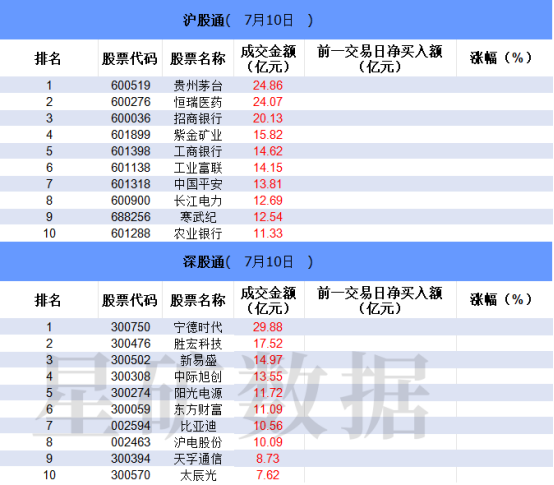
Summary of Key Points Core Viewpoint - The trading volume of the Shanghai and Shenzhen Stock Connect reached a total of 202.64 billion, with Kweichow Moutai and CATL leading in individual stock trading volume. The non-bank financial sector saw the highest net inflow of funds, while the coal ETF experienced a significant increase in trading volume. Trading Volume - The total trading amount for the Shanghai Stock Connect was 1009.52 billion, and for the Shenzhen Stock Connect, it was 923.12 billion [2]. Top Trading Stocks - In the Shanghai Stock Connect, Kweichow Moutai ranked first with a trading volume of 24.86 billion, followed by Hengrui Medicine at 24.07 billion and China Merchants Bank at 20.13 billion [3]. - In the Shenzhen Stock Connect, CATL led with a trading volume of 29.88 billion, followed by Shenghong Technology at 17.52 billion and Xinyi Technology at 14.97 billion [4]. Sector Performance - The sectors with the highest net inflow of funds included: - Non-bank financial: 34.07 billion (3.97% net inflow rate) - Real estate: 22.61 billion (8.36% net inflow rate) - Securities: 22.28 billion (4.67% net inflow rate) [5]. - The sectors with the highest net outflow of funds included: - Electronics: -63.45 billion (-3.76% net outflow rate) - Computers: -40.40 billion (-2.58% net outflow rate) [6]. ETF Trading - The top ETF by trading volume was the Hong Kong Securities ETF with 207.00 billion, followed by the Hong Kong Innovative Drug ETF at 56.60 billion [8]. - The coal ETF saw a remarkable increase in trading volume, growing by 318% [9]. Futures Positioning - In the futures market, both long and short positions increased significantly, with the IF and IC contracts seeing a greater increase in long positions [10]. Institutional Activity - Institutional buying was notable in stocks like JA Solar, which saw a purchase of 1.32 billion, while New City faced a sell-off exceeding 500 million [11]. - The overall activity of institutional investors was relatively low, with significant selling in stocks like Honghe Technology [12]. Retail and Quantitative Trading - Retail investors showed a decline in activity, with significant buying in Xiexin Integration exceeding 1.2 billion, while stocks like BYD faced substantial selling [12]. - Quantitative trading was active, with notable purchases in Xinya Technology exceeding 1.2 billion [13].