电影营销

Search documents
电影如果继续这么干,很可能真的没戏了
Hu Xiu· 2025-06-19 08:06
Core Viewpoint - The Chinese film industry is facing significant challenges, with a sharp decline in box office revenues and a reliance on outdated marketing strategies, leading to concerns about the sustainability of the industry moving forward [2][3][18]. Group 1: Box Office Performance - The box office for May was just over 1.7 billion, a 40% decrease compared to the same month last year, which previously saw figures exceeding 4 billion [2]. - The current film market is experiencing a severe contraction, with only five domestic films surpassing 100 million in box office this year, and the overall market volume is reminiscent of pre-2015 levels [18][22]. - The film industry is struggling to recover from the pandemic, with many films failing to achieve even moderate box office success, indicating a systemic issue within the market [20][22]. Group 2: Marketing Strategies - The industry has shifted towards cost-cutting measures in marketing, with many companies attempting to achieve significant results with minimal budgets, leading to ineffective promotional strategies [5][12]. - The trend of using simplistic marketing materials, such as "big character posters," has emerged as a response to budget constraints, but these strategies have proven to be ineffective in driving audience engagement [6][8][9]. - There is an over-reliance on short video platforms for marketing, which has not yielded better creative outcomes and has led to increased marketing costs without substantial returns [12][15]. Group 3: Audience Engagement - The film industry is witnessing a significant decline in young audiences, with the proportion of viewers under 25 dropping for three consecutive years, indicating a critical loss of a key demographic [30]. - High-frequency moviegoers have decreased from 16% in 2018 to just 6%, suggesting that price sensitivity is not the primary factor influencing their viewing decisions [31]. - The industry must rethink its approach to audience engagement, moving away from price reductions and instead focusing on enhancing the overall viewing experience through diverse offline activities [32]. Group 4: Future Outlook - The upcoming summer film season is under scrutiny, with projections indicating a 44% decline in box office compared to the previous year, raising doubts about the industry's ability to recover [33]. - The industry's core strategies need to evolve; without significant changes, even a successful summer season may not lead to meaningful improvements in the long-term health of the market [34].


还没看就打负分,凭什么这样对贾玲?
Hu Xiu· 2025-06-05 07:59
Group 1 - The core theme of the article revolves around director Jia Ling's new film "Turning Point," which shifts focus from previous themes of "mother-daughter relationships" and "weight loss" to a narrative centered on "anti-pyramid schemes" [1][2] - The film's plot involves a housewife who transitions from resistance to actively assisting the police in solving a pyramid scheme case, featuring actors Zhang Xiaofei and Yang Zi in significant roles [2][38] - The marketing strategy for "Turning Point" is under scrutiny, especially following the mixed reception of Jia Ling's previous film "Hot and Spicy," which faced criticism for excessive marketing and a disconnect between promotional content and the film's actual themes [5][10][41] Group 2 - The article discusses the evolving perception of Jia Ling as a director, noting the challenges she faces in transitioning from a comedic background to tackling serious themes in her films [20][30] - It highlights the audience's skepticism regarding the effectiveness of her storytelling in addressing real societal issues, particularly in the context of her previous works that may not have fully engaged with the complexities of reality [32][36] - The anticipation for "Turning Point" is mixed, with some viewers expressing hope for a more profound exploration of female perspectives in crime narratives, especially in light of the film's focus on the struggles of pyramid scheme victims [39][40]

微博还能影响电影营销吗?
3 6 Ke· 2025-05-15 11:40
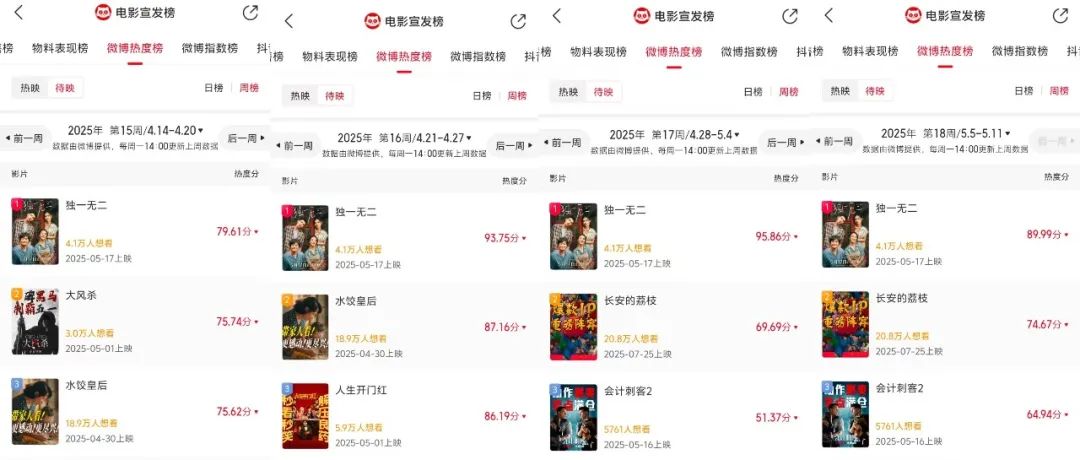
Group 1 - The film "Unique" has topped the Weibo movie heat list for four consecutive weeks, but its first-day pre-sale ticket sales have only surpassed 200,000, with a projected total box office of around 15 million [1][3] - Despite the lackluster performance, the film's ability to maintain high visibility on Weibo raises questions about the effectiveness of Weibo's marketing strategies compared to other platforms like Douyin [3][4] - Weibo's traditional strength in movie promotion, primarily through its celebrity ecosystem, is diminishing as stars are less impactful for films compared to other forms of media [4][5] Group 2 - The various promotional strategies on Weibo, such as fan interactions and trending topics, do not translate effectively into box office success, indicating that Weibo's heat metrics may not be reliable indicators of a film's performance [5][6] - The shift in internet traffic towards platforms with higher engagement, like Douyin, has contributed to Weibo's declining influence in film marketing [5][6] - Weibo still holds a unique position as an official communication channel for the film industry, providing authoritative announcements and updates that are quickly disseminated through social networks [6][10] Group 3 - Weibo's increasing involvement in film production, with a significant rise in the number of projects it co-invests in, reflects a strategy to gain more influence in the industry [8][10] - However, this dual role as a promotional platform and a co-producer may compromise its impartiality, potentially leading to conflicts of interest [10][11] - In contrast, Douyin has shifted away from film co-production, focusing instead on being a pure marketing platform, which may enhance its effectiveness in that domain [10][11] Group 4 - The "Big V Recommendation" system on Weibo has become a prominent film rating tool, but it lacks the critical differentiation seen in other rating systems, which may undermine its credibility [11][13] - This rating system allows for early scoring of films, providing a marketing advantage, but its high scores across the board reduce its ability to distinguish quality effectively [13][15] - Overall, Weibo's position as the leading platform for film marketing has weakened, and while it may not reclaim its former status, it can explore niche opportunities in film ratings and industry marketing [15]