监管科技

Search documents
吴清主席视频会见瑞士金管局主席马琳·阿姆施塔特
证监会发布· 2025-07-28 11:41
Group 1 - The core viewpoint of the article highlights the meeting between the Chairman of the China Securities Regulatory Commission and the Chairman of the Swiss Financial Market Supervisory Authority, focusing on enhancing regulatory technology cooperation and bilateral regulatory exchanges [1]

什么是RWA?
Sou Hu Cai Jing· 2025-07-24 08:03
Core Insights - Real World Assets (RWA) represent a financial innovation that digitizes tangible and intangible assets through blockchain technology, allowing for their circulation in a decentralized environment [1][2] - RWA retains the value stability of traditional assets while integrating the technological advantages of digital assets, potentially transforming the financial market and promoting a more inclusive global financial system [2] Characteristics of RWA - Asset Anchoring: Each token corresponds to a specific real-world asset [3] - Technological Dependence: Relies on smart contracts and token standards (e.g., ERC-20, ERC-721) for functionality [3] - Value Transmission: The value of digital tokens is directly derived from the underlying physical assets [3] Comparison with Digital Assets - Value Basis: RWA's value is anchored in real assets, while digital assets derive value from network consensus and scarcity design [3] - Price Formation Mechanism: RWA prices are linked to the value of the underlying assets, whereas digital asset prices are determined solely by market supply and demand [3] Regulatory Environment - RWA must comply with both traditional financial and blockchain regulatory requirements, unlike digital assets which are still developing their regulatory frameworks [3] - Legal compliance and cross-border regulatory coordination present challenges for RWA [3] Future Trends - Rise of Hybrid Finance (HyFi): Deep integration of traditional finance and decentralized finance (DeFi) [3] - Expansion of Asset Classes: Extension from financial assets to intellectual property and carbon credits [3] - Development of Regulatory Technology: Emergence of compliance automation tools [3] - Cross-Chain Interoperability: Facilitating asset circulation across different blockchain networks [3]
8月1日起,黄金交易戴上“紧箍咒”:现金超10万即触发反洗钱雷达!
Sou Hu Cai Jing· 2025-07-02 12:55
Core Viewpoint - The new regulations implemented by the People's Bank of China on August 1 aim to strengthen anti-money laundering measures in the precious metals sector, marking a significant upgrade in the financial regulatory framework in China [1][3]. Group 1: Regulatory Changes - The reporting threshold for large cash transactions has been raised from 50,000 to 100,000 yuan, which appears to be a relaxation but is actually a tightening of regulations [3]. - Precious metals transactions, particularly gold, have been identified as tools for money laundering, prompting the need for stricter compliance measures [3][4]. - Businesses in the precious metals sector are now required to establish customer due diligence systems, documenting identity information for transactions over 100,000 yuan [3][4]. Group 2: Impact on Industry - The new regulations are expected to disproportionately affect small and medium-sized enterprises, which will face increased compliance costs and operational changes [3][5]. - The transition to a more regulated environment may lead to industry consolidation, as smaller players may struggle to meet the new compliance requirements [3][5]. - The implementation of these regulations is seen as a precursor to the future rollout of digital currency in China, enhancing the transparency of cash transactions [4][5]. Group 3: Future Outlook - The regulatory changes may lead to the emergence of new business models, such as "gold exchanges + blockchain," as the industry adapts to the new compliance landscape [5]. - The overall goal of these regulations is to modernize China's financial governance capabilities, ensuring that the precious metals market evolves from a less regulated environment to a more structured and compliant one [5].

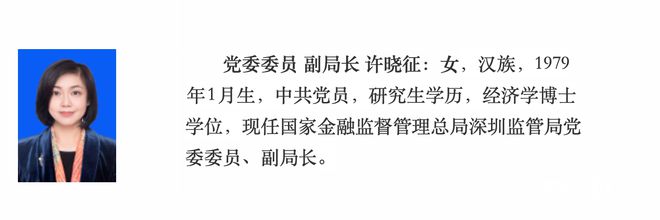
许晓征出任深圳金融监管局副局长,曾长期深耕普惠金融领域
Nan Fang Du Shi Bao· 2025-04-27 12:16
Core Viewpoint - The appointment of Xu Xiaozheng as the Deputy Director of the Shenzhen Financial Regulatory Bureau marks a significant move in enhancing the regulatory framework and promoting inclusive finance in Shenzhen, a region known for its financial innovation and development [1][8]. Group 1: Xu Xiaozheng's Background and Experience - Xu Xiaozheng, born in January 1979, has extensive experience in financial regulation, particularly in the field of inclusive finance, having previously served as the Deputy Director of the Inclusive Finance Department at the National Financial Regulatory Administration [2][4]. - During her tenure at the Chongqing Banking and Insurance Regulatory Bureau, she led the development of the "Jin Yu Wang" financial service platform, which integrated data from 19 municipal departments to connect over 170 banking and insurance institutions [2][3]. - Xu has emphasized the importance of promoting a culture of integrity in finance and has been involved in various initiatives aimed at supporting economic stability and poverty alleviation [3][4]. Group 2: Shenzhen Financial Sector Performance - As of the end of March 2023, the total assets of banks under the supervision of the Shenzhen Financial Regulatory Bureau reached 13.87 trillion yuan, with a loan balance of 9.79 trillion yuan [7]. - The manufacturing sector saw a loan balance of 1.62 trillion yuan, reflecting a year-on-year growth of 5.05%, with the average financing cost for new manufacturing loans dropping to 2.57%, a decrease of 79 basis points from the previous year [7]. - The financial sector in Shenzhen is actively supporting digital economy industries, technology enterprises, and green loans, with year-on-year growth rates of 6.66%, 7.23%, and 15.18% respectively [7]. Group 3: Strategic Importance of Xu's Appointment - Xu Xiaozheng's appointment is seen as a strategic move to deepen the collaboration between central and local regulatory bodies, which is crucial for fostering innovation and stability in Shenzhen's financial landscape [8]. - The regulatory framework in Shenzhen is evolving, with a focus on enhancing support for small and micro enterprises through innovative financial products like "Park Loans," which have shown significant growth [7][8].