
科技金融改革

Search documents
陕西将迎来第十五家科创板上市公司
Shan Xi Ri Bao· 2025-08-14 23:14
Core Viewpoint - Xi'an Yiswei Material Technology Co., Ltd. has successfully passed the listing review by the Shanghai Stock Exchange and will be listed on the Sci-Tech Innovation Board, marking a significant milestone for the company and the region [1][2]. Company Overview - Established in March 2016, Xi'an Yiswei is a private enterprise located in Xi'an High-tech Zone, primarily engaged in the R&D, manufacturing, and sales of 12-inch silicon single crystal polished wafers and epitaxial wafers [2]. - As of 2024, the company's average monthly shipment accounts for approximately 6% of the global market and 30% of the domestic market, ranking sixth globally [2]. - The company has developed a core technology system covering all process stages of 12-inch silicon wafer production, including crystal pulling, shaping, polishing, cleaning, and epitaxy [2]. - By the end of 2024, Xi'an Yiswei has obtained 539 authorized invention patents, ranking first in the field of 12-inch silicon wafers in China [2]. Financial and Market Position - The company plans to issue up to 538 million shares, representing approximately 13.32% of the total share capital post-issuance, with the aim to raise 4.9 billion yuan, all of which will be used for the construction of the second phase of the Xi'an Yiswei silicon industry base [1]. - This listing will make Xi'an Yiswei the 83rd A-share listed company in Shaanxi and the 15th on the Sci-Tech Innovation Board, contributing to the province's position as the 11th in the country and second in the western region for the number of listed companies [1]. Industry Impact - The successful listing of Xi'an Yiswei is seen as a significant achievement in Shaanxi's efforts to promote innovation-driven development and implement reforms in technology finance [2]. - The provincial financial office aims to deepen multi-level capital market reforms and enhance the cultivation system for technology-based enterprises to accelerate their entry into the capital market, thereby supporting high-quality economic development in the province [2].
省级上市后备企业名单!汉中多家企业入围→
Sou Hu Cai Jing· 2025-08-07 09:54
Core Points - The Shaanxi Provincial Financial Office has released the list of 520 provincial-level listed reserve enterprises for 2025, an increase of 20 from the previous year [1][3] - Among the listed enterprises, 80 are classified as A-level, 120 as B-level, and 320 as C-level [2][3] - A significant majority of the enterprises, 502, are technology-based, accounting for 96.54% of the total, while 438 are from key manufacturing industry chains, representing 84.23% [2] Group 1 - The list includes 520 high-quality enterprises, with a focus on technology and manufacturing sectors [1][3] - The A-level enterprises include 80 companies, while B-level and C-level enterprises consist of 120 and 320 companies respectively [2][3] - The increase in the number of private enterprises to 428, which is 82.31% of the total, shows a rise of 7.71 percentage points compared to last year [2] Group 2 - The technology-based enterprises cover various sectors, including 16 in the photon industry, 26 in aerospace, 36 in aviation, and 14 in artificial intelligence [2] - The initiative aims to enhance the cultivation and service of provincial-level listed reserve enterprises, facilitating their entry into the capital market [3]

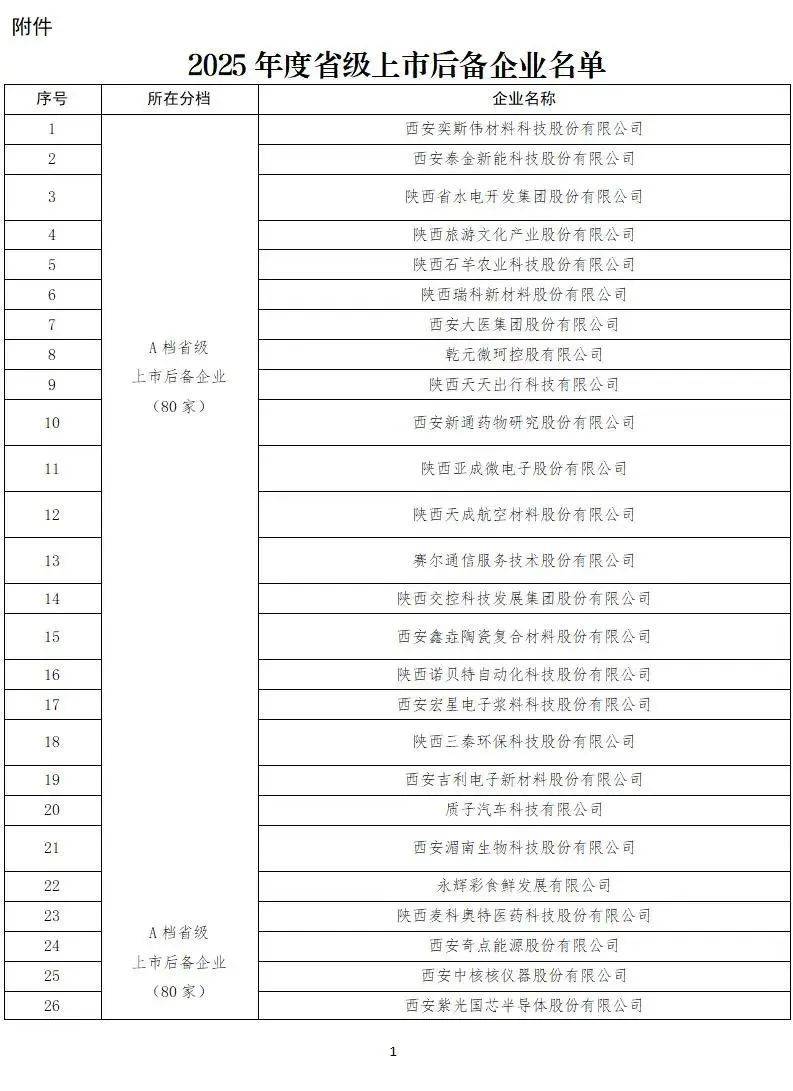
陕西省级上市后备企业名单发布
Sou Hu Cai Jing· 2025-08-07 08:24
Core Points - The Shaanxi Provincial Financial Office has released the list of 520 provincial-level listed reserve enterprises for 2025, expanding by 20 companies compared to last year [1][2] - Among the listed reserve enterprises, there are 80 in Category A, 120 in Category B, and 320 in Category C [1][2] - A significant majority of the enterprises are technology-oriented, with 502 companies (96.54%) classified as such, and 438 companies (84.23%) are from key manufacturing industry chains [1][2] - Private enterprises dominate the list, with 428 companies (82.31%), marking an increase of 7.71 percentage points from the previous year [1][2] Summary by Categories Category A Enterprises - There are 80 enterprises classified as Category A, including notable companies such as Xi'an Yisiwei Material Technology Co., Ltd. and Qianyuan Weike Holdings Co., Ltd. [4][5] Category B Enterprises - The list includes 120 enterprises in Category B, such as BoRui JiXin (Xi'an) Electronic Technology Co., Ltd. and Huachuang Synthetic Pharmaceutical Co., Ltd. [7][8] Category C Enterprises - A total of 320 enterprises fall under Category C, which includes a wide range of companies across various sectors [10][11] Industry Focus - The technology sector is heavily represented, with a focus on industries such as photonics (16 companies), aerospace (26 companies), aviation (36 companies), and artificial intelligence (14 companies) [1][2]
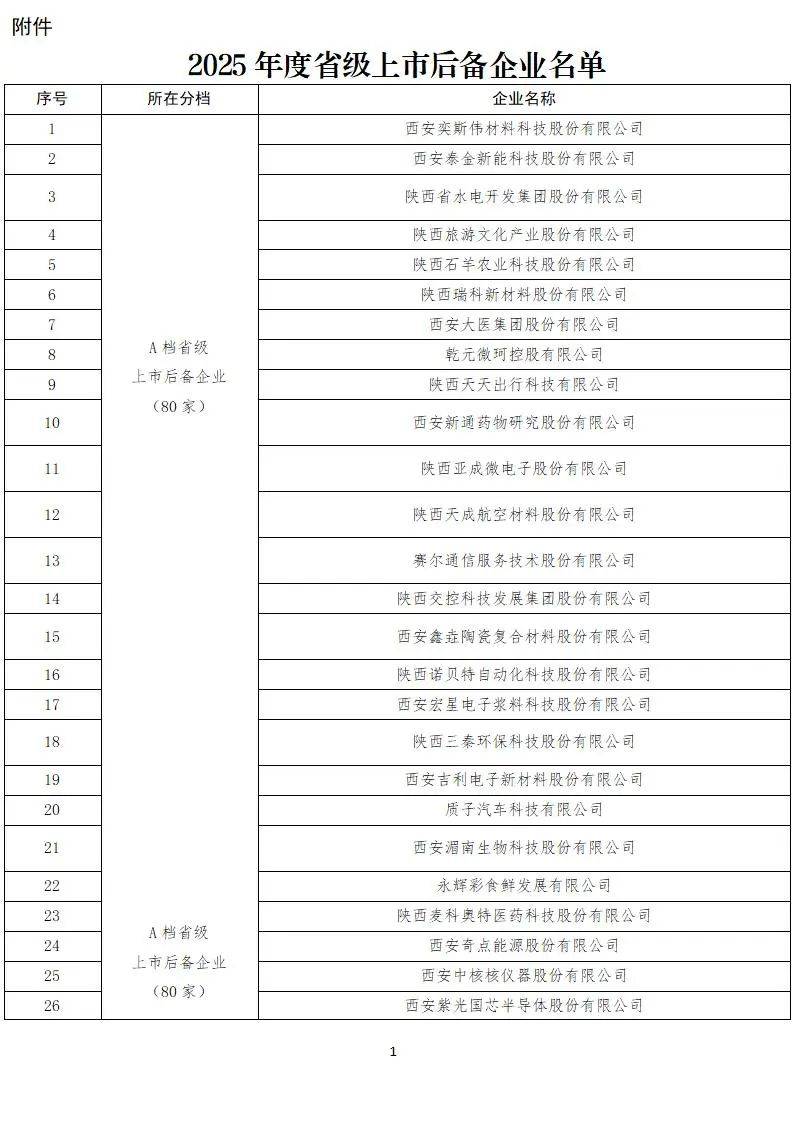
陕西省发布2025年度上市后备企业名单 科技型企业占比达96.5%
Zheng Quan Shi Bao Wang· 2025-07-30 12:54
今年是陕西省第五年发布省级上市后备企业名单。今年申请参评升级上市后备企业1591家,较去年新增 加205家。陕西省各有关单位联合评选出520家优质企业进入今年省级上市后备企业名单,较去年扩充20 家。520家后备企业中,科技型企业有502家,占比96.54%,制造业单项冠军42家,国家级专精特新"小 巨人"96家,瞪羚企业150家。 人民财讯7月30日电,7月29日,陕西省委金融办会同省级有关部门、沪深北交易所驻陕基地举办2025年 资本市场赋能科技金融改革暨省级上市后备企业名单发布会。 ...
4000亿,这个省拼了,还鼓励取消回购
母基金研究中心· 2025-06-20 09:32
Core Viewpoint - The "Action Plan" aims to promote high-quality development of venture capital in Shandong Province, targeting an annual growth of over 10% in venture capital investment by the end of 2027, with a management scale exceeding 4 trillion yuan and a focus on early-stage and technology investments [1][2]. Group 1: Action Plan Highlights - The plan includes comprehensive measures for fundraising, investment, management, and exit strategies, with notable incentives for venture capital institutions [2]. - A risk subsidy of 20% on actual investment losses will be provided to venture capital institutions investing in early-stage technology companies for over two years, with a maximum subsidy of 3 million yuan per project and 600 million yuan per institution annually [2][3]. Group 2: Risk Mitigation and Evaluation - The initiative aims to alleviate the investment hesitation of institutions by sharing investment risks, thus supporting early-stage companies in overcoming challenges [3]. - A differentiated evaluation system for state-owned venture capital funds will be established, focusing on the overall performance of funds rather than individual project outcomes, and encouraging a higher risk tolerance [3][4]. Group 3: Current Industry Challenges - The article highlights the pressing issue of buyback agreements in the venture capital industry, which have become a significant concern amid economic downturns [5][6]. - There is a growing trend of startups triggering buyback clauses, leading to legal disputes and financial strain on both founders and investors [6][10]. Group 4: Innovative Solutions and Industry Practices - Some regions have begun to explore legislative measures to encourage venture capital funds to avoid mandatory buyback clauses for founders [7]. - Certain venture capital firms are adopting flexible approaches to handling buybacks, including negotiating alternative solutions that do not rely on traditional buyback agreements [8][9]. Group 5: Systemic Issues and Collaborative Solutions - The current buyback situation is described as a systemic issue that requires collaborative efforts from all stakeholders to find effective solutions [11][12]. - The call for rational restraint and mutual understanding among parties involved in the buyback crisis is emphasized, along with the need for systemic reforms to address these challenges [13][14].

破冰科技金融改革!国信证券助力首批民营创投科创债落地深圳
Nan Fang Du Shi Bao· 2025-06-19 08:49
Group 1 - The core viewpoint of the news is that the successful issuance of the "2025 Annual First Phase Targeted Technology Innovation Bond" by Dongfang Fuhai marks a significant milestone in China's bond market, showcasing innovative financial products and mechanisms for supporting technology innovation [1][2][6] - The bond issuance was led by Guosen Securities, which played a crucial role in facilitating the process, establishing a collaborative working group, and customizing financing solutions for Dongfang Fuhai [2][4] - The bond achieved a subscription rate of 6.325 times, with a total issuance scale of 400 million yuan and a coupon rate of 1.85%, setting multiple records in the bond market [1][3] Group 2 - The issuance is seen as a benchmark for private venture capital institutions, providing a replicable model for direct financing channels and introducing new capital for technology innovation enterprises [2][4] - The bond's structure includes a large issuance scale, long maturity, and low cost, effectively addressing the financing challenges faced by private venture capital institutions [4][6] - The supportive policies from regulatory bodies, such as the People's Bank of China and the China Securities Regulatory Commission, are crucial for easing the financing difficulties of technology-oriented small and medium-sized enterprises [6][7]

