
稀土战略资源

Search documents
中方给稀土加上“新锁”,特朗普察觉情况不妙,对华收回一个禁令
Sou Hu Cai Jing· 2025-06-29 07:23
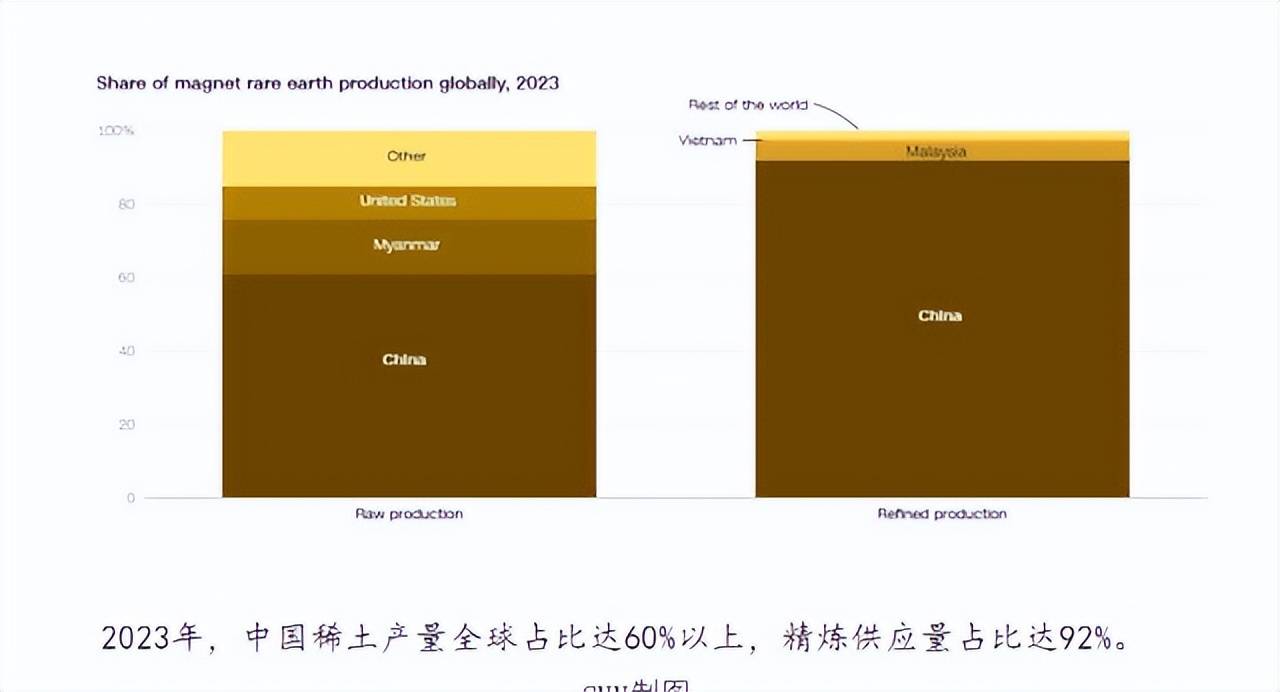
Group 1 - Rare earth elements are essential for modern technology, including smartphones, electric vehicles, and military equipment, making them crucial for both economic and national security [1] - China controls approximately 37% of global rare earth reserves and dominates 80% of processing capacity, particularly in heavy rare earth refining technology [2][5] - In April 2025, China announced strict export controls on rare earth elements, transitioning from a quota system to a more stringent licensing requirement for each export batch [2][5] Group 2 - The Chinese government aims to safeguard national security and public interest through these export controls, as rare earth elements are vital for sensitive military and industrial applications [5] - Following the announcement, rare earth prices surged dramatically, with dysprosium oxide reaching $850 per kilogram and terbium exceeding $3000, reflecting a price increase of over 210% [5] - The U.S. defense sector, heavily reliant on rare earths, expressed significant concern over potential supply disruptions affecting high-tech and military industries [5][6] Group 3 - In response to China's actions, the U.S. government declared a "national emergency" regarding its dependence on critical minerals and initiated efforts to boost domestic rare earth mining [6][8] - The U.S. is attempting to form a rare earth alliance with allies like Japan and Australia to reduce reliance on China, but faces significant challenges in matching China's processing capabilities [8][9] - The geopolitical implications of the rare earth situation highlight the ongoing U.S.-China rivalry, with both nations leveraging their resources in the tech and military sectors [9][11] Group 4 - Recent U.S.-China trade talks indicate a desire to avoid a complete breakdown in relations, yet the rare earth issue remains a contentious topic [11] - The long-term outlook suggests that the rare earth dilemma could lead to a reshaping of global supply chains, as countries seek alternative sources to mitigate dependence on China [11]

普京打出“稀土牌”明目张胆的给特朗普开后门,中国要警惕了!
Sou Hu Cai Jing· 2025-06-26 10:04
Core Viewpoint - The global competition for rare earth elements has intensified, with Russia's recent involvement heightening the rivalry between China and the United States [1][3]. Group 1: Russia's Position - Russia claims to have abundant rare earth reserves, with a total of 28.5 million tons identified, primarily located in the Lovozero and Tomtor mines [10]. - The announcement from Russia coincides with a stalemate in US-China negotiations, suggesting a potential supply option for the US [3][10]. - Despite the impressive figures, Russia's rare earth extraction and purification technology remains underdeveloped, posing challenges for large-scale production [12][14]. Group 2: China's Dominance - China holds 37% of global rare earth reserves and dominates the processing capacity, accounting for over 70% of the global market [14]. - The country has established a comprehensive and interconnected rare earth industry chain, excelling particularly in high-end rare earth products [14]. - China's technological advantages in rare earth processing are a significant barrier for competitors like the US and Russia, which lack similar capabilities [14]. Group 3: US Concerns - The US is heavily reliant on imported rare earths, primarily from China, which poses risks to its high-tech sectors if supply is disrupted [6][9]. - Recent negotiations between the US and China regarding rare earth exports have seen China maintaining strict controls on military-grade supplies while showing flexibility on civilian uses [7]. - The US is actively seeking alternative suppliers in light of potential supply chain vulnerabilities due to China's dominance [9]. Group 4: Strategic Implications - Rare earths are critical not only for civilian applications but also for military technologies, making them a strategic resource in global geopolitics [4][9]. - China is advised to enhance its rare earth reserves to ensure supply stability amid external pressures [16].
中国手握稀土“王牌”,美扛不住了?特朗普放低姿态,拨通中方电话
Sou Hu Cai Jing· 2025-06-09 08:45
Group 1: Core Insights - China holds approximately 40% of the world's rare earth reserves and dominates the industry with a complete and advanced supply chain, producing about 90% of the global output in the refining and separation stage [1][3] - The U.S. military heavily relies on rare earth elements for advanced weaponry, with each F-35 fighter jet consuming around 417 kilograms of rare earth materials, highlighting the critical nature of these resources for national defense [3] - The U.S. faces significant challenges in rare earth production and processing, with 70% of its rare earth compounds and metals imported from China between 2020 and 2023, and a lack of capability in heavy rare earth processing [3][4] Group 2: U.S. Strategies and Challenges - The Trump administration sought to diversify rare earth supply sources by exploring partnerships with countries like Saudi Arabia, Brazil, and Mongolia, but faced numerous obstacles in these efforts [4][6] - Technological gaps, high initial investment requirements, and a shortage of skilled professionals hinder the U.S. from quickly developing a reliable rare earth supply chain [6] - China's recent export controls on certain rare earth elements and magnets have directly impacted U.S. industries, particularly automotive and military sectors, leading to production delays and operational challenges [6][8] Group 3: Diplomatic Dynamics - During a recent phone call, President Trump emphasized the need for negotiations on rare earth issues, but China's response indicated a cautious and firm stance on managing its strategic resources [8] - China's approach to rare earth management reflects its commitment to protecting national interests while promoting equitable international cooperation [8] - The ongoing U.S.-China dialogue on rare earths is a microcosm of broader geopolitical tensions, with future interactions likely to influence the global rare earth industry significantly [8]
中国出手!稀土价格涨超210%!
证券时报· 2025-05-05 02:30
Core Viewpoint - The article discusses the significant price surge of rare earth metals following China's announcement of export controls on seven categories of medium and heavy rare earth elements, leading to potential supply shortages in overseas markets and increased prices globally [1][2]. Group 1: Price Surge and Market Impact - As of May 1, the price of dysprosium in Europe has doubled since early April, reaching $850 per kilogram, while terbium has surged from $965 to $3000 per kilogram, marking an increase of over 210% [1][2]. - The export controls are expected to create a short-term shortage in overseas markets, with prices anticipated to rise above domestic levels initially, before converging in the medium term [8]. Group 2: Strategic Importance of Rare Earths - Rare earth metals are referred to as "industrial vitamins" due to their critical role in enhancing material performance, particularly in advanced products like electric vehicles, wind turbine motors, and aerospace applications [2][3]. - The majority of medium and heavy rare earth supply is sourced from China, making these controls particularly impactful on global supply chains [2][3]. Group 3: Industry Performance and Financial Results - In Q1, several rare earth companies reported significant revenue growth, with China Rare Earth achieving a revenue of 728 million yuan, up 141.32% year-on-year, and a net profit turnaround from a loss of 289 million yuan to a profit of 72.6 million yuan [6]. - Northern Rare Earth reported a revenue of 9.287 billion yuan, a year-on-year increase of 61.19%, with net profit soaring by 727.30% [6][7]. Group 4: Future Demand and Opportunities - The global demand for rare earth materials is expected to rise significantly, driven by the anticipated increase in electric vehicle sales, projected to reach 10 million units by 2025, and the growing humanoid robot market [8]. - The export controls are seen as an opportunity for domestic rare earth processing companies, as some processed products are not subject to these restrictions, potentially expanding profit margins [8].

中国出手!暴涨超210%!
券商中国· 2025-05-04 23:21
Core Viewpoint - The article highlights the significant increase in rare earth metal prices following China's announcement of export controls on seven categories of medium and heavy rare earth elements, leading to potential shortages in overseas markets and a rise in global prices [1][3][4]. Price Surge - As of May 1, the price of dysprosium in Europe has doubled since early April, reaching $850 per kilogram, while terbium has surged from $965 to $3000 per kilogram, marking a cumulative increase of over 210% [1][3][4]. Strategic Importance of Rare Earths - Rare earth metals, referred to as "industrial vitamins," are crucial for enhancing material performance and are widely used in sectors such as renewable energy, aerospace, military, and electronics [1][4][7]. Impact on Supply Chains - Analysts indicate that the export restrictions may lead to a significant impact on the supply chains of electric vehicles and military systems in the U.S., with over 1900 U.S. weapon systems relying on key minerals sourced from China [5][6]. Financial Performance of Rare Earth Companies - In Q1, several rare earth companies reported substantial revenue growth, with China Rare Earth achieving a revenue of 728 million yuan (up 141.32%) and a net profit of 72.6 million yuan, reversing a loss from the previous year [8]. Future Demand and Market Trends - The global demand for rare earth materials is expected to rise, particularly with projections of 10 million electric vehicles sold by 2025 and additional demand from the humanoid robot market, which could add 200,000 to 400,000 tons [9]. Overall Market Outlook - The article suggests that the overall price center for rare earths is likely to rise, with short-term expectations of higher overseas prices compared to domestic prices, and a convergence in the medium term [9].



北方稀土20250407
2025-04-07 16:27
Summary of Northern Rare Earth Conference Call Industry Overview - The rare earth sector has recently experienced volatility due to export control measures announced by the Chinese Ministry of Commerce and the General Administration of Customs on April 4, affecting seven categories of medium and heavy rare earth items, including samarium and cobalt magnetic materials [3] - China is the only country capable of producing all 17 rare earth elements, making its supply irreplaceable globally [4][11] - The rare earth market is expected to face a short-term supply shortage, leading to potential price increases and an expansion of the domestic-international price gap [4] Company Insights - Northern Rare Earth, leveraging resources from the Baotou Steel's Baiyun Obo mining area, is focusing on an integrated industrial chain to enhance its market position [4][6] - The company has a diversified product range, including raw materials, functional materials, and end-use products, which helps it maintain profitability during market downturns [6] - Northern Rare Earth plans to invest 7.8 billion in green smelting upgrades to enhance production efficiency and profitability, aiming to shift towards high-end products [4][14] Market Dynamics - The rare earth prices are projected to gradually increase by 2025 as the supply-demand gap narrows, with significant price rises expected for both light and medium-heavy rare earths [10] - The domestic demand for rare earths is anticipated to grow at around 10% from 2024 to 2027, driven by sectors such as electric vehicles, energy-efficient air conditioning, and industrial robotics [12] Regulatory Environment - The Chinese government is intensifying its management of the rare earth industry, implementing total control over mining and smelting to protect resources and eliminate illegal mining activities [8] - Policy support is expected to provide long-term price stability for domestic and international markets, benefiting companies like Northern Rare Earth [8][9] Competitive Landscape - Northern Rare Earth holds a dominant position in the market, accounting for 70% of total indicators, alongside the China Rare Earth Group, forming a dual-leader structure in the industry [4][11] - Recommended companies in the current policy environment include Northern Rare Earth, China Guangshun Nonferrous, and social resources, all of which exhibit strong risk resistance and can benefit from policy support [9] Financial Projections - Northern Rare Earth's projected net profits for 2025 and 2026 are estimated at 1.588 billion and 2.72 billion respectively, indicating a positive growth trajectory [14]