
算力上天

Search documents
从蓝箭朱雀三首飞看后续商业航天投资机会
2025-12-08 00:41
Summary of Key Points from the Conference Call on Commercial Aerospace Investment Opportunities Industry Overview - The conference call focuses on the commercial aerospace industry, particularly highlighting the advancements and investment opportunities related to companies like Blue Arrow and SpaceX [1][2][5]. Core Insights and Arguments - Blue Arrow's successful test of a reusable rocket indicates its capability for large-scale launches, potentially accelerating its listing on the Sci-Tech Innovation Board, exceeding market expectations [1][2]. - SpaceX's valuation surged from $400 billion to $800 billion, reflecting the U.S. capital market's strong recognition of the space economy, which includes traditional broadband and deep space economic expansion [2][5]. - The commercial aerospace supply chain includes key players such as rocket launch companies (e.g., Blue Arrow, Chang 12), satellite manufacturers (e.g., Shanghai Port Bay), and substrate manufacturers (e.g., Yunnan Germanium) [1][4]. - The demand for satellites is expected to grow significantly, with StarNet's first-generation enhanced satellites set to enter deployment by the end of 2026, and a second-generation experimental satellite planned for launch early next year [1][10]. Emerging Trends - The demand for computational power in space is increasing, with companies like StarCloud and Beijing Orbital Morning Light planning to achieve substantial computational capabilities by 2030 and 2035, respectively [1][11]. - The establishment of satellite super factories in various regions of China, such as the Wenchang Aerospace City, aims to produce 100 rockets and 1,000 satellites annually by 2027, enhancing domestic manufacturing capabilities [12][13]. Investment Opportunities - The commercial aerospace sector is currently in a nascent stage, akin to the robotics industry in late 2024, with significant investment opportunities anticipated in the coming months [2][16]. - Investors are encouraged to focus on both emerging sectors like computational satellites and traditional satellite companies, as the market is expected to adjust positively in 2026 [16][17]. - The upcoming launch of multiple rocket companies and the support from the Shanghai Stock Exchange's green channel indicate a robust investment environment [2][16]. Key Companies and Their Roles - Blue Arrow and Chang 12 are highlighted as significant players in the rocket launch segment, with upcoming tests expected to drive investment interest [4][15]. - Shanghai Port Bay is noted for its solar wing energy system, which holds a substantial market share [4]. - Companies involved in testing, such as Guangdian Measurement and Su Shi Experiment, are crucial for ensuring the reliability of satellite launches [7]. Conclusion - The commercial aerospace industry is poised for growth, driven by technological advancements and increasing demand for satellite launches. Investors should remain vigilant and consider both high-risk and traditional investment opportunities within this sector [16][17].
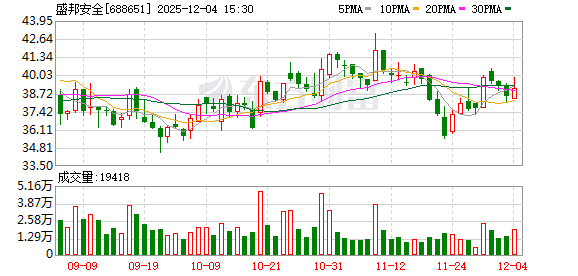
盛邦安全:近期推出200G高速链路加密网关产品
Mei Ri Jing Ji Xin Wen· 2025-12-04 08:13
Core Insights - The company, Shengbang Security (688651.SH), has announced its "integrated air-space-ground" security strategy, establishing partnerships with key enterprises across the industry chain, including satellite manufacturing, communication operations, and terminal applications [2] Strategic Developments - The company has made strategic investments in satellite manufacturing unicorn, Weina Starry Sky, and satellite communication equipment provider, Xingzhan Measurement and Control, to deepen cooperation in satellite internet security, low-altitude economy scenarios, and emergency rescue [2] - These collaborations lay a solid foundation for future participation in satellite constellation construction and the expansion of satellite application scenarios [2] Future Focus - The company will continue to focus on core aspects of satellite internet and deepen investment cooperation within the industry chain, exploring new directions such as 6G and cloud computing [2] - Recent years have seen increased R&D investment aimed at consolidating technological barriers and broadening the product matrix to meet the demands of integrated air-space-ground development [2] R&D Priorities - R&D efforts are concentrated in three core areas: 1. Deepening the core technology system, focusing on the iteration of advantageous technologies such as vulnerability and weakness detection, and application security defense [2] 2. Layout in emerging sectors, with R&D resources prioritized for satellite internet security, including the recent launch of a 200G high-speed link encryption gateway product [2] 3. Enhancing the integration of AI and cybersecurity in research and development [2]


商业航天与卫星互联网:关注火箭产业链突破
2025-11-24 01:46
Summary of Key Points from the Conference Call on Commercial Aerospace and Satellite Internet Industry Overview - The commercial aerospace industry is experiencing multiple turning points, driven by increased policy support and positive performance changes in key companies during Q3 2025, indicating an acceleration in industry development [1][2][12]. Core Insights and Arguments - **Turning Points in Commercial Aerospace**: Three turning points identified include: 1. **Policy Support**: The establishment of commercial aerospace agencies announced by the State Council [2]. 2. **Performance Changes**: Positive Q3 performance from key beneficiary companies [2]. 3. **Technological Developments**: Focus on reusable rocket technology and NTN standard systems, with several domestic companies planning intensive launches by the end of 2025 [2][6]. - **Global Competition in Reusable Rocket Technology**: - SpaceX's Falcon 9 and Starship are operational, while Blue Origin's New Glenn has achieved first-stage recovery [3][4]. - Domestic companies like Blue Arrow are also preparing for multiple launches, marking a new phase in global commercial aerospace [1][3]. - **Challenges in Computing Power in Space**: - Issues such as bandwidth limitations, complex space environments, and equipment depreciation pose challenges for deploying computing power in space, necessitating exploration of solutions [5]. - **2026 Commercial Aerospace Outlook**: - The first year of the "15th Five-Year Plan" is expected to see significant changes, including reduced satellite launch costs and increased launch capacity due to the intensive launch schedule of domestic companies [6][12]. - **Significance of Zhuque 3 Launch**: - Zhuque 3, a commercial rocket, launched ahead of state-backed projects, showcasing advancements in domestic aerospace technology and boosting confidence in the sector [7][8]. Additional Important Insights - **Global and Chinese Launch Performance**: - As of November 2025, there have been 277 global orbital launches, with China leading in numbers, having completed 72 launches, surpassing the total for the previous year [9][12]. - **SpaceX Starship Testing Progress**: - SpaceX's Starship project has faced challenges but is crucial for the Artemis program and the global heavy-lift market, highlighting the difficulties even leading companies face in technological innovation [10]. - **Recent Breakthroughs in China's Reusable Rocket Technology**: - Significant advancements have been made, with companies like Blue Arrow achieving rapid progress in developing reusable rockets, aiming to reduce launch costs by 80-90% [11]. - **Policy Support in the US and China**: - Both countries have implemented supportive policies for the commercial aerospace sector, enhancing the industry's competitiveness and commercialization [12]. - **Key Technologies of Blue Origin's New Glenn Rocket**: - New Glenn features a height of 98 meters and a payload capacity of over 50 tons, designed for reusability to lower overall launch costs [13][14]. - **Challenges Faced by Rocket Lab**: - Rocket Lab's Neutron rocket development has been delayed, with plans for a 2026 launch, emphasizing the need for innovative designs to reduce costs [15]. - **Current Status of Domestic Private Rocket Companies**: - These companies have developed a robust ecosystem, with leading firms achieving multiple successful launches and diversifying their technological approaches [16]. - **Launch Site Resource Constraints**: - There is a shortage of launch site resources in China, prompting expansions and new constructions to meet growing demand [17]. - **Investment Directions in the Rocket Industry**: - The rocket industry value chain includes high-tech materials, manufacturing, and launch services, with potential investment opportunities in companies preparing for IPOs [18].