
通胀削减法案

Search documents
5月21日电,美国众议院议长约翰逊表示,即将就《通胀削减法案》的能源信贷达成最终协议。
news flash· 2025-05-20 21:51
Core Points - The U.S. House Speaker Johnson indicates that a final agreement on the energy credits of the Inflation Reduction Act is imminent [1] Group 1 - The upcoming agreement is expected to impact the energy sector significantly [1]
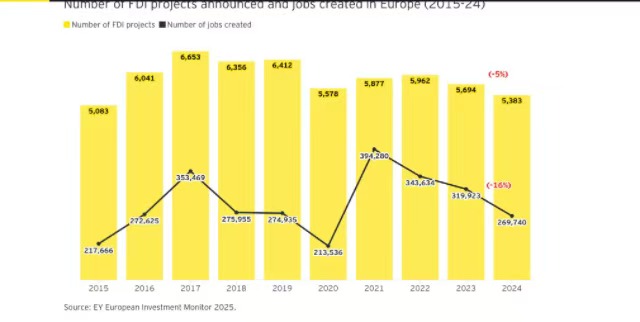
美国对欧FDI创近10年新低,欧洲缘何在特朗普重返白宫前就被美国投资者冷落?
Di Yi Cai Jing· 2025-05-16 04:08
Core Insights - The report indicates that foreign direct investment (FDI) in Europe is unlikely to recover immediately, with a significant decline in investment projects from the US [1][6] - In 2024, European FDI is projected to drop to a nine-year low, with a 5% decrease in projects and a 16% reduction in jobs created [1][3] FDI Trends in Major European Countries - France remains the top destination for foreign investment in Europe, despite a 14% decrease in project numbers; the country is becoming a key hub for AI investment [1][3] - The UK experienced a 13% decline in FDI projects in 2024, shifting focus towards high-quality projects and significant growth in R&D investment by 32% [5][6] - Germany's FDI is primarily driven by expansion projects, with a 17% decrease in project numbers; Asian investors continue to play a crucial role [5][6] Regional Performance - Spain saw a notable increase in FDI projects, with a 15% rise, making it the fourth-largest destination for foreign investment in Europe [5][6] - Other countries with significant FDI growth include Denmark (86%), Austria (31%), and Switzerland (25%), driven by increased business services and marketing projects [5][6] Manufacturing and Sectoral Insights - FDI in the manufacturing sector in Europe declined by 9%, reaching the lowest level of new projects since 2020, with a 25% reduction in jobs created [6][7] - The software and IT services sector, traditionally the largest for foreign FDI, saw a 17% decline, attributed to tightened outsourcing budgets [6][7] Investor Sentiment and Future Outlook - 37% of surveyed companies have reduced their investment plans in Europe, with a drop in the percentage of companies intending to invest in Europe over the next 12 months from 72% to 59% [6][7] - Despite current challenges, 61% of respondents still expect improvements in European FDI over the next three years, with potential growth areas identified in renewable energy, semiconductors, pharmaceuticals, AI, and electric vehicles [8][9]

SKInnovation2025Q1电池业务实现营收1.61万亿韩元,该业务营业亏损2993亿韩元
HUAXI Securities· 2025-05-05 08:17
Investment Rating - The report recommends the industry [6] Core Insights - The overall revenue for the company in Q1 2025 reached 21.15 trillion KRW (114.21 billion RMB), marking the highest quarterly revenue in 10 quarters, driven by the inclusion of SK Innovation E&S performance [1][19] - Despite improvements in the battery business, the company faced operating losses due to declining refining profit margins and falling international oil prices [1][19] Financial Performance Summary Q1 2025 Overall Performance - The company reported an operating loss of 446 billion KRW (24.1 million RMB) in Q1 2025 [1][19] Business Segment Performance 1. **Refining Business** - Revenue: 11.92 trillion KRW (643.68 million RMB); Operating profit: 363 billion KRW (19.6 million RMB) [4][19] - Operating profit decreased by 306.1 billion KRW (16.53 million RMB) compared to the previous quarter due to global economic slowdown concerns and OPEC+ production cuts [4] 2. **Petrochemical Business** - Revenue: 2.48 trillion KRW (133.92 million RMB); Operating loss: 1.14 trillion KRW (61.7 million RMB) [5][19] - Continued operating losses due to weak demand for paraxylene (PX) and olefin products [5] 3. **Lubricants Business** - Revenue: 972.2 billion KRW (52.50 million RMB); Operating profit: 121.4 billion KRW (6.56 million RMB) [7][19] - Operating profit decreased by 18.1 billion KRW (977.4 thousand RMB) due to economic slowdown impacts [7] 4. **Exploration & Production (E&P) Business** - Revenue: 383.1 billion KRW (20.69 million RMB); Operating profit: 120.4 billion KRW (6.50 million RMB) [8][19] - Slight revenue growth, but operating profit decreased by 25.4 billion KRW (1.37 million RMB) due to declining sales in Peru [8] 5. **Battery Business** - Revenue: 1.61 trillion KRW (86.94 million RMB); Operating loss: 299.3 billion KRW (16.16 million RMB) [9][19] - Revenue growth driven by increased sales in North America, with operating profit improving by 60.1 billion KRW (3.25 million RMB) compared to the previous quarter [9] 6. **Materials Business** - Revenue: 238 billion KRW (1.29 million RMB); Operating loss: 548 billion KRW (2.96 million RMB) [10][19] - Operating profit increased by 19.3 billion KRW (1.04 million RMB) due to sales growth and reduced one-time costs [10] 7. **SK Innovation E&S** - Revenue: 3.75 trillion KRW (202.5 million RMB); Operating profit: 1.93 trillion KRW (10.43 million RMB) [11][19] - Operating profit increased by 78.9 billion KRW (4.26 million RMB) due to increased urban gas sales driven by winter heating demand [11] Q2 2025 Outlook 1. **Refining Business** - Expected gradual improvement in refining profit margins due to seasonal demand factors [12] 2. **Petrochemical Business** - Anticipated improvement in aromatics spreads due to reduced regional PX supply and new PTA facilities coming online [13] 3. **Lubricants Business** - Expected to maintain stable profitability due to strong demand for high-quality base oils [14] 4. **Exploration & Production Business** - Ongoing discussions for drilling more production wells following successful drilling operations [16] 5. **Battery Business** - Anticipated continued growth in North American sales driven by electric vehicle battery demand [17] 6. **Materials Business** - Expected significant sales growth due to increased sales to major customers and new product launches [17] 7. **SK Innovation E&S** - Plans to ensure stable and competitive LNG supply through various channels [18]
AES(AES) - 2025 Q1 - Earnings Call Transcript
2025-05-02 15:02
Financial Data and Key Metrics Changes - The company reported adjusted EBITDA of $591 million for Q1 2025, a decrease from $640 million in the same quarter last year, which was anticipated due to prior year revenues from the accelerated monetization of the Warrior Run PPA and the sale of AES Brazil [22][23] - Adjusted EPS for the quarter was $0.27, down from $0.50 year-over-year, also in line with expectations [23] Business Line Data and Key Metrics Changes - The Renewables segment saw a 45% year-over-year increase in EBITDA, driven by contributions from new projects and the inclusion of renewables in Chile, previously part of the Energy Infrastructure segment [24][25] - The Utilities segment experienced higher adjusted PTC, primarily due to tax attributes from the Pike County Energy Storage Project and new rates implemented in Indiana [26] Market Data and Key Metrics Changes - The company has a backlog of 11.7 gigawatts, with significant contributions expected from new projects, including a 1 gigawatt solar plus storage project contracted with Amazon [6][9] - The company is well-positioned against potential tariff impacts, with 80% of its backlog scheduled to come online between 2025 and 2027 having zero exposure to tariffs [10][11] Company Strategy and Development Direction - The company reaffirmed its 2025 guidance and long-term growth rate targets, emphasizing a focus on long-term contracted generation and growth in U.S. regulated utilities [5][33] - The company is executing the largest investment program in the history of AES Indiana and AES Ohio, with plans to invest approximately $1.4 billion this year [19][20] Management's Comments on Operating Environment and Future Outlook - Management expressed confidence in the resilience of the business model, highlighting that two-thirds of EBITDA comes from long-term contracted generation, which is not tied to underlying demand conditions [17][32] - The company anticipates strong demand from corporate customers, particularly data centers, and expects to meet its financial metrics despite economic uncertainties [7][33] Other Important Information - The company achieved its asset sale proceeds target for the year with the sale of a minority stake in its global insurance company for $450 million [6][18] - The company has successfully completed all financings needed to address its 2025 debt maturities and has hedged 100% of its benchmark interest rate exposure through 2027 [31] Q&A Session Summary Question: Impact of the insurance transaction on EBITDA - Management expects the EBITDA impact from the insurance transaction to be in the range of $25 million to $30 million, viewing it as a low-cost equity financing that supports growth [40][41] Question: Clarification on tariff exposure - Management clarified that the majority of tariff exposure is limited to a small quantity of batteries imported from Korea, with active measures in place to mitigate this exposure [48][50] Question: Status of asset sale targets - The company is close to achieving its $3.5 billion asset sale target, with ongoing discussions about potential sales in its thermal portfolio and other assets [93][96] Question: Renewable demand trends - Management noted continued strong demand from data center customers, with no significant pull forward in contracts due to potential IRA changes [71][73] Question: Future plans for AES Ohio - The recent legislation is seen as net positive for AES Ohio, allowing for a more constructive regulatory framework and eliminating regulatory lags [120]

减肥药“折戟”降本力度“救场”,辉瑞(PFE.US)Q1利润超预期但营收下滑
智通财经网· 2025-04-29 12:47
Core Viewpoint - Pfizer's Q1 earnings report shows a decline in overall revenue despite cost-cutting measures and better-than-expected profits, primarily due to setbacks in its weight-loss drug development and decreased revenue from COVID-related products [1][2]. Group 1: Financial Performance - Pfizer reported Q1 revenue of $13.72 billion, an 8% year-over-year decline, falling short of the analyst consensus of $13.91 billion [1]. - The company's net profit for Q1 was $2.97 billion, or $0.52 per share, compared to $3.12 billion, or $0.55 per share, in the same period last year; adjusted EPS was $0.92, exceeding the average analyst estimate of $0.66 [1]. - Pfizer maintains its full-year 2025 revenue outlook between $61 billion and $64 billion, with adjusted EPS expectations of $2.80 to $3.00, despite external pressures from potential tariffs on imported drugs [4]. Group 2: Cost-Cutting Initiatives - Following the failure of its weight-loss drug Danuglipron, Pfizer is expanding its cost-cutting plans, aiming for an additional $1.2 billion in savings by the end of 2027, primarily from reductions in sales, information, and administrative expenses [2]. - The company previously announced a cost-cutting plan targeting $4.5 billion in net savings by the end of 2025, with an additional $500 million expected to be saved through research and organizational restructuring by the end of 2026 [2][3]. - Pfizer's independent multi-year cost reduction plan aims to save $1.5 billion by the end of 2027, helping the company recover from the rapid decline in COVID-related business and stock price [3]. Group 3: Market Outlook and Challenges - Pfizer's decision to abandon the development of Danuglipron has led to adjustments in market forecasts for weight-loss drugs, with Goldman Sachs removing Pfizer's projections for the drug from their models, previously estimating sales of $1.2 billion and $1.9 billion for 2030 and 2035, respectively [1]. - The company anticipates that the Inflation Reduction Act will reduce its sales by $1 billion, with a projected growth rate decrease of approximately 1.6% compared to 2024 [4]. - CEO Albert Bourla expressed confidence in the company's ability to adapt to uncertain external conditions, emphasizing the inherent strengths of its business [4].
