银行业反内卷

Search documents
银行业“反内卷”持续升级,浙粤等地新规直击返佣抢单乱象
Di Yi Cai Jing Zi Xun· 2025-08-05 12:43
Core Viewpoint - The banking industry is undergoing a "de-involution" movement aimed at curbing "involution-style" competition, which has led to irrational practices such as commission payments to real estate companies and intermediaries [1][2][4] Group 1: Regulatory Actions - The Zhejiang Provincial Banking Association has issued a self-regulatory convention prohibiting commission payments to real estate firms and intermediaries, targeting practices like "commission grabbing" and "dark box operations" [1][2] - Other regions, including Guangdong and Ningxia, have also taken similar actions to promote rational development in the banking sector [2] Group 2: Nature of "Involution" Competition - "Involution-style" competition refers to low-level homogenized competition in a saturated market, characterized by blind expansion, price wars, and excessive marketing [2][4] - Practices such as "commission grabbing" involve banks paying commissions to intermediaries based on loan amounts, which are often hidden from regulatory scrutiny [2][3] - "Dark box operations" occur when banks bypass public regulations to provide undue benefits to specific clients or partners, often through undisclosed agreements [3][4] Group 3: Impact on the Banking Sector - The "involution" phenomenon has led to adverse effects at various levels: micro-level issues include "bad money driving out good," while macro-level issues involve distorted resource allocation and suppressed economic vitality [4][6] - Factors contributing to the persistence of "involution" include a significant decline in net interest margins, increased pressure on banks to stabilize income and profits, and a performance evaluation system that emphasizes scale and speed [4][5] Group 4: Risks and Consequences - "Commission grabbing" distorts mortgage rate pricing, leading to higher overall financing costs for borrowers, as intermediaries may pass on hidden costs [6] - The practice can also trigger malicious competition, where intermediaries select partners based on commission rates, ultimately increasing operational costs for banks and affecting consumer interests [6][7] Group 5: Future Directions - To address the "involution" issue, industry experts suggest establishing a three-dimensional governance framework that includes regulatory guidance, industry collaboration, and institutional transformation [7] - The transition from a focus on scale to value creation is essential for reshaping a healthy banking ecosystem, although it may involve short-term challenges such as customer loss and performance declines [7]
【发展之道】 银行业反内卷须杜绝“规模情结”“速度情结”
Zheng Quan Shi Bao· 2025-07-31 18:24
Core Viewpoint - The banking industry is urged to combat "involution" by adhering to self-regulatory mechanisms, implementing relevant interest rate policies, and establishing reasonable incentive structures to promote rational and healthy competition, ultimately serving economic and social development better [1] Group 1: Manifestations of "Involution" in Banking - "Involution" in the banking sector is primarily reflected in high-interest deposit acquisition and low-interest lending, with some banks still using high-interest rates to attract deposits despite regulatory measures [2] - High commissions are offered by banks to stabilize market share or attract customers, disrupting normal market order [2] - Banks exhibit "window dressing" behaviors at month-end or quarter-end to meet specific operational targets, often through practices like "buying deposits" [2] - Some banks relax risk control requirements to expand market reach, leading to ineffective credit risk management [2] Group 2: Factors Contributing to "Involution" - Global economic pressures are impacting growth, leading to a low-interest environment that compresses net interest margins for banks [3] - The significant decline in net interest margins and the homogeneity of financial services compel banks to engage in price wars for market competition [3] - Some banks are driven by a "scale obsession" and "speed obsession," with performance evaluation mechanisms focusing on business scale and growth rates, prompting employees to use low prices and high commissions to attract clients [3] - Increased sensitivity of enterprises and individuals to interest rate changes, coupled with high substitutability of financial services, makes price a crucial decision factor, further driving "involution" [3] Group 3: Negative Impacts of "Involution" - "Involution" reduces asset yield for banks and increases liability costs, intensifying downward pressure on net interest margins, which is detrimental to sustainable development and service to the economy [4] - The homogeneity of competition fails to meet the personalized financial service needs of clients, while the "quantity for price" model can lead to funds flowing into arbitrage areas, hindering effective fund utilization [4] - Inadequate credit risk management in lending can accumulate risks, increasing instability in economic development [4] - Distorted performance evaluation mechanisms place unnecessary pressure on employees, leading to potential violations [4] Group 4: Measures to Address "Involution" - The banking industry must correct its development philosophy, operate in compliance with laws, eliminate "scale obsession" and "speed obsession," and maintain good market competition order [5] - Banks should enhance research efforts and innovation capabilities to provide high-quality financial services tailored to various entities [5] - Regulatory bodies need to enforce strict oversight, establish a negative list for "involution" competition, and address price wars through timely inspections and penalties [5] - The banking association and market interest rate pricing self-regulatory mechanisms should be effectively utilized to promote healthy market competition through industry consensus [5] - Strengthening external supervision is essential to guide market participants in monitoring banking financial services and competition [5]
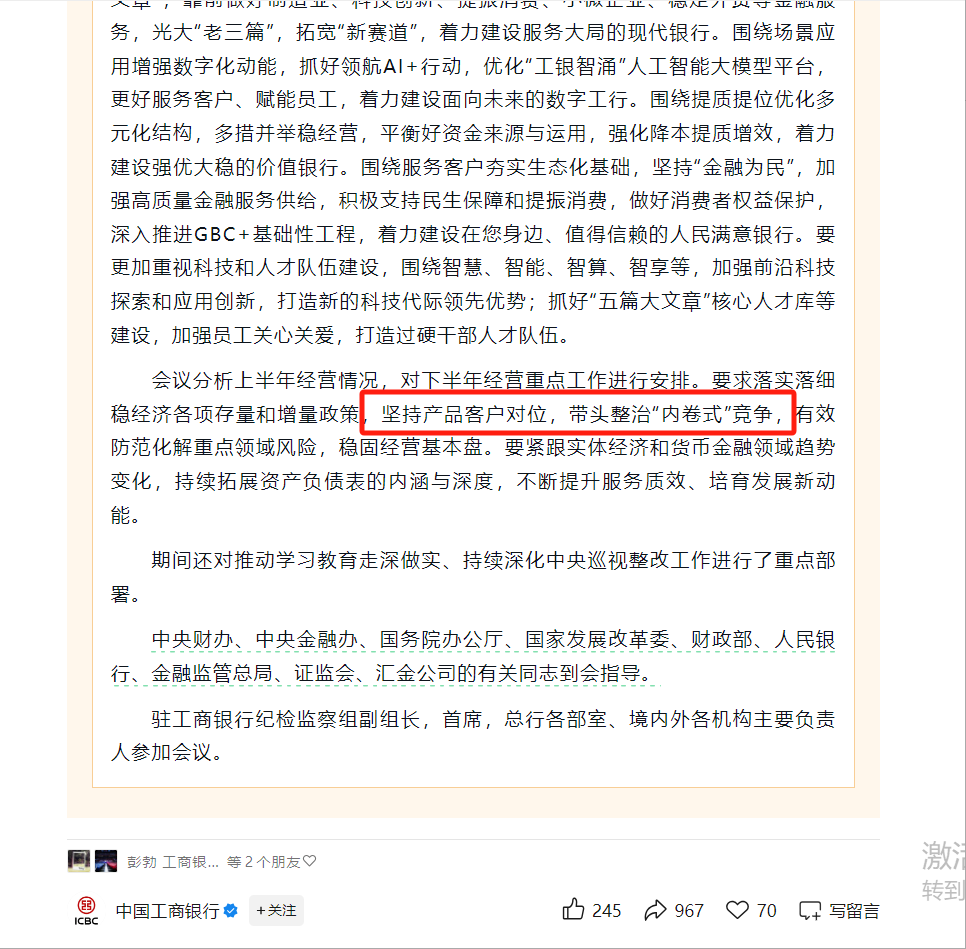
工行,带头整治“内卷式”竞争
财联社· 2025-07-31 15:41
Core Viewpoint - The article discusses the ongoing "anti-involution" measures in the banking industry, emphasizing the need for improved market competition and the regulation of chaotic competition among enterprises [2][3]. Group 1: Industry Trends - The anti-involution actions in the banking sector are expanding both regionally and across different industries, with major banks like ICBC taking the lead in addressing this issue [3]. - A significant factor contributing to the internal competition in the banking sector is the insufficient effective credit demand, leading banks to compete aggressively for high-quality clients [4][5]. - The People's Bank of China (PBOC) has noted that severe internal competition is affecting the effectiveness of monetary policy, with loan rates declining faster than deposit rates [5][10]. Group 2: Causes of Involution - The internal competition in the banking industry is driven by several objective factors, including economic adjustments and increased competition from non-bank financial institutions [3][5]. - The decline in consumer borrowing and the resulting lower interest rates on loans are indicative of the industry's struggle to maintain profitability amidst heightened competition [5][10]. Group 3: Regulatory Responses - Various regional banking associations are implementing self-regulatory agreements to combat internal competition, focusing on retail banking while also addressing corporate banking practices [6][7]. - The effectiveness of these self-regulatory measures may be limited if they are not supported by national policies and regulatory oversight [8][9]. Group 4: Future Outlook - The ongoing anti-involution efforts are seen as necessary for the long-term health of the banking sector, as excessive competition can undermine profitability and hinder talent attraction [9][10]. - The current environment presents both challenges and opportunities for smaller banks, prompting them to consider restructuring and focusing on niche markets [12].



工商银行公开表态带头整治“内卷式”竞争 银行业“反内卷”号角吹响?
Mei Ri Jing Ji Xin Wen· 2025-07-31 14:22
Core Viewpoint - The Industrial and Commercial Bank of China (ICBC) has publicly committed to addressing "involution" in the banking sector, which has sparked significant reactions within the industry [2][5]. Group 1: ICBC's Meeting and Policy Statements - ICBC held a mid-year operational management meeting emphasizing the need to implement economic policies and prevent risks in key areas while addressing "involution" in competition [1]. - The bank's leadership has called for a focus on aligning products with customer needs and stabilizing the operational foundation of the bank [1]. Group 2: Industry Reactions and Initiatives - The call to combat "involution" has resonated across the banking industry, with other banks also taking steps to mitigate harmful competition practices [4][5]. - A recent meeting organized by the Ningbo Banking Association involved 57 banks agreeing to prevent "involution" and establish self-regulatory guidelines for personal housing loan practices [5]. Group 3: Regulatory Context and Historical Background - The issue of "involution" in the banking sector has been recognized for some time, with ICBC's president previously advocating for self-regulation and fair market practices in January [6]. - The People's Bank of China highlighted the negative impact of intense competition on interest rates in its monetary policy report, indicating a significant deviation between loan rates and policy rates from August 2019 to August 2024 [7][8].
国有大行也表态了!工行明确下半年将带头整治“内卷式竞争”,银行业反内卷正向纵深推进
Xin Lang Cai Jing· 2025-07-31 08:17
Core Viewpoint - The Chinese banking industry is undergoing a significant shift towards reducing "involution" in competition, as emphasized by recent government meetings and actions from major banks [1][2][3]. Group 1: Regulatory Actions and Industry Response - The Central Political Bureau meeting highlighted the need to optimize market competition and regulate disorderly competition in the banking sector [1]. - Following Guangdong's initiative against involution, other regional banking associations are beginning to adopt similar self-regulatory measures [1][5]. - The Industrial and Commercial Bank of China has made combating involution a key focus for the second half of the year, marking a significant step among state-owned banks [1][3]. Group 2: Causes of Involution - A banking official noted that the excessive supply of funds without good outlets has led banks to compete for loans, resulting in price involution [2]. - Factors contributing to the banking industry's involution include economic adjustments affecting traditional business sectors, intensified competition from peers and non-bank financial institutions, and reduced salaries impacting frontline employees [2][4]. - The decline in effective credit demand is directly linked to the involution observed in the banking sector [3][4]. Group 3: Impact on Credit and Monetary Policy - The core issue of involution is attributed to insufficient effective credit demand, leading to lower interest rates for high-quality credit clients [4]. - The People's Bank of China has indicated that severe involution is affecting the effectiveness of monetary policy, with deposit rates unable to decrease while loan rates are falling rapidly [4][10]. - The average loan interest rate has decreased by 1.9 percentage points from 2019 to 2024, while the average deposit rate has only dropped by 0.5 percentage points, highlighting the disparity caused by involution [4]. Group 4: Self-Regulation and Future Outlook - Recent self-regulatory agreements focus primarily on retail banking, while previous efforts in corporate banking have already begun to address involution [5][6]. - The effectiveness of self-regulatory measures is under scrutiny, with concerns that local initiatives may lack the strength of national policies [7][9]. - The banking sector is encouraged to pursue transformation and consolidation opportunities as a response to the pressures of involution, potentially leading to new business models [11].
银行业“反内卷”破局
Jing Ji Wang· 2025-07-31 06:32
Core Viewpoint - The banking industry is facing intense competition characterized by price wars and a struggle for quality customers, leading to a phenomenon known as "involution" which is detrimental to long-term profitability and resource allocation efficiency [1][2][3]. Group 1: Industry Challenges - The banking sector is experiencing a downward trend in loan interest rates, with some banks offering rates as low as 2.5% for business loans, leading to a competitive environment where banks are forced to lower rates to retain customers [2][3]. - The net interest margin for banks has dropped to 1.43% in the first quarter, indicating shrinking profit margins due to intense competition and price wars [3]. - The internal competition has led to a "prisoner's dilemma" where banks are aware that price wars harm overall industry profits but feel compelled to follow suit to avoid losing market share [4][5]. Group 2: Recommendations for Improvement - Experts suggest that financial management departments should implement strong measures to create a multi-tiered, widely covered, and differentiated financial institution system to better serve various customer groups [1][6]. - There is a call for a shift in performance evaluation from a scale-oriented approach to one focused on quality and efficiency, incorporating risk-adjusted returns and customer value contributions into assessment criteria [6][7]. - The restructuring of business models is recommended, moving from a scale-driven to a value-driven approach, emphasizing the profitability of individual customers and reducing reliance on single credit products [6][7].
银行业“反内卷”:突围之困与破局之路
Shang Hai Zheng Quan Bao· 2025-07-30 18:03
Core Viewpoint - The banking industry is facing intense competition characterized by price wars and a struggle for quality customers, leading to a common dilemma of "involution" that requires a systemic approach to break free and achieve high-quality development [3][4][6]. Group 1: Involution Challenges - The competition for quality customers has intensified, with some banks offering consumer loan rates as low as 2.6% earlier this year, only to see rates rise above 3% by April, and then drop again to around 2.5% for business loans in July [4][5]. - Many banks are resorting to high-interest deposit strategies at the end of assessment periods to attract customers, leading to a significant decline in net interest margins, which fell to 1.43% in the first quarter [5]. - The internal competition is exacerbated by a "prisoner's dilemma," where banks are aware that price wars harm overall industry interests but feel compelled to follow suit to avoid losing market share [6][7]. Group 2: Recommendations for Improvement - Experts suggest that financial management departments should implement strong measures to create a multi-layered, widely covered, and differentiated financial institution system, allowing institutions to provide tailored products and services based on market and customer needs [2][8]. - There is a call for a shift in performance assessment from a scale-oriented approach to one focused on quality and efficiency, incorporating risk-adjusted returns and customer value contributions into evaluation systems [8][9]. - The restructuring of business models is recommended, moving from scale-driven to value-driven strategies, emphasizing the profitability of individual clients and reducing reliance on single credit products [9].

多地银行业出台“反内卷”措施
第一财经· 2025-07-29 14:45
Core Viewpoint - The article discusses the rising issue of "involution" in the banking industry, highlighting how irrational competition is driving up operational costs and eroding industry profits, leading to a call for self-regulation and measures to combat this trend [1][2]. Group 1: Industry Response to Involution - Various banking associations across China are taking a stand against "involution" by implementing self-regulatory measures, such as the "Self-Regulatory Convention for Personal Housing Loan Business" in Ningbo, which aims to curb rebate practices and promote fair competition [1][2]. - The Guangdong Banking Association has initiated a comprehensive rectification plan against "involution," establishing a regulatory framework that includes a negative list of practices and self-regulatory agreements [2][3]. - The Ningxia Banking Association has introduced a four-step governance mechanism to restore compliance and innovation in the banking sector, focusing on market order and sustainable development [2][3]. Group 2: Consequences of Involution - Short-term gains from violating regulations and lowering standards can lead to market share increases for some institutions, but ultimately these practices deplete industry profits and compromise service quality [3]. - Long-term effects of "involution" include weakened risk management and potential systemic risks, threatening the sustainable development of the banking industry [3]. - The need for enhanced self-regulation and differentiation in services is emphasized, with calls for major commercial banks to lead by example and avoid price wars [3].