
零工市场

Search documents
积石山1.6万名安置点群众实现就业
Xin Lang Cai Jing· 2025-12-21 02:12
Core Insights - The article highlights the successful employment initiatives in Jishishan County, where 16,000 individuals from resettlement points have secured jobs through various methods, ensuring their stability and potential for wealth creation [1][2]. Employment Initiatives - Jishishan County has established a comprehensive employment service system, referred to as "1+16," which includes one labor market and 16 labor stations, facilitating job placements for the resettled population [1]. - A total of 46 recruitment events have been conducted, offering 8,754 job positions and achieving flexible employment for 8,247 individuals [1]. Training and Skill Development - Targeted training programs have been implemented for resettled individuals, covering practical skills such as Chinese pastry making, domestic services, and agricultural work, with 15 training sessions completed and 630 participants trained [2]. - Post-training, 289 individuals found employment, resulting in an employment rate of 46% [2]. Labor Transfer and Employment Support - The county has successfully transferred 9,981 surplus laborers to various industries, including mining, manufacturing, construction, services, and building materials, contributing to stable income growth [2]. - Local employment factories have absorbed 759 individuals, with an average monthly income increase of 2,200 yuan [2]. Public Welfare Positions - Jishishan County has developed 781 public welfare positions aimed at providing stable employment for vulnerable groups, prioritizing those unable to work outside or lacking fixed income [2].
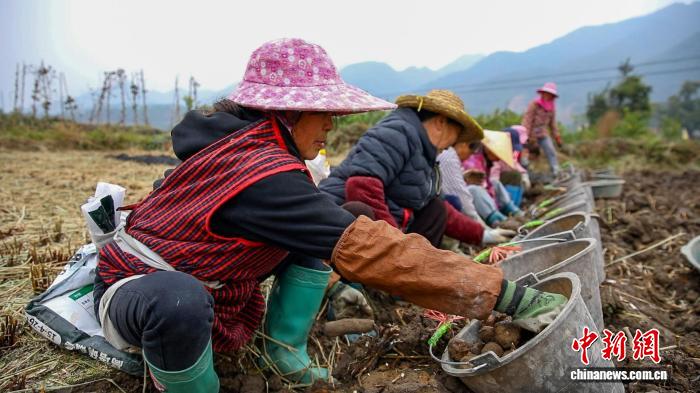
湖南江永12支“农闲务工队” 上岗 破解用工荒
Zhong Guo Xin Wen Wang· 2025-12-18 00:17
Core Insights - The establishment of "off-season labor teams" in Jiangyong County, Hunan, addresses the seasonal labor shortage in agriculture while providing villagers with continuous income opportunities during the off-season [1][4]. Group 1: Labor Teams and Their Impact - Jiangyong County has formed 12 "off-season labor teams" that have absorbed over 1,000 local laborers, effectively solving the labor shortage in agricultural production [4]. - Team members, primarily middle-aged and elderly individuals, earn around 100 yuan per day, translating to an annual income of 20,000 to 30,000 yuan, while also being able to care for their families [2][4]. Group 2: Operational Mechanisms - The county utilizes a "zero labor market" and "Le Ye Xiaozhan" to integrate labor demands from large-scale growers and agricultural enterprises, creating a dynamic job database that publishes information both online and offline [2]. - A mechanism for precise demand matching and scientific scheduling of personnel has been established, coordinating labor across regions based on crop maturity schedules [2].

“退而不休”,零工市场的超龄困境
Hu Xiu· 2025-08-29 09:17
Core Viewpoint - The article highlights the precarious living conditions of older female migrant workers in rural areas, emphasizing their struggles in the gig economy and the systemic issues that perpetuate their vulnerability [2][22]. Group 1: Vulnerability of Older Female Workers - In rural areas, older female workers from the "60s" and "70s" generations dominate the gig economy, driven by economic pressures rather than choice [4][5]. - The economic burden of children's education, marriage, and housing costs forces these women to continue working despite the risks involved [5][6]. - Agricultural income is insufficient, with annual earnings from a single acre of rice or wheat barely exceeding 1,000 yuan, compelling them to seek additional work [7]. Group 2: Economic Contributions and Living Conditions - Women's economic contributions are often overlooked, as their earnings primarily support daily household expenses, making them essential to family survival [8]. - Many older female workers live frugally, spending very little on personal items, and their income is largely sent back home [9]. - Despite the challenges, having a job provides them with a sense of agency and improved status within their families and communities [9]. Group 3: Labor Rights and Safety Issues - The gig work that older female workers engage in is often informal, lacking labor contracts, social security, and legal protections, which poses significant safety risks [10][11]. - The recruitment process relies on informal networks, increasing transportation risks, as evidenced by tragic accidents involving workers [11]. - In contrast, labor conditions in coastal regions have improved significantly due to historical events that prompted regulatory changes, leaving the central and western regions lagging behind [12][13]. Group 4: Challenges for New Generation Migrant Workers - The new generation of migrant workers faces distinct challenges, including emotional trauma from family separation and limited career advancement opportunities [18][19]. - Many young workers are drawn into low-end service industries, which offer less stability and lower social security coverage compared to traditional manufacturing jobs [18]. - The educational and housing pressures on the children of migrant workers create a cycle of economic strain, as families invest in education while struggling to afford housing [19][20]. Group 5: Call for Systemic Change - The article advocates for the urgent need to standardize labor practices in the central and western regions, improve social security and healthcare systems for migrant workers, and enhance rural education and pension resources [23].
山西省首家建筑业零工市场揭牌
Zhong Guo Chan Ye Jing Ji Xin Xi Wang· 2025-08-27 07:32
Core Viewpoint - The establishment of the Taiyuan Construction Industry Gig Market marks the first specialized gig market in Shanxi province, aimed at providing professional, standardized, and intelligent services for construction workers and flexible employment groups [1] Group 1: Market Overview - The Taiyuan Construction Industry Gig Market integrates various services including business reception, recruitment discussions, skills training, certification examination, and employment recommendations, creating a comprehensive service system [1] - The market serves as a practical platform for government public employment services, fostering a positive interaction model of "government guidance, enterprise implementation, and social benefits" [1] Group 2: Operational Model - The market operates on an "online + offline" integrated model, connecting with the Taiyuan Municipal Human Resources and Social Security Bureau service system to eliminate spatial and temporal limitations, making job seeking and recruitment more convenient [1] - Offline services include business reception, recruitment discussions, and skills training, ensuring precise and efficient service delivery [1] Group 3: Employment Support - The seamless connection between skills training and employment services aims to assist gig workers in achieving high-quality employment [1]