非禁即入

Search documents
经济观察|负面清单持续“瘦身”激活中国市场
Zhong Guo Xin Wen Wang· 2025-04-24 07:24
Core Viewpoint - The continuous reduction of the negative list for market access in China reflects a commitment to creating a more open and competitive market environment, benefiting various types of enterprises, especially private ones [1][2][3]. Group 1: Market Access Reforms - The negative list for market access has been significantly reduced from 151 items in 2018 to 106 items currently, indicating a more streamlined approach to market entry [1]. - The "non-prohibited, just enter" principle allows all types of enterprises, including state-owned, private, large, and small businesses, to enter the market equally, enhancing market efficiency [1][2]. - The latest version of the negative list (2025) has removed several national measures and relaxed some local restrictions, further promoting market access [1]. Group 2: Impact on Private Enterprises - The ongoing reduction of the negative list has directly benefited private enterprises, allowing them to participate more actively in key sectors such as energy, railways, and telecommunications [3]. - The successful operation of the first privately-held high-speed railway and the launch of privately-funded nuclear power projects signify breakthroughs for private enterprises in competitive industries [3]. Group 3: Adaptation to New Market Dynamics - The emergence of new business models and rapid technological advancements necessitate a flexible and resilient market access management approach, moving away from traditional administrative approval methods [3][4]. - The government plans to focus on strategic emerging industries and key areas for pilot projects to further relax market access, aiming to refine and optimize the negative list [4]. - Scene-based innovation is expected to be a highlight in the next phase of market access reform, aiming to reshape technology innovation models and create new market entry rules [4].
市场准入再放宽!这些新业态被纳入
券商中国· 2025-04-24 04:25
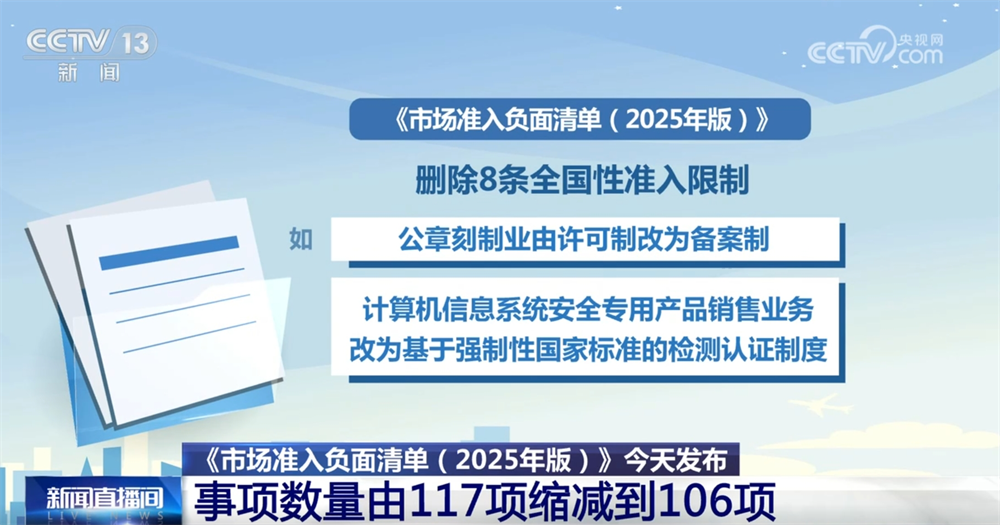
Core Viewpoint - The release of the "Market Access Negative List (2025 Edition)" indicates a significant reduction in restrictions, promoting a more open market environment and enhancing economic development [1][3][8]. Summary by Sections Reduction of Restrictions - The number of items in the new negative list has decreased from 117 to 106, with national specific management measures reduced from 486 to 469, and local management measures from 36 to 20 [1]. - Since the first edition in 2018, the total number of items has been cut from 151 to 106, representing a reduction of approximately 30% [2]. Enhanced Market Access - The new list has removed 8 national measures, such as changing the public seal engraving industry from a licensing system to a filing system, and reforming the sales of computer information system security products to a testing and certification system based on mandatory national standards [3]. - Additionally, 17 local measures have been deleted, covering areas like transportation logistics and vehicle rental services [4]. New Regulations for Emerging Industries - The updated list introduces new measures for emerging sectors, including unmanned aerial vehicles and electronic cigarettes, ensuring regulatory compliance in these areas [5]. - For instance, the operation qualification certificate for civil unmanned aerial vehicles is now included in the list, and electronic cigarette production and sales require specific approvals [5]. Focus on Safety and Compliance - The new list emphasizes maintaining safety in critical areas such as finance and production, with specific regulations to prevent unauthorized use of terms related to futures companies [5]. - This approach aims to balance high-level safety with quality development, ensuring that legitimate rights are protected while fostering growth [6]. Market Access Barrier Cleanup - The three departments will jointly conduct actions to clear market access barriers, aiming to eliminate unreasonable regulations and practices that hinder market entry [8]. - The "non-prohibition means entry" management model is highlighted as a significant reform that reduces institutional transaction costs for businesses [8].


缩减至106项,市场准入负面清单2025年版来了
Di Yi Cai Jing· 2025-04-24 02:52
Core Viewpoint - The National Development and Reform Commission (NDRC) and other departments have released the "Market Access Negative List (2025 Edition)", reducing the number of items from 117 in the 2022 version to 106, indicating a further relaxation of market access restrictions and optimization of market access management [1][2]. Group 1: Market Access Changes - The number of items in the negative list has been reduced from 151 in the 2018 version to 106 in the current version, representing a reduction of approximately 30% [1]. - The 2025 version reflects the results of legal and regulatory reforms, with national management measures decreasing from 486 to 469 and local management measures from 36 to 20 [2]. - A number of national measures have been removed, such as changing the licensing system for the seal engraving industry to a filing system [2][3]. Group 2: New Measures and Areas - The 2025 version includes new management measures for emerging industries, such as the operation certification for civil unmanned aerial vehicles and regulations for e-cigarettes and new tobacco products [3]. - Several national measures have been relaxed, including the establishment of drug wholesale and retail enterprises and the management of medical institutions using radioactive drugs [3]. Group 3: Risk Management and Compliance - The 2025 version strengthens risk prevention in key areas, clarifying that non-financial institutions must not illegally use the term "futures company" [4]. - The NDRC, Ministry of Commerce, and State Administration for Market Regulation will conduct actions to clear and rectify market access barriers, focusing on unreasonable regulations set by local governments [5].
新版清单为民企开拓空间按下“快进键” 越缩越短、越放越活映射出巨大潜力
Yang Shi Wang· 2025-04-24 02:51
Core Viewpoint - The newly released "Market Access Negative List (2025 Edition)" further relaxes market access restrictions in China, reducing the number of items from 117 to 106 compared to the 2022 version, indicating a more vibrant market environment [1][3][7]. Group 1: Market Access Changes - The 2025 edition of the list has removed 8 national access restrictions, such as changing the licensing system for seal engraving to a filing system and modifying the sales of computer information system security products to a mandatory national standard testing and certification system [3]. - The list has also partially relaxed 8 national measures in areas including new telecommunications business trials, TV production, and the establishment of drug wholesale and retail units [5][10]. - Since the first version of the market access negative list was introduced in 2018, the number of items has decreased from 151 to 106, a reduction of approximately 30%, while the total number of business entities has increased by over 70% [7]. Group 2: Impact on Enterprises - The new list opens up more space for private enterprises and aims to create a fairer and more open market environment, enhancing the vitality of various business entities [8][12]. - The revisions emphasize the implementation of a "non-prohibited, non-restricted" principle, ensuring that all types of business entities can enter the market equally without illegal barriers [5][12]. - The ongoing optimization of the market access environment is expected to stimulate innovation and entrepreneurship, boosting social investment confidence and contributing to stable growth and employment [12]. Group 3: Local Initiatives - In Hefei, Anhui Province, pilot projects are being conducted to explore market access policies for new business models, including the establishment of a comprehensive unmanned system [13][15]. - Hefei has built over 30 temporary take-off and landing points for flying vehicles and has become a center for advanced technology applications, fostering a conducive environment for new technology testing [15][17]. - The local government collaborates with enterprises to clarify regulations and standards, facilitating broader market participation and addressing investment hesitations [17].