
项目融资

Search documents
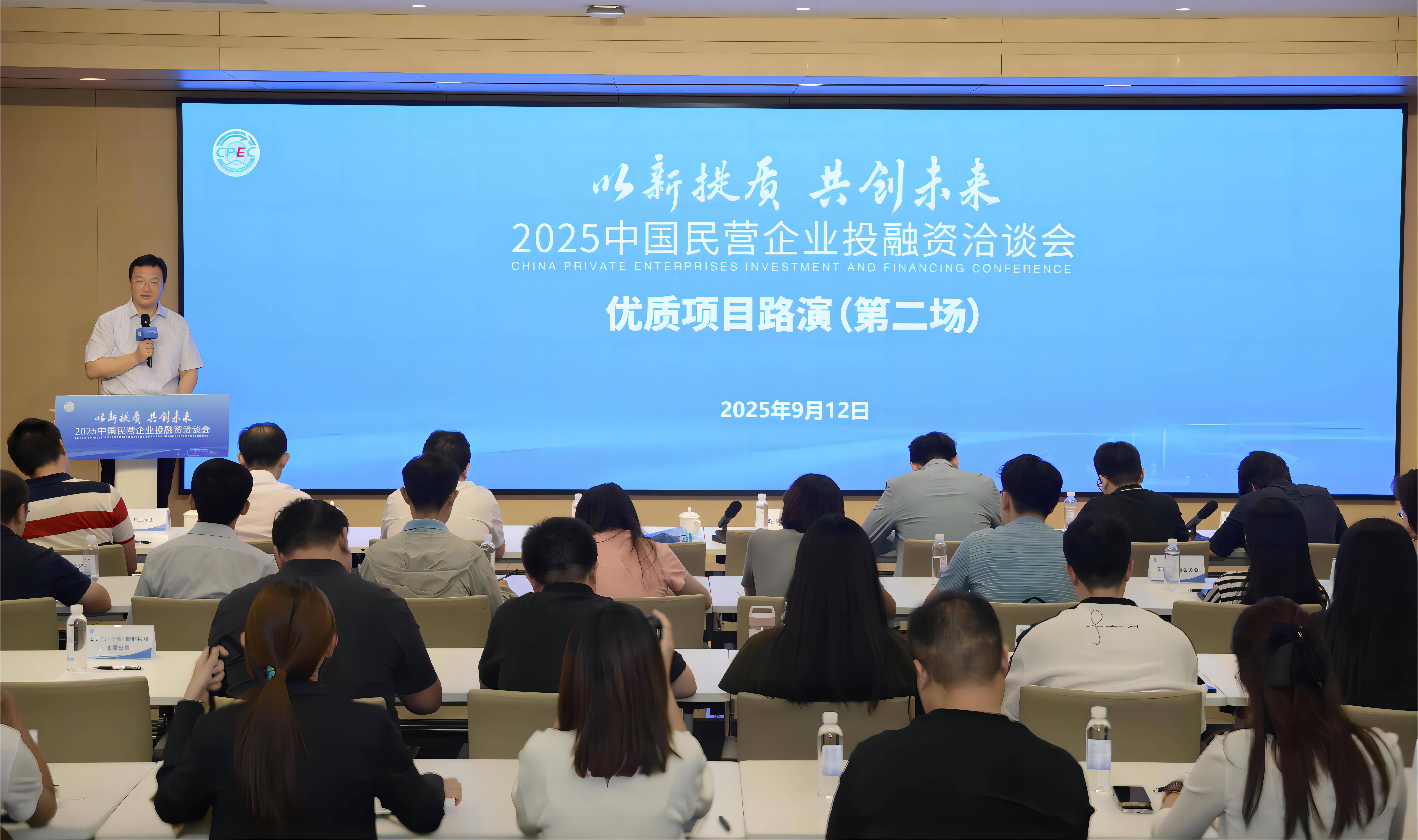
2025中国民营企业投融资洽谈会第二场优质项目路演活动在津成功举办
Sou Hu Cai Jing· 2025-09-12 12:27
Group 1 - The 2025 China Private Enterprise Investment and Financing Fair, co-hosted by the Ministry of Science and Technology and the Tianjin Municipal Government, will be held in late September in Tianjin [1] - As a key pre-event for the fair, a second high-quality project roadshow focusing on the low-altitude economy was successfully held on September 12, featuring seven innovative companies [6] - The roadshow invited 22 well-known investment institutions and 14 financial institution representatives to support and diagnose the projects, facilitating the acceleration of quality enterprises [6] Group 2 - The event effectively promoted deep integration between industry and finance, achieving efficient connections between quality projects and capital [9] - More than ten thematic roadshow activities will be launched during the fair to continuously expand financing channels for enterprises [9] - The initiative aims to build an efficient cooperation platform for innovative projects and investment institutions across various fields, fostering empowerment and collaborative development [9]

Westwater Resources(WWR) - 2025 Q2 - Earnings Call Transcript
2025-08-14 16:00
Financial Data and Key Metrics Changes - As of June 30, the company incurred approximately €124 million of the total expected €245 million cost for Phase one construction [5] - The company ended the quarter with €6.7 million in cash, which includes proceeds from a €5 million convertible note issuance in June [7] - Following the quarter, the company completed a follow-on transaction for an additional €5 million, resulting in over €12 million in cash on hand [8] Business Line Data and Key Metrics Changes - The qualification line at the Callantan graphite plant produced CSPG samples exceeding one metric ton for customer preproduction sales trials and testing [5] - Enhancements were implemented to improve cycle times and graphite flow rates, optimizing line performance [6] Market Data and Key Metrics Changes - The company is encouraged by the level of engagement from financing partners and believes the Callatin project aligns with U.S. policy priorities and growing market demand for domestic battery-grade graphite [7][10] Company Strategy and Development Direction - The company is focused on securing capital to complete the build of the Callantan graphite plant and is advancing multiple financing paths [7][10] - Long-term strategy includes vertical integration through the Coosa deposit while currently prioritizing flexibility and progress on the Callantan project [11] Management's Comments on Operating Environment and Future Outlook - Management expressed confidence in the ability to finance and produce the Callantan project, citing strong demand signals and federal policy support [12][13] - The company is committed to execution, transparency, and long-term value creation for shareholders [13] Other Important Information - The company has faced broader capital market volatility and trade policy shifts but remains optimistic about project financing and market conditions [7][10] Q&A Session Summary Question: Impact of potential interest rate cuts on financing - Management indicated that lower interest rates would be beneficial for project financing and long-term growth [17] Question: Future plans for convertible notes - Management stated that they would remain opportunistic regarding potential follow-on convertible note issuances [18] Question: Status of the project in Turkey - Management clarified that they are 100% focused on graphite and Phase one financing, with no current presence or claims in Turkey [22][24]

北京中鼎经纬实业发展有限公司项目融资与企业贷款在校园安全管理中的应用
Sou Hu Cai Jing· 2025-08-04 06:34
Group 1 - Project financing is essential for upgrading campus security management systems, such as smart access control systems and monitoring networks, through long-term loans with lower capital costs [1] - Equipment procurement loans, including installment payments or specialized loans, can alleviate upfront investment pressure for schools purchasing security equipment [1] Group 2 - Collaborating with professional security service providers can lead to comprehensive technical solutions and tailored security management services based on risk assessments [3] - Local governments in China have established special funds to support educational institutions in enhancing their security management, allowing schools to apply for such funds to reduce financial burdens [3]

日本土木工程建筑行业公司注册指南:资质要求与项目融资策略
Sou Hu Cai Jing· 2025-07-31 05:36
Core Insights - The article emphasizes the importance of understanding registration processes, qualification standards, and financing strategies for companies entering the civil engineering and construction industry in Japan [1]. Company Registration Basics - The registration process for civil engineering companies in Japan includes company establishment, industry license application, and relevant qualification certification [2]. - Companies must complete registration with relevant authorities, defining company type, business scope, and registered address before commencing operations [2]. Qualification Categories and Application Conditions - Japan's civil engineering qualifications are categorized into various levels, including construction management qualifications and specific engineering category qualifications [3]. - Companies must demonstrate financial stability with registered capital typically ranging from several million to tens of millions [3]. - A requisite number of qualified technical personnel, such as construction managers and project leaders, must be employed, with necessary qualifications obtained through professional examinations [3][5]. Project Experience and Compliance - Companies need to showcase project experience and performance, particularly in similar scale or type projects, as part of the qualification application [5]. - Compliance with safety management and environmental standards is essential to ensure adherence to industry regulations during construction [5]. Financing Strategies - Japanese civil engineering companies typically employ multi-channel financing strategies to ensure adequate project funding [6]. - Bank loans are a common financing method, requiring detailed project budgets, financial statements, and cash flow forecasts for loan applications [7]. - Companies may also consider partnerships or investors to share funding and risks, enhancing project success rates [7]. Risk Control and Management - Effective risk management is crucial due to the complexity and high investment nature of civil engineering projects [8]. - Companies should conduct thorough project risk assessments to identify potential risks and develop corresponding mitigation strategies [8]. - Strengthening contract management and ensuring compliance with safety standards are vital to minimize legal and financial risks [9][10]. Industry Development Trends and Future Outlook - The Japanese civil engineering industry is evolving towards smart and green technologies, necessitating companies to stay updated on technological advancements [11]. - Financing channels are expanding beyond traditional bank loans to include bond issuance and project financing companies [11]. - Emphasizing innovation and continuous learning will be essential for companies to adapt to industry changes and ensure sustainable growth [11]. Summary - Qualification requirements include financial stability, qualified personnel, and project experience to obtain necessary construction qualifications [12]. - The registration process involves company registration, industry license application, and qualification certification to operate legally [13]. - Financing strategies should combine bank loans, cooperative investments, and sound financial management to ensure project funding and effective risk control [14].
日美对“5500亿美元投资”说法不一:特朗普称“签约奖金”,日本“美国也得出钱”
Hua Er Jie Jian Wen· 2025-07-26 07:39
Core Points - The recent trade agreement between the US and Japan has significant interpretative discrepancies, particularly regarding the nature of a $550 billion investment plan and profit distribution [1][2] - The US claims that Japan's investment is a "signing bonus" for reducing tariffs from 25% to 15%, while Japan insists that risk and contributions must be shared [1][3] - The agreement was hastily reached during a 70-minute meeting between Japanese chief negotiator Ryosei Akazawa and President Trump, following a significant electoral loss for Japan's ruling party [2] Investment Structure Discrepancies - US Commerce Secretary Ross described the agreement as project financing, with 90% of profits going to US taxpayers and 10% to Japan, suggesting a clear financial benefit for the US [3] - Conversely, Japan's explanation indicates that part of the $550 billion investment may involve US government-owned assets, with funding supported by both countries and leased to the private sector [3] - There are ongoing discussions about the details of the plan, indicating unresolved differences between the two parties [3] Concessions and Actual Benefits - Japan made substantial concessions, such as allowing the import of US cars without additional safety tests and reforming subsidies favoring hydrogen fuel cell vehicles over electric cars [4] - Although Japan agreed to purchase more US rice, the import quota of 770,000 tons remains unchanged [4] - Analysts suggest that the agreement lacks inspiring elements, with uncertain commitments regarding the actual level of Japanese investment [4] - Overall, Japan appears to have secured a favorable deal at a minimal cost, setting a precedent for other major exporting countries [4]
Bowen Coking Coal (6NG) Conference Transcript
2025-07-23 06:50
Summary of Conference Call Industry Overview - The discussion primarily revolves around the mining and exploration industry, particularly focusing on precious metals, energy minerals, and technology minerals [2][8][10]. Key Points and Arguments 1. **Decline in Exploration Spending**: Exploration spending has decreased significantly from over $1 billion to $635 million in the last quarter, leading to fewer drilling opportunities in the marketplace [2][3]. 2. **Recent IPO Activity**: There has been a resurgence in IPOs, with five new IPOs in the current month, indicating potential growth in the market [3][4]. 3. **Permitting Challenges**: The permitting process for mining projects can take up to ten years, which can lead to a loss of market interest during this lengthy period [5][6]. 4. **Environmental and Regulatory Issues**: Duplication in state and federal regulations and environmental court challenges are seen as unnecessary hurdles that prolong project timelines [7]. 5. **Production vs. Exploration**: Only 15.6% of gold and silver explorers are in production, while the percentage is higher for energy minerals, indicating a disparity in the market [8]. 6. **Market Dynamics for Technology Minerals**: The market for technology minerals is heavily dominated by China, making it challenging for explorers to find buyers outside of this market [11][12]. 7. **Cash Reserves of Explorers**: The average cash held by explorers peaked in 2021 and has been declining, which poses a challenge for ongoing exploration projects [12][13]. 8. **Capital Raising Trends**: Capital raising has seen fluctuations but overall has declined since 2021, with smaller companies able to raise between $400 million and $600 million in sub-$10 million raisings each quarter [13]. 9. **Commodity Price Changes**: There have been significant changes in commodity prices over the last twelve months, with gold prices increasing by 41% and silver by 25%, while some other commodities like copper have seen a price increase of 26% but a decline in share prices [15][16][17]. 10. **Investment Opportunities in Gold**: Producing gold companies are highlighted as having great investment potential, especially those with low production costs [20][21]. 11. **Western Australia Mining Potential**: There are opportunities in Western Australia for small resource companies to profitably mine and process gold, although not all will succeed due to capacity constraints [22]. 12. **Market Cap Discrepancies**: The market appears to be favoring explorers over producers, which may lead to overlooked opportunities in the production sector [25]. Additional Important Insights - The average All-In Sustaining Cost (AISC) for Australian gold companies is approximately $2,300 per ounce, reflecting a 20% increase over the past year, indicative of inflation in the resource sector [21]. - The market's excitement around explorers may lead to a neglect of producers, which could present a risk for investors [25][26]. - The speaker emphasizes the importance of understanding the specific minerals involved in the mining sector, as different minerals have varying market dynamics and pricing [25]. This summary encapsulates the key insights and trends discussed in the conference call, providing a comprehensive overview of the current state and future opportunities within the mining and exploration industry.
RWA:金融服务实体经济的一场革命——从公司融资到项目融资|金融与科技
清华金融评论· 2025-07-21 09:17
Core Viewpoint - The article emphasizes that Real World Assets (RWA) are reshaping the financial services ecosystem for the real economy through blockchain technology, creating efficient and transparent financing pathways and indicating a fundamental transformation in financial service models [2][4]. Summary by Sections Definition and Connotation of RWA - RWA refers to Real World Assets, which involves the digitization and tokenization of physical assets like real estate and receivables through blockchain technology, enhancing liquidity and trading attributes of these assets [6]. Origin and Development of RWA in Finance - The development of RWA stems from traditional financial systems' exploration of risk management and asset liquidity enhancement, evolving from corporate credit-based financing to project financing that focuses on specific project cash flows and assets [7][8]. Main Types of RWA - RWA includes various types such as: - Real estate RWA, which simplifies transaction processes and broadens investment channels - Infrastructure RWA, optimizing financing and management for projects - Commodity RWA, enhancing transaction transparency and reducing costs and risks - Receivables RWA, improving corporate financing and cash flow efficiency - Intellectual property RWA, facilitating the transfer and licensing of intellectual property [9]. Differences Between RWA and Traditional Financial Models - RWA significantly differs from traditional financial models in several aspects: - Lowering entry barriers for small investors and enterprises - Ensuring information transparency through blockchain technology - Enhancing transaction efficiency via digital technology and smart contracts - Increasing asset liquidity by transforming traditional assets into digital assets for rapid global trading [10]. Current State and Challenges of Corporate Financing - Corporate financing primarily occurs through debt and equity financing, with challenges including rising costs, economic instability, information asymmetry, and limitations of traditional financing models [12][13]. Emergence and Advantages of Project Financing - Project financing, which uses specific project assets and expected revenues as collateral, has distinct advantages such as risk isolation, flexible financing structures, diversified investment attraction, improved project efficiency, and promotion of financial innovation [15][17].

关于项目融资 一些好玩的事
叫小宋 别叫总· 2025-06-05 19:12
Core Viewpoint - The article discusses the nuances of corporate financing announcements and the potential discrepancies between public relations statements and actual financial maneuvers, highlighting various common practices in the industry [1][3]. Group 1: Common Practices in Financing Announcements - A prevalent practice is the "left hand to right hand" maneuver, where the same institution transfers equity from one fund to another, often due to fund expiration without a successful exit strategy [5][6]. - Another common scenario involves relocating headquarters for financing, where multiple funds involved in a financing round share common limited partners (LPs) from the same city [6][8]. - When a fund's investment period is nearing its end, it may opt to reinvest in existing portfolio companies rather than returning capital to LPs, indicating urgency to deploy capital [9]. - The use of "+" in financing rounds (e.g., A+ round) often suggests stagnant valuations, as companies may face conditions that prevent them from raising at higher valuations [10][11]. Group 2: Potential Misleading Announcements - Instances arise where a company announces investment from a major overseas corporation that has no direct involvement or relevance to the business, often due to prior investments in related entities [14][15]. - Some announcements may involve natural persons as investors, who are actually former shareholders transferring their stakes back to themselves rather than making new investments, indicating a "shareholder restoration" rather than new capital infusion [16][17]. - Companies may use PR to enhance their image post-financing, which can stabilize talent retention and attract new talent, while also increasing brand influence and preparing for future funding rounds [19].

第一太平(00142) - 2024 Q4 - 业绩电话会
2025-03-28 09:00
Financial Data and Key Metrics Changes - The company reported record high contributions, recurring profits, and full-year distributions to shareholders, with a total payout of HKD0.25 per share [6][11][12] - The interest coverage ratio at the end of the year was four times, exceeding the comfort level of three times [8][49] - The company maintained two investment-grade credit ratings and had no borrowings due in 2025 [6][7] Business Line Data and Key Metrics Changes - Indofood achieved record revenues for the eleventh consecutive year, with EBIT margins for the Noodles division reaching 25.9%, the highest ever [9][10] - Metro Pacific's core profit also reached record highs, driven primarily by power, water, and toll roads, with expectations for continued strong performance in 2025 [11][12] - PLDT reported record high sales and service revenues, with mobile data and SMS showing the strongest growth [12][14] Market Data and Key Metrics Changes - The company noted that the electricity generation market in Singapore is expected to grow at rates exceeding 4% annually [24] - The Philippines and Indonesia's economies are projected to double from 2018 to 2029, which is expected to positively impact Metro Pacific's revenues and profits [75] Company Strategy and Development Direction - The company is focusing on capitalizing on strong growth in its core businesses, particularly in defensive industries like power and water [75][80] - There are ongoing discussions regarding the potential IPO of Metro Pacific, with a focus on finding new capital through private placements [57][62] - The company is also exploring strategic options for Maya, its fintech venture, including potential IPOs or trade sales in the future [72] Management's Comments on Operating Environment and Future Outlook - Management expressed optimism about the future, indicating that current trends suggest another strong year for Metro Pacific in 2025 and 2026 [75][80] - The management highlighted the importance of improving operational efficiencies and reducing non-revenue water in Metro Pacific's water utility business to enhance valuation [33] Other Important Information - The company has secured long-term contracts for gas supply, which is expected to provide a competitive advantage in the electricity generation market [26] - The new 600 megawatt hydrogen-ready power project is anticipated to begin operations in January 2029, adding significant capacity to the portfolio [16][25] Q&A Session Summary Question: What is the expected earnings trajectory for Pacific Light Power in 2025 and 2026? - Management indicated that 2023 was an exceptional year, and while profits are expected to taper, the overall portfolio remains strong with new projects in the pipeline [24][25] Question: Can you provide updates on the Terra Solar Phase two project? - The focus remains on Phase one of the Terra Solar project, with initial deliveries expected in Q1 2026 [27][29] Question: What are the considerations for the spin-off of MailiNet? - The valuation is tied to strong performance and operational efficiencies, with a focus on reducing non-revenue water [30][33] Question: Will there be share buybacks given the current NAV discount? - Management stated that share buybacks are part of a dynamic capital allocation strategy and will be assessed based on liquidity and other commitments [35][39] Question: What is the financing mix for PLP's new power plant projects? - The financing plan anticipates approximately 60% debt and 40% equity for the project costs [45][47] Question: What are the expected returns for the new power project in Singapore? - Expected returns are projected to be in excess of 12% up to mid-teens for investments in this space [53][54] Question: Any updates on the potential IPO for Maya? - Management confirmed that Maya is at an inflection point with growing customer bases and is generating positive net income, with discussions ongoing about future strategic options [70][72]

Plug Power(PLUG) - 2024 Q4 - Earnings Call Transcript
2025-03-04 17:33
Financial Data and Key Metrics Changes - Reported revenue for Q4 2024 was $191 million, with full-year revenue of $629 million, reflecting a year-over-year decline despite significant improvements in the electrolyzer business [22][23] - Cash burn for the quarter decreased by over 70% year-over-year, and gross profit improved year-over-year when excluding non-cash charges [21][22] - Non-cash charges in the quarter amounted to approximately $971 million for asset impairments and bad debt, alongside $104 million in COGS for inventory valuation adjustments [28][29] Business Line Data and Key Metrics Changes - The material handling business saw significant margin improvements, expanding by approximately $120 million compared to 2023, excluding customer warrant charges [11][12] - The electrolyzer business experienced nearly six-fold revenue growth in Q4 2024 compared to Q4 2023, although it faced revenue impacts of up to $68 million due to customer delays and site readiness issues [24][25] - The cryogenic tanker and trailer business faced revenue impacts of about $16 million due to strategic decisions and production delays [23][24] Market Data and Key Metrics Changes - Customer demand for hydrogen production stands at approximately 55 tons per day, while Plug Power's capacity will reach 39 tons per day by the end of the month [13] - The company anticipates Q1 2025 revenue to be in the range of $125 million to $140 million, influenced by seasonal factors and revenue pushouts from Q4 2024 [26][27] Company Strategy and Development Direction - The company is focusing on three key areas: material handling, electrolyzers, and hydrogen generation to support material handling, aligning with market demand and profitability [10][17] - Project Quantum Leap aims to streamline costs, targeting annualized savings of $150 million to $200 million through staff reductions, product focus refinement, and facility consolidation [8][9] - The company plans to prioritize profitable cash-generating assets and will not pursue programs that are not tied to profitability or cash generation [17] Management's Comments on Operating Environment and Future Outlook - Management expressed confidence in hydrogen's role in the future energy mix, projecting it could contribute 10% to 20% of the world's energy supplies [10] - The slower-than-expected development in the hydrogen market is attributed to various factors, including policy implementation pace and geopolitical conflicts [9] - Management expects continued gross margin improvement and significant bookings in the electrolyzer business in 2025, while focusing on reducing cash burn and expanding margins [27][30] Other Important Information - The company ended 2024 with over $200 million in unrestricted cash and is exploring additional capital solutions with existing partners [32] - The DOE approval for the Limestone plant in Texas was secured, with project completion expected 18 to 24 months after the anticipated start in 2025 [14] Q&A Session Summary Question: Can you talk about the maturity of the financing for a number of the projects? - Management indicated that financing for large projects in Europe and North America is secured and not a concern, with a focus on final investment decisions [43][44] Question: Can you discuss spending patterns in warehouse automation? - Management noted that a major customer has committed funds for future business, indicating anticipated growth in material handling [47][48] Question: What is the status of the DOE loan package? - Management confirmed ongoing discussions with the DOE and expressed optimism about the loan package's support [57][58] Question: How do you see the policy environment in Washington evolving? - Management highlighted a supportive political environment for hydrogen initiatives, with ongoing engagement with local political teams [105][106] Question: What is the outlook for the electrolyzer business? - Management expects continued growth in the electrolyzer business, driven by existing backlog and potential new bookings [171][172]
