马斯克概念

Search documents
资管一线 | 永赢基金张璐:2026机器人行业主线聚焦规模量产与延伸挖掘
Xin Hua Cai Jing· 2025-12-23 05:46
Core Insights - The humanoid robotics and commercial aerospace sectors are at a critical development stage, driven by new productive forces, with both areas becoming focal points for market and institutional attention [1] Group 1: Humanoid Robotics - The humanoid robotics industry is currently in the early stages of development, comparable to levels L1 to L2 in autonomous driving, where human intervention is still required [2] - The core differentiation in future robotic products will depend on the maturity of software, including the intelligence of the "brain" and "cerebellum," as well as the reliability of coordination between them [2] - Key challenges for the robotics industry include reducing costs to below 200,000 yuan (approximately 28,000 USD), enhancing intelligence to move beyond simple programming, and improving product performance in terms of noise, stability, and efficiency [2] Group 2: Commercial Aerospace - The commercial aerospace sector is expected to replicate the development path of the robotics industry, currently experiencing a phase similar to the robotics sector at the end of the previous year [3] - The current market dynamics for commercial aerospace are primarily driven by capital, while the robotics sector is transitioning to a phase where companies with real performance and market share are gaining prominence [3][4] - The commercial aerospace sector is anticipated to integrate more into everyday life, with potential applications such as mobile phones supporting low-orbit satellite functions [3] Group 3: Investment Opportunities - By 2026, the humanoid robotics sector will focus on "mass production," with expectations of increasing production from thousands to tens of thousands of units annually [5] - Key investment areas in the robotics sector include monitoring core supply chains, assessing company quality and performance stability, and evaluating liquidity levels of companies [5] - In commercial aerospace, three main focus areas include satellite-related companies, reusable rocket technology, and emerging space computing capabilities, which are gaining market attention [4]

SpaceX若上市,特斯拉的“马斯克溢价”还能撑多久?
硬AI· 2025-12-19 14:02
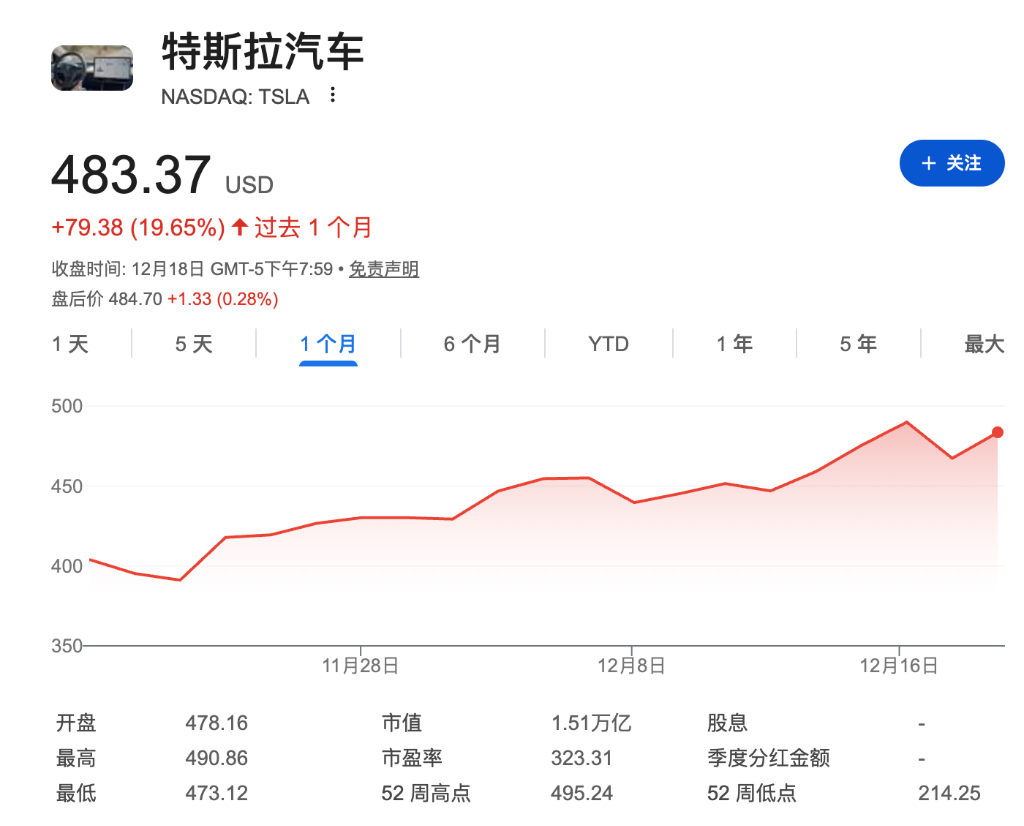
Core Viewpoint - SpaceX's IPO plan may challenge the long-held "Musk premium" associated with Tesla stock, potentially reallocating funds that were previously concentrated in Tesla due to investor support for Musk's vision rather than the automotive business itself [1][2] Group 1: Tesla's Current Situation - Tesla's stock price has increased nearly 20% in the past month and has a year-to-date gain of over 27%, with a forward P/E ratio of approximately 220, ranking second among S&P 500 constituents [1] - Despite the rising stock price, Tesla faces concerns regarding slowing sales growth and declining profitability, compounded by a tightening regulatory environment and reduced consumer spending on automobiles [5] - Analysts express skepticism about Tesla's current valuation, with some stating it lacks fundamental support, leading to significant sell-offs by certain investment firms [5] Group 2: Impact of SpaceX's IPO - The potential IPO of SpaceX is expected to exert selling pressure on Tesla's stock, as some investors primarily hold Tesla shares to gain exposure to Musk's vision rather than its automotive business [6] - Conversely, historical trends suggest that significant milestones for Musk's companies can enhance market sentiment for related firms, potentially attracting more investors to the ecosystem [6] - Analysts note that Tesla's stock price has already been influenced by expectations surrounding SpaceX's IPO, highlighting strategic synergies between the two companies, such as Tesla's Optimus robot aiding Mars colonization and SpaceX's Starlink enhancing vehicle connectivity [6]



SpaceX若上市,特斯拉的“马斯克溢价”还能撑多久?
Hua Er Jie Jian Wen· 2025-12-19 10:02
Core Viewpoint - The potential IPO of SpaceX may challenge the unique "Musk premium" that Tesla stock has enjoyed, as investors could reallocate funds from Tesla to SpaceX, which is expected to reach a valuation of $800 billion, making it the highest-valued private company globally [1][4]. Group 1: SpaceX IPO Impact on Tesla - SpaceX's IPO could lead to a redistribution of funds that were previously concentrated in Tesla, as some investors hold Tesla stock primarily for exposure to Musk's vision rather than its automotive business [1][5]. - Analysts have mixed views on the impact of SpaceX's IPO on Tesla, with some suggesting it may create selling pressure on Tesla shares, while others believe it could enhance market sentiment towards Tesla due to the synergistic potential between the two companies [5][6]. Group 2: Tesla's Current Performance and Valuation Concerns - Despite a nearly 20% increase in Tesla's stock price over the past month and a year-to-date gain of over 27%, concerns about the company's fundamentals are rising, including slowing sales growth and declining profits [4]. - Tesla's forward P/E ratio has reached approximately 220, ranking second among S&P 500 constituents, which has led to widespread skepticism regarding its valuation being unsupported by fundamentals [4]. - Technical indicators suggest that Tesla's stock is nearing overbought territory, with historical data indicating a potential decline following similar conditions [4].