Consumption

Search documents
Top Chinese Economist Says It's Time to Allow Stronger Yuan
Bloomberg Television· 2025-12-03 20:14
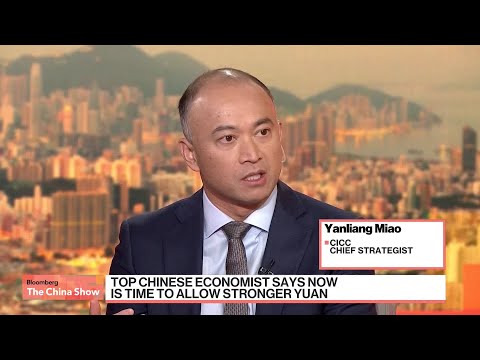
Renminbi Exchange Rate and Policy Recommendations - The renminbi is at its weakest since 2012 in real effective terms, having depreciated about 16% over the past ten years [2] - The US dollar is at its strongest in almost 40 years in real effective terms, although it has weakened from an index of 110 at the beginning of the year to about 100 [2] - Exchange rates should be determined by market forces, considering fundamentals, interest rates, and capital flows [7] - Policymakers should consider a combination of monetary and fiscal easing to achieve both a stronger renminbi and escape the low inflation zone [14] - A modest appreciation of the renminbi is unlikely to hurt Chinese companies' competitiveness [16] Renminbi Internationalization - The renminbi is already a reserve currency as it joined the SDR basket ten years ago, but its share is still low at 2% to 3% [18] - The shift from high to low interest rates in China makes it cheaper to borrow in renminbi, favoring internationalization [20] - Further opening up access to Chinese markets for foreigners and vice versa is needed [21][22] - More Chinese bonds should be issued both domestically and offshore to supply safe assets [23] Consumption and Investment Strategies - Boosting labor income requires a strong job market, while transfer income has slowed due to local government difficulties [24][25] - The marginal propensity to consume in China has decreased from $0.68 to $0.66 per dollar earned, indicating cautiousness [26] - Both Hong Kong and mainland markets are good strategies for equity allocation, considering the global monetary reset [31][32]

美国股票策略展望-2026 前瞻 -市场情绪高涨,却无处可去-2026 Year Ahead_ All bulled up, and no place to go
2025-12-02 06:57
Summary of Key Points from the Conference Call Industry and Company Overview - The conference call focuses on the **US Equity Strategy** for the year ahead, particularly the **S&P 500** and its projected performance through 2026. Core Insights and Arguments 1. **S&P 500 Target for 2026**: The target for the S&P 500 is set at **7100**, indicating a **5% price return** from current levels, supported by a forecasted **14% earnings growth** or **$310** per share, despite a **10-point PE contraction** [1][18][19]. 2. **Market Sentiment**: Current market sentiment is described as contained rather than euphoric, with a recommended equity allocation of **56%**, which is below historical peaks [10][31]. 3. **Capex vs. Consumption**: There is an expectation of broadening capital expenditures (capex) over consumption, with a shift towards **blue-collar jobs** as AI impacts white-collar employment [2][12][13]. 4. **Sector Adjustments**: The outlook for **Consumer Staples** has been raised to **overweight** from **underweight**, while **Consumer Discretionary** has been lowered to **underweight** from **marketweight**. The firm remains **overweight** on **Financials, Real Estate, Materials, Health Care, and Energy** [6][12]. 5. **AI Investment Outlook**: There is caution regarding AI investments, with a noted **air pocket** ahead as monetization remains uncertain. The capital intensity of hyperscalers has increased significantly, raising concerns about future returns [3][14][15]. 6. **Credit Cycle Concerns**: The credit cycle is anticipated to be different from previous cycles, with emerging issues in private lending and a potential increase in **bad vintage** private investments due in **2026** [4][16]. 7. **Earnings Growth and Valuation**: Earnings growth is expected to be in the mid-double digits, but multiples are projected to compress by **5-10%**. The fair value model estimates the S&P 500's fair value at **5900**, indicating a potential downside from current levels [10][21][22]. Additional Important Insights 1. **Liquidity Trends**: While liquidity has been strong, the direction is expected to worsen, with less emphasis on buybacks and more on capex [11][13]. 2. **Job Market Dynamics**: The job market is shifting, with a decrease in entry-level office jobs due to efficiency gains from AI, impacting consumption growth [12][13]. 3. **Valuation Metrics**: The S&P 500 is statistically expensive across multiple metrics, trading above historical averages, which raises concerns about future returns [55][56]. 4. **Investor Behavior**: Individual investors have significantly influenced market volumes, accounting for approximately **40%** of small-cap and **20%** of large-cap volumes this year [13]. This summary encapsulates the key points discussed in the conference call, providing insights into the expected performance of the S&P 500, sector adjustments, and broader market dynamics.
X @The Economist
The Economist· 2025-11-10 05:40
Studies suggest moderate consumption is harmless. It may even be beneficial https://t.co/LLEA512VvT ...
X @Investopedia
Investopedia· 2025-11-06 16:01
Economic Growth & Inflation - Economists and policymakers view moderate inflation as beneficial for driving economic growth [1] - Moderate inflation helps in preventing deflation [1] Impact on Consumption & Savings - Moderate inflation has an impact on consumption and savings [1]
Lululemon China CEO Discusses Consumption Outlook
Bloomberg Television· 2025-11-06 06:48
The big news this week, corporate in corporate China, right. You remember Starbucks and the issues they're having there with their foreign units. In fact, when you look at the opposite, some of the success stories, Lululemon, when you look at their specific China unit and the amount of growth they've seen throughout the year is expected into the next few years.So from about early 2020 to $400 million into the expected close to 2 billion off the China business, that's about a5x growth just over five years. R ...


MetLife's Drew Matus: There's a split forecasts around job growth, underscores bifurcated economy
Youtube· 2025-10-28 16:57
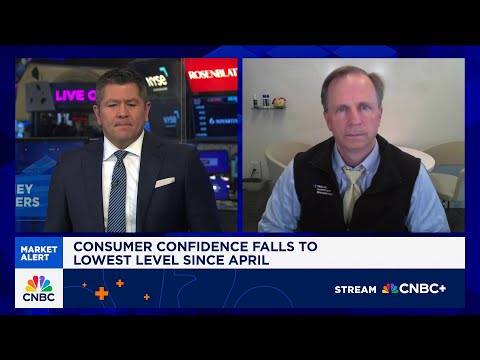
Economic Outlook - Consumer confidence has fallen to its lowest level since April, indicating potential challenges in the broader markets and economic outlook [1] - There is a split in expectations regarding job growth, with some anticipating higher growth while others foresee lower growth, reflecting a mixed sentiment among consumers [3] Consumer Behavior - Real personal disposable income is declining at an annual rate of approximately 1%, yet consumer spending remains stable, likely supported by equity gains and home appreciation [4] - Consumers are currently relying heavily on the wealth effect to maintain their consumption patterns, despite underlying economic stress [4][5] - There are indications that consumers may be growing weary of spending, which could impact future consumption patterns [7] Market Sentiment - The investment community remains cautious, with widening outcomes in economic forecasts, particularly regarding the impact of AI on productivity and labor markets [9][10] - The expectation is for a slowing economy with decent nominal growth, potentially leading to a resurgence in productivity driven by AI in the coming years [11] Federal Reserve Policy - The Federal Reserve is likely to continue its quantitative tightening through the end of the year, as concerns about the balance sheet size persist among committee members [13][14] - There is ongoing debate about whether the Fed will adjust its inflation target from 2% to 3%, reflecting broader discussions on monetary policy [12]

MetLife's Drew Matus: There's a split forecasts around job growth, underscores bifurcated economy
CNBC Television· 2025-10-28 16:37
Let's get back to the broader markets and the outlook for the economy after consumer confidence this month did fall to the lowest level since April. Joining us this morning is Medlife Investment Management chief market strategist Drew Mattis. Been watching a lot of this stuff closely.Drew, good to see you again. >> Good to good to be here. So, Conference Board is is kind of instructive and it it does fit a little bit with the narrative being built at Amazon and GM and Paramount uh where headcount is either ...
X @The Economist
The Economist· 2025-10-28 01:40
Health & Consumption - Studies suggest moderate consumption is harmless [1] - Moderate consumption may even be beneficial [1]
Stifel CEO's message to Gen Z investors: ‘Investing is compounding, gambling is consumption'
Youtube· 2025-10-22 15:57
Market Environment - The current credit market is very active, with record pipelines and earnings across the board, indicating a strong cycle for credit despite some expected hiccups [2][4]. - The uncertainty that previously affected the market, such as tax policy and tariffs, has largely been resolved, allowing for increased business activity including M&A and IPOs [4][5]. Economic Outlook - The market is believed to be in the earlier innings of a positive cycle, with expectations of continued growth into 2026, barring any significant geopolitical events [5]. - There is a caution regarding Federal Reserve policy, suggesting that while some rate cuts may be necessary, the idea of multiple significant cuts is not supported [6][10]. Investor Behavior - A generational divide exists in investment perspectives, with older investors focusing on performance while younger investors prioritize interaction through social apps and do not view performance as a primary concern [11][12]. - The blending of prediction markets with investing is seen as problematic, emphasizing the need for education on the differences between investing and gambling [13].