
人民币汇率

Search documents
金融期货早评-20260122
Nan Hua Qi Huo· 2026-01-22 02:13
Report Industry Investment Ratings - Not provided in the content Core Views - **Macro and Financial Futures** - The current macro - environment features global geopolitical turmoil and domestic structural differentiation with targeted policies for stable growth. The old US - led global system is ending, and the global financial market is in a risk - averse stage. China's economy is expected to achieve a GDP growth target of 4.5% - 5% in 2026, and the government is working to boost domestic demand [1]. - The RMB exchange rate has a solid basis for appreciation due to China's export resilience and increased corporate willingness to settle foreign exchange. However, its appreciation process will be relatively moderate [2][3]. - The stock index is in an adjustment stage in the short - term, with a continued structural market. In the long - term, the logic of loose liquidity driving the market remains positive [4]. - The bond market is not recommended for short - term chasing as the upside is limited despite improved market sentiment [5]. - The container shipping European route futures are expected to maintain a volatile pattern, with near - month contracts weak and far - month contracts relatively resistant to decline [6][7][8]. - **Commodities** - Lithium carbonate is likely to show "off - season not off" characteristics in the spot market, and it is recommended to go long on dips before early February in the futures market [11][12]. - Industrial silicon is expected to have an upward - biased price due to increased demand for export and supply - side disturbances. Polysilicon is in a de - stocking phase with no clear upward driver [12][13]. - Copper prices continue to adjust with limited upward momentum. Aluminum is expected to oscillate strongly in the long - term, while alumina is expected to be weak, and cast aluminum alloy is expected to be strong [15][17][19]. - Zinc prices are likely to be weak and volatile in the short - term. Nickel - stainless steel is expected to be strong with some fundamental support. Tin prices may maintain a high - level wide - range oscillation. Lead prices are expected to oscillate within a narrow range [19][20][22]. - For oilseeds, the external soybean market is weak and volatile, while domestic soybean meal and rapeseed meal have different outlooks. For oils, the sector is likely to be strong in the short - term, with palm oil being the strongest [24][25][26]. - High - sulfur fuel oil has a poor fundamental situation but is supported by the Iran issue. Low - sulfur fuel oil has a weak cracking spread. Asphalt is expected to oscillate with limited upside and downside [30][31][33]. - Precious metals are in an upward - biased pattern but may face short - term correction pressure. Gold and silver can be considered for mid - term long positions on dips [34][35]. - **Chemicals** - Pulp and offset paper markets are relatively bearish, and it is recommended to wait and see. LPG shows an internal - external divergence. PTA - PX and MEG - bottle chips have different supply - demand situations, and it is recommended to go long on PX and short on polysilicon [36][39][41]. - Methanol is affected by geopolitical factors, and it is recommended to wait and see. PP is expected to be in a wide - range oscillation, and PE is in a pattern of increasing supply and decreasing demand [45][47][49]. - Pure benzene and styrene have improved supply - demand situations. Rubber is expected to oscillate widely, and it is recommended to go long with a light position. Urea is recommended to hold long positions [50][52][56]. - Soda ash is in a situation of increasing supply, and glass is in a supply - demand weak pattern. Propylene prices are driven by cost and are expected to be affected by geopolitical and device changes [58][59][60]. - **Black Metals** - Rebar and hot - rolled coils are in a low - level oscillation. Iron ore prices have fallen but have support below. Coking coal and coke prices are under pressure in the long - term. Ferroalloys are expected to oscillate at the bottom [61][62][63]. - **Agricultural and Soft Commodities** - Hog prices are expected to decline slightly, and the supply - demand situation is still unbalanced. Cotton prices are expected to oscillate. Sugar prices are short - term weak. Rubber is expected to oscillate widely. Apples' future performance depends on demand. Jujubes are in a low - level oscillation. Logs are recommended for range - bound operations and long positions on dips [65][67][76] Summary by Directory Financial Futures - **Macro** - **Market Information**: Trump's statements on Greenland, central bank's payment settlement work meeting, and other geopolitical and economic events [1]. - **Core Judgments**: The global geopolitical situation affects the financial market, and China focuses on stable growth and boosting domestic demand [1]. - **RMB Exchange Rate** - **Market Review**: The on - shore RMB against the US dollar declined slightly. - **Core Logic**: China's export and corporate behavior support the RMB's appreciation, and the process is affected by the US dollar index and central bank policies [2][3]. - **Strategy Suggestions**: Export enterprises can lock in forward exchange settlement, and import enterprises can adopt a rolling purchase strategy [3][4]. - **Stock Index** - **Market Review**: The stock index showed a differentiated performance, and the trading volume decreased. - **Core Logic**: Affected by geopolitical risks, the market is in an adjustment stage with a structural market [4]. - **Strategy Suggestions**: Wait for short - term callbacks to increase positions [4]. - **Bond** - **Market Review**: The bond market showed a differentiated performance, and the money market was loose. - **Core Logic**: The bond market follows the stock market, and the upside is limited [5]. - **Strategy Suggestions**: Hold medium - term long positions and wait and see in the short - term [5]. - **Container Shipping European Route** - **Market Review**: The futures market showed a "near - weak, far - strong" pattern. - **Core Logic**: The market is in a game between weak current demand and long - term detour cost support [6][7]. - **Strategy Suggestions**: Trend traders can wait or operate in a narrow range [8]. Commodities - **Lithium Carbonate** - **Market Review**: The futures price increased, and the trading volume decreased. - **Industry Performance**: The spot market of the lithium - battery industry chain is general, and the prices of upstream and downstream products are rising [11]. - **Strategy Suggestions**: Go long on dips before early February and reduce positions before the Spring Festival [11][12]. - **Industrial Silicon and Polysilicon** - **Market Review**: Industrial silicon futures rose slightly, and polysilicon futures fell. - **Industry Performance**: The spot market of industrial silicon is general, and the photovoltaic industry spot market is weak [12][13]. - **Strategy Suggestions**: Go long on industrial silicon and short on polysilicon, and reduce positions before the Spring Festival [13][14]. - **Non - ferrous Metals** - **Copper** - **Market Review**: Copper prices showed different trends in different markets. - **Industry Information**: Warehouse receipts and inventory changes, and Rio Tinto's production increase [15][16]. - **Strategy Suggestions**: Do not build new positions above 100,000, hold long positions in the 90,000 - 95,000 range, and adjust positions flexibly in the 95,000 - 100,000 range [17]. - **Aluminum Industry Chain** - **Market Review**: Aluminum prices oscillated, and alumina and cast aluminum alloy prices changed slightly [17]. - **Industry Information**: The spot market of electrolytic aluminum improved slightly [17]. - **Strategy Suggestions**: Aluminum is expected to be oscillatory and strong, alumina is expected to be weak, and cast aluminum alloy is expected to be strong [18][19]. - **Zinc** - **Market Review**: Zinc prices showed a weak oscillation. - **Core Logic**: The supply is expected to be loose, and the demand is cold [19]. - **Strategy Suggestions**: Weakly oscillate, and aggressive investors can try short - selling [19][20]. - **Nickel - Stainless Steel** - **Market Review**: Nickel and stainless steel prices rose. - **Industry Performance**: The spot market prices and inventory changes [20]. - **Strategy Suggestions**: Oscillate strongly, and pay attention to the supply and demand situation [20][21]. - **Tin** - **Market Review**: Tin prices were volatile. - **Core Logic**: The supply is affected, and the demand is in the off - season [22]. - **Strategy Suggestions**: Be cautious when entering the market due to high volatility [22]. - **Lead** - **Market Review**: Lead prices oscillated in a narrow range. - **Core Logic**: The supply and demand are in a weak pattern [22]. - **Strategy Suggestions**: Oscillate, and sell options to collect premiums [22][23]. - **Oils and Feeds** - **Oilseeds** - **Market Review**: The external soybean market rebounded, and the domestic market was weak. - **Supply - Demand Analysis**: The supply and demand of imported soybeans, domestic soybean meal, and rapeseed meal are different [24][25]. - **Strategy Suggestions**: Exit the M3 - 5 long - short spread, and hold a small short position in rapeseed meal [25][26]. - **Oils** - **Market Review**: The oils market continued to strengthen. - **Supply - Demand Analysis**: The supply and demand of palm oil, soybean oil, and rapeseed oil have different characteristics [26][27]. - **Strategy Suggestions**: The oils sector is strong in the short - term, and pay attention to the spread between rapeseed oil and palm oil [27][28]. Energy and Oil and Gas - **Fuel Oil** - **Market Review**: The fuel oil futures price increased. - **Industry Performance**: The supply and demand of high - sulfur and low - sulfur fuel oil have different situations [30][31]. - **Core Logic**: High - sulfur fuel oil has a poor foundation, and low - sulfur fuel oil has a weak cracking spread [30][31]. - **Asphalt** - **Market Review**: The asphalt market price decreased slightly. - **Industry Performance**: The supply and demand and inventory changes [31][32]. - **Core Logic**: Affected by geopolitics, the asphalt market is expected to oscillate [32][33]. - **Strategy Suggestions**: Pay attention to long - short spreads, basis, and cracking long - positions [33]. Precious Metals - **Gold and Silver** - **Market Review**: Gold prices first rose and then fell, and silver prices were weaker [34]. - **Trading Logic**: Pay attention to geopolitical events, Fed policies, and other factors [35]. - **Strategy Suggestions**: The precious metals are in an upward - biased pattern, and consider long positions on dips [35]. Chemicals - **Pulp - Offset Paper** - **Market Review**: The pulp and offset paper futures prices oscillated. - **Industry Performance**: The port inventory of pulp increased, and the downstream demand was weak [36]. - **Strategy Suggestions**: Wait and see, and consider long positions in offset paper at low prices [36]. - **LPG** - **Market Review**: The LPG futures price increased. - **Industry Performance**: The supply and demand and inventory changes [36][37]. - **Core Logic**: The internal and external markets diverge, and pay attention to geopolitical and device changes [37][38]. - **PTA - PX** - **Market Review**: The PX and PTA futures prices changed. - **Industry Performance**: The supply, demand, and inventory of PX and PTA are different [39][40]. - **Core Logic**: The supply - demand situation of PTA and PX is complex, and the long - term pattern is good [40][41]. - **Strategy Suggestions**: Go long on PX and PTA on dips [41]. - **MEG - Bottle Chips** - **Market Review**: The ethylene glycol futures price changed. - **Industry Performance**: The supply, demand, and inventory of ethylene glycol and bottle chips [41][42][43]. - **Core Logic**: The demand is under pressure, and the long - term pattern is bearish [43][44]. - **Methanol** - **Market Review**: The methanol futures price increased. - **Industry Performance**: The inventory decreased, and the downstream profit was affected [45]. - **Core Logic**: Affected by geopolitics, the operation is difficult [45][46]. - **Strategy Suggestions**: Wait and see [46]. - **PP** - **Market Review**: The PP futures price increased. - **Industry Performance**: The supply and demand and inventory changes [46][47]. - **Core Logic**: The short - term supply - demand pattern is improved, but the long - term is uncertain [47][48]. - **Strategy Suggestions**: Oscillate widely [48]. - **PE** - **Market Review**: The PE futures price increased. - **Industry Performance**: The supply is expected to increase, and the demand is expected to decrease [48][49]. - **Core Logic**: The supply - demand pattern is unfavorable [49]. - **Pure Benzene - Styrene** - **Market Review**: The pure benzene and styrene futures prices increased. - **Industry Performance**: The inventory and supply - demand changes [50][51][52]. - **Core Logic**: The supply - demand situation of pure benzene and styrene is improved [51][52]. - **Rubber** - **Market Review**: The rubber futures prices oscillated. - **Industry Performance**: The inventory and supply - demand changes [52][53][54]. - **Core Logic**: Affected by macro and supply - demand factors, the price oscillates widely [55][56]. - **Strategy Suggestions**: Go long with a light position and pay attention to spreads [56]. - **Urea** - **Market Review**: The urea futures price increased. - **Industry Performance**: The inventory decreased, and the market sentiment changed [56][57]. - **Core Logic**: The supply is excessive, and the price is affected by policies [57]. - **Strategy Suggestions**: Hold long positions [57]. - **Glass - Soda Ash** - **Soda Ash** - **Market Review**: The soda ash futures price decreased. - **Industry Performance**: The inventory decreased, and the supply is expected to increase [58]. - **Core Logic**: The supply is excessive, and the price is under pressure [58]. - **Glass** - **Market Review**: The glass futures price decreased. - **Industry Performance**: The inventory decreased, but the demand is weak [59]. - **Core Logic**: The supply - demand is weak, and the price has no trend [59]. - **Propylene** - **Market Review**: The propylene futures price increased. - **Industry Performance**: The supply and demand and inventory changes [59][60]. - **Core Logic**: Affected by cost and geopolitics, the supply - demand is balanced [60]. - **Strategy Suggestions**: Pay attention to geopolitical and device changes [60]. Black Metals - **Rebar and Hot - Rolled Coils** - **Market Review**: The prices oscillated, and the trading volume was low. - **Core Logic**: The supply - demand is neutral, and the price is affected by raw materials [61]. - **Strategy Suggestions**: The price will oscillate in a certain range [61]. - **Iron Ore** - **Market Review**: The iron ore price continued to fall. - **Core Logic**: The previous high valuation is being adjusted, but there is support below [62]. - **Coking Coal and Coke** - **Market Review**: The prices oscillated. - **Core Logic**: The supply is increasing, and the price is under pressure in the long - term [63]. - **Ferroalloys** - **Market Review**: The ferroalloys prices oscillated. - **Core Logic**: The supply - demand is weak, and the price is supported by cost [63]. - **Strategy Suggestions**: Oscillate at the bottom [64]. Agricultural and Soft Commodities - **Hogs** - **Market Review**: The hog futures price decreased. - **Industry Performance**: The supply - demand is unbalanced, and the price is under pressure [65][66]. - **Strategy Suggestions**: Pay attention to pre - festival stocking demand [67]. - **Cotton** - **Market Review**: The cotton futures price oscillated. - **Industry Performance**: The inventory increased, and the supply - demand situation is complex [67]. - **Strategy Suggestions**: Oscillate and pay attention to downstream imports and orders [68].
人民币汇率中间价调贬5基点报7.0019
Bei Jing Shang Bao· 2026-01-22 02:05
2026年开年以来,人民币汇率延续震荡升值走势。高盛首席中国经济学家闪辉预测,人民币对美元汇率 在2026年底将升至6.85,2027年底进一步升至6.54,呈现持续温和升值趋势。 北京商报讯(记者 廖蒙)1月22日,中国人民银行授权中国外汇交易中心公布,当日银行间外汇市场人 民币汇率中间价为1美元对人民币7.0019元,相较前一交易日中间价7.0014元,调贬5基点。 同日,在岸人民币、离岸人民币对美元汇率小幅升值。截至当日9时40分,在岸人民币对美元报 6.9622,日内升值幅度为0.02%;离岸人民币对美元报6.9583,日内贬值幅度为0.02%。 ...
人民币对美元中间价报7.0019 调贬5个基点
Zhong Guo Jing Ji Wang· 2026-01-22 01:31
中国人民银行授权中国外汇交易中心公布,2026年1月22日银行间外汇市场人民币汇率中间价为:1 美元对人民币7.0019元,1欧元对人民币8.1537元,100日元对人民币4.4112元,1港元对人民币0.89820 元,1英镑对人民币9.3657元,1澳大利亚元对人民币4.7138元,1新西兰元对人民币4.0709元,1新加坡 元对人民币5.4322元,1瑞士法郎对人民币8.7678元,1加拿大元对人民币5.0408元,人民币1元对1.1472 澳门元,人民币1元对0.57886马来西亚林吉特,人民币1元对11.0553俄罗斯卢布,人民币1元对2.3323南 非兰特,人民币1元对210.45韩元,人民币1元对0.52651阿联酋迪拉姆,人民币1元对0.53758沙特里亚 尔,人民币1元对47.1610匈牙利福林,人民币1元对0.51669波兰兹罗提,人民币1元对0.9168丹麦克朗, 人民币1元对1.3066瑞典克朗,人民币1元对1.4300挪威克朗,人民币1元对6.20658土耳其里拉,人民币1 元对2.5039墨西哥比索,人民币1元对4.4906泰铢。 (责任编辑:魏京婷) 中国经济网北京1月22日讯 ...
中信建投:美债的买点将至
Xin Lang Cai Jing· 2026-01-21 23:33
中信建投研报指出,近期美元兑人民币汇率同样持续走高,鉴于结汇意愿短期仍较强,且每年年初都是 人民币升值的主要时间窗口,不排除春节前人民币继续冲高,释放升值压力。美债下跌、人民币走强的 组合,对美债目前持仓而言会是不小的压力,但进入到3月份之后,美债利率和人民币汇率可能出现同 时筑顶的情况,届时将提供更为理想的买点。 ...

利好!高盛最新发声
Xin Lang Cai Jing· 2026-01-21 12:59
Core Viewpoint - Goldman Sachs predicts China's GDP growth rate will be 4.8% in 2026, supported by strong export growth. The MSCI China Index target is set at 100 points, and the CSI 300 Index target is 5200 points by the end of 2026. Net inflows from southbound funds are expected to reach $200 billion (approximately 1.4 trillion yuan), a new record high [1][9]. Export Support Factors - China's export growth is projected to maintain a rate of 5%-6%, significantly higher than the global trade growth of 2%-3%. This forecast is based on three core factors: steady global economic recovery boosting demand, China's cost advantages across various industries, and unique capabilities in rare earths and supply chains, making it difficult for international tariffs to be imposed [2][11]. - The negative impact of the real estate sector on economic growth is expected to diminish over time, with the most significant effects occurring in 2024 and 2025. As the market size shrinks, the downward pressure on GDP growth will lessen [2][11]. Currency Outlook - The RMB is expected to appreciate moderately, with an estimated undervaluation of about 25%. By the end of 2026, the RMB/USD exchange rate is projected to reach 6.85, further strengthening to 6.54 by the end of 2027, indicating an annual appreciation of approximately 2%-3% [3][11]. Stock Market Valuation and Returns - The dynamic P/E ratios for the MSCI China Index and CSI 300 Index have returned to historical averages, at approximately 13 times and 15 times, respectively. The expected stock market return for 2026 is between 15%-20%, primarily driven by earnings growth, with a projected earnings growth rate of 14% [4][12]. - Three main factors are anticipated to drive earnings growth: contributions from the AI industry, expansion into overseas markets, and positive impacts from the "anti-involution" trend [4][12][13]. Liquidity Support - Net inflows from southbound funds are expected to reach $200 billion (approximately 1.4 trillion yuan), reflecting increased demand for stock allocations from domestic individuals and institutions [6][14]. - There is still room for improvement in overseas fund allocations to Chinese stocks, which currently account for less than 8% of total risk exposure among hedge fund clients tracked by Goldman Sachs. Recent communications indicate a growing interest from overseas investors in Chinese investments [6][14]. - Personal investors are projected to contribute approximately 2 trillion yuan to the stock market over the next 12 months, driven by expectations of stock returns between 10%-15% and improved inflation expectations [6][14]. Sector Preferences - Goldman Sachs maintains a high allocation recommendation for AI and technology hardware, reflecting strong confidence in the AI narrative. The materials sector is also favored, while insurance is newly recommended for overweight allocation due to its potential for higher investment returns in a slow bull market and attractive dividend characteristics [8][15]. Policy Focus - The concept of "investing in people" is highlighted as a key policy direction, expected to manifest in various initiatives, including annual childcare subsidies of 3600 yuan. This focus is anticipated to continue and expand, covering the entire life cycle from birth to retirement, with policy support likely to strengthen to improve living standards and increase birth rates [8][16].
【财经分析】人民币开年延续强势 春节前温和偏强格局可期
Xin Hua Cai Jing· 2026-01-21 06:55
Group 1 - The core viewpoint of the articles indicates that despite a rebound in the US dollar index and pressure on non-US currencies, the Chinese yuan (RMB) has maintained a strong upward trend, supported by seasonal factors and stable demand for foreign exchange [1][2][6] - The RMB exchange rate has shown resilience, with the offshore RMB reaching a high of 6.9615 against the US dollar, marking a 0.12% increase since the end of the previous year, while the onshore RMB rose by 0.21% [2][6] - The CFETS RMB exchange rate index and other indices have reached new highs, indicating a strengthening of the RMB against major trading partner currencies and an improvement in its status within the international monetary system [3][4] Group 2 - The foreign exchange market in China has demonstrated significant resilience, with trading volume reaching a historical high of 42.6 trillion USD in 2025, and the corporate foreign exchange hedging ratio increasing to 30% [5] - The People's Bank of China (PBOC) has emphasized the importance of maintaining the RMB's exchange rate flexibility and preventing excessive fluctuations, indicating a commitment to a stable foreign exchange market [6][7] - There are differing views on the future appreciation of the RMB, with some analysts predicting a gradual increase of 2-3% annually, while others suggest that the most aggressive appreciation phase may have passed, leading to a more volatile trading range [6][7]
1月21日人民币对美元中间价报7.0014元 下调8个基点
Zhong Guo Xin Wen Wang· 2026-01-21 06:40
中新网1月21日电 据中国外汇交易中心网站消息,中国人民银行授权中国外汇交易中心公布,2026年1 月21日银行间外汇市场人民币汇率中间价为:1美元对人民币7.0014元,下调8个基点。 来源:中国新闻网 编辑:张嘉怡 广告等商务合作,请点击这里 1月21日人民币对美元中间价报7.0014元 下调8个基点 图片来源:中国外汇交易中心网站截图 本文为转载内容,授权事宜请联系原著作权人 中新经纬版权所有,未经书面授权,任何单位及个人不得转载、摘编或以其它方式使用。 关注中新经纬微信公众号(微信搜索"中新经纬"或"jwview"),看更多精彩财经资讯。 ...

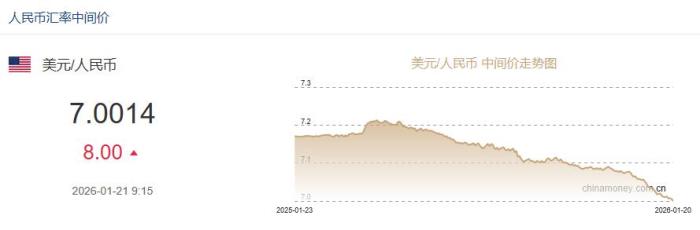
人民币对美元中间价报7.0014 下调8个基点
Zhong Guo Jing Ji Wang· 2026-01-21 01:46
中国人民银行授权中国外汇交易中心公布,2025年1月21日银行间外汇市场人民币汇率中间价为:1美元 对人民币7.0014元,1欧元对人民币8.1745元,100日元对人民币4.4095元,1港元对人民币0.89779元,1 英镑对人民币9.3662元,1澳大利亚元对人民币4.6898元,1新西兰元对人民币4.0555元,1新加坡元对人 民币5.4286元,1瑞士法郎对人民币8.8238元,1加拿大元对人民币5.0365元,人民币1元对1.1478澳门 元,人民币1元对0.58102马来西亚林吉特,人民币1元对11.2079俄罗斯卢布,人民币1元对2.3539南非兰 特,人民币1元对212.41韩元,人民币1元对0.52707阿联酋迪拉姆,人民币1元对0.53819沙特里亚尔,人 民币1元对47.0962匈牙利福林,人民币1元对0.51673波兰兹罗提,人民币1元对0.9143丹麦克朗,人民币 1元对1.3092瑞典克朗,人民币1元对1.4352挪威克朗,人民币1元对6.21082土耳其里拉,人民币1元对 2.5220墨西哥比索,人民币1元对4.4565泰铢。 中国经济网北京1月21日讯 来自中国外汇交易中心的 ...
人民币兑美元升破6.96关口 创32个月新高
Xin Hua Cai Jing· 2026-01-20 07:40
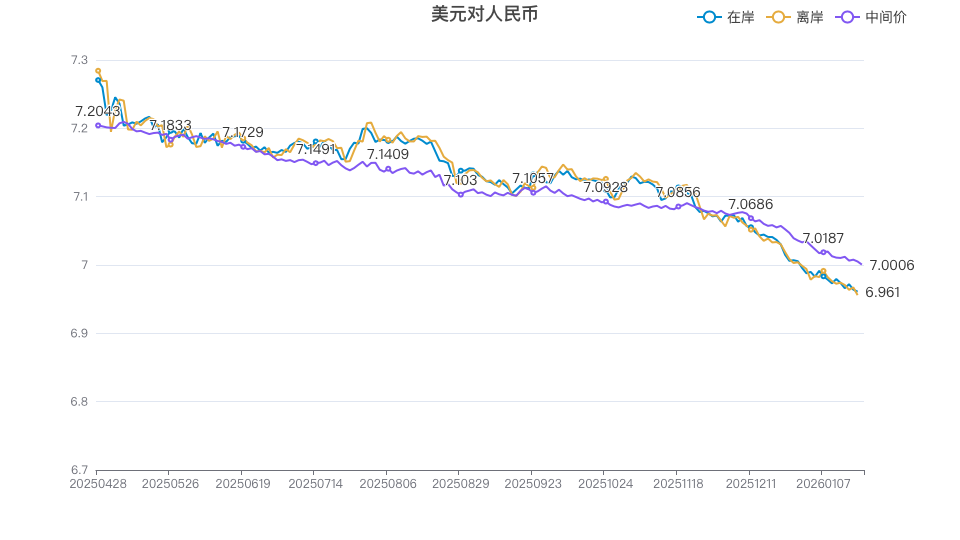
Core Viewpoint - The Chinese yuan has strengthened significantly against the US dollar, reaching a 32-month high in the onshore market and a new high since May 15, 2023, in the offshore market, driven by seasonal demand for currency settlement and expectations of continued appreciation due to internationalization efforts and easing trade tensions [1][4]. Group 1: Currency Performance - The onshore yuan against the US dollar broke the 6.96 mark, reaching a peak of 6.9593 [1]. - The offshore yuan peaked at 6.95285, marking the highest level since May 15, 2023 [1]. - The central parity rate of the yuan against the US dollar was adjusted up by 45 points to 7.0006, the highest since May 18, 2023 [3]. Group 2: Year-to-Date Appreciation - Year-to-date, the onshore yuan has appreciated by 0.4% against the US dollar, while the offshore yuan has appreciated by 0.3% [4]. - Historical data indicates that the yuan typically appreciates by 0.5% and 0.8% in December and January, respectively, with appreciation probabilities of 75% and 67% [4]. Group 3: Future Outlook - Analysts from China International Capital Corporation (CICC) suggest that the recent strengthening of the yuan is significantly influenced by seasonal settlement demand, particularly in December and January [4]. - Citigroup economists predict that the yuan will strengthen further due to China's efforts to internationalize the currency and mitigate trade tensions, forecasting a rise to 6.80 against the US dollar in the next 6 to 12 months [4]. - Chief economist Zhao Wei from Shenwan Hongyuan anticipates that the yuan will enter an appreciation phase starting in 2025, potentially appreciating by at least 2-3% annually over the next several years, leading to a total appreciation of over 30% in about a decade [4].
贸易创汇为底,资本回稳为翼
Hua Tai Qi Huo· 2026-01-20 03:06
Report Industry Investment Rating No relevant information provided. Core Viewpoints of the Report - The key to the settlement and sale of foreign exchange surplus in December lies in the real return of trade cash flow rather than sentiment. The surge in exports directly boosts the bottom - line of foreign exchange settlement, with the supply side clearly dominant. Enterprises' behavior is more in line with business logic than exchange - rate speculation. Forward hedging is active without squeezing spot foreign exchange settlement, indicating that the market is mainly focused on stable hedging. The US dollar against the RMB is expected to decline slowly, and in the short - term, it may test the 6.90–6.95 range, with limited room for the US dollar to rebound [2]. Summary by Related Catalogs Market Supply - Demand Relationship Analysis Foreign Exchange Market Supply - Demand Balance - In December 2025, the surplus of bank settlement and sale of foreign exchange significantly expanded to 1000.67 billion US dollars (bank settlement of 3179.60 billion US dollars and sale of 2178.93 billion US dollars), indicating a strong end - of - year supply of foreign exchange settlement. This is closely related to high - level export and cross - border payment activities, and the large trade surplus provides strong support for the RMB [9]. - The significant increase in the customer - side foreign exchange settlement momentum is the core of the surplus structure change. The surplus of bank customer - related settlement and sale of foreign exchange jumped to about 999.34 billion US dollars, reflecting the concentrated release of the real demand of domestic enterprises and institutions for foreign exchange settlement [10]. Forward Foreign Exchange Settlement and Purchase Willingness - In December, in the context of a stronger RMB and active trading in the spot market, enterprises' spot trading behavior became more rational. The average spot value of the US dollar against the RMB decreased by about 1.17% compared with November. The spot inquiry trading volume decreased to 345.59 billion US dollars, while the settlement rate of received foreign exchange rose to 61.01% and the purchase rate of paid foreign exchange dropped to 55.41% [13]. - In December, both forward signing and performance increased, reflecting the enhanced demand for cross - period risk management and real - demand matching. Forward foreign exchange sales signing increased to 169.66 billion US dollars, and forward foreign exchange settlement signing rose to 524.32 billion US dollars. The performance on the execution side also strengthened, indicating that enterprises' foreign exchange layout focuses on cash - flow matching and exchange - rate risk management [14]. Analysis of Settlement and Sale of Foreign Exchange Structure Bank's Own Settlement and Sale of Foreign Exchange - In the macro - data analysis of bank settlement and sale of foreign exchange, the bank's internal settlement and sale of foreign exchange activities, mainly including dividend payments, profit repatriation, and capital injection, have a small scale and are seasonal, with limited impact on the overall trend [18]. Bank Customer - Related Settlement and Sale of Foreign Exchange - In December, the surplus of domestic bank customer - related cross - border payments and receipts in the current account significantly expanded. The current - account surplus increased from 552.38 billion US dollars to 1024.65 billion US dollars. The goods - trade surplus increased from 726.66 billion US dollars to 1259.22 billion US dollars, while the service - trade deficit expanded to - 85.34 billion US dollars, and the deficits in income and current transfer items deepened [22]. - In December, the capital and financial account turned from deficit to surplus, with net inflows from securities and other investments as important driving factors. The securities investment account turned from a deficit of 345.99 billion US dollars to a surplus of 108.15 billion US dollars, the direct - investment deficit slightly narrowed, and other investment accounts turned from deficit to surplus [22]. Deconstruction of December's Settlement and Sale of Foreign Exchange Securities Investment - In December, the trading volumes of north - bound and south - bound funds both decreased, indicating a wait - and - see attitude in cross - border equity asset allocation, with limited impact on foreign exchange supply and demand. The trading volumes of the Shanghai - Hong Kong Stock Connect and Shenzhen - Hong Kong Stock Connect decreased to 43563.02 billion yuan and 15900.50 billion yuan respectively, reflecting a slowdown in trading rhythm [28]. Goods Trade - Amid the differentiation in domestic and foreign economic climates, China's manufacturing momentum marginally recovered, supporting export expectations and foreign exchange settlement willingness. In December, China's manufacturing PMI rose to 50.10, back above the boom - bust line, while the US PMI dropped to 51.80 and the eurozone's to 48.80 [34]. - In December, imports and exports rebounded more than expected, and the annual trade surplus reached a record high of 1.2 trillion US dollars. High - tech product exports increased by 13.2% year - on - year, with industrial robots, lithium batteries, and wind - power equipment showing high growth. However, the intensity of foreign exchange settlement is restricted by enterprises' "demand - based foreign exchange" strategy and the relative attractiveness of US dollar interest rates [35].