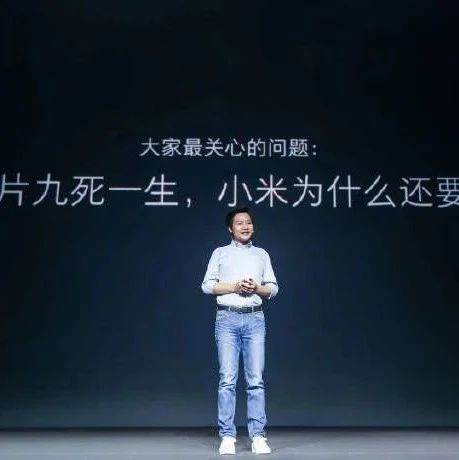
芯片研发

Search documents
芯片重磅!雷军官宣!
新华网财经· 2025-05-19 05:41
Core Insights - Xiaomi's founder Lei Jun announced the upcoming launch of the self-developed 3nm processor chip, Xuanjie O1, marking a significant milestone as the first successful 3nm chip design in mainland China, filling a gap in advanced chip design capabilities [1][2][4] Group 1: Chip Development - Xiaomi has invested ten years in chip research and development, starting its exploration of SoC chips in 2014, and after facing setbacks, shifted focus to smaller chips like ISP and fast-charging chips before resuming SoC development in 2021 [4] - The company has committed a strategic investment of 50 billion yuan over ten years, culminating in the creation of the Xuanjie O1 chip, making Xiaomi the fourth global company capable of designing 3nm mobile SoC chips after Apple, Qualcomm, and MediaTek [4] - Xiaomi's total R&D investment over the past five years has reached 105 billion yuan, with an expected investment of 30 billion yuan this year, employing over 20,000 engineers, including more than 2,500 chip engineers [4] Group 2: Industry Impact - In 2024, China's integrated circuit exports are projected to exceed 1 trillion yuan for the first time, showcasing significant advancements across all segments of the semiconductor industry, with Xiaomi's 3nm chip breakthrough being a notable highlight [2] - Xiaomi aims to become a global leader in next-generation hard technology, focusing on three key technological areas: chips, AI, and operating systems [4] Group 3: Upcoming Product Launch - The strategic new product launch event is scheduled for May 22 at 7 PM, featuring multiple significant products including the Xiaomi Xuanjie O1 chip, Xiaomi 15S Pro, Xiaomi Pad 7 Ultra, and the first SUV, Xiaomi Yu 7 [6][7]



刚刚,雷军官宣!小米YU7发布时间定了!小米芯片,采用第二代3nm工艺制程
Zheng Quan Shi Bao Wang· 2025-05-19 04:14
Core Insights - Xiaomi is set to hold a strategic new product launch event on May 22, featuring multiple significant products including the Xiaomi SoC chip "Xiaomi玄戒O1," Xiaomi 15S Pro, Xiaomi Pad 7 Ultra, and the first SUV "Xiaomi YU7" [1][9] - The Xiaomi玄戒O1 chip utilizes second-generation 3nm process technology, aiming to rank among the top-tier flagship experiences [3][11] Group 1: Chip Development Strategy - In early 2021, Xiaomi made a major decision to enter the automotive sector and restart its "big chip" business, focusing on the development of mobile SoC [4][7] - Xiaomi has a long-standing ambition in chip development, recognizing that achieving greatness as a hardcore technology company requires overcoming the challenges of chip production [4][8] - The company has set high goals for the Xiaomi玄戒 project, including the latest process technology, flagship-level transistor scale, and top-tier performance and efficiency [4][8] Group 2: Investment and R&D Progress - Xiaomi has committed to a long-term investment plan of at least 500 billion RMB over ten years for chip development, with a focus on steady progress [4][8] - As of April this year, the cumulative R&D investment in the Xiaomi玄戒 project has exceeded 135 billion RMB, with a projected R&D expenditure of over 60 billion RMB for this year [8][11] - The R&D team for the Xiaomi玄戒 project has grown to over 2,500 members, positioning Xiaomi among the top three in the domestic semiconductor design sector in terms of both investment and team size [8][11]
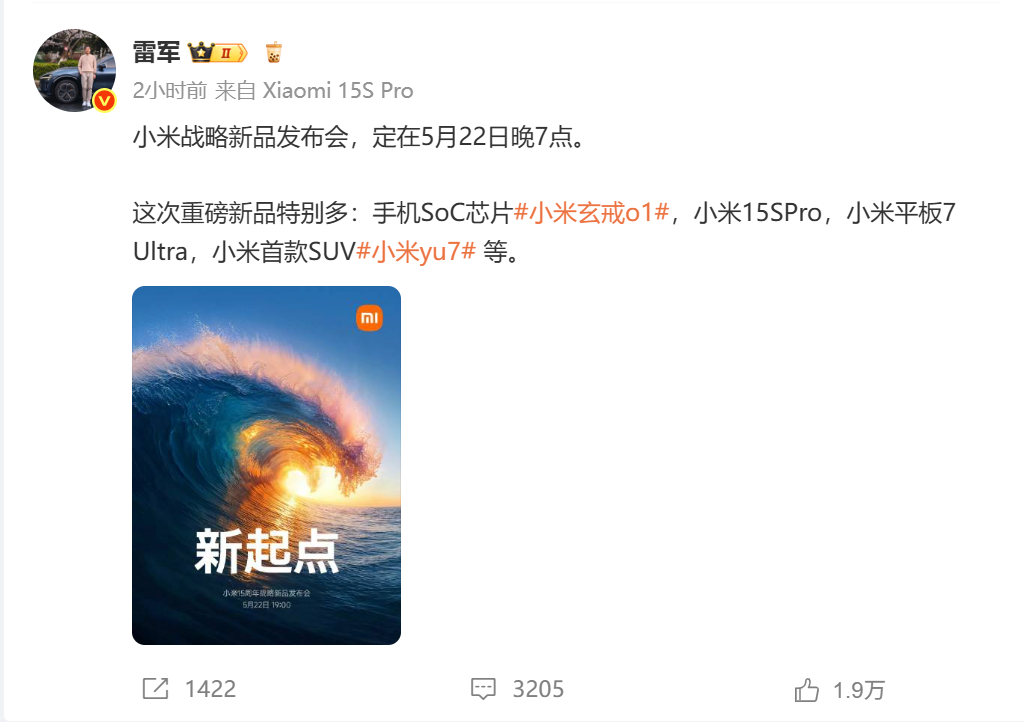
热搜第一!雷军发长文官宣:小米3nm芯片来了
华尔街见闻· 2025-05-19 04:09
Core Viewpoint - The company has announced the launch of its first 3nm chip, the Xiaomi Xuanjie O1, emphasizing the importance of high-end SoC development to support its premium strategy [1]. Group 1: Chip Development - The company restarted its "big chip" business in 2021, focusing on the development of mobile SoCs [1]. - The Xuanjie O1 chip utilizes second-generation 3nm process technology, aiming to rank among the top-tier flagship experiences [1]. - Over the past four years, the cumulative R&D investment in the Xuanjie project has exceeded 13.5 billion RMB, with an expected investment of over 6 billion RMB this year, placing it among the top three in the industry [1]. Group 2: Industry Position - The company acknowledges that despite its 11-year journey in chip development, it is still at the beginning stage compared to competitors who have more accumulated experience in the chip sector [1].
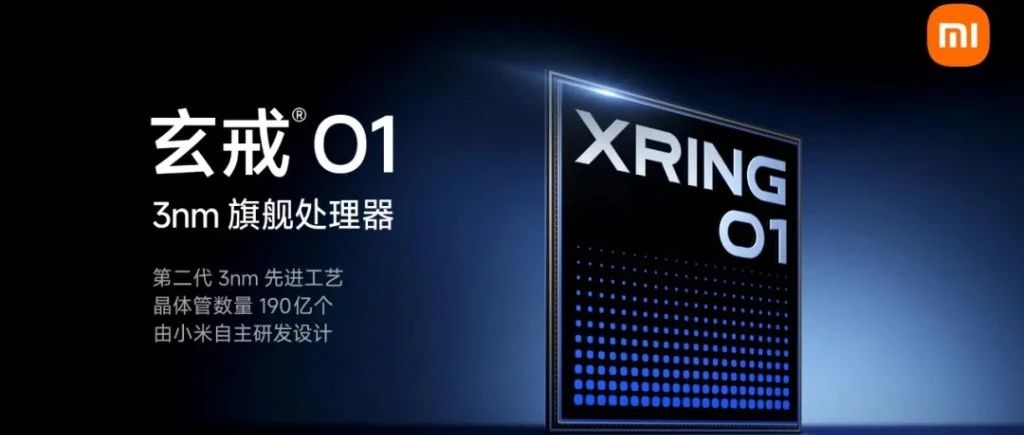
热搜!雷军宣布,小米YU7、自研芯片“定档”!小米股价快速拉升
21世纪经济报道· 2025-05-19 03:41
Core Viewpoint - Xiaomi is set to launch multiple significant products, including the self-developed smartphone SoC chip "Xuanjie O1," the Xiaomi 15 Pro smartphone, and the first SUV model "YU7" on May 22, 2023, indicating a strong push into the semiconductor and automotive sectors [1][2][6]. Group 1: Product Launches - The upcoming launch includes the "Xuanjie O1" chip, Xiaomi 15 Pro smartphone, Xiaomi Pad 7 Ultra, and the SUV model "YU7" [2][1]. - The "Xuanjie O1" chip has seen a cumulative R&D investment exceeding 1.35 billion RMB, with a team of over 2,500 people dedicated to its development [6][8]. Group 2: R&D Investment and Strategy - Xiaomi's R&D investment for the current year is expected to exceed 6 billion RMB, positioning the company among the top three in the domestic semiconductor design sector in terms of investment and team size [8][6]. - The company has invested in 110 semiconductor-related enterprises since 2017, covering various fields such as optical chips and automotive chips [15]. Group 3: Historical Context and Milestones - Xiaomi's journey in chip development began in 2014 with the establishment of Beijing Pinecone Electronics, leading to the release of the first self-developed chip, "Panghu S1," in 2017 [14][15]. - The "Xuanjie O1" chip is considered a key milestone in Xiaomi's ten-year journey in chip development, with expectations of significant advancements in technology [10][14]. Group 4: Future Outlook - The launch of the "Xuanjie O1" chip is anticipated to mark a breakthrough in Xiaomi's chip technology autonomy, potentially positioning the company alongside major players like Apple, Samsung, and Huawei [12][17]. - Xiaomi plans to invest over 100 billion RMB in R&D from 2022 to 2026, focusing on AI, operating systems, and chip technology [16].

雷军:小米玄戒O1 采用第二代3nm工艺制程
news flash· 2025-05-19 03:03
小米集团董事长雷军微博发文表示,早在11年前,2014年,我们就开始芯片研发之旅。我们深知造芯之 艰难,制定了长期持续投资的计划:至少投资十年,至少投资500亿,稳打稳扎,步步为营。四年多时 间,截止今年4月底,玄戒累计研发投入已经超过了135亿人民币。目前,研发团队已经超过了2500人, 今年预计的研发投入将超过60亿元。现在,我们终于交出了第一份答卷:小米玄戒O1,采用第二代3nm 工艺制程,力争跻身第一梯队旗舰体验。 ...
时隔多年,中国再有先进手机芯片,国产最强,遥遥领先!
Xin Lang Cai Jing· 2025-05-18 16:10
Core Viewpoint - A domestic smartphone company is set to launch a new mobile SOC chip, potentially using 4nm or 3nm technology, which may rival Qualcomm's Snapdragon 8 Gen 3, positioning it as a leading player in the domestic smartphone chip market [1][3]. Group 1: Company Overview - The smartphone company is based in northern China and is reportedly naming its new chip "Xuanjie O1," utilizing the widely adopted ARM architecture for compatibility with its existing mobile operating system [3]. - The company previously launched a mobile chip in 2017, which faced performance and thermal issues, leading to poor market reception and subsequent suspension of sales [3][5]. - After the initial setback, the company shifted focus to developing less complex chips, such as ISP and fast-charging chips, to build technical expertise before tackling more challenging SOC chip development [5]. Group 2: Technological Advancements - The upcoming SOC chip represents the culmination of eight years of technological accumulation, indicating a significant advancement in the company's capabilities in mobile chip development [5]. - If the new chip indeed utilizes 4nm or 3nm technology and outperforms the Snapdragon 8 Gen 3, it would become the most advanced and powerful domestic smartphone SOC chip available [5][6]. Group 3: Market Implications - There is a high level of consumer interest in domestically developed SOC chips, and the successful launch of this chip could enhance the company's position in the domestic smartphone market, potentially allowing it to secure the top market share in 2024 [7].
自曝退订会导致“小米汽车崩塌”?小米汽车副总裁否认!雷军:小米不再是行业新人,必须承担大公司责任
Mei Ri Jing Ji Xin Wen· 2025-05-16 13:04
Core Viewpoint - The ongoing controversy surrounding Xiaomi's SU7 Ultra model has escalated, with numerous consumers seeking resolutions for perceived discrepancies between the vehicle's advertised features and actual performance [10][14][18]. Group 1: Consumer Complaints and Legal Actions - A prominent social media influencer, "风云XTony," reported a meeting with Xiaomi's executives regarding the SU7 Ultra model, but no agreement was reached on compensation for affected customers [2][3]. - A group of over 70 car owners has formed a litigation group, planning to sue Xiaomi for false advertising, demanding a "triple compensation" for their losses [4]. - The dissatisfaction stems from claims that the vehicle's features, such as the carbon fiber hood, do not perform as advertised, leading to demands for refunds of deposits totaling 20,000 yuan [10][14]. Group 2: Company Response and Public Relations - Xiaomi's Vice President, Li Xiaoshuang, publicly denied the accuracy of reports regarding the discussions and emphasized the company's willingness to engage with customers directly [6][7]. - Xiaomi's public relations head supported Li's stance, encouraging open communication with users and dismissing rumors as distractions [9]. - CEO Lei Jun acknowledged the company's responsibility as a major player in the automotive industry, emphasizing the need for enhanced safety standards and accountability following a recent tragic accident involving the SU7 [15][21].
中微半导:长城证券、赢舟资本等多家机构于5月15日调研我司
Zheng Quan Zhi Xing· 2025-05-16 09:40
Core Viewpoint - Company reported significant growth in gross margin and aims to exceed historical revenue levels in 2025 [2][10] Financial Performance - In Q1 2025, the company achieved a revenue of 206 million yuan, a year-on-year increase of 0.52% [11] - The net profit attributable to shareholders was 34.42 million yuan, up 19.4% year-on-year [11] - The net profit after deducting non-recurring items was 32.58 million yuan, reflecting a 31.75% increase year-on-year [11] - The gross margin stood at 34.46% [11] - The company has a debt ratio of 7.93% and reported investment income of 9.51 million yuan [11] Product Development - The company has improved its gross margin due to lower wafer prices and the introduction of cost-effective new products [2] - The second-generation automotive-grade MCU has enhancements in frequency, interfaces, and resources compared to the first generation, making it more competitive [3] - The company is expanding its automotive-grade control chips into general and specialized products, focusing on high-performance SoC designs for applications like motor control and battery management [4] Market Presence - The automotive-grade chips have been adopted by several well-known car manufacturers, including Changan, Seres, Hongqi, and Geely [6] - The company is experiencing a continuous increase in orders for automotive MCUs [5] Industrial Growth - Growth in the industrial control sector is primarily driven by the demand for brushless motor drive control products [7] Supply Chain and Pricing - The company has not received any price adjustment notifications from foundries and maintains stable relationships with suppliers, ensuring reasonable pricing and capacity [9]

雷军发文感慨小米造芯路
Zheng Quan Shi Bao· 2025-05-16 03:34
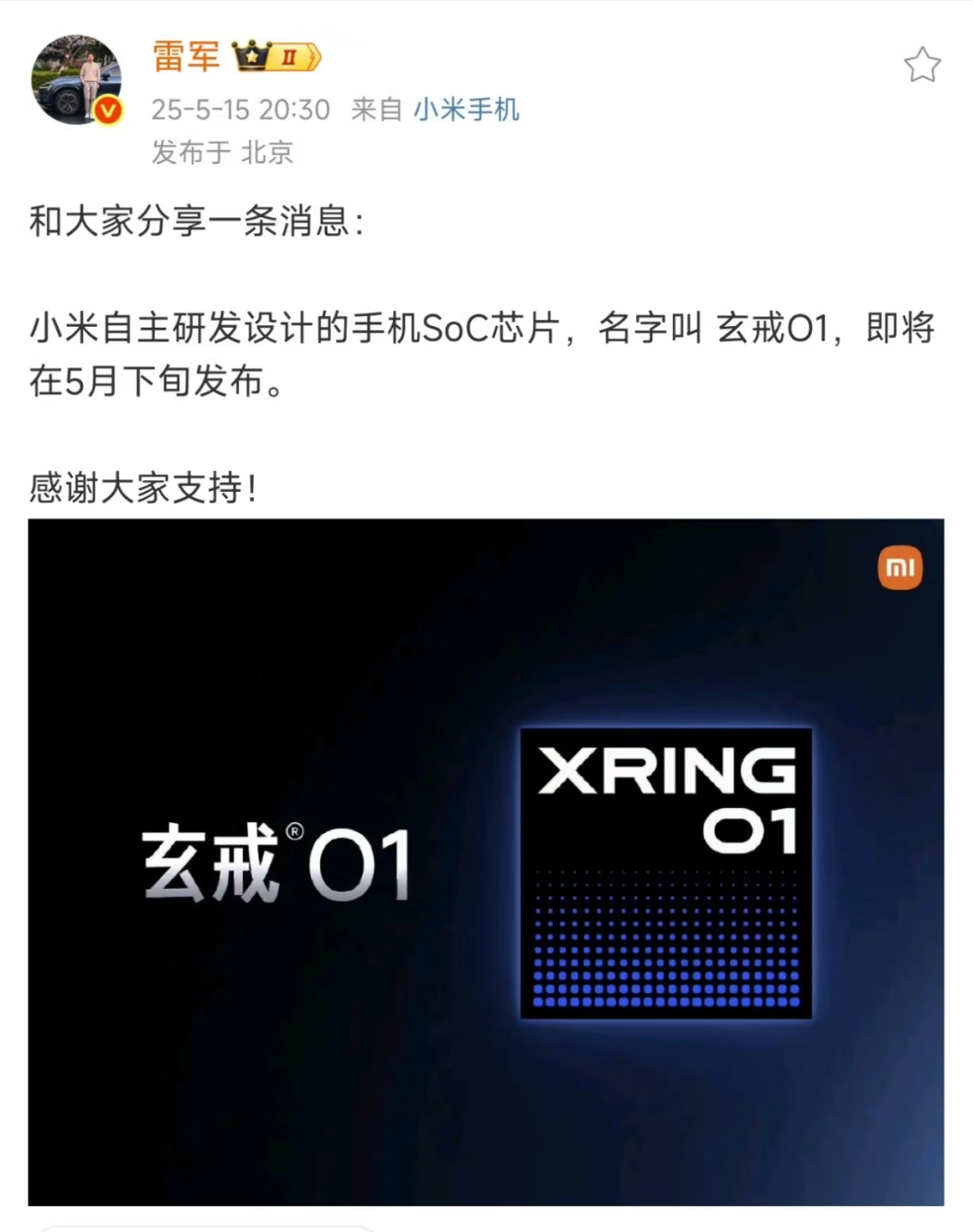
雷军最新发文。 今日早间,雷军还转发了人民网评小米芯片即将问世相关微博,并引用文章内容写道:"只要坚定实干,就没有不可逾越的高山;只要奋起直追,后来者 永远有机会。" 公开资料显示,早在2014年,小米就成立了松果电子公司,负责芯片研发设计。2017年,小米松果发布首款手机芯片——澎湃S1,使得小米成为继苹 果、三星、华为之后的第四家能够自主制造手机芯片的手机厂商。但随后小米的自研芯片却少有动静,在小米十周年的发布会上,雷军坦言,芯片研发遇 到困难,但并没有放弃对澎湃的研发。 2018年9月,湖北小米长江产业基金成立,募集资金120亿元。随后,该基金在半导体领域频频出手,据不完全统计,小米长江产业基金投资的来自芯片领 域相关企业超过40家。 本次小米自研的手机SoC芯片名为"玄戒O1"。企查查显示,北京玄戒技术有限公司(以下简称"北京玄戒")成立于2023年10月26日,注册资本为30亿元, 执行董事为曾学忠。 5月16日早间,小米创始人雷军在微博发文称,"十年饮冰,难凉热血!小米造芯路,始于2014年9月。时间过得好快,转眼十多年过去了……" 昨日晚间,雷军发文宣布,小米自主研发设计的手机SoC芯片即将在5 ...
雷军发文感慨小米造芯路
证券时报· 2025-05-16 03:25
Core Viewpoint - Xiaomi is set to launch its self-developed mobile SoC chip named "Xuanjie O1" by the end of May 2023, marking a significant milestone in its chip development journey that began in 2014 [3][5]. Group 1: Chip Development Journey - Xiaomi established Pinecone Electronics in September 2014 to focus on chip research and development [7]. - The first mobile chip, Surge S1, was released in 2017, making Xiaomi the fourth smartphone manufacturer to produce its own chips after Apple, Samsung, and Huawei [7]. - Despite initial progress, Xiaomi faced challenges in chip development, as acknowledged by founder Lei Jun during the company's tenth anniversary [7]. Group 2: Investment and Funding - In September 2018, Xiaomi established the Hubei Xiaomi Changjiang Industrial Fund, raising 12 billion yuan to invest in the semiconductor sector, with over 40 companies in the chip field receiving investments [7]. - The newly formed Beijing Xuanjie Technology Co., Ltd. has a registered capital of 3 billion yuan and was established on October 26, 2023 [7]. Group 3: Leadership and Expertise - Zeng Xuezhong, the current executive director of Beijing Xuanjie, has a strong background in mobile product development and has held senior positions at ZTE and Unisoc [7]. - Zeng is also the vice chairman of the China Integrated Circuit Design Industry Technology Innovation Strategic Alliance, highlighting his expertise in the industry [7]. Group 4: Patent Activity - Since 2025, Beijing Xuanjie has been actively applying for public invention patents related to chips, with 10 applications filed on May 13, including methods and structures for chip packaging [8]. - The company currently has 115 public patents, with 113 under review, covering various categories such as telecommunications technology and basic electronic circuits [8].