
中华民族共同体意识

Search documents
铸牢中华民族共同体意识 团结奋进中国式现代化新征程——习近平总书记出席西藏自治区成立60周年庆祝活动让西藏各族干部群众备受鼓舞
Yang Guang Wang· 2025-08-23 02:32
Core Viewpoint - The celebration of the 60th anniversary of the Tibet Autonomous Region, attended by General Secretary Xi Jinping, highlights the central government's emphasis on Tibet's development and the unity of its diverse ethnic groups [1][2]. Group 1: Celebration and Significance - Xi Jinping's attendance at the celebration marks the first time a central government delegation has participated in such an event, reflecting the Party's high regard for Tibet's work and its people [1]. - Attendees expressed their pride and excitement about the significant changes in Tibet under the leadership of the Communist Party, emphasizing the importance of unity among ethnic groups [2][3]. Group 2: Development and Future Goals - Since the 18th National Congress, Tibet has experienced its best development period, with the most significant changes and benefits for its people [3]. - Local leaders and residents are committed to enhancing collective economic strength and promoting tourism, aiming to make their communities well-known across the nation [3]. - The emphasis on creating a model region for ethnic unity and progress is a key directive from Xi Jinping, with a focus on fostering a sense of community among all ethnic groups [3][4]. Group 3: Environmental Protection - The commitment to ecological preservation in Tibet is underscored by the need to protect its unique environment, referred to as the "world's roof" and "Asia's water tower," through integrated environmental management [4].
8月22日晚间央视新闻联播要闻集锦
Yang Shi Xin Wen Ke Hu Duan· 2025-08-22 14:04
Group 1 - Xi Jinping attended the 60th anniversary celebration of the Tibet Autonomous Region, emphasizing the importance of strengthening the sense of community among the Chinese nation and advancing modernization [2][5] - The State Council, led by Premier Li Qiang, held a meeting to discuss policies for equipment upgrades and the promotion of sports consumption [4] - The State Administration for Market Regulation reported significant achievements in high-quality development during the 14th Five-Year Plan period [6] Group 2 - The 2025 Shanghai Cooperation Organization Summit is scheduled for August 31 to September 1 in Tianjin, where Xi Jinping will host key meetings and deliver a keynote speech [3] - The Jiangsu Free Trade Zone's plan for the biopharmaceutical industry has been approved, aiming to enhance R&D capabilities and service levels [11] - A new mandatory national standard for harmful substances in electronic products has been issued, detailing limits and compliance evaluation methods [10]
省委常委会召开会议 刘宁主持会议并讲话
He Nan Ri Bao· 2025-08-22 10:46
Group 1: Urban Development - The meeting emphasized the importance of understanding Xi Jinping's significant discussions on urban work and implementing the spirit of the Central Urban Work Conference [2] - It aims to promote urban connotative development, focusing on creating innovative, livable, beautiful, resilient, civilized, and smart modern cities [2] - The strategy includes enhancing the comprehensive competitiveness of major cities and improving the capacity of small and medium-sized cities and towns [2] Group 2: Agricultural Development - The meeting reviewed the "Henan Province Accelerating the Construction of an Agricultural Strong Province Plan (2025-2035)" and highlighted the need to implement Xi Jinping's important discussions on rural work [3] - It aims to establish a long-term mechanism for comprehensive rural revitalization and promote the modernization of agriculture and rural areas [3] - The focus is on achieving agricultural upgrades, rural progress, and farmer development through coordinated efforts [3]
中共中央 全国人大常委会 国务院 全国政协 中央军委关于庆祝西藏自治区成立六十周年的贺电
Xin Hua She· 2025-08-22 00:27
值此西藏自治区成立60周年之际,中共中央、全国人大常委会、国务院、全国政协、中央军委向西 藏自治区各族干部群众和各界人士,向驻藏人民解放军指战员、武警部队官兵和政法干警,向所有参加 和支援西藏建设、关心和支持西藏发展进步的人们,致以热烈的祝贺和亲切的慰问! 1965年西藏自治区成立,是西藏发展史上的一座丰碑,标志着民族区域自治制度在西藏正式实施, 开启了西藏各民族共同团结奋斗、共同繁荣发展的时代新篇。60年来,在党中央坚强领导下,在全国人 民大力支持下,西藏各族干部群众艰苦奋斗、顽强拼搏,民族区域自治制度成功实践,反分裂斗争富有 成效,宗教信仰自由得到充分尊重和保障,经济社会全面发展,人民生活极大改善,西藏的面貌、西藏 各族人民的面貌发生了翻天覆地的历史性巨变。 中共西藏自治区委员会、西藏自治区人大常委会、西藏自治区人民政府、西藏自治区政协、西藏军区: 党的十八大以来,以习近平同志为核心的党中央高度重视西藏发展、十分关心西藏各族人民,确立 新时代党的治藏方略,推动西藏各项事业取得全方位进步、历史性成就,中国式现代化在世界屋脊不断 创造新的奇迹。西藏脱贫攻坚全面胜利,同全国一道实现全面小康;社会大局持续稳定向好 ...
中央代表团在拉萨看望慰问各族干部群众
Xin Hua She· 2025-08-22 00:20
Group 1 - The central delegation, led by Wang Huning, visited Lhasa to express care and support from the central government and the Communist Party for the development of Tibet [1] - Wang Huning emphasized the significance of Xi Jinping's presence at the 60th anniversary celebration of the Tibet Autonomous Region, marking a historic first for the Party and the nation [1] - The delegation highlighted the remarkable changes in Lhasa over the past 60 years, particularly since the 18th National Congress, and called for continued adherence to Xi Jinping's thoughts and strategies for Tibet [1] Group 2 - The delegation visited various locations, including the Jokhang Temple and Tibet University, to assess the development of religious and higher education in Tibet [2] - Wang Huning urged religious leaders to promote national unity and social harmony while guiding the faithful to support the Party and contribute to the modernization of Tibet [2] - The focus on ecological development and improving people's livelihoods was reiterated, with an emphasis on achieving a balance between economic prosperity and environmental sustainability [2]
持续深入抓好稳定、发展、生态、强边四件大事
Ren Min Ri Bao· 2025-08-21 22:13
Group 1 - Xi Jinping's speech at the 60th anniversary of Tibet's establishment emphasizes the importance of high-quality development and the need to adhere to the new development philosophy [1] - The focus is on maintaining political stability, social harmony, and ethnic unity in Tibet, with initiatives like the "National Unity Progress Demonstration City" and community engagement activities [2][3] - The promotion of highland characteristic industries, such as barley processing, is highlighted as a key to increasing local income and economic development [4] Group 2 - The implementation of poverty alleviation measures and job creation efforts are crucial, with significant progress reported in employment and housing for disaster-affected areas [5] - The importance of party leadership and strengthening party organizations is emphasized, with various educational initiatives and community projects being undertaken [6][7] - The commitment to anti-corruption measures and governance reforms is reinforced to ensure a prosperous and harmonious modern Tibet [7]
奋进一甲子 雪域换新颜
Ren Min Ri Bao· 2025-08-21 22:13
Core Viewpoint - The development of Tibet over the past 60 years has led to significant improvements in the living standards of its residents, driven by effective policies and initiatives from the central government [1][5][10]. Group 1: Economic Development - Tibet's GDP reached its first trillion in 50 years and is expected to exceed 300 billion this year, achieving the third trillion target in just 6 years [7]. - Major economic indicators have consistently ranked among the top in the country, with over 50% of the region's land included in ecological protection red lines [1][5]. - The per capita disposable income for urban and rural residents is projected to reach 55,444 yuan and 21,578 yuan respectively by 2024 [6]. Group 2: Social Welfare and Community Development - Over 80% of fiscal revenue is invested in social welfare, enhancing education, healthcare, and elderly care services [5][6]. - The establishment of a comprehensive social security system has significantly improved the sense of gain, happiness, and security among the population, with satisfaction rates exceeding 99% [1][5]. - The number of medical institutions has surpassed 7,200, contributing to an increase in life expectancy to 72.5 years [6]. Group 3: Ethnic Unity and Cultural Integration - The deepening of exchanges among various ethnic groups has strengthened the sense of community and social stability [2][3]. - A total of 154 collectives and 204 individuals have been recognized as "National Model for Ethnic Unity and Progress," with all cities and districts in Tibet designated as demonstration areas for ethnic unity [2]. - The implementation of paired assistance programs has fostered strong ties between Tibet and supporting provinces, enhancing local development [2][3]. Group 4: Environmental Protection - Tibet has made significant strides in ecological conservation, with a stable forest coverage rate of 12.31% and an increase in grassland vegetation coverage [8]. - The promotion of artificial grass planting techniques has effectively addressed grassland degradation, benefiting local livestock production [8]. - The integration of various ecological protection measures has led to a successful transformation of previously barren lands into green spaces [8].
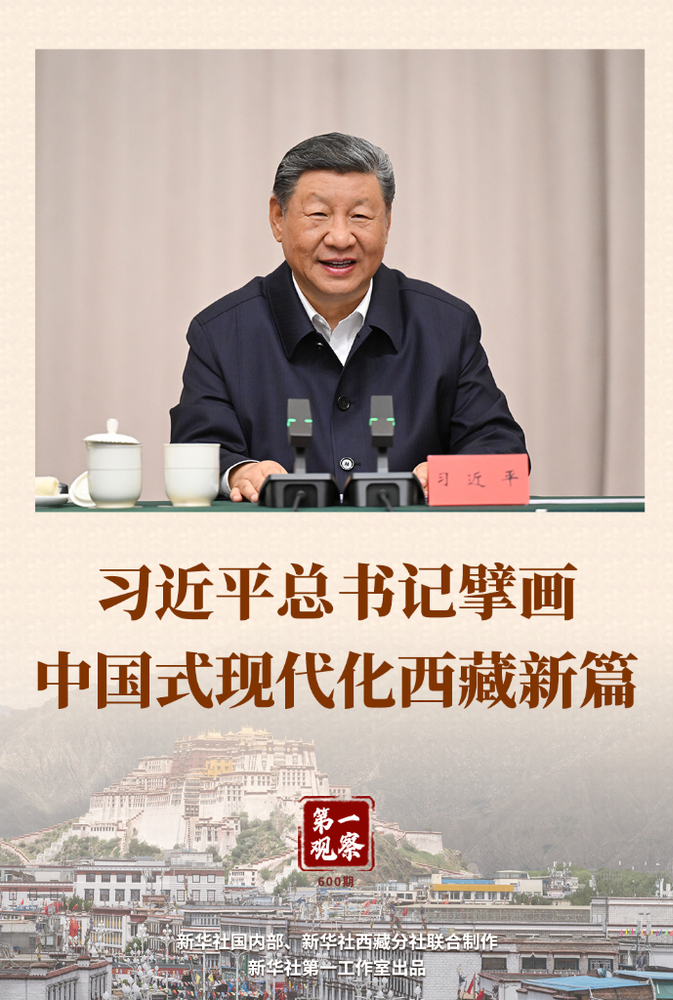
第一观察 | 习近平总书记擘画中国式现代化西藏新篇
Xin Hua She· 2025-08-21 21:46
Core Viewpoint - The article emphasizes the importance of political stability, social harmony, and ethnic unity as foundational elements for the long-term development and high-quality growth of Tibet, as articulated by General Secretary Xi Jinping during his visit to Lhasa for the 60th anniversary of the Tibet Autonomous Region [4][5][6]. Group 1: Political Stability and Ethnic Unity - Political stability and social harmony are deemed essential for Tibet's development and prosperity, with a focus on maintaining national unity and strengthening ethnic solidarity [4][5]. - The central government's strategy for Tibet emphasizes the need for a long-term commitment to fostering a sense of shared identity among the Chinese nation, which is crucial for social cohesion [4][5]. Group 2: High-Quality Development - High-quality development is identified as a necessary requirement for China's modernization, with Xi Jinping urging the need for a development path that aligns with Tibet's unique characteristics [6][8]. - The article highlights the importance of leveraging Tibet's natural resources and ecological advantages to promote specialized industries and major infrastructure projects, such as the Yarlung Tsangpo River hydropower project and the Sichuan-Tibet Railway [8]. Group 3: People-Centric Development - Enhancing the people's sense of gain, happiness, and security is framed as a fundamental aspect of high-quality development, with specific attention to employment, education, healthcare, and social security [9]. - The article underscores the necessity of strong party leadership and organizational capacity to effectively implement development strategies in Tibet [10][12].

西藏自治区成立60周年庆祝大会隆重举行 中共中央全国人大常委会国务院全国政协中央军委致电祝贺 习近平出席大会 王沪宁出席并讲话 蔡奇出席
Shang Hai Zheng Quan Bao· 2025-08-21 19:37
Core Points - The 60th anniversary of the establishment of the Tibet Autonomous Region was celebrated with a large gathering in Lhasa, attended by key leaders including Xi Jinping [1][3] - The event highlighted the historical significance of the establishment of the region in 1965 and the achievements made over the past six decades in economic and social development [3][4] - The celebration included speeches emphasizing the importance of national unity and the implementation of policies aimed at high-quality development in Tibet [4][5] Summary by Sections Celebration Event - Approximately 20,000 people gathered at the Potala Palace Square in Lhasa to celebrate the 60th anniversary [1] - The event featured a festive atmosphere with colorful flags and traditional attire, showcasing the cultural diversity of the region [1][5] Leadership and Speeches - Key leaders, including Wang Huning, delivered speeches acknowledging the historical achievements of the region since its establishment [3][4] - Wang Huning presented a plaque with Xi Jinping's inscription promoting the construction of a beautiful new Tibet [3] Historical Context and Achievements - The establishment of the Tibet Autonomous Region in 1965 marked a significant milestone in the region's development, leading to improvements in social systems and economic conditions [3] - The past 60 years have seen substantial progress in ethnic unity, poverty alleviation, and overall living standards for the people of Tibet [3][4] Future Directions - Emphasis was placed on continuing to implement the Party's strategies for Tibet, focusing on stability, development, ecological preservation, and border security [4] - The goal is to build a prosperous, harmonious, and beautiful socialist modern Tibet, contributing to the overall rejuvenation of the Chinese nation [4]
六十载春华秋实,向未来豪情满怀——习近平总书记出席西藏自治区成立60周年庆祝大会鼓舞广大干部群众团结奋进新征程
Xin Hua Wang· 2025-08-21 18:13
Core Points - The celebration of the 60th anniversary of the Tibet Autonomous Region highlights the significant changes and development in Tibet over the past six decades, emphasizing the importance of unity among different ethnic groups and the leadership of the Communist Party of China [1][2][3][5]. Group 1 - The event was marked by the presence of General Secretary Xi Jinping, who emphasized the importance of building a shared Chinese national community and enhancing ethnic unity [1][5]. - Representatives from various ethnic groups expressed their gratitude towards the Communist Party for the improvements in their lives and the development of the region [2][3]. - The celebration showcased cultural performances that reflected the unity and harmony among different ethnic communities in Tibet [6][10]. Group 2 - The leadership of the Communist Party is seen as crucial for the prosperity and development of ethnic regions, with calls for continued efforts to promote ethnic unity and community building [4][8]. - Local leaders and community members pledged to work towards furthering the development goals set by the Party, emphasizing the need for collective effort and dedication [11][12]. - The event served as a platform to reinforce the commitment to national development and the importance of integrating ethnic minority regions into the broader national framework [10][12].