零碳园区

Search documents
施耐德电气携上海交通大学在进博会发布重磅报告 共探零碳园区规模化建设路径
Zheng Quan Ri Bao Wang· 2025-11-06 09:13
Core Insights - The report highlights the significance of zero-carbon parks in achieving China's dual carbon goals, emphasizing their role in industrial and building decarbonization [1][2] - The transition from policy-driven to market-driven development of zero-carbon parks is anticipated by 2025, although challenges such as high initial investment and immature technology remain [2][3] Group 1: Challenges in Zero-Carbon Park Development - The construction of zero-carbon parks faces challenges including commercial model difficulties, immature technology, and unclear pathways [2] - Initial investment for zero-carbon parks is substantial, leading to financial pressure on developers and enterprises due to long payback periods [2] - The technology-intensive nature of zero-carbon parks requires customized solutions due to varying energy consumption and decarbonization methods across different industries [2] Group 2: Strategies for Advancement - The report suggests that scaling up zero-carbon parks requires a focus on technological innovation and ecological collaboration [3] - Technology is identified as a key driver for low-carbon transition, providing economically viable solutions while directly reducing carbon emissions [3] - Collaboration between park operators and enterprises is essential to overcome the limitations of individual capabilities, integrating top-down design with bottom-up optimization [3] Group 3: Practical Experience and Case Studies - Practical experience is deemed crucial for the development of zero-carbon parks in China, with Schneider Electric's Wuxi factory serving as a benchmark for sustainable practices [4] - The Wuxi factory has successfully reduced carbon emissions by 90% and water usage by 15% through innovative measures such as AI-driven ecological design and a closed-loop CO2 tracking platform [4] - Schneider Electric emphasizes that the value of zero-carbon parks extends beyond emissions reduction, acting as a new engine for green competitiveness and productivity [4]
施耐德电气携上海交通大学进博会发布《2025零碳园区行业影响力洞察报告》
Xin Lang Ke Ji· 2025-11-06 09:12
Core Insights - The report emphasizes the importance of zero-carbon parks as a crucial pathway for energy transformation, highlighting their role in enhancing renewable energy consumption and energy structure transition [1][2] - The shift towards zero-carbon park development is expected to move from "policy-driven" to "market-driven" by 2025, although challenges such as commercial viability, technological maturity, and unclear pathways remain [1][2] Group 1: Technological Innovation - Technological innovation is identified as a core driver for low-carbon transformation, with AI technology enabling over 10% efficiency improvement in HVAC systems and direct current architecture reducing energy loss by over 7% [2] - The collaborative operation of source-network-load-storage systems can optimize demand charges, helping businesses lower electricity costs and enhance economic viability [2] Group 2: Ecological Collaboration - The essence of zero-carbon parks lies in the deep integration of top-down mechanism design and bottom-up scenario optimization, requiring collaboration among government, park management, enterprises, service providers, and academic institutions [2] - Mechanism innovation is necessary to clarify responsibilities, while technological integration can address professional challenges, ultimately facilitating the transition from pilot demonstrations to widespread adoption of zero-carbon parks [2] Group 3: Practical Experience - Practical experience is deemed crucial for the construction of zero-carbon parks in China, with Schneider Electric's Wuxi factory serving as a model for modular, profitable, and scalable solutions that combine advanced technology with carbon reduction measures [3] - The Wuxi factory achieved a 90% reduction in Scope 1 and Scope 2 carbon emissions and a 15% reduction in water usage within two years through innovative practices such as AI-driven ecological design and a closed-loop CO2 tracking platform [3] Group 4: Future Outlook - The value of zero-carbon parks extends beyond mere emissions reduction, positioning them as a key battleground for achieving carbon neutrality and a new engine for developing green industrial competitiveness [3] - Schneider Electric aims to continue driving digital and green transformation through innovation and practical experience, collaborating with various partners to accelerate the development of zero-carbon parks in China [3]
施耐德电气进博会发布报告 共探零碳园区规模化建设路径
Zheng Quan Shi Bao Wang· 2025-11-06 08:14
Core Insights - The report highlights the significance of zero-carbon parks in achieving carbon neutrality goals and addresses the challenges faced in their construction [1][2][3] Group 1: Overview of Zero-Carbon Parks - Zero-carbon parks are seen as a crucial approach to tap into the decarbonization potential of industries and buildings, serving as a breakthrough for economic decarbonization [1] - The construction of zero-carbon parks is transitioning from being policy-driven to market-driven by 2025, indicating a growing interest and urgency in this area [1] Group 2: Challenges in Development - The initial investment for zero-carbon parks is substantial, leading to financial pressure on developers and enterprises due to long payback periods [1] - The construction process faces challenges such as immature technology, unclear pathways, and difficulties in closing commercial loops [2] - Different park types require customized solutions due to significant variations in energy consumption and carbon reduction methods, complicating the implementation of zero-carbon initiatives [2] Group 3: Recommendations for Advancement - The report suggests that scaling up zero-carbon parks requires innovation in technology and collaborative ecosystems involving various stakeholders [3] - Technological advancements, such as AI, can enhance energy efficiency by over 10%, playing a critical role in the low-carbon transition [3] - A collaborative approach among government, park management, enterprises, service providers, and academic institutions is essential to overcome professional challenges and balance green benefits with economic value [3] Group 4: Case Studies and Future Directions - Schneider Electric's Wuxi factory, recognized as a "sustainable lighthouse factory," exemplifies a modular, profitable, and scalable solution that integrates advanced technology with carbon reduction measures [4] - The company emphasizes that the value of zero-carbon parks extends beyond emissions reduction, serving as a new engine for green competitiveness and productivity [4] - Schneider Electric plans to continue driving digital and green transformation through innovation and collaboration with various partners to accelerate the construction of zero-carbon parks in China [4]

关于举办绿电直连及零碳园区创建研讨培训的通知丨系列培训
中国能源报· 2025-11-06 05:31
Core Viewpoint - The article emphasizes the importance of low-carbon transformation in industrial parks and the promotion of green electricity consumption, highlighting the establishment of zero-carbon parks as a key initiative supported by national policies [2]. Group 1: Policy and Initiatives - The "14th Five-Year Plan" aims to establish around 100 national-level zero-carbon parks, with provinces actively applying for national and provincial-level zero-carbon park construction [2]. - The government is accelerating the increase of green electricity consumption in key energy-consuming sectors, encouraging the development of green electricity factories and parks that achieve 100% green electricity consumption [2]. - The "Notice on Promoting Green Electricity Direct Connection" encourages export-oriented enterprises to utilize surrounding renewable energy resources for green electricity direct connection projects [2]. Group 2: Training Program Details - A training seminar on green electricity direct connection and zero-carbon park creation will be held from November 21 to 22 in Chengdu, organized by China Energy News and supported by the China Energy Economic Research Institute [3]. - The training targets various stakeholders, including power companies, renewable energy enterprises, energy service companies, and professionals interested in zero-carbon park construction [3][4]. Group 3: Course Modules - The training will cover topics such as green electricity direct connection policies, project pricing mechanisms, planning and design points, investment and returns, and the application of green electricity direct connection in zero-carbon parks [5]. - It will also address the evaluation index system for zero-carbon parks, construction status, investment analysis, key technology paths, and certification processes [5]. Group 4: Financial Information - The training fee is set at 3,900 yuan per person, which includes the training cost, while transportation and accommodation are self-catered [5].


国家电投集团与福建省福州市举行工作会谈
Zheng Quan Shi Bao Wang· 2025-11-05 14:31
Core Viewpoint - The meeting between Liu Mingsheng, Chairman of State Power Investment Corporation, and Guo Ningning, Deputy Secretary of Fujian Provincial Committee, focused on enhancing cooperation between central and local governments in energy projects and green energy transition [1] Group 1: Cooperation and Projects - The discussion emphasized the planning of key energy projects during the 14th Five-Year Plan period [1] - Both parties expressed commitment to deepen practical cooperation in areas such as technological innovation and key projects [1] Group 2: Green Energy and Low-Carbon Transition - The meeting highlighted the acceleration of green energy and low-carbon transformation efforts [1] - There was a focus on improving energy security and ensuring a stable energy supply [1] Group 3: Communication and Collaboration - The parties agreed to strengthen communication regarding zero-carbon parks and other collaborative initiatives [1]
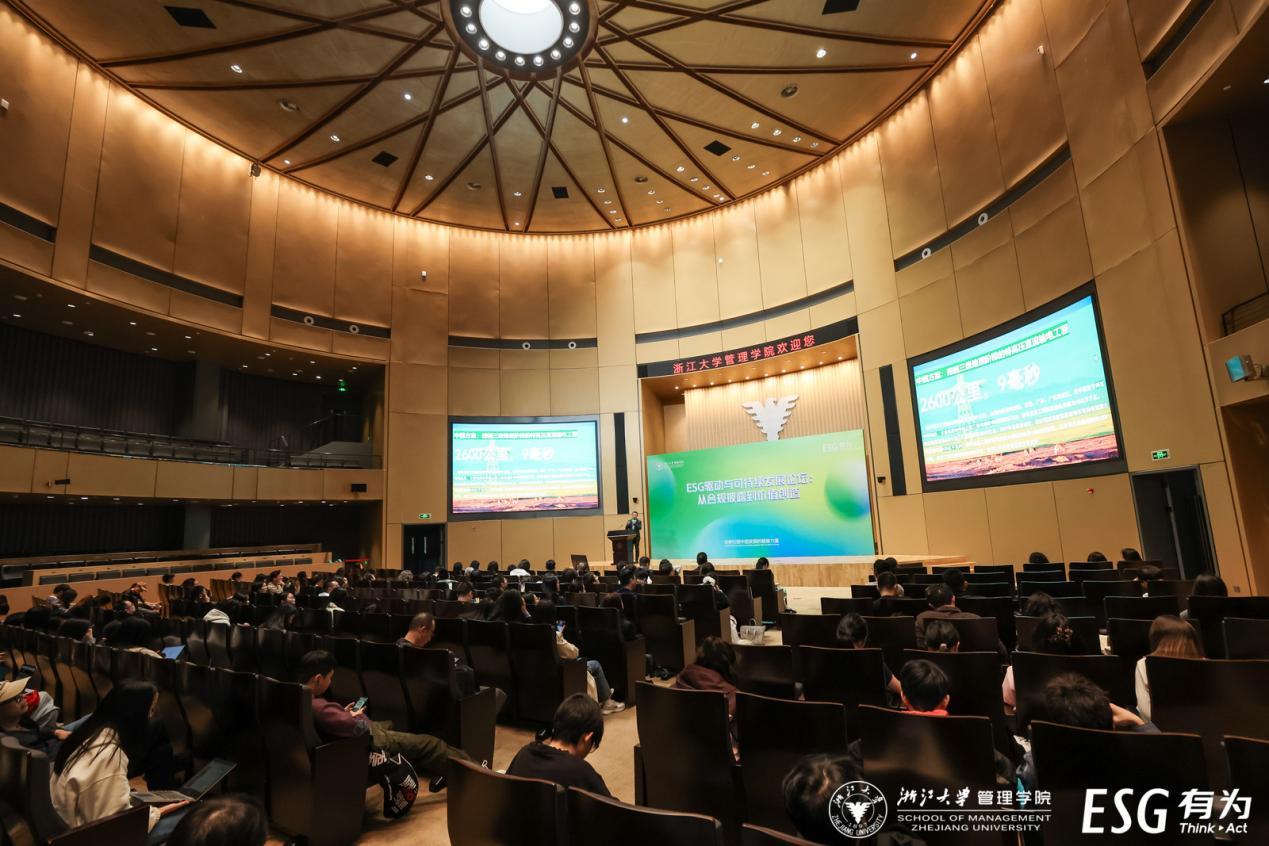
“ESG驱动与可持续发展论坛”圆满举行,“产学研金用”共探价值创造新路径
Mei Ri Jing Ji Xin Wen· 2025-11-05 11:06
Core Viewpoint - The forum emphasized that ESG (Environmental, Social, Governance) has evolved from a voluntary action to a core strategy for companies, driven by global sustainable development trends and the "dual carbon" strategy [1][3]. Group 1: ESG as a Strategic Imperative - ESG is now considered a "must-answer question" for listed companies, integrating environmental, social, and governance dimensions into corporate strategy for risk management and innovation [3]. - The essence of ESG is to drive businesses towards positive societal impact, rooted in a reflection on the negative externalities of industrial civilization and the need for sustainable development [4][6]. Group 2: Implementation and Challenges - The best driving force for ESG practice is the entrepreneurial spirit, which emphasizes balancing economic, social, and environmental values, contrasting with traditional shareholder primacy [6]. - Companies face the challenge of translating high-level ESG theoretical requirements into executable and quantifiable management strategies, especially as regulatory demands for ESG disclosures increase [6][8]. Group 3: ESG Reporting and Value Creation - ESG reports serve as platforms for showcasing sustainable practices and provide valuable insights for external stakeholders, with a focus on forward-looking non-financial indicators [10]. - Companies like Hikvision have integrated ESG principles into their operations, demonstrating how technology can align with sustainable development goals [9][10]. Group 4: Zero-Carbon Initiatives - The concept of zero-carbon parks is highlighted as a critical component for achieving urban and corporate sustainability, acting as a nexus for clean energy and economic growth [12]. - The construction of zero-carbon parks is seen as a key battleground for corporate green transformation and sustainable development from 2025 to 2030 [12]. Group 5: Capital and Industry Collaboration - Achieving ESG value creation requires breaking down barriers between industry and capital, emphasizing the importance of integrating ESG into investment decision-making [13][17]. - High-quality ESG information disclosure is crucial for facilitating collaboration between capital and industry, helping companies understand their sustainability management levels and enabling investors to identify risks and opportunities [18].
关于举办绿电直连及零碳园区创建研讨培训的通知丨系列培训
中国能源报· 2025-11-05 07:15
Core Viewpoint - The article emphasizes the importance of green electricity consumption and the establishment of zero-carbon parks as key components in the low-carbon transition of energy utilization in industrial parks. It highlights the government's initiative to create approximately 100 national-level zero-carbon parks during the "14th Five-Year Plan" period, moving from concept to project implementation [2]. Group 1: Policy and Initiatives - The "Notice on the Construction of Zero-Carbon Parks" outlines the construction conditions, key tasks, and organizational measures for zero-carbon parks [2]. - Various provinces are actively applying for national-level zero-carbon parks and promoting provincial-level zero-carbon park construction [2]. - The government aims to increase the proportion of green electricity consumption in key energy-consuming units and industries, encouraging the establishment of green electricity factories and parks with 100% green electricity consumption [2]. Group 2: Training Program Details - A training seminar on green electricity direct connection and zero-carbon park creation will be held from November 21 to 22 in Chengdu [3]. - The seminar is organized by the China Energy News Agency and supported academically by the China Energy Economic Research Institute [3]. - Target participants include power companies, renewable energy enterprises, energy service companies, and professionals interested in zero-carbon park construction [3]. Group 3: Course Modules - The training will cover various topics, including green electricity direct connection policies, application scenarios, pricing mechanisms, investment and returns, and the integration of renewable energy stations [4][5]. - It will also address the evaluation index system for zero-carbon parks, construction status, site investment analysis, key technology paths, and certification processes [5]. Group 4: Training Fees and Contact Information - The training fee is set at 3,900 yuan per person, excluding transportation and accommodation [5]. - Payment can be made via bank transfer, and contact information for inquiries is provided [5].

霍普股份签订5亿元储能系统采购合同
Zheng Quan Shi Bao· 2025-11-04 17:36
Core Viewpoint - Hop Holdings (霍普股份) has signed a significant energy storage system procurement contract worth 500 million yuan with Nanjing Sijiang New Energy Technology Co., Ltd, which is expected to positively impact the company's future operating performance [1] Group 1: Contract Details - The contract price is 500 million yuan (including tax) [1] - The delivery period for the equipment is set between April 1 and April 30, 2026 [1] - Nanjing Sijiang will transport the goods to the designated site in batches according to construction site requirements [1] Group 2: Business Overview - Hop Holdings operates in two main segments: architectural design and green energy [1] - The architectural design segment offers comprehensive professional services from consulting and planning to engineering implementation [1] - The green energy segment focuses on distributed renewable energy development, operation management, and resource aggregation, providing customized zero-carbon solutions [1] Group 3: Financial Performance - The green energy segment's revenue for the first half of 2025 reached 20.8039 million yuan, a year-on-year increase of 256.89% [1] - The segment's revenue contribution to total revenue rose from 11.91% in the same period last year to 40.69% [1] - The gross margin for the segment was 56.79%, an increase of 1 percentage point year-on-year [1] Group 4: Recent Achievements - In July, the subsidiary Tianjin Jiahui won a bid for the "Langyuan New Energy 200MW/400MWh Shared Energy Storage Demonstration Project" with a contract value of 449 million yuan [2] - In the same month, Tianjin Jiahui also secured a contract for the Tongwei Yiheng New 50MW/200MWh Independent Energy Storage Station Demonstration Project worth 159 million yuan [2] - At the end of October, Hop Holdings' subsidiary signed a procurement contract for the Dunhuang Guosheng Nandu 200MW/800MWh Independent Energy Storage Demonstration Project valued at 520 million yuan [2]
全资子公司签订5亿元储能系统采购合同 霍普股份加码建筑绿能业务板块
Zheng Quan Shi Bao Wang· 2025-11-04 11:31
Core Viewpoint - Hop Holdings (霍普股份) has signed a significant energy storage system procurement contract worth 500 million yuan with Nanjing Sijiang New Energy Technology Co., Ltd, which is expected to positively impact the company's future operating performance [1][2] Group 1: Contract Details - The contract signed by Hop Holdings' subsidiary, Shanghai Hop Intelligent New Energy Development Co., Ltd, stipulates a delivery period from April 1 to April 30, 2026 [1] - The contract price is 500 million yuan, including tax [1] Group 2: Business Segments - Hop Holdings operates in two main business segments: architectural design and green energy [1] - The architectural design segment offers comprehensive professional services from consulting and planning to engineering implementation [1] - The green energy segment focuses on distributed renewable energy development, operation management, and resource aggregation, providing customized zero-carbon factory and park solutions [1] Group 3: Recent Performance and Growth - The green energy segment has seen significant growth, with revenue reaching 20.8039 million yuan in the first half of 2025, a year-on-year increase of 256.89%, and its share of total revenue rising from 11.91% to 40.69% [1] - The gross margin for this segment was 56.79%, up by 1 percentage point year-on-year [1] Group 4: Recent Contracts and Future Plans - In 2023, Hop Holdings secured multiple large-scale energy storage contracts, including a 449 million yuan project and a 159 million yuan project [2] - For the first three quarters of 2023, the company reported revenue of 78.0132 million yuan, a year-on-year decrease of 1.54%, and a net loss of 31.4815 million yuan, although the loss margin has narrowed [2] - The company plans to enhance its architectural design business while increasing investments in the green energy sector, focusing on developing distributed renewable energy aggregation platforms and exploring innovative business models for virtual power plants [2]
关于举办绿电直连及零碳园区创建研讨培训的通知丨系列培训
中国能源报· 2025-11-04 09:08
Core Viewpoint - The article emphasizes the importance of low-carbon transformation in industrial parks and the promotion of green electricity consumption, highlighting the establishment of zero-carbon parks as a key initiative supported by national policies [2]. Group 1: Policy and Initiatives - The "14th Five-Year Plan" aims to establish around 100 national-level zero-carbon parks, with provinces actively applying for national and provincial-level zero-carbon park construction [2]. - The government is accelerating the increase of green electricity consumption in key energy-consuming sectors, encouraging the development of green electricity factories and parks that achieve 100% green electricity consumption [2]. - The "Notice on Promoting Green Electricity Direct Connection" encourages export-oriented enterprises to utilize surrounding renewable energy resources for green electricity direct connection projects [2]. Group 2: Training Program Details - A training seminar on green electricity direct connection and zero-carbon park creation will be held from November 21 to 22 in Chengdu, organized by China Energy News and supported by the China Energy Economic Research Institute [3]. - The training targets various stakeholders, including power companies, renewable energy enterprises, energy service companies, and professionals interested in zero-carbon park construction [3][4]. Group 3: Course Modules - The training will cover topics such as green electricity direct connection policies, project pricing mechanisms, planning and design points, investment and returns, and the application of green electricity direct connection in zero-carbon parks [5]. - It will also address the evaluation index system for zero-carbon parks, construction status, investment analysis, key technology paths, and certification processes [5]. Group 4: Financial Information - The training fee is set at 3,900 yuan per person, which includes the training cost, while transportation and accommodation are self-catered [5].