
Interest Rates

Search documents
X @CryptoJack
CryptoJack· 2026-03-02 09:51
BREAKING:🇺🇸 Odds of the Fed not cutting rates in March have surged to 95.7%. https://t.co/X7mSNrQtQU ...
X @Cointelegraph
Cointelegraph· 2026-03-02 09:48
🇺🇸 NOW: Odds of the Fed not cutting rates in March have surged to 95.7%. https://t.co/FnsPnRKo9u ...
X @Cointelegraph
Cointelegraph· 2026-03-02 09:00
🇺🇸 NOW: Odds of the Fed not cutting rates in March have surged to 99.5%. https://t.co/FbVlbXl8pw ...
X @Bloomberg
Bloomberg· 2026-03-02 06:16
India’s policy rate will remain around current levels for an extended period and may even trend lower, the country’s central bank governor said in an interview with The Economic Times newspaper https://t.co/w2Io9DeaVC ...
X @Bloomberg
Bloomberg· 2026-03-01 22:16
One of Japan’s largest regional banks is testing the country’s choppy bond market by investing in shorter-term notes to secure higher returns, while avoiding longer-dated securities as interest rates rise. https://t.co/82V0u9wWOA ...
全球市场分析- 从利率视角看 AI 热潮-Global Markets Analyst_ A Rates View of the AI Boom
2026-03-01 17:23
Summary of Key Points from the Conference Call Industry Overview - The discussion centers around the impact of Artificial Intelligence (AI) on global markets, particularly focusing on productivity growth and its implications for interest rates and investment dynamics [2][3][4]. Core Insights and Arguments 1. **AI-Driven Productivity Boom**: Expectations of an AI-driven productivity boom have led to increased investment and a repricing of equity markets, with potential implications for interest rates that are complex and multifaceted [2][3]. 2. **Interest Rate Dynamics**: Higher productivity growth could lead to higher neutral rates by increasing expected returns on capital, which may reduce savings and increase investments. However, the transition to this higher growth state may involve significant cyclical variations in interest rates [2][12]. 3. **Front-End Rates Pressure**: Front-end rates are influenced by competing cyclical pressures from AI, with potential for both upward pressure from increased investment and consumption, and downward pressure from reduced inflation due to productivity improvements [2][12]. 4. **Investment Surge**: AI-related investment is currently annualizing at approximately $250 billion, representing around 0.8 percentage points of US GDP, comparable to the rise in business investment seen in the 1990s [12][20]. 5. **Labor Market Disruption**: The adoption of AI is expected to cause significant labor displacement, with estimates suggesting a potential impact on 6-7% of jobs during the adoption period. This could lead to temporary increases in unemployment [20][31]. 6. **Historical Context**: The report draws parallels with past productivity booms, such as the electrification and the 1990s tech rally, highlighting how initial investment surges can lead to inflationary pressures followed by a moderation in price pressures as productivity gains materialize [21][26]. 7. **Fiscal Implications**: Stronger growth from AI could improve fiscal outlooks, but actual improvements will depend on policy choices. The UK aims to save approximately £45 billion annually through digitization and AI in the public sector [45][41]. 8. **Bond Market Dynamics**: The report anticipates that AI-related corporate issuance could compete for savings, potentially limiting relief for long-end risk premia. The sensitivity of long-end yields to public debt levels is expected to increase due to rising investment funded by debt [51][58]. 9. **Volatility and Investment Cycles**: The current investment landscape is characterized by increased volatility, with AI-related investment acting as a new source of macroeconomic volatility that should be factored into rates views [62][59]. Other Important Insights - **Cyclical Volatility**: The rise in AI-related investment has the potential to drive business cycles in both directions, with stronger conditions now but potential weaknesses later due to over-investment or labor market concerns [12][20]. - **Dovish Policy Outlook**: Despite the potential for upward pressure on rates from strong business investment, the focus on labor market disruption suggests that policy rates may lean towards a dovish stance [2][35]. - **Investment in Information Processing**: Information processing currently constitutes about 12% of total investment, indicating a significant shift in investment patterns compared to historical norms [17]. This summary encapsulates the key points discussed in the conference call, providing a comprehensive overview of the implications of AI on productivity, interest rates, and the broader economic landscape.
Mortgage Rates Just Dipped Below 6%–Here's When to Refinance
The Wall Street Journal· 2026-02-26 17:42
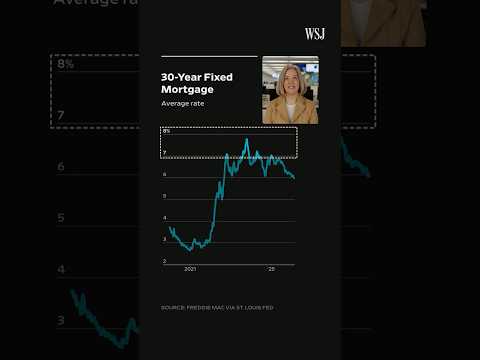
Mortgage rates are dipping below 6% and that's tempting for people who want to refinance, especially those who have mortgage rates in the 7 to 8% [music] range. But before you refi, you need to do the math. Closing costs have surged in recent years, and they typically range from 2 to 6% of your new loan balance.On a $400,000 mortgage, that translates to about $8,000 to $24,000 in fees. To make a refi worthwhile, you need a rate that's at least half a percentage point lower than your current rate, and you'll ...

What's Happening Now Has Happened Before
Principles by Ray Dalio· 2026-02-26 17:21
In order to have a balance, a successful economy, uh a successful capital market, since one man's debts are another man's assets, you have to keep interest rates not so high that they crush the debtor, right. >> Without having them so low that they are bad for the creditor, >> right. So you see these cycles when we had uh zero interest rates and negative real interest rates.What you saw was massive creation of credit and and money and borrowing and so on. That's what the cycle looks like if you have losses. ...

Analysis-Japan's Takaichi gets her doves in a row with BOJ board appointees
Yahoo Finance· 2026-02-26 10:00
Core Viewpoint - Japanese Prime Minister Sanae Takaichi's appointment of two dovish members to the Bank of Japan's board indicates her preference against higher interest rates, raising questions about the future of monetary policy tightening [1][3]. Group 1: Appointments and Market Reaction - The nominations of Toichiro Asada and Ayano Sato to the Bank of Japan board surprised market participants who expected more moderate candidates, leading to a decline in the yen's value [2]. - Asada, known for advocating significant stimulus, will replace dovish board member Asahi Noguchi at the end of March, while Sato, who supports expansionary fiscal and monetary policy, will take over from Junko Nakagawa in June [7]. Group 2: Implications for Monetary Policy - The appointments may have long-term implications for the Bank of Japan's policy normalization process, which could span years or decades, as Takaichi's administration may continue to appoint more reflationists to the board [3]. - If Takaichi remains in power, she will have the authority to select new leadership for the Bank of Japan when current Governor Kazuo Ueda and his deputies' terms end in 2028, potentially increasing political pressure on the institution [4]. Group 3: Political Dynamics - The Ministry of Finance was excluded from the candidate selection process, indicating Takaichi's desire to maintain control over monetary policy decisions [2]. - Analysts suggest that while the independence of the Bank of Japan is not currently threatened, the government's increasing influence over policy decisions could lead to outcomes similar to those seen in the U.S., such as bond and currency selling [5]. Group 4: Legislative Approval - The nominations require approval from both houses of parliament, with Takaichi's ruling coalition holding a majority in the lower house but needing support from opposition lawmakers in the upper house, where it is in the minority [6].
Bond Investors Embrace Maturity Risk in 2026
Investing· 2026-02-25 12:46
Core Insights - The bond market's risk appetite has increased in 2026 as investors become more confident in the economic outlook and interest rate trajectory [1] - A strategy favoring long-dated government securities has proven successful this year [1] Bond Market Performance - Long-dated Treasuries are leading the market with significant year-to-date gains, with the Vanguard LongTerm Corporate Bond ETF (VCLT) up 3.5% and the iShares 10–20 Year Treasury Bond ETF (TLH) up 2.8% [2] - The Vanguard Total Bond Market ETF (BND), representing the US investment-grade fixed income benchmark, has only gained 1.5% [2] - Bank loans (BKLN) have declined by 2.0% this year, primarily due to rising credit risk concerns, particularly in the software industry [2] Economic Context - The current market sentiment is influenced by expectations that inflation will remain manageable and that the Federal Reserve will maintain steady rates before potentially cutting them in June [3] - Economic growth is slowing, and hiring has downshifted, creating a favorable environment for increased risk in government bonds [3] Potential Risks - There are concerns that shifts in fiscal policy or the federal budget deficit could impact the current appetite for Treasuries [4]
