
中国特色社会主义

Search documents
中华民族伟大复兴势不可挡
Zhong Guo Zheng Quan Bao· 2025-09-03 22:42
Core Viewpoint - The commemoration of the 80th anniversary of the victory in the Chinese People's War of Resistance Against Japanese Aggression highlights the determination of the Chinese people and their commitment to national rejuvenation and global peace [1][2]. Group 1 - The establishment of the Chinese Communist Party provided a central leadership for the Chinese people's struggle for national independence and prosperity, transforming their spirit from passive to active [2]. - The victory in the Anti-Japanese War is seen as a significant turning point for the Chinese nation, marking the beginning of a new historical journey towards rejuvenation [2]. - Under the strong leadership of the Chinese Communist Party, China has achieved remarkable transformations, creating a path of socialism with Chinese characteristics and entering a new era of development [2]. Group 2 - The historical context emphasizes the importance of remembering past struggles and the enduring spirit of hope, as reflected in memorial inscriptions and the aspirations of wartime heroes [3]. - The current generation is tasked with continuing the legacy of past sacrifices, with a strong belief in achieving the goal of national rejuvenation through collective effort and resilience [3]. - The commitment to overcoming challenges and advancing towards the goal of national rejuvenation is underscored by a united front under the Party's leadership, emphasizing determination and creativity [3].
中华民族伟大复兴势不可挡——论学习贯彻习近平总书记在纪念中国人民抗日战争暨世界反法西斯战争胜利80周年大会上重要讲话
Shang Hai Zheng Quan Bao· 2025-09-03 20:53
Group 1 - The article emphasizes the significance of the 80th anniversary of the victory in the Chinese People's War of Resistance Against Japanese Aggression, highlighting it as a moment of national pride and global attention [1][2] - It underscores the role of the Communist Party of China as a central force in uniting the people for national independence and prosperity, marking a historical turning point for the Chinese nation [2] - The narrative reflects on the transformative changes in China over the past 80 years, attributing the country's achievements to the leadership of the Communist Party and the collective efforts of the people [2][3] Group 2 - The article calls for remembrance of history, emphasizing the enduring spirit and hope that emerged from past struggles, and the commitment to continue the work of national rejuvenation [3] - It expresses confidence in achieving the goal of national rejuvenation, while acknowledging the need for continued hard work and determination in the face of challenges [3] - The message conveys a strong sense of unity and resolve among the people under the Party's leadership, reinforcing the idea that collective strength will overcome any obstacles [3]
人民日报评论员:中华民族伟大复兴势不可挡——论学习贯彻习近平总书记在纪念中国人民抗日战争暨世界反法西斯战争胜利80周年大会上重要讲话
Xin Hua Wang· 2025-09-03 18:01
Core Viewpoint - The article emphasizes the unstoppable momentum of the great rejuvenation of the Chinese nation, highlighting the significance of unity and collective effort in achieving national strength and prosperity [1][2][3] Group 1: Historical Context - The establishment of the Communist Party of China provided a central leadership for the Chinese people's struggle for national independence and prosperity, transforming their spirit from passive to active [2] - The victory in the Anti-Japanese War marked a historical turning point for the Chinese nation, leading to a new journey of revival and transformation [2] Group 2: Achievements and Progress - Over the past 80 years, under the strong leadership of the Communist Party, China has achieved significant transformations, creating two major miracles and opening a new era of socialism with Chinese characteristics [2] - The article asserts that the great achievements of the new era are the result of the joint efforts of the Party and the people, demonstrating the decisive significance of the "two establishments" [2] Group 3: Future Aspirations - The article calls for remembrance of history, emphasizing the enduring spirit and hope that drives the nation towards its goals of rejuvenation [3] - It stresses the need for unity and determination to overcome challenges, with confidence in achieving the great rejuvenation of the Chinese nation [3]
人民日报评论员:中华民族伟大复兴势不可挡 ——论学习贯彻习近平总书记在纪念中国人民抗日战争暨世界反法西斯战争胜利80周年大会上重要讲话
Xin Hua She· 2025-09-03 15:09
Core Viewpoint - The article emphasizes the unstoppable momentum of the great rejuvenation of the Chinese nation and the collective aspiration for peace and development among the world's peoples, as articulated by President Xi Jinping during the 80th anniversary of the victory in the Chinese People's War of Resistance Against Japanese Aggression and the World Anti-Fascist War [1][2]. Group 1 - The establishment of the Communist Party of China provided a central force for the Chinese people's struggle for national independence, liberation, and prosperity, transforming their spirit from passive to active [2]. - The victory in the Anti-Japanese War is highlighted as a significant achievement of the Communist Party, marking a historical turning point for the Chinese nation and initiating a new journey of revival [2]. - Over the past 80 years, under the strong leadership of the Communist Party, China has undergone tremendous changes, achieving two major miracles and entering an irreversible historical process of national rejuvenation [2]. Group 2 - The article stresses the importance of remembering history, not only for the hardships endured but also for the enduring spirit and hope that continues to inspire the nation [3]. - It calls for unity under the Party's banner to confront challenges and emphasizes the determination and courage to overcome difficulties in the pursuit of national rejuvenation [3]. - The narrative reinforces the belief that the current generation is closer than ever to achieving the goal of national rejuvenation, while also acknowledging the need for greater efforts and sacrifices [3].
匈牙利“中国书屋”举办中国式现代化成就图书展
Xin Hua Wang· 2025-07-08 07:30
Core Points - The exhibition titled "Chinese-style Modernization Achievements" opened in Budapest, Hungary, showcasing nearly a hundred books aimed at enhancing Hungarian readers' understanding of socialism with Chinese characteristics and Chinese-style modernization [1][2] Group 1: Event Overview - The book exhibition is organized by the Hungarian Workers' Party with support from the Chinese Embassy in Hungary and the Hungary-Eurasia Center [2] - The event coincides with the 104th anniversary of the founding of the Communist Party of China, aiming to bridge political and ideological gaps between Hungary and China [2] Group 2: Key Messages - The Chairman of the Hungarian Workers' Party emphasized the importance of showcasing the theoretical foundation and practice of socialism with Chinese characteristics to inspire Hungarian youth [2] - The Chinese Ambassador to Hungary described Chinese-style modernization as a development model that is people-centered, harmonious with nature, and promotes peaceful development while being rooted in China's national conditions and experiences from other countries [2] Group 3: Initiatives and Contributions - A proposal was made by a youth member of the Hungarian Workers' Party to read at least one Chinese book annually, highlighting the significance of learning from China's development path [2] - The "Chinese Book House," established by the Hungarian Workers' Party and the Chinese Embassy, has over 400 books in various languages covering topics such as Chinese politics, economy, society, culture, and history since its opening in 2024 [3]
中国式现代化赋予中华文明以现代力量(深入学习贯彻习近平新时代中国特色社会主义思想·原创性概念标识性概念纵横谈)
Ren Min Wang· 2025-06-16 22:12
Core Viewpoint - Chinese-style modernization empowers Chinese civilization with modern strength, closely linking Chinese-style modernization, the great rejuvenation of the Chinese nation, and Chinese civilization [1][3] Group 1: Historical Context - The influence of Western modernization on China began in 1840, initially leading to passive responses from China until the establishment of the Communist Party in 1921, which marked a shift to proactive engagement and the establishment of Chinese-style modernization [2][3] - The transformation from passive to proactive responses was driven by factors such as Marxism as the guiding ideology, the leadership of the Communist Party, the cultural strength of traditional Chinese culture, and the role of the people as the main force in modernization [2][3] Group 2: Path of Modernization - The concept of "walking one's own path" emphasizes independence and the necessity for China to develop its own solutions based on its unique conditions, rejecting foreign paths, especially erroneous ones [4] - The establishment of the socialist path with Chinese characteristics during the reform and opening-up period is seen as a historical necessity rooted in China's long civilization history, leading to significant achievements in modernization [5] Group 3: New Cultural Identity - Chinese-style modernization represents a new type of modernization that transcends Western models, rooted in the practice of achieving the great rejuvenation of the Chinese nation and the transformation of Chinese civilization [6] - The promotion of a strong cultural identity through the construction of a cultural power is essential for breaking the historical pattern of "the East belonging to the West" and enhancing the cultural subjectivity of the Chinese nation [7] Group 4: Cultural Integration - The new cultural identity formed through Chinese-style modernization addresses the "ancient vs. modern" and "East vs. West" debates by creatively transforming and developing traditional Chinese culture while integrating advanced elements from Western culture [8][9] - This integration is not merely a mix but a profound transformation that creates a unified cultural identity, emphasizing the importance of Marxism and traditional Chinese culture as foundational elements [9] Group 5: Modernization Challenges - The challenges of modernization include establishing clear goals, choosing the right path, and enabling latecomer countries to catch up with modernization trends, emphasizing the need for independent development paths based on national conditions [11][12][13] - Chinese-style modernization, rooted in traditional culture, offers insights for latecomer countries to avoid the pitfalls of blindly following Western models while leveraging their unique advantages [13]
习近平在中国共产党第二十次全国代表大会上的报告
Xin Hua Wang· 2025-06-06 02:25
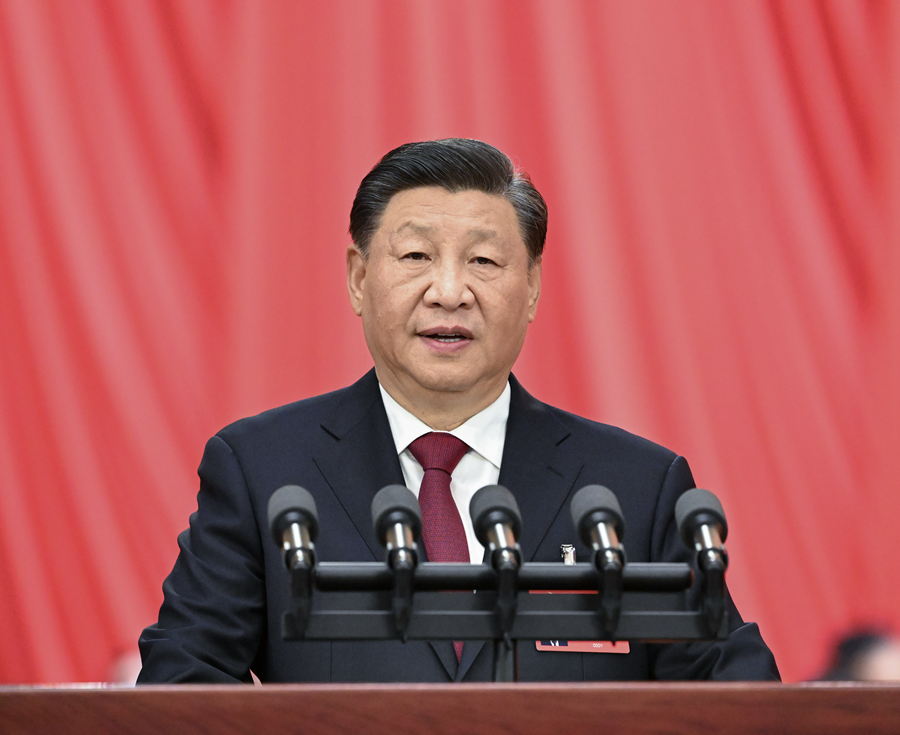
Core Viewpoint - The report emphasizes the importance of uniting under the banner of socialism with Chinese characteristics to achieve the goal of building a modern socialist country and advancing the great rejuvenation of the Chinese nation [3][4]. Summary by Sections Historical Context - The past five years have been described as extraordinary, with the Party addressing significant challenges and making strategic decisions to advance national development and respond to complex international situations [4][5]. Achievements - The report highlights major accomplishments, including the completion of the poverty alleviation campaign, the establishment of a moderately prosperous society, and significant advancements in various sectors such as economy, culture, and national defense [6][10][11]. Economic Development - China's GDP increased from 54 trillion yuan to 114 trillion yuan, with the economy's share of the global total rising from 11.3% to 18.5% [11]. - The report emphasizes the shift towards high-quality development and the establishment of a new development pattern, focusing on domestic circulation while enhancing international cooperation [34][35]. Social Progress - Improvements in living standards are noted, with per capita disposable income rising from 16,500 yuan to 35,100 yuan, and life expectancy increasing to 78.2 years [14]. - The report stresses the importance of ensuring that development benefits all citizens and promotes social equity [28][33]. Governance and Reform - The report outlines the need for comprehensive reforms to enhance governance capabilities and modernize the governance system, emphasizing the importance of the Party's leadership [9][12][36]. - It calls for a more robust market economy and the optimization of state-owned enterprises while supporting the growth of the private sector [35]. National Security and Foreign Relations - The report underscores the importance of national security and the need to maintain sovereignty while promoting a peaceful development path [15][16]. - It highlights the commitment to building a community with a shared future for mankind and enhancing China's role in global governance [16][32]. Future Goals - The report sets ambitious targets for the next five years, including breakthroughs in high-quality economic development, significant improvements in governance, and enhanced international influence [31][32]. - It outlines a two-step strategy for achieving modernization by 2035 and becoming a leading global power by the mid-21st century [30][34].

时代专论 | “两个结合”是必由之路和最大法宝学习《习近平文化思想学习纲要》
Zhong Yang Ji Wei Guo Jia Jian Wei Wang Zhan· 2025-06-05 00:50
Group 1 - The core idea of the articles emphasizes the importance of the "two combinations" in advancing the sinicization and modernization of Marxism, which is seen as a fundamental approach to developing socialism with Chinese characteristics [1][5][9] - The "two combinations" refer to the integration of Marxism with China's specific realities and the integration of Marxism with excellent traditional Chinese culture, which are essential for the success of the Chinese Communist Party [6][7][12] - The articles highlight that the "second combination" is a significant theoretical innovation that reflects the original contributions and breakthroughs of Xi Jinping's cultural thought, marking a new chapter in the sinicization of Marxism [13][15][16] Group 2 - The articles discuss the historical significance of Marxism in shaping the direction of human society and its enduring relevance in contemporary times, asserting that Marxism remains a guiding principle for the Chinese Communist Party [2][3][4] - The emphasis on the development and openness of Marxism is noted, indicating that it is a dynamic theory that evolves with changing times and practices, which is crucial for its application in China [4][5] - The articles also stress the necessity of rooting Marxism in the rich historical and cultural context of China to ensure its effective application and to avoid dogmatism [6][10][11] Group 3 - The "two combinations" are presented as the key to understanding the historical inevitability and cultural connotations of the Chinese path, which is characterized by its unique features derived from both Marxism and Chinese civilization [9][10][12] - The articles assert that the successful advancement of Chinese-style modernization is one of the greatest achievements of the Chinese path, driven by the principles of the "two combinations" [12][16] - The integration of Marxism with traditional Chinese culture is portrayed as a means to revitalize Chinese civilization and ensure its relevance in the modern world, fostering a cultural identity that supports the goals of socialism [15][17]