
中微子

Search documents
【人民日报】江门中微子实验大科学装置正式运行
Ren Min Ri Bao· 2025-08-27 00:36
Core Insights - The Jiangmen Neutrino Experiment (JUNO) has successfully completed the infusion of 20,000 tons of liquid scintillator and has officially begun data collection, marking a significant milestone in particle physics research [1][2] - This experiment is the first of its kind in the world to operate a large-scale and high-precision neutrino-specific scientific facility, aimed at addressing the fundamental question of neutrino mass ordering [1][2] Group 1 - The JUNO experiment is a major international collaboration led by the Institute of High Energy Physics of the Chinese Academy of Sciences, involving approximately 700 researchers from 74 institutions across 17 countries and regions [2] - The detector is located 700 meters underground in Jiangmen, Guangdong Province, and is capable of detecting neutrinos produced by nearby nuclear power plants, allowing for high-precision measurements of their energy spectrum [1] - The successful operation of JUNO is expected to pave the way for determining the mass hierarchy of neutrinos, which is a fundamental parameter influencing the evolution of the universe [1][2] Group 2 - The experiment's initial data collection has shown that key performance indicators of the detector have met or exceeded design expectations, enabling advanced research on neutrinos from various cosmic sources [1] - The research will open new avenues for exploring unknown physics, including the search for sterile neutrinos and proton decay [1]
江门中微子实验装置正式运行,中国高能物理领域的大科学装置建设实现重大突破
Huan Qiu Wang Zi Xun· 2025-08-26 23:29
Core Insights - The Jiangmen Underground Neutrino Observatory (JUNO) has successfully completed the injection of 20,000 tons of liquid scintillator and has officially begun data collection, marking a significant breakthrough in China's high-energy physics research [1] - This facility is the first of its kind in the world to be operational as a next-generation large neutrino experiment, positioning China at the forefront of neutrino research [1] - The primary scientific goal of JUNO is to determine the mass ordering of neutrinos, which is a major focus in particle physics and cosmology for the next decade [1] Group 1: Technical Achievements - The JUNO detector is located 700 meters underground in Jiangmen, Guangdong, and has already obtained its first batch of scientific data, exceeding performance expectations [1] - The core detector consists of a 20,000-ton liquid scintillator housed in a 41.1-meter diameter stainless steel structure, equipped with 20-inch and 3-inch photomultiplier tubes [1] - The successful injection of the liquid scintillator involved meticulous operations, including the prior filling of over 60,000 tons of ultra-pure water and maintaining strict control over liquid levels and flow rates [1] Group 2: Research Capabilities - JUNO is capable of detecting neutrinos from the Taishan and Yangjiang nuclear power plants, as well as from solar, supernova, atmospheric, and terrestrial sources, enabling cutting-edge research in various fields [3] - The facility will also explore new physical phenomena such as sterile neutrinos and proton decay, enhancing the understanding of fundamental physics [3] - The project is a significant international collaboration involving over 700 researchers from 74 institutions across 17 countries and regions, highlighting the importance of global cooperation in scientific advancements [3]

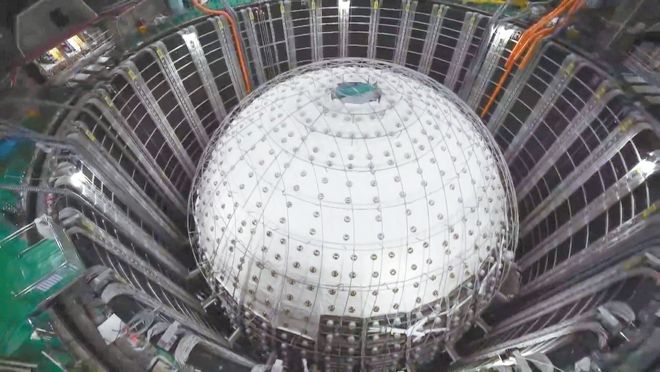
江门中微子实验大科学装置正式运行
Ren Min Ri Bao· 2025-08-26 22:09
Core Insights - The Jiangmen Underground Neutrino Observatory (JUNO) has successfully completed the infusion of 20,000 tons of liquid scintillator and has officially begun data collection, marking a significant milestone in particle physics research [1][2] - This facility is the first of its kind in the world to operate as a large-scale and high-precision neutrino-specific scientific apparatus, aimed at addressing the fundamental question of neutrino mass ordering [1][2] Group 1 - The JUNO experiment is a major international collaboration led by the Institute of High Energy Physics of the Chinese Academy of Sciences, involving approximately 700 researchers from 74 institutions across 17 countries and regions [2] - The detector is located 700 meters underground in Jiangmen, Guangdong Province, and is capable of detecting neutrinos produced by nearby nuclear power plants, as well as those from solar, supernova, atmospheric, and terrestrial sources [1] - The successful operation of JUNO is expected to pave the way for determining the mass hierarchy of neutrinos, which is a fundamental parameter influencing the evolution of the universe [1][2]
中国地下700米,有了个全球第一!
Huan Qiu Wang Zi Xun· 2025-08-26 02:57
Core Insights - The Jiangmen Neutrino Experiment, a significant scientific facility in China, has officially commenced operations, marking it as the world's first large-scale and high-precision neutrino detection facility [1][6]. Group 1: Facility Overview - The Jiangmen Neutrino Experiment is located 700 meters underground in Jiangmen, Guangdong Province, and is capable of detecting neutrinos produced by the Taishan and Yangjiang nuclear power plants, which are 53 kilometers away [3]. - This facility aims to capture elusive neutrinos, which are considered crucial for understanding the universe's past and future [4]. Group 2: Technology and Innovation - The key technology for detecting neutrinos involves photomultiplier tubes, which can detect the faint light emitted when neutrinos interact with scintillating materials. The brightness of this light is one billionth of that of a smartphone screen [4]. - Chinese scientists have successfully developed their own photomultiplier tubes, breaking a foreign monopoly and reducing the cost of individual tubes by over 50%, resulting in savings of several hundred million yuan for the project [4].
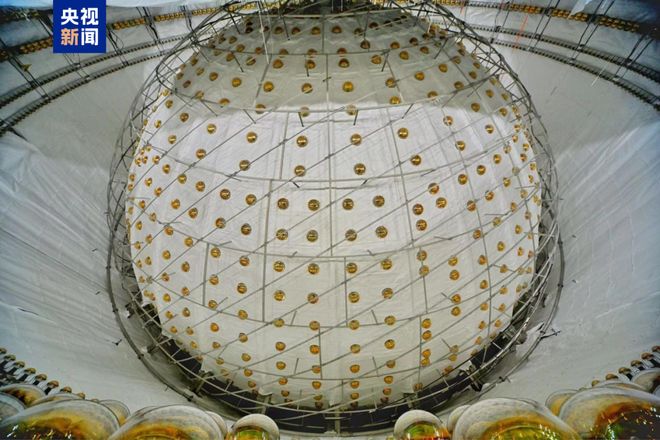
捕捉“幽灵粒子” 江门中微子实验正式运行
Xin Hua She· 2025-08-26 00:21
Core Viewpoint - The Jiangmen Underground Neutrino Observatory (JUNO), led by the Institute of High Energy Physics of the Chinese Academy of Sciences, has successfully completed the infusion of 20,000 tons of liquid scintillator and has officially begun data collection to capture neutrinos, which are known as "ghost particles" [1] Group 1 - The successful operation of JUNO allows scientists to address fundamental questions about the nature of matter and the universe [1] - The initial data obtained during the trial operation indicates that the key performance indicators of the detector have fully met or exceeded design expectations [1] - This marks the first time an ultra-large scale and ultra-high precision neutrino-specific scientific facility has been operated internationally [1]
新华鲜报丨地下700米捕捉“幽灵粒子” 我国开启中微子研究新篇章
Xin Hua Wang· 2025-08-26 00:17
Core Insights - The Jiangmen Neutrino Experiment (JUNO) has officially begun data collection, aiming to address significant questions in particle physics, particularly the mass ordering of neutrinos [1][2] - This facility, located 700 meters underground, features a large organic glass sphere designed to detect elusive neutrinos, which are fundamental particles that interact very weakly with matter [1][3] Group 1: Experiment Overview - The JUNO experiment is equipped with a core detector containing 20,000 tons of liquid scintillator, surrounded by thousands of photomultiplier tubes to capture faint light signals generated by neutrino interactions [3] - The construction of this high-precision detector involved significant challenges, including the successful infusion of over 60,000 tons of ultra-pure water within 45 days, ensuring stability and safety of the detector structure [3] Group 2: Research Goals and Future Plans - The experiment aims not only to determine the mass ordering of neutrinos but also to measure neutrino oscillation parameters with higher precision and explore various astrophysical phenomena, including supernovae and solar neutrinos [2][4] - Designed for a lifespan of 30 years, JUNO has the potential for upgrades to investigate neutrinoless double beta decay, which could provide insights into the absolute mass of neutrinos and their nature as Majorana particles [4]

探微观之谜 展创新之力(院士新语)
Ren Min Ri Bao· 2025-08-24 22:40
Core Insights - The article emphasizes the necessity for scientific leadership in technology innovation, highlighting that without it, entities will remain mere followers and lack source innovation capabilities [1][6] - It discusses the evolution of particle physics, detailing how advancements in technology, such as electron microscopes and particle accelerators, have allowed for deeper understanding of matter's fundamental structure [2][3] - The future of particle physics is framed as needing to transcend the current standard model to address significant scientific questions like dark matter and the matter-antimatter asymmetry [4] Group 1: Particle Physics Research - Particle physics has evolved from early atomic theories to the modern understanding of subatomic particles, with significant milestones including the discovery of quarks and the development of the standard model, which has won approximately 30 Nobel Prizes [3] - Current research in particle physics is at a critical juncture, with the standard model being unable to explain several phenomena, indicating a need for new theoretical frameworks and experimental evidence [4] Group 2: China's Position in High-Energy Physics - China has made significant strides in high-energy physics, with key contributions from facilities like the Beijing Electron-Positron Collider (BEPC) and the Daya Bay neutrino experiment, showcasing its innovative capabilities [4] - The country is considering the development of a circular electron-positron collider as a strategic choice for future research, which aligns with global trends and reflects a commitment to scientific advancement [5] Group 3: Technological Innovation and Industry Impact - The advancements in particle physics and accelerator technology have broader implications, leading to applications in various fields such as materials science, advanced manufacturing, and pharmaceuticals [5] - The article stresses that maintaining scientific leadership is crucial for technological dominance, as reliance on foreign innovations could hinder core technological development [6]