
品质竞争

Search documents
下半年,安徽还有15个新商场开业!
3 6 Ke· 2025-06-24 02:17
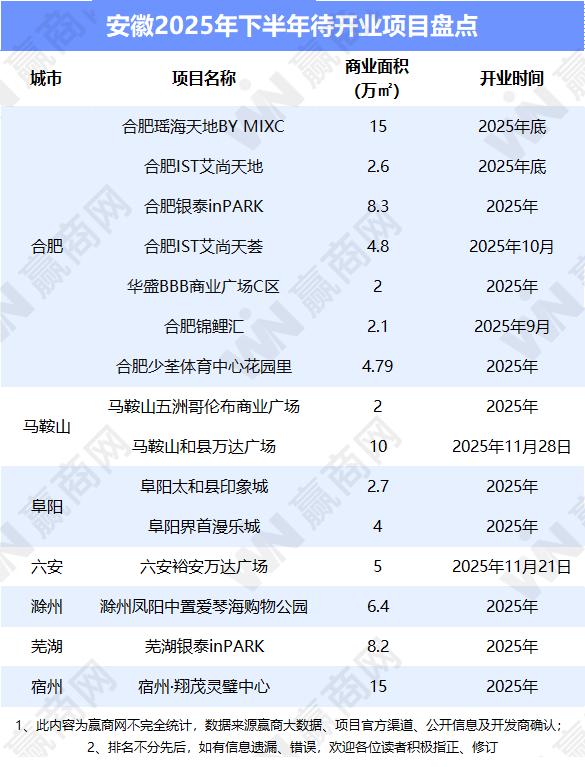
Core Insights - The commercial market in Anhui province is experiencing significant growth, with six projects already opened in the first half of 2025, adding approximately 323,000 square meters of commercial space [1] - The second half of 2025 is expected to see a surge in new mall openings, with 15 new projects planned, totaling around 930,000 square meters, indicating a shift from "scale expansion" to "quality breakthrough" in Anhui's commercial landscape [1] Project Overview - In the second half of 2025, major projects include: - Hefei Yaohai Tiandi BY MIXC (150,000 m²) and Hefei IST Aishang Tiandi (26,000 m²) both set to open by the end of 2025 [2][5] - Hefei Yintai inPARK (83,000 m²) and Hefei IST Aishang Tianhui (48,000 m²) also scheduled for 2025 [2][11] - Other cities like Ma'anshan, Fuyang, and Lu'an will see new projects, contributing to regional commercial diversity [2] Market Dynamics - The new projects reflect a trend towards smaller, more specialized commercial spaces, with 60% of the 15 projects being under 50,000 m², focusing on community life and niche markets [3] - Major players like China Resources, Yintai, and Wanda are actively expanding their presence in Anhui, indicating a competitive landscape [3] Operational Strategies - New projects are emphasizing cultural IP integration, experiential innovation, and community engagement rather than traditional opening strategies [3] - Examples include the industrial heritage revitalization at Yaohai Tiandi BY MIXC and the focus on Z-generation culture at Hefei IST Aishang Tiandi [3][10] Urban Impact - The upcoming projects are expected to enhance the commercial ecosystem in Anhui, transitioning from quantity to quality in consumer experiences [4] - The integration of diverse commercial functions and cultural elements aims to redefine urban consumption landscapes [16]

降低商家营销流量权重,美团反“内卷” 动真格 谁将是外卖大战赢家?
Mei Ri Jing Ji Xin Wen· 2025-06-11 12:18
Core Viewpoint - The takeaway from the articles is that the competition in the food delivery industry is shifting from a price war to a focus on quality and service, as major platforms like Meituan, JD, and Taobao are implementing strategies centered around enhancing quality rather than engaging in low-cost competition [1][5][6]. Summary by Sections Industry Trends - The food delivery market is witnessing a collective shift towards quality as a core strategy, moving away from the previous "price war" mentality [1][5]. - Major players are emphasizing quality and service, with Meituan launching marketing tool reforms to combat low-quality, low-price competition [1][2]. Meituan's Initiatives - Meituan has introduced a series of reforms aimed at reducing the emphasis on low-cost marketing activities, including lowering the weight of promotional activities in traffic recommendations and implementing automatic warnings for excessive marketing efforts [1][2][3]. - The company reported a 15% decrease in merchant subsidy investments for promotional activities and an 85% reduction in the number of merchants using large discount promotions after the optimization [2]. Merchant Feedback and Challenges - Despite the reforms, some merchants still face challenges related to reliance on subsidies and the pressure of low-quality competition, indicating that the issue of "internal competition" remains unresolved [3][4]. - Merchants have expressed concerns about the lack of transparency and the negative impact of low-price competition on their businesses [3]. Quality Improvement Measures - Meituan is focusing on enhancing the quality of offerings by adjusting its traffic system to favor quality merchants and products, while also implementing strict measures against deceptive marketing practices [3][4]. - The platform is utilizing data on store characteristics, product information, and customer reviews to highlight unique selling points and assist merchants in transitioning from price competition to quality competition [4]. Market Outlook - The overall trend in the food delivery industry is towards a more mature and rational competition model that prioritizes quality and service over price [5][6]. - Analysts suggest that the long-term sustainability of the industry relies on improving overall quality and ensuring that high-quality merchants have opportunities to thrive without solely depending on marketing tactics [6].
