淘宝闪购

Search documents
电商“四大巨头”火拼:阿里 京东 美团 拼多多谁最“烧钱”和赚钱
Xin Lang Cai Jing· 2026-03-31 14:56
Core Insights - The four major e-commerce companies, Alibaba, JD.com, Pinduoduo, and Meituan, reported their 2025 financial results, showcasing a mix of revenue growth and profit declines, with some companies opting for long-term strategies over immediate profits [1][20][21]. Revenue Performance - JD.com led in revenue with 1.3091 trillion yuan, a year-on-year increase of 12.97%, followed by Alibaba at 1.0167 trillion yuan, growing approximately 3.56%. Pinduoduo reported 431.8 billion yuan, up 9.65%, while Meituan reached 364.9 billion yuan, growing 8.08% [2][22][24]. - JD.com demonstrated the highest revenue growth rate, indicating strong growth momentum, while Alibaba's slower growth reflects competitive pressures in its core e-commerce business [25]. Profitability Trends - All four companies experienced a decline in net profits. Alibaba's net profit fell by 23.78% to 92.164 billion yuan, Pinduoduo's decreased by 11.62% to 99.4 billion yuan, JD.com reported a 52.54% drop to 19.6 billion yuan, and Meituan shifted from a profit of 35.8 billion yuan to a net loss of 23.5 billion yuan, marking the most significant deterioration [2][27][26]. Marketing Expenditures - Alibaba's marketing expenses surged to 191.6 billion yuan, a 77.67% increase, making it the highest among the four companies. Meituan's marketing costs reached 102.9 billion yuan, up 60.9%, while JD.com spent 83.95 billion yuan, increasing by 75.07%. Pinduoduo's marketing expenses were 125.3 billion yuan, with a more moderate growth of 12.57% [8][28][29]. - The significant rise in marketing expenses reflects the competitive landscape, with companies engaging in aggressive strategies to maintain market share [30]. Strategic Focus for 2026 - Alibaba is focusing on "AI + Instant Retail" to enhance user engagement and retention, leveraging its full-stack AI capabilities [36]. - JD.com aims to maintain double-digit growth in its core retail business while reducing losses in its new ventures, emphasizing international expansion and AI integration [37]. - Pinduoduo is shifting its strategy towards upgrading the Chinese supply chain, focusing on long-term value creation rather than immediate user growth [38]. - Meituan is transitioning from aggressive expansion to defending market share, prioritizing high-quality growth and AI investments [39]. Industry Outlook - The e-commerce sector is moving away from the "subsidy for growth" model towards a focus on technology-driven, efficiency-first competition, with an emphasis on sustainable long-term strategies [39].



阿里死磕即时零售
雷峰网· 2026-03-31 00:30
Core Viewpoint - Alibaba has committed to significant investments in instant retail, spending approximately 700 billion yuan, despite facing declining profit margins and increasing losses in other business segments [2][5][6]. Group 1: Financial Performance - As of Q4 2025, Alibaba's operating profit margin has dropped to single digits, with a reported operating margin of 4% and an adjusted EBITA margin of 8%, marking the lowest levels in three years [5][6]. - In Q4 2025, Alibaba's losses in the instant retail segment, particularly through Taobao Flash Sale, were estimated to be around 200 billion yuan, with some estimates suggesting actual losses could be higher [7][10]. - The company has sacrificed approximately 700 billion yuan in profits over the first three quarters of FY2026 to fund its instant retail initiatives [6][8]. Group 2: Market Position and Strategy - Instant retail is viewed as a critical growth area for Alibaba, with the company aiming to enhance its market position through aggressive investment in this sector [3][9]. - The revenue from instant retail has reached 16.6% of Alibaba's overall e-commerce revenue, indicating its growing importance within the company's business model [9]. - Alibaba's management has indicated that profitability is not the immediate focus for 2026 and 2027, as they continue to invest heavily in instant retail and AI technologies [7][14]. Group 3: Future Outlook - Alibaba has set ambitious targets for its cloud and AI business, aiming for a revenue scale of 100 billion USD within five years, with a projected compound annual growth rate exceeding 40% [15][17]. - The company is also focusing on integrating instant retail with its existing e-commerce platforms to drive user engagement and sales growth [12][13]. - Despite the aggressive investment strategy, investor sentiment remains cautious, with concerns about profitability and the effectiveness of the company's long-term plans [16][18].
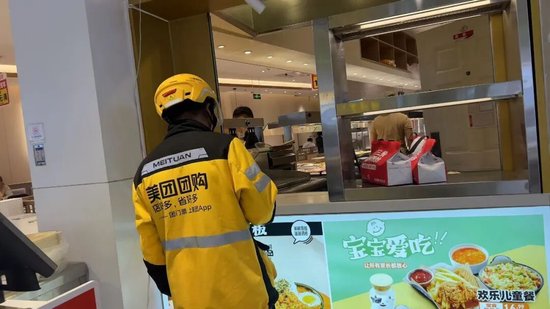
美团巨亏234亿:一场烧钱的外卖大战还有未来吗?
Xin Lang Cai Jing· 2026-03-29 06:05
Core Insights - Meituan reported a significant loss of over 23 billion yuan in 2025, a stark contrast to a profit of 35.8 billion yuan in 2024, indicating a nearly 60 billion yuan profit gap [4][19] - The company is currently navigating a challenging competitive landscape, balancing the need to defend its core business while investing in new ventures [19][30] Financial Performance - Meituan's losses peaked in the second quarter, with core business losses reaching 14.1 billion yuan, before narrowing to 10 billion yuan in the fourth quarter [5][20] - The gross margin fell from 38.4% in 2024 to 30.4% in 2025, a decline of 8 percentage points, primarily due to sales costs rising 22.2% to 253.8 billion yuan, while revenue only grew by 8.1% [20] - Marketing expenses surged from 64 billion yuan to 102.9 billion yuan, a 60.9% increase, now accounting for 28.2% of revenue [20] Core Business Challenges - The core business, which previously generated 52.4 billion yuan in profit in 2024, turned into a loss of 6.9 billion yuan in 2025, indicating a significant loss of market share and profitability [6][20] - The competitive landscape intensified with the entry of JD.com and Alibaba into the food delivery market, leading to a costly price war [21][22] Market Position - Meituan maintains a market share of over 60% in the food delivery sector, despite facing pressure from competitors like Taobao Flash and JD.com [22] - The company has managed to keep its losses lower than its competitors, suggesting a stronger defensive position, although market share has slightly declined [22][24] New Business Ventures - New business revenue grew by 19% in 2025, but losses in this segment increased from 1.3 billion yuan to 4.7 billion yuan in the fourth quarter [29] - Meituan is investing heavily in AI, with R&D spending reaching 26 billion yuan, a 23.5% increase, indicating a commitment to technological advancement despite financial pressures [29][30] Competitive Landscape - Meituan's in-store services are under threat from competitors like Douyin and Gaode, which are gaining traction in the local services market [25][26] - Douyin's local service transaction volume grew by 59% in 2025, while Gaode launched a new ranking system that has rapidly gained user engagement [25][26] Strategic Adjustments - The company is shifting focus towards self-operated retail and has made significant investments in logistics and supply chain infrastructure [30] - Meituan's future strategy involves balancing core business defense with new business investments, indicating a complex operational environment [30][31]
蒸发1万亿!阿里巴巴,又跌麻了
商业洞察· 2026-03-28 09:22
Core Viewpoint - Alibaba's stock price has dropped significantly, losing one-third of its value in just two months, causing distress among investors [3]. Financial Performance Summary - For the third fiscal quarter of 2026, Alibaba reported revenue of 284.843 billion yuan, a year-on-year increase of 2%. Excluding disposed businesses, the same-store revenue grew by 9% [6]. - Operating profit fell to 10.645 billion yuan, a 74% decline year-on-year. Net profit attributable to ordinary shareholders was 16.322 billion yuan, down 67%. Adjusted net profit also decreased by 67% to 16.71 billion yuan [6]. - Net cash flow from operating activities was 36.032 billion yuan, a 49% drop, while free cash flow plummeted by 71% to 11.346 billion yuan [6][7]. Causes of Financial Decline - The financial downturn is attributed to the impact of "instant retail business investments," particularly the intensified competition in the food delivery sector, which has severely affected Alibaba's cash flow [8]. Stock Market Reaction - Following the financial report, Alibaba's stock price fell sharply, with a drop of over 7% on March 19, resulting in a loss of nearly 230 billion USD, approximately 1.6 trillion yuan [9]. - The stock continued to decline, with a drop of over 6% on March 20 and more than 3% on March 23. Since the end of January, Alibaba's stock has decreased from 174.2 HKD to 117.7 HKD, marking a decline of 32.4% and a market value loss exceeding 1 trillion HKD [11]. Competitive Landscape and Market Concerns - The decline in Alibaba's stock is part of a broader trend affecting major players in the food delivery market, including Meituan and JD.com, which have also seen significant stock price drops due to concerns over their cash-burning market share acquisition strategies [14]. - Alibaba's sales and marketing expenses surged to 71.9 billion yuan, nearly 300 billion yuan more than the previous year, representing 25.3% of the company's revenue, up from 15.2% [15]. Future Outlook and Strategic Direction - Alibaba's management has reiterated its goal to achieve over 1 trillion yuan in gross merchandise volume (GMV) for its instant retail business by fiscal year 2028, with expectations of profitability by fiscal year 2029 [16]. - The company is committed to continuing its aggressive investment in instant retail, which poses a significant challenge to its cash flow [17]. AI and Cloud Investments - Alibaba has announced plans to invest over 380 billion yuan in cloud and AI infrastructure over the next three years, setting a record for private enterprise investment in AI in China [22]. - The market responded positively to Alibaba's AI initiatives, with stock prices rising significantly during periods of major announcements related to AI investments [24]. - However, recent stock declines are attributed to concerns over the immediate costs associated with the instant retail business overshadowing the positive sentiment around AI developments [27].

2026年中国闪电仓模式深度解析:即时零售赛道新变量,分钟级消费时代来临
Qin Ce Xiao Fei Yan Jiu· 2026-03-27 12:35
Investment Rating - The report indicates a positive investment outlook for the lightning warehouse model in the instant retail sector, highlighting significant growth potential and market opportunities [3][4]. Core Insights - The lightning warehouse model is reshaping China's instant retail infrastructure, with Meituan's lightning warehouses expected to exceed 50,000 by 2025 and reach over 100,000 by 2027, generating a GMV of over 200 billion yuan [3][4]. - The industry is characterized by a "one strong, many strong" pattern, with Meituan's lightning purchase holding a 70% market share, followed by Taobao and JD [3][4]. - The report emphasizes the shift from emergency consumption to daily consumption, driven by a 30-minute delivery experience [3][4]. Summary by Sections Industry Overview and Current Development - The instant retail market is entering a "minute-level" era, supported by over 50,000 lightning warehouses, contributing to a market size exceeding 1 trillion yuan [8][14]. - The lightning warehouse model, launched by Meituan in 2020, operates purely online with flexible site selection, 24-hour service, and a wide range of SKUs [9][10]. Key Data Overview - As of 2023, the instant retail market is valued at 650 billion yuan, with lightning warehouses contributing 60 billion yuan, representing 9.2% of the market [15]. Investment Logic - Short-term focus on leading brands like Huiyixuan and Xiaochai Purchase, which benefit from supply chain barriers [7]. - Mid-term potential for vertical sectors (alcohol, maternal and infant, pharmaceuticals) to produce niche leaders, with SKU depth and fulfillment efficiency being critical [7]. - Long-term growth expected in instant retail penetration, with a market size projected to exceed 2 trillion yuan by 2030 [7]. Competitive Landscape - The competitive landscape shows Meituan's lightning purchase leading with 70% market share, followed by Taobao and JD [13][24]. - The report notes a concentration of top brands, with only three brands consistently ranking over the past three years [26][27]. Regional Distribution and Brand Ecosystem - Eastern and Southern regions are mature markets, while Central and Western regions present significant growth opportunities, particularly in county markets [96][97]. - The county market has seen a 54% year-on-year growth in orders, becoming a new growth engine for the industry [100][101]. Future Outlook and Trends - By 2027, the number of lightning warehouses is expected to exceed 100,000, with a GMV of 200 billion yuan, indicating a shift towards refined operations [129][130]. - Key trends include increased concentration among top brands, expansion into high-ticket categories, and the rise of official brand warehouses [134].
开启加速减亏,美团最差的时候过去了?
雷峰网· 2026-03-27 10:47
Core Viewpoint - After a significant loss of 23.4 billion yuan in the previous year, Meituan is expected to substantially reduce its losses in Q1 2026, with improvements in its takeaway business profits compared to Q4 2025, although the average loss per order will still exceed 1 yuan [2][3]. Group 1: Financial Performance and Market Position - Meituan's Q4 2025 financial report indicated a loss of 15.1 billion yuan, with core local business losses amounting to 10 billion yuan and new business losses increasing to 4.6 billion yuan, a rise of 3.3 billion yuan from the previous quarter [3][4]. - The core local business is projected to continue incurring losses in Q1 2026, but the reduction in losses will exceed 50% compared to Q4 2025 [3][4]. - Meituan's market share in the takeaway sector remains strong, with over 60% in GMV and around 70% in high-value orders above 30 yuan [6][8]. Group 2: Competitive Landscape - The profit margin for Meituan's takeaway and in-store services has decreased, with the in-store business profit margin dropping from over 30% to around 25% [7][9]. - The competitive gap in unit economics (UE) between Meituan and its rivals is expected to widen, with a projected difference of about 2 yuan in Q1 2026, primarily due to a faster recovery in average order value (AOV) [6][9]. - Alibaba's strategy may shift resources from food delivery to non-food sectors, potentially leading to a misalignment in competition with Meituan's flash purchase services [6][8]. Group 3: Strategic Initiatives and AI Investment - Meituan is heavily investing in AI, viewing it as a strategic opportunity to reshape local service products, with significant capital expenditure and talent acquisition in this area [11][12]. - The company has made substantial adjustments in its technology department to fully embrace AI, aiming to enhance service efficiency and user experience through AI-driven applications [11][12]. - The AI assistant "Xiaotuan" has been made available to users, providing precise answers regarding merchant locations, operating hours, and store facilities, with plans for deeper integration with the Meituan app [12].

外卖大战可能快结束了,但美团的战争才刚开始
36氪未来消费· 2026-03-27 10:22
Core Viewpoint - The intense competition in the instant retail market is not the only challenge for Meituan, as it faces significant losses and operational hurdles in its core business and emerging sectors like AI and international expansion [2][5]. Financial Performance - In 2025, Meituan's revenue grew by 8.1% to 364.9 billion yuan, but it reported a loss of 23.4 billion yuan, a significant decline from a profit of 35.8 billion yuan the previous year [2]. - The core local business experienced a substantial operating loss of 6.9 billion yuan, indicating a challenging financial environment [2]. - In Q4 2025, the core local business revenue decreased by 1.1% to 64.8 billion yuan, with rising sales costs and marketing expenses attributed to fierce competition [3]. Competitive Landscape - Meituan's management openly acknowledged the competitive pressures during a recent earnings call, emphasizing the need to focus on enhancing core capabilities and reducing losses [4]. - The competition has shifted, with rivals like Alibaba and JD.com adjusting their strategies, leading to a more stable environment for Meituan to operate [4][13]. - Meituan is now prioritizing high-value orders over overall market share, focusing on improving unit economic efficiency [9]. Business Strategy - Meituan's strategy includes expanding its instant retail business, which has seen significant growth, with over 50,000 flash warehouses and double-digit growth in order volume and GTV [10]. - The company is also focusing on international expansion, with its international business Keeta achieving profitability in Hong Kong and expected to do so in Saudi Arabia by 2026 [23]. AI and Future Prospects - Meituan is investing in AI to enhance its service offerings, although it faces challenges in creating widely adopted AI products [26][27]. - The company aims to leverage AI to improve operational efficiency and customer experience in the local services sector [26]. Market Dynamics - The competition in the instant retail space is expected to evolve, with a shift from food delivery to non-food retail sectors, indicating a broader market opportunity [15]. - Meituan's management is committed to reducing inefficient investments in non-core areas while focusing on innovation and operational efficiency [21].

美团全年亏234亿,阿里利润降67%,即时零售内卷,停不下来
3 6 Ke· 2026-03-27 08:15
Industry Overview - The instant retail sector is experiencing intense competition, with companies unwilling to stop despite incurring losses [1][4] - In 2025, over 150 billion was invested in instant retail, but this has not led to industry profitability [2][3] - The competition is characterized by a lack of absolute winners, leading to a continuous cycle of investment and loss [5] Company Analysis: Meituan - Meituan reported a revenue of 364.9 billion, an 8% year-on-year growth, but faced a net loss of 23.4 billion [6] - The core local business segment, which includes food delivery and instant retail, suffered an operating loss of 6.9 billion [6] - The primary reason for the losses is the cutthroat competition in the instant retail market, forcing Meituan to spend heavily to maintain market share [7] Company Analysis: Alibaba - Alibaba's instant retail platform, Taobao Flash Sale, showed a revenue of 20.84 billion, a 56% increase, but the overall e-commerce market only grew by 1% [12] - Alibaba's net profit dropped by 67%, indicating that growth in instant retail is not translating into overall profitability [10][12] - Similar to Meituan, Alibaba relies on subsidies to attract users and maintain market share, leading to ongoing losses [12][13] Competitive Dynamics - The lack of customer loyalty in instant retail means users are driven by price and speed, making it risky for companies to reduce subsidies [18] - The market is not yet dominated by any single player, prompting ongoing competition as companies strive to capture market share [18] - Strategic value in instant retail outweighs short-term profits, as companies view it as essential for future growth [18][20] Future Outlook - The competition in instant retail is expected to continue, with companies like Alibaba committed to significant investments despite current losses [16][20] - The industry is seen as a critical battleground for future consumer engagement, with the potential for substantial market size [16][20] - The ongoing investment and competition will likely persist until a clear leader emerges, making it a high-stakes environment for all players involved [20]
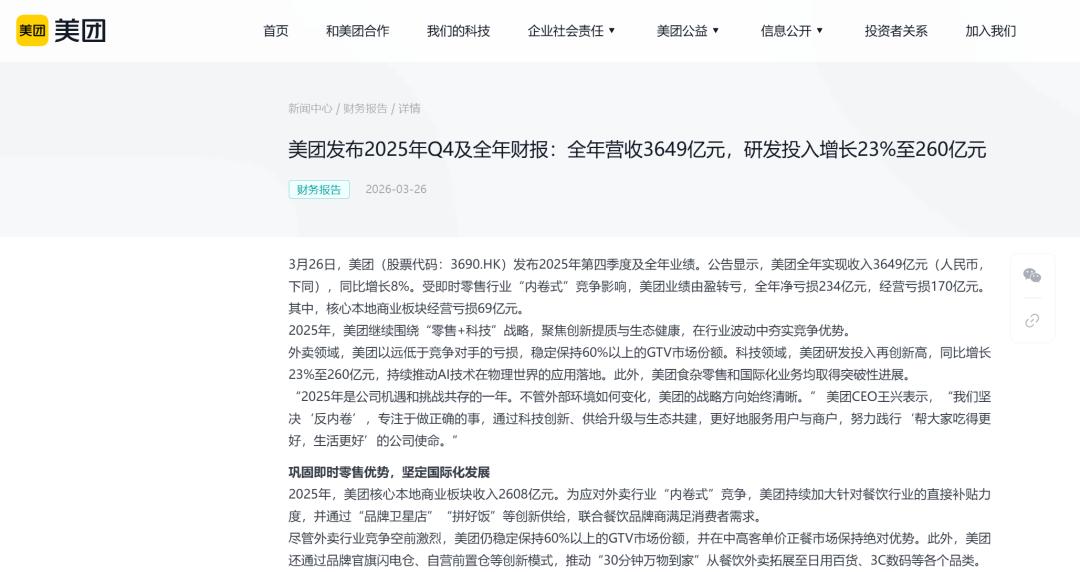
外卖大战一年美团少赚近600亿,市值较去年高点腰斩
21世纪经济报道· 2026-03-27 05:26
Core Viewpoint - Meituan reported a significant annual revenue of 364.9 billion RMB for 2025, but faced a net loss of 23.4 billion RMB due to the intense competition in the food delivery sector, raising concerns about its competitive edge in local services [1][6] Financial Performance - In 2024, Meituan's net profit was 35.8 billion RMB, indicating a decrease of 59.2 billion RMB compared to 2025 [1] - The operating profit for Meituan's local services business plummeted from 52.4 billion RMB in 2024 to an operating loss of 6.9 billion RMB in 2025, reflecting a year-on-year decrease of 59.3 billion RMB [7] - Meituan's market capitalization has halved from a peak of 1.2 trillion HKD in February 2025 to below 500 billion HKD in February 2026 [11] Competitive Landscape - Despite the challenges, Meituan maintained over 60% of the GTV market share in the food delivery sector, with lower losses compared to competitors [7] - The competition in the food delivery market remains fierce, with rivals like Alibaba and JD.com continuing to invest heavily, although JD.com has reduced its subsidy efforts recently [10] AI Strategy - Meituan's CEO emphasized the importance of an offensive strategy in the AI revolution, viewing AI as a strategic opportunity to enhance local services [5] - The company has significantly increased its investment in AI, with a total R&D expenditure of 26 billion RMB in 2025, a 23% increase year-on-year [12] - Meituan has developed an AI assistant named "XiaoTuan," which aims to improve user experience by quickly matching service needs with quality merchants and products [13] Future Outlook - Meituan aims to leverage its extensive data on the physical world to enhance its AI capabilities, with plans to optimize its AI model and integrate it further into the Meituan app [15] - The company is focused on becoming a leading AI-driven application for local life needs, enhancing its search and execution capabilities [15]

美团业绩改善的背后:收缩、省钱,等待阿里犯错
晚点LatePost· 2026-03-27 03:35
Core Viewpoint - Meituan is facing stronger and more determined competitors in the market, particularly Alibaba, which has significantly more cash reserves and is committed to increasing its market share in the instant retail and food delivery sectors [2][3]. Group 1: Competitive Landscape - Meituan's core local business segment reported a loss of approximately 10 billion yuan in Q4, a 30% reduction in losses compared to Q3, indicating a strategic shift to improve efficiency and reduce subsidies [3][4]. - Alibaba's cash reserves are four times greater than Meituan's, allowing it to invest heavily in its Taobao Flash Purchase platform, aiming to surpass Meituan's market share by 2026 [3][4]. - Competitors like Pinduoduo and Douyin are rapidly increasing their e-commerce business, posing additional challenges to Meituan's market position [4][5]. Group 2: Market Dynamics - The food delivery market has entered a consumption war, with Meituan's employees experiencing increased workloads as they attempt to regain lost market share from Alibaba [5][6]. - Meituan has adjusted its subsidy strategy, reducing costs while increasing delivery fees for merchants, which has led to a slight recovery in market share [5][6]. - The competition has intensified, with both Meituan and Alibaba focusing on high-value orders, leading to a shift in market dynamics where Meituan's share of high-value orders has decreased from 70% to approximately 60% [6][9]. Group 3: Strategic Adjustments - Meituan is shifting its focus from third-party flash purchase models to more controlled self-operated retail formats, such as its own supermarkets and convenience stores, to enhance efficiency and profitability [10][11]. - The company has significantly reduced subsidies for third-party flash purchase merchants, leading to a decline in their performance and a strategic pivot towards self-operated models [10][11]. - Meituan's acquisition of Dingdong Maicai's China business for $717 million aims to prevent competitors from gaining access to valuable infrastructure and to strengthen its own instant retail capabilities [12][13]. Group 4: Cost Management - Meituan is undergoing a comprehensive review of its business operations, focusing on cost-cutting measures and efficiency improvements across various departments [14][16]. - The company has scaled back its hotel business expansion plans and community group buying initiatives, reallocating resources to more promising areas [14][15]. - The emphasis on profitability has shifted the focus of various business units from growth to achieving sustainable earnings within a specified timeframe [16].