
宗教中国化

Search documents
传达学习总书记重要讲话和重要指示精神 久久为功做好对口援疆各项工作 市委常委会会议举行
Jie Fang Ri Bao· 2025-10-01 01:57
Group 1 - The meeting emphasized the importance of implementing Xi Jinping's speeches regarding religious work, promoting the integration of religion with traditional Chinese culture and socialist society [1] - The meeting highlighted the need for Shanghai to contribute to Xinjiang's stability and development through targeted assistance in education and healthcare, while enhancing local industries to stimulate internal growth [2] - The meeting called for a comprehensive safety and operational guarantee plan for the National Day and Mid-Autumn Festival, focusing on risk assessment and management in key areas [3] Group 2 - The meeting discussed the importance of fostering national unity and enhancing communication among different ethnic groups to ensure a harmonious living environment in Shanghai [2] - The meeting underscored the role of technological innovation in agriculture, aiming to develop new agricultural productivity and promote rural consumption [2] - The meeting addressed the need for a positive festive atmosphere to enhance public welfare, stimulate consumption, and ensure a safe holiday experience for citizens [3]
省委常委会召开会议学习习近平总书记重要讲话重要指示精神 部署科学谋划“十五五”经济社会发展宗教和党校等工作
Shan Xi Ri Bao· 2025-10-01 00:32
Group 1 - The meeting emphasized the importance of studying and implementing the spirit of Xi Jinping's recent important speeches and directives, focusing on the strategic mission of writing a new chapter for Shaanxi and becoming a model for the western region [1] - The meeting outlined the need to integrate various important requirements such as "Five Solidities," "Five Requirements," and "Four Focuses" into the planning process for the "14th Five-Year" economic and social development [1] - Key areas of focus include developing new productive forces tailored to local conditions, enhancing cultural strength, promoting regional coordination and urban-rural integration, improving ecological civilization, and ensuring social welfare and security [1] Group 2 - The meeting highlighted the necessity of advancing the sinicization of religion in China, guiding religious communities to align with socialist values and enhancing the legal framework for religious work [2] - It stressed the importance of strengthening the leadership of party committees over religious work and building a solid grassroots foundation to maintain social harmony [2] - The meeting also addressed the need for party schools to adhere to party principles, improve training quality, and enhance the management and supervision of students to foster high-quality development in party education [2]
习言道|激发宗教界主动作为、自我变革
Zhong Guo Xin Wen Wang· 2025-09-30 01:05
Core Viewpoint - The continuous promotion of the Sinicization of religion is essential for fostering religious harmony, ethnic unity, social stability, and long-term national security in China [2][6][10]. Group 1: Religious Integration with Society - China is a socialist country led by the Communist Party, and it is a necessary requirement to actively guide religion to adapt to socialist society [5]. - The core socialist values should lead the religious community and believers to establish correct views of the nation, history, ethnicity, culture, and religion, enhancing the "five identities" and contributing to the modernization of China [6][8]. Group 2: Cultural Roots and Identity - Religions in China must be rooted in Chinese soil and infused with Chinese culture to ensure healthy transmission [8]. - There is a need to integrate religions with the excellent traditional culture of China, enhancing the sense of cultural identity among religious figures and believers [8]. Group 3: Self-Transformation and Governance - It is crucial to stimulate the religious community to take proactive actions and self-reform to advance the Sinicization of religion [10]. - Supporting and guiding the religious community to reflect Chinese characteristics in doctrines, management systems, rituals, and behavioral norms is essential to meet contemporary requirements [10]. - Legal governance of religious affairs is fundamental to addressing various contradictions and issues in the religious sector, necessitating the improvement of relevant laws and policies [12].

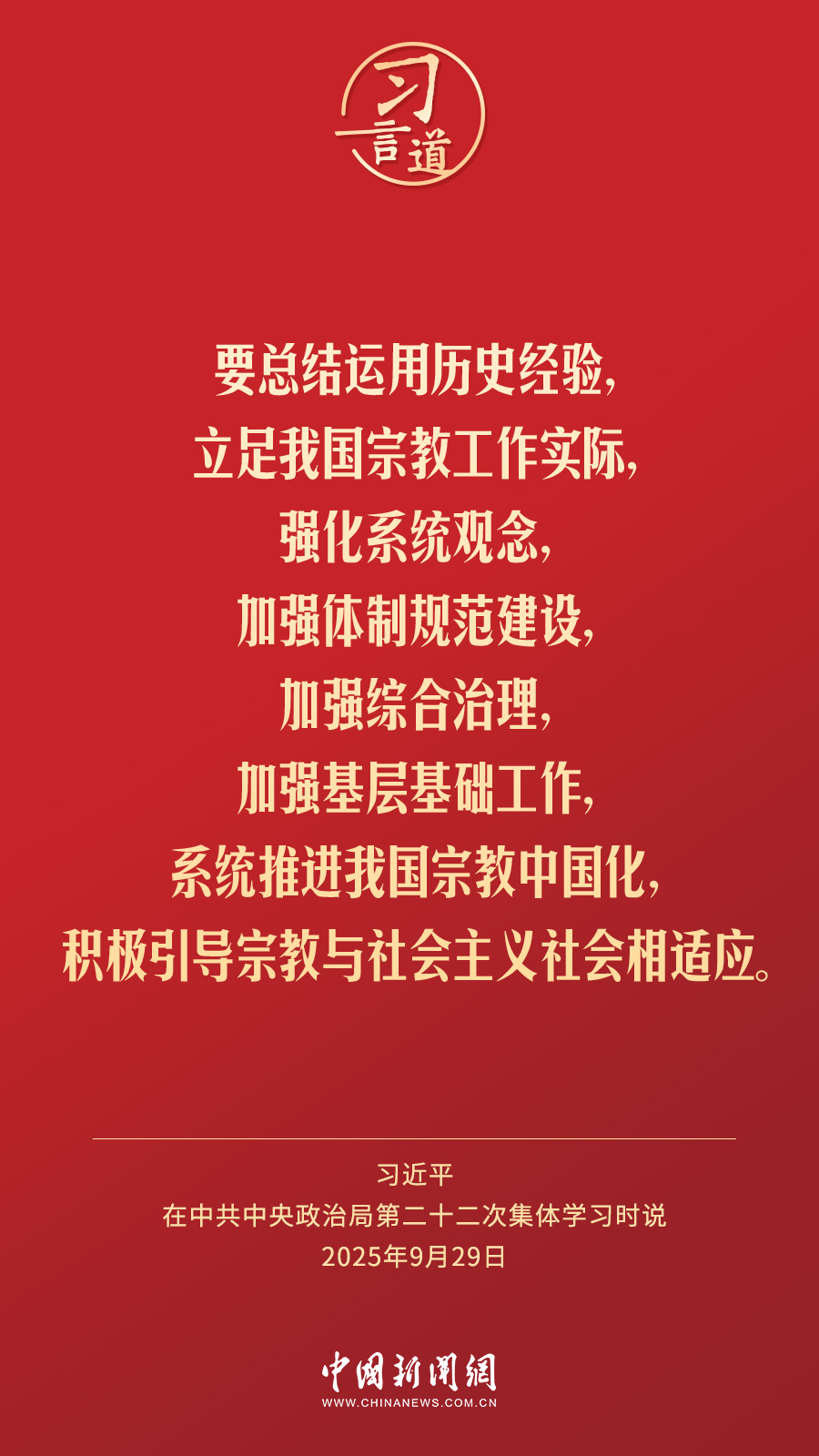
习近平在中共中央政治局第二十二次集体学习时强调系统推进我国宗教中国化 积极引导宗教与社会主义社会相适应
Xin Hua She· 2025-09-29 23:18
Group 1 - The core viewpoint emphasizes the importance of systematically promoting the Sinicization of religion in China, aligning it with socialist society [1][2] - Xi Jinping highlighted that since the 18th National Congress, the Party has prioritized religious work, introducing new concepts and measures to enhance the legal framework and effectiveness of religious governance [1] - The necessity of integrating religion with Chinese culture and civilization to ensure healthy transmission and development of various religions was stressed [2] Group 2 - Xi Jinping called for the active engagement and self-reform of religious communities to facilitate the Sinicization of religion, encouraging them to adapt their doctrines and practices to reflect Chinese characteristics [2] - The importance of legal governance in managing religious affairs was underscored, with a focus on improving relevant laws and policies to enhance the rule of law in religious work [2] - Local Party committees are urged to strengthen leadership in religious work, ensuring the implementation of the Party's theories and policies regarding religion [2]
系统推进我国宗教中国化积极引导宗教与社会主义社会相适应
Zhong Guo Zheng Quan Bao· 2025-09-29 20:45
Core Points - The Chinese Communist Party emphasizes the importance of promoting the Sinicization of religion as a key aspect of governance and social harmony [1][2] - Xi Jinping highlights the need for religions to integrate with Chinese culture and values, ensuring that they remain rooted in the nation's historical context [2] Group 1 - The Central Committee of the Communist Party has placed religious work at a significant position in governance since the 18th National Congress, introducing new concepts and measures to enhance the legal framework and effectiveness of religious work [1] - Xi Jinping stresses that only by continuously promoting the Sinicization of religion can the country achieve social harmony, ethnic unity, and long-term stability [1] - The necessity for religions to align with socialist values and foster a correct understanding of national, historical, ethnic, cultural, and religious perspectives is emphasized [1][2] Group 2 - Xi Jinping calls for the integration of religious practices with traditional Chinese culture, urging religious communities to enhance their cultural identity [2] - The importance of self-initiated reform within religious communities is highlighted as crucial for advancing the Sinicization of religion [2] - Legal governance of religious affairs is identified as a fundamental approach to addressing various issues within the religious sector, with a call for improved regulations and law enforcement [2]
习近平在中共中央政治局第二十二次集体学习时强调 系统推进我国宗教中国化 积极引导宗教与社会主义社会相适应
中国能源报· 2025-09-29 12:43
Core Viewpoint - The article emphasizes the importance of promoting the Sinicization of religion in China, aligning religious practices with socialist values, and enhancing the governance and legal framework surrounding religious affairs [1][2]. Group 1: Historical Context and Current Policies - Since the 18th National Congress, the Communist Party has prioritized religious work, introducing new concepts and measures to enhance the legal governance of religious affairs and achieve positive outcomes in the new era [1]. - Historical and practical evidence suggests that advancing the Sinicization of religion is essential for fostering harmony among religions, ethnic groups, and society, as well as ensuring national stability [1]. Group 2: Integration with Chinese Culture - All religions in China must be rooted in Chinese soil and infused with Chinese culture to ensure healthy transmission, promoting integration with the excellent traditional culture of China [2]. - There is a need to enhance the sense of cultural identity among religious figures and believers, encouraging them to embrace Chinese cultural values [2]. Group 3: Self-Transformation and Governance - It is crucial to stimulate proactive self-transformation within the religious community, adapting doctrines, management systems, and practices to reflect Chinese characteristics and meet contemporary demands [2]. - Legal governance of religious affairs is identified as a fundamental approach to addressing various conflicts and issues within the religious sector, necessitating improvements in relevant laws and policies [2]. Group 4: Leadership and Implementation - Local party committees are urged to strengthen leadership in religious work, fully implementing the Party's theories and policies regarding religion, and enhancing research on strategic and practical issues [2]. - There is a call to build a robust team for religious work and solidify grassroots foundations to create a collective effort in promoting the Sinicization of religion [2].

习近平在中共中央政治局第二十二次集体学习时强调 系统推进我国宗教中国化 积极引导宗教与社会主义社会相适应
证监会发布· 2025-09-29 11:14
Core Viewpoint - The article emphasizes the importance of systematically promoting the Sinicization of religion in China, highlighting the need for historical experience, system norms, and grassroots work to align religion with socialist society [2][3][4]. Group 1: Historical Context and Current Policies - Since the 18th National Congress, the Communist Party has prioritized religious work, proposing new concepts and measures to enhance the legal framework and effectiveness of religious governance [2]. - The promotion of Sinicization is seen as essential for social harmony, national stability, and the integration of religion with Chinese culture [2][3]. Group 2: Cultural Integration - Religions in China must root themselves in Chinese civilization and integrate with traditional culture to ensure healthy transmission [3]. - There is a call for religious figures and believers to enhance their recognition of Chinese culture and values [3]. Group 3: Governance and Legal Framework - Legal governance of religious affairs is deemed crucial for addressing conflicts and issues within the religious domain [4]. - The article advocates for improved regulations, law enforcement, and education to elevate the legal standards of religious work [4]. Group 4: Leadership and Organizational Development - Local party committees are urged to strengthen leadership in religious work and to implement the Party's theories and policies effectively [4]. - There is a focus on building a competent workforce in religious affairs and reinforcing grassroots foundations to create a collective effort in promoting Sinicization [4].

习近平在中共中央政治局第二十二次集体学习时强调:系统推进我国宗教中国化 积极引导宗教与社会主义社会相适应
Xin Hua She· 2025-09-29 10:47
Core Viewpoint - The article emphasizes the importance of systematically promoting the Sinicization of religion in China, aligning religious practices with socialist values, and enhancing governance and legal frameworks in religious affairs [2][3]. Group 1: Historical Context and Current Initiatives - Since the 18th National Congress of the Communist Party, the government has prioritized religious work, introducing new concepts and measures to enhance the legal and institutional frameworks governing religion [2]. - The article highlights the necessity of integrating religion with Chinese culture and values, promoting harmony among religions, ethnic groups, and society as a whole [3]. Group 2: Strategic Directions - The government aims to guide religious communities to adapt to socialist society, emphasizing the importance of the socialist core values in shaping religious perspectives [2][3]. - There is a call for religious organizations to reflect Chinese characteristics in their doctrines, management, and practices, enhancing self-regulation and self-education within these communities [3]. Group 3: Governance and Legal Framework - The article stresses the need for legal governance in religious affairs as a fundamental approach to resolving conflicts and issues within the religious sector [3]. - It advocates for the improvement of relevant laws and policies, alongside rigorous law enforcement and education on legal matters related to religion [3].
省委常委会召开会议学习习近平总书记重要讲话重要指示精神部署“三农”和推进作风建设常态化长效化等工作
Shan Xi Ri Bao· 2025-09-27 22:39
Group 1 - The meeting emphasized the importance of implementing Xi Jinping's recent important speeches and directives, particularly regarding the development of Xinjiang and the need for comprehensive adherence to the Party's governance strategies [1] - There is a focus on enhancing economic, cultural, and educational exchanges with Xinjiang, aiming to support the construction of a modern socialist Xinjiang [1] - The meeting highlighted the necessity of strengthening technological and industrial innovation, fostering unique advantageous industries, and improving the level of openness to better safeguard and improve people's livelihoods [1] Group 2 - The meeting called for a serious study and implementation of Xi Jinping's greetings to farmers and those working in the "three rural" areas, emphasizing the need for rural reform and comprehensive rural revitalization [2] - There is a commitment to ensuring the completion of annual grain production targets while addressing disaster prevention and recovery for autumn grain [2] - The meeting reiterated the importance of adhering to the central eight regulations and implementing long-term mechanisms for integrity and anti-corruption, promoting a culture of frugality and combating waste [2]
加强和改进新时代侨务工作 提高宗教工作法治化水平 确保党中央决策部署落地见效
Ren Min Ri Bao· 2025-09-11 22:02
Group 1 - The core viewpoint emphasizes the importance of adhering to Xi Jinping's thoughts and the need to enhance the mechanisms of overseas Chinese affairs while promoting the sinicization of religion to unite people for the great rejuvenation of the Chinese nation [1][2][3] Group 2 - The research highlights the focus on innovation and development in overseas Chinese-funded and private high-tech enterprises, as well as the importance of higher education and cultural heritage in fostering a sense of national identity among overseas Chinese [2] - The need for improved policies and legal frameworks to support overseas Chinese, ensuring a conducive environment for their work and life, is also emphasized [2] - The promotion of the sinicization of religion and the management of religious activities are critical for aligning religious practices with socialist values and enhancing the overall governance of religious affairs [3]