汽车产业变革

Search documents
汽车视点|上海车展“缺席的品牌”,能否再上“牌桌”?
Xin Hua Cai Jing· 2025-05-01 04:49
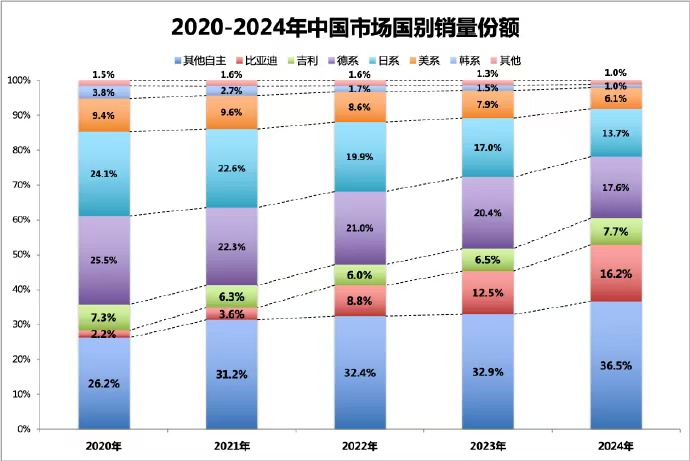
Core Insights - The 2025 Shanghai Auto Show has set multiple records in terms of scale, exhibitors, and technological displays, attracting nearly 1,000 renowned companies from 26 countries and regions, with a total exhibition area exceeding 360,000 square meters, showcasing the vitality of the global automotive industry [1] - A notable phenomenon at the show is the coexistence of a "star-studded lineup" and "strategic absences," with major brands like Volkswagen, Mercedes-Benz, and Toyota participating, while several foreign brands, including Hyundai and Kia, are absent, indicating a significant transformation in the automotive industry [2][3] Industry Dynamics - The absence of over 20 automotive brands, including Hyundai, Kia, and Jaguar Land Rover, highlights the challenges faced by foreign brands in the Chinese market, reflecting a broader industry reshuffle [2][3] - The German brands lead the market with a sales volume of 4.04 million units, capturing 17.6% market share, while Korean brands collectively sold only 234,000 units, shrinking to a mere 1.0% market share [4] - Beijing Hyundai's sales have plummeted from a peak of 1.14 million units in 2016 to just 154,000 units in 2024, marking a 33% year-on-year decline [5] Strategic Responses - Companies like Beijing Hyundai are exploring new strategies, such as off-peak product launches to avoid competition and gain attention, while also focusing on local partnerships to enhance their product offerings [12] - Nissan has showcased its commitment to the Chinese market by launching innovative models like the Frontier Pro PHEV and N7, emphasizing the importance of local development and market responsiveness [9] - Domestic brands like BYD and Geely are expanding their exhibition presence, reflecting strong market performance, with BYD achieving over 1 million sales in the first quarter [8] Future Outlook - The automotive industry is undergoing a significant transformation, with the survival of brands dependent on continuous innovation and adaptation to market changes, as evidenced by the contrasting fortunes of participating and absent companies at the auto show [10][13] - The 2025 Shanghai Auto Show serves as a mirror reflecting the harsh realities of the automotive industry, where only those who continuously innovate can maintain their competitive edge [13]

从上海车展看消费新风向:今年你想买什么车?
Huan Qiu Wang Zi Xun· 2025-04-26 22:40
Group 1: Market Trends and Consumer Preferences - The Shanghai International Automobile Industry Exhibition serves as a window to observe trends in China's automotive consumption and industry transformation, highlighting the rise of domestic brands, accelerated electrification, and rapid iteration of intelligent technologies [1] - A survey indicates that 74.58% of respondents prefer domestic brands, significantly higher than German (14.24%) and Japanese (6.25%) brands, with the core reason shifting from "low price" to "high value" [5][6] - Price and usage costs are the primary considerations for consumers, with 43.63% citing price fluctuations and 42.81% citing maintenance costs as key factors influencing their purchasing decisions [2] Group 2: Industry Dynamics and Competition - The Chinese automotive market is experiencing a price war, with a shift from "scale growth" to a focus on both "scale and efficiency" as emphasized by government officials [2] - The retail growth rate for automobiles reached a nearly 10-year high in March 2025, indicating a stabilization in the market and a shift in competition focus from price to technology [3] - Domestic brands are enhancing their technological confidence and product offerings, showcasing high-end models equipped with self-developed intelligent driving systems and advanced energy solutions at the auto show [6] Group 3: Technological Innovations and Safety - Safety features have become a significant consideration for consumers, with 45% of respondents prioritizing safety configurations in their purchasing decisions [6] - The introduction of intelligent safety systems at the auto show, including a new safety framework that defines safety through various scenarios, reflects the industry's focus on enhancing safety in intelligent driving [7] - Companies are emphasizing the importance of safety in intelligent driving technologies, with a growing trend towards rational discussions about the practical applications of these technologies [6][7] Group 4: Global Competitors' Strategies - German and Japanese automakers are facing challenges in the Chinese market, with a decline in market share and a need to adapt to local consumer preferences for electric and hybrid vehicles [12][13] - Audi is focusing on innovation and collaboration with local partners to enhance its product offerings in China, aiming to shorten development cycles and meet the demands of younger consumers [12][16] - Nissan plans to launch 10 new energy models by 2027 and is investing significantly in local R&D to improve its responsiveness to the fast-paced Chinese market [15][16]