
现代煤化工

Search documents
【最全】2025年煤化工行业上市公司全方位对比(附业务布局汇总、业绩对比、业务规划等)
Qian Zhan Wang· 2025-05-01 03:09
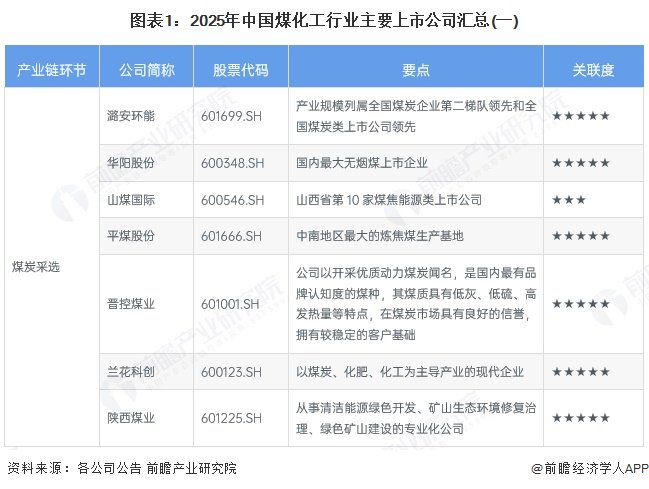
Core Viewpoint - The coal chemical industry in China is characterized by a diverse range of listed companies, each with distinct business layouts and performance metrics, focusing on both traditional and modern coal chemical products [1][3][20]. Industry Overview - The coal chemical industry is supported by upstream coal mining companies, which provide raw materials, and is influenced by coal price fluctuations that affect production costs and profit margins [1]. - The industry is divided into traditional coal chemical (e.g., coal-based fertilizers, synthetic ammonia) and modern coal chemical (e.g., new coal-based energy and materials) [1]. Key Listed Companies - Major listed companies in the coal chemical sector include China Shenhua (601088), Yanzhou Coal (600188), Baofeng Energy (600989), and others, with varying degrees of involvement in the coal chemical value chain [1][3][4]. - China Shenhua is recognized as a global leader in coal-based comprehensive energy [3]. Financial Performance - In the first half of 2024, China Shenhua reported revenues of 1680.78 billion, while other companies like Yanzhou Coal and Baofeng Energy reported revenues of 723.12 billion and 168.97 billion respectively [4][5]. - The overall gross profit margins in the coal chemical sector vary significantly, with Baofeng Energy achieving a gross margin exceeding 40% [19]. Business Layout and Strategy - Companies are strategically located in resource-rich regions, primarily in North and East China, focusing on traditional coal chemical products while expanding into modern coal chemical sectors [16][18]. - Business strategies emphasize safety, environmental protection, energy efficiency, and technological advancement to align with national policies and market demands [20][21]. Employee Composition - China Shenhua has the largest workforce in the sector, employing approximately 83,400 individuals, including 11,400 technical staff [11]. Future Planning - Companies are focusing on high-quality development, with plans to enhance core competencies, ensure energy security, and promote green and sustainable practices [21][22].






新疆系列报告之二:新疆煤制油、煤制气登上舞台
Huachuang Securities· 2025-03-31 23:30
Investment Rating - The report maintains a "Buy" recommendation for the coal-to-oil and coal-to-gas sectors in Xinjiang, highlighting their potential for significant growth and investment opportunities [2]. Core Insights - Xinjiang is emerging as a strategic base for coal-to-oil and coal-to-gas projects, driven by the increasing importance of energy security and favorable local coal prices [12][18]. - The report emphasizes the economic viability of coal-to-oil projects in Xinjiang, particularly due to the high oil content of Hami coal and advancements in technology that reduce production costs [18][22]. - The coal-to-gas sector is also highlighted for its improved profitability due to technological advancements and changes in commercial models, which enhance operational stability and market access [6][20]. Summary by Sections 1. Xinjiang as a Core Development Base for Coal-to-Oil and Coal-to-Gas - The report discusses the acceleration of coal-to-oil and coal-to-gas construction in Xinjiang, emphasizing the region's role in enhancing national energy security and reducing reliance on energy imports [12][13]. 2. Coal-to-Oil: Economic Viability and Technological Advancements - The report details the current state of coal-to-oil projects, noting that the average oil yield from Hami coal is significantly higher than that from other regions, with a total resource estimate of 570.8 billion tons and proven oil-rich coal resources of 64 billion tons [18][22]. - It highlights the ongoing technological improvements that have led to a decrease in production costs, with a breakeven point for indirect coal-to-oil at approximately $40 per barrel under favorable coal price conditions [18][22]. 3. Coal-to-Gas: Enhanced Profitability and Infrastructure Development - The report outlines the advancements in coal-to-gas technology and the establishment of a more competitive commercial model, which allows coal-to-gas companies to choose buyers freely, thus improving profitability [20][22]. - It mentions the completion of key infrastructure projects, such as the West-to-East Gas Pipeline, which enhances the transportation capacity for coal-to-gas products [20][22]. 4. Investment Recommendations - The report suggests focusing on three main investment lines: 1. Companies benefiting from capital expenditures in Xinjiang's coal chemical sector, including design and equipment firms [7]. 2. Service providers for coal chemical operations and mining, such as logistics and mining service companies [7]. 3. Companies investing in Xinjiang to leverage low coal prices for long-term cost advantages [7].