神经退行性疾病

Search documents
按摩面颈部就能“清洁”大脑?
Ke Ji Ri Bao· 2025-06-11 08:18
Core Insights - The article discusses a potential method for "cleaning" the brain through facial and neck massage, which may help in removing metabolic waste linked to neurodegenerative diseases like Alzheimer's and Parkinson's [1][3] Group 1: Brain Waste Management - The brain operates continuously, accumulating metabolic waste that can lead to neurodegenerative diseases if not cleared [1] - The brain has its own waste disposal system involving cerebrospinal fluid (CSF) that flushes out waste through lymphatic pathways [1][2] - Aging leads to a decline in the efficiency of this waste disposal system, resulting in the accumulation of harmful substances [1] Group 2: Research Findings - Recent research identified a superficial lymphatic network near the skin of the face and neck, which could facilitate the movement of CSF [2] - A mechanical stimulation device was developed that, when applied to the skin, significantly increased the outflow of CSF, achieving up to three times the normal rate [2] - The intensity of the massage is crucial, as excessive force may hinder the desired effect [2][3] Group 3: Implications and Future Research - This non-invasive technique does not involve drugs or surgery, suggesting a simple method for potentially enhancing brain health through skin massage [3] - Further research is needed to determine the effectiveness of this method in preventing diseases like Alzheimer's [3] - The findings open up possibilities for daily facial care routines to contribute to brain health [3]
颜宁发文祝贺!美国两院院士、睡眠领域顶尖学者丹扬教授回国,全职加盟深圳医学科学院
生物世界· 2025-06-02 02:42
Core Viewpoint - The article highlights the significant contributions of Professor Danyang in the field of sleep research and her recent affiliation with Shenzhen Medical Academy, where she will establish a Sleep and Consciousness Laboratory [1][4]. Group 1: Professor Danyang's Background - Professor Danyang graduated from Peking University with a degree in Physics and later pursued a PhD in Biology at Columbia University, followed by postdoctoral research at Rockefeller University and Harvard Medical School [4]. - She has been a faculty member at the University of California, Berkeley since 1997, focusing on the neural circuits that control sleep and the functions of the prefrontal cortex [4][21]. Group 2: Recent Research Contributions - On December 8, 2023, Professor Danyang's team published a study in Cell, revealing that frontal cortical ignition, related to consciousness awareness, is strongly suppressed during NREM sleep in mice due to cholinergic modulation [7][10]. - On January 18, 2024, a study published in Nature Neuroscience demonstrated that microglia can promote sleep through calcium-dependent modulation of norepinephrine transmission, suggesting a protective role for microglia in brain health [12][13]. - On January 17, 2025, a study in Science Advances explored how activation of locus coeruleus noradrenergic neurons rapidly increases homeostatic sleep pressure, indicating a mechanism for sleep regulation [15][17]. Group 3: Implications for Sleep Research - The findings from Professor Danyang's research suggest that understanding the mechanisms of sleep regulation could have implications for addressing sleep disruptions associated with neurodegenerative diseases like Alzheimer's [13]. - The research emphasizes the importance of microglial function in maintaining sleep and brain homeostasis, potentially offering insights into therapeutic strategies for sleep-related disorders [13]. - The studies collectively indicate that the functional fatigue of locus coeruleus neurons may lead to increased sleep pressure, providing a new perspective on the relationship between wakefulness and sleep [17].


一种小分子可精准阻断细胞凋亡
news flash· 2025-05-19 22:04
Core Insights - Scientists from Walter and Eliza Hall Institute in Australia have discovered a small molecule that can selectively inhibit apoptosis, which opens new avenues for treating neurodegenerative diseases such as Parkinson's and Alzheimer's [1] Group 1 - The research findings were published in the latest issue of the journal "Science Advances" [1]
Cell:我国学者揭示大脑“排污网络”的发育和神经调控密码,为阿尔茨海默病等大脑疾病的治疗开辟新方向
生物世界· 2025-05-02 02:15
Core Viewpoint - The research reveals the developmental control mechanism of the meningeal lymphatic system in the brain, highlighting the dynamic regulation by neural activity through specific glial cell subtypes, which provides new insights into the interaction between the nervous and immune systems [3][6][9]. Group 1: Research Findings - The study identifies that neural activity regulates the expression of Vegfc in slc6a11b+ radial astrocytes, which in turn controls the development of mural lymphatic endothelial cells (muLEC) in the meninges [3][5]. - It demonstrates that slc6a11b+ radial astrocytes are the primary source of Vegfc, essential for muLEC development, and that this process is modulated by neural activity [7][9]. - The collaboration between slc6a11b+ radial astrocytes and ccbe1+ fibroblasts ensures that muLEC is restricted to the brain surface, preventing invasion into the brain parenchyma [5][9]. Group 2: Implications for Future Research - The findings suggest that the brain not only processes neural information but also coordinates its microenvironment, providing a new framework for understanding brain-immune interactions [9]. - The research opens avenues for interventions targeting this regulatory network, potentially offering new perspectives on the role of the meningeal lymphatic system in neurodegenerative diseases [9][14]. - It emphasizes the importance of a functional lymphatic network for brain health, indicating that targeting the external lymphatic pathways may enhance treatment efficacy for neurological disorders [14].
帕金森病不只是“抖”,这个假期,留意身边老人的“慢、僵、倒”
Bei Ke Cai Jing· 2025-04-30 08:49
Core Insights - Parkinson's disease is the second most common neurodegenerative disease among the elderly in China, following Alzheimer's disease, with a current patient population of approximately 3.62 million, projected to rise to 5 million by 2030, accounting for about half of the global cases [2][3] Group 1: Disease Characteristics - Parkinson's disease symptoms include both motor and non-motor symptoms, with motor symptoms characterized by slowness, tremors, stiffness, and postural instability, while non-motor symptoms may include constipation, low mood, depression, olfactory dysfunction, and sleep disturbances [3][4] - Non-motor symptoms can appear up to 20 years before the onset of motor symptoms, indicating a higher probability of developing Parkinson's disease [2][3] Group 2: Diagnosis and Treatment - Early diagnosis is crucial for improving patient outcomes, but there are significant challenges in identifying early-stage patients due to misdiagnosis and delayed treatment [3][4] - The latest treatment guidelines recommend that once Parkinson's disease is diagnosed, treatment should begin promptly, regardless of the impact on quality of life, emphasizing the need for long-term management and a collaborative approach involving healthcare providers, patients, caregivers, and society [4]
AI新工具创建大脑代谢组高清3D图谱
Ke Ji Ri Bao· 2025-03-24 08:55
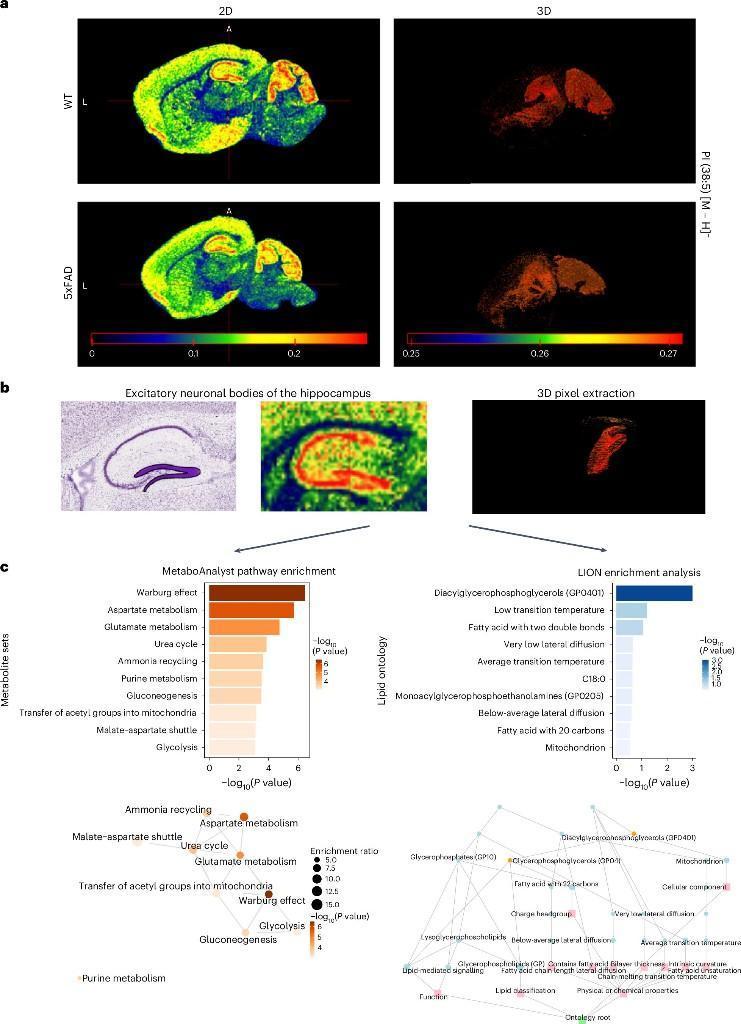
Core Insights - A research team from the University of Florida has developed a powerful AI tool named MetaVision3D, capable of generating high-resolution 3D maps of the mouse brain metabolome [1][4] - The research findings are published in the latest issue of the journal Nature Metabolism [1] Group 1: AI Tool Development - MetaVision3D allows users to zoom in and out on images to view all molecules related to mouse brain metabolic functions [1] - The tool was used to create interactive 3D maps of the metabolomes of normal mice and those suffering from Alzheimer's disease and Pompe disease [4] Group 2: Metabolome Significance - The metabolome consists of thousands of molecules that provide energy for brain function, enabling a deeper understanding of metabolism's role in neurodegenerative diseases [4] - This advancement may lead to the discovery of new drugs for treating Alzheimer's and other neurodegenerative diseases [4] Group 3: Research Methodology - The research team utilized advanced imaging technology to scan 79 brain slices layer by layer, identifying and counting essential nutrients like fats and carbohydrates [4] - AI was employed to stack these images together, reconstructing the entire brain's metabolome [4] Group 4: Future Applications - The research team plans to integrate the AI tool with established MRI imaging and genetic analysis to develop targeted therapies for specific brain regions [4]