空天经济

Search documents
神秘资金再出手!卫星产业ETF(159218)盘中狂揽超5000万,中国卫星三连升
Sou Hu Cai Jing· 2026-01-06 02:39
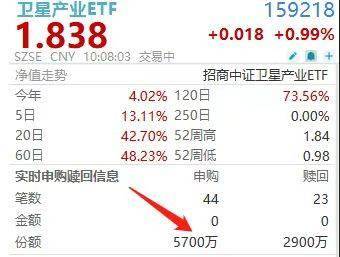
Group 1 - The satellite industry continues to perform strongly, with the satellite industry ETF (159218) rising by 1.04% as of 10:08 AM, marking a three-day increase [1] - Major stocks in the sector include China Satellite, which rose by 2.39%, China Satcom, which increased by 7.28%, and Huace Navigation, which gained 1.62%, while Zhongke Star Map fell by 2.43% [1] - The market saw a net inflow of over 50 million CNY during the trading session, indicating sustained investor interest [1] Group 2 - The core driver of the current market trend is the capitalization process of leading commercial aerospace companies [1] - Blue Arrow Aerospace, which successfully launched the Zhuque-3 rocket, has had its IPO application accepted, planning to issue no less than 40 million shares to raise 7.5 billion CNY, with an estimated valuation of 75 billion CNY [1] - The company aims to develop reusable rocket technology using liquid oxygen and methane, drawing comparisons to SpaceX, and its IPO has been selected for on-site inspection, highlighting regulatory attention on commercial aerospace firms [1] Group 3 - The commercial aerospace industry is entering a rapid development phase driven by policy support, capital assistance, and technological breakthroughs [2] - The satellite industry ETF serves as a comprehensive investment tool covering the entire industry chain, gaining favor among investors and becoming a key vehicle for market positioning in the "aerospace economy" [2]


商业航天第一股引爆做多热情!卫星产业ETF(159218)单日获近3.8亿抢筹,量能近8亿再刷历史新高
Jin Rong Jie· 2026-01-06 02:17
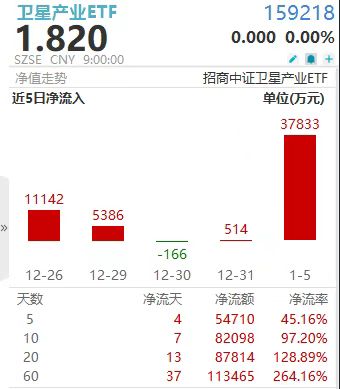
Group 1 - The satellite industry sector has shown strong performance driven by multiple catalysts, with the satellite industry ETF (159218) rising by 3% and achieving a record trading volume of nearly 800 million yuan and a net inflow of approximately 380 million yuan [1][3] - The core driver of this market trend is the capitalization process of leading commercial aerospace companies, exemplified by Blue Arrow Aerospace, which has successfully completed the launch of the Zhuque-3 rocket and has had its IPO application accepted, aiming to issue no less than 40 million shares to raise 7.5 billion yuan with an expected valuation of 75 billion yuan [3] - The Chinese aerospace industry is witnessing favorable developments, as the Commercial Rocket Company under China Aerospace Science and Technology Corporation has increased its registered capital from 1 billion yuan to 1.396 billion yuan, indicating ongoing state support and investment in the commercial aerospace sector [3] Group 2 - The commercial aerospace industry is entering a rapid development phase due to a threefold resonance of policy support, capital assistance, and technological breakthroughs, with the satellite industry ETF (159218) being favored by investors as a key vehicle for market positioning in the "aerospace economy" [3]
苦干实干 勇于争先 打造高质量发展高品质生活高效能治理示范区
Xin Lang Cai Jing· 2025-12-26 21:02
Group 1 - The core message emphasizes the commitment of the Ping'an District to implement the economic work meeting's spirit, focusing on high-quality development and efficient governance to ensure a strong start for the 14th Five-Year Plan [1] - The district aims to strengthen domestic demand by attracting renowned automotive brands and enhancing consumer activities, with plans for 160 promotional events and the establishment of 20 new brand flagship stores [1] - The district has set ambitious targets for project implementation, with 160 new contracts signed for projects over 100 million and over 200 projects expected to resume or commence construction [1] Group 2 - Innovation-driven growth is prioritized, with support for the establishment of key laboratories and innovation platforms, and a focus on emerging industries such as artificial intelligence and digital economy [2] - The district is enhancing its business environment through reforms, aiming for over 90% of services to be "one-time no-run" and promoting the growth of state-owned enterprises with a target of over 5% revenue increase [2] - The district is committed to improving living standards by upgrading urban infrastructure, creating over 600 new parking spaces, and increasing employment opportunities by over 16,000 [3]
加速买入!卫星产业ETF(159218)盘中净流入持续放大,“空天经济”持续发酵
Sou Hu Cai Jing· 2025-12-15 06:50
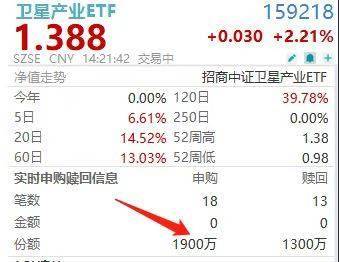
战略层面,太空安全议题升温。军事专家公开警示部分国家发展太空攻击能力的野心,凸显了太空资产 在国家竞争中的极端重要性。商业繁荣与战略博弈交织,共同构成了卫星产业链无可替代的投资价值, 吸引长期资金持续布局。 风险提示:基金有风险,投资需谨慎。 | T 屋产业ETF | | 159218 | | --- | --- | --- | | 3.24 | | +0.030 +2.21% | | CNY 14:21:42 交易中 | | / 0 + | | 净值走势 | | 招商中证卫星产业ETF | | 今年 | 0.00% 120日 | 39.78% | | 5日 | 6.61% 250日 | 0.00% | | 20日 | 14.52% 52周高 | 1.38 | | 60日 | 13.03% 52周低 | 0.98 | | 实时申购随回信息 | 曲胸 | 顾回 | | 管教 | 18 | 13 | | 全额 | 0 | 0 | | 份额 | 1900万 | 1300万 | 产业层面,发射加速与成本革命并行。国内火箭高密度发射已成常态,可复用技术稳步推进。同时,上 海交通大学与国星宇航签约共建国内首个"太空计算联 ...
罕见盘前申购!卫星产业ETF(159218)再获资金抢注,太空“双线争夺”持续演绎
Sou Hu Cai Jing· 2025-12-15 02:09
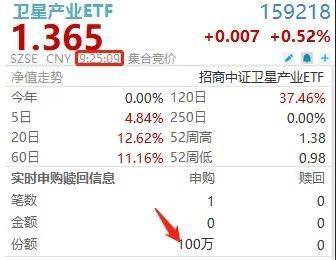
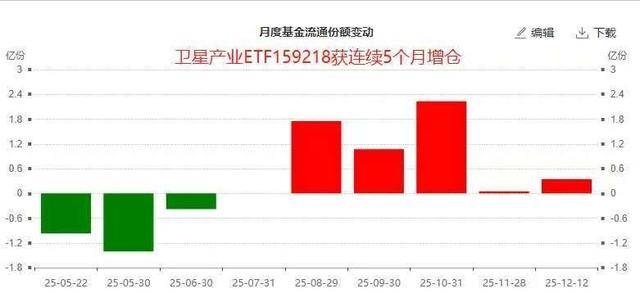
12月15日,卫星板块逆市活跃。截至9时25分,首支卫星产业ETF(159218)涨0.52%,资金热度不减,据 Wind Level2实时行情,盘前惊现申购资金涌入。 | 卫星产业ETF | | 159218 | | --- | --- | --- | | 365 | | +0.007 +0.52% | | SZSE CNY @2500 集合竞价 | | / 8 + | | 净值走势 | | 招商中证卫星产业ETF | | 今年 | 0.00% 120日 | 37.46% | | 5日 | 4.84% 250日 | 0.00% | | 20日 | 12.62% 52周高 | 1.38 | | 60日 | 11.16% 52周低 | 0.98 | | 实时申购质回信息 | 由胸 | 恒国 | | 笔数 | 1 | 0 | | 金额 | 0 | 0 | | 份额 | 100万 | 0 | 拉长周期看,市场对"空天经济"的长期信心持续高涨。截至12月12日,卫星产业ETF(159218)已获资金 连续5个月净流入,持续获得市场重仓。 产业层面,发射加速与成本革命并行。国内火箭高密度发射已成常态,可复用技术稳步推进 ...
从“太空AI”实验室到“太空珍珠港”警示:卫星产业站在历史拐点
Sou Hu Cai Jing· 2025-12-15 01:59
【商业闭环加速形成:从发射成本到太空算力】 近期,产业链各环节捷报频传。12月9日,长征六号改与长征四号乙火箭接连成功发射,将卫星互联网 低轨组网与遥感观测任务推向常态化。而实现成本革命的可重复使用火箭正稳步推进。业界专家分析认 为,即便明年成功实现技术验证,初期的复用次数预计在3次左右,三五年后才可能提升至5到10次。这 为产业链提供了明确的成本下降与产能爬坡预期。 全球范围内的"空天经济"热潮正从商业探索、技术竞赛,向更广阔的国家战略层面延伸。这一变化也清 晰的反应在二级市场。数据显示,截至12月12日,首只卫星产业ETF(159218)已实现连续5个月的资金净 流入,映射出资本市场对卫星产业链长期价值的共识。 综合来看,当前卫星产业正面临一个前所未有的复杂局面:一方面是商业化带来的成本降低与市场爆发 (如SpaceX的IPO),另一方面是大国竞争加剧带来的战略紧迫性。无论是应对潜在的"太空珍珠港", 还是抢占"太空AI"的科技制高点,建设强大、自主、完备的太空基础设施体系都已成为国家发展的必选 项。 在这一宏大背景下,卫星产业ETF(159218)所覆盖的,正是从火箭发射、卫星制造、地面设备到核心元 器 ...
“空天经济”闪耀两市!资金重注卫星产业ETF(159218)布局产业未来
Sou Hu Cai Jing· 2025-12-12 01:45
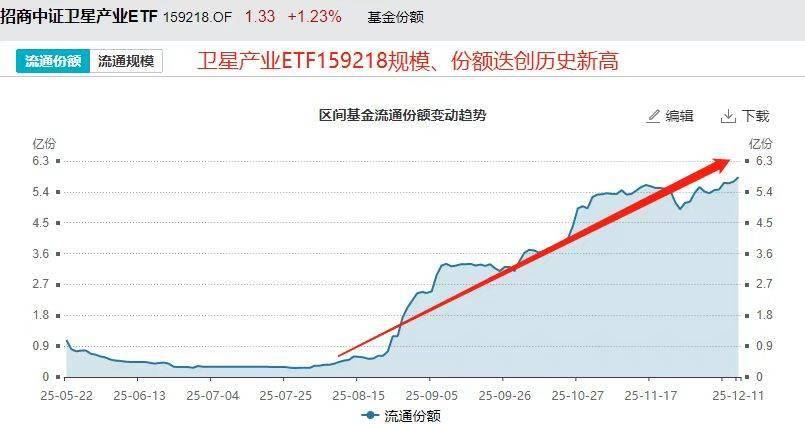
Core Viewpoint - The capital market's enthusiasm for the "space economy" is rising, with the satellite industry ETF (159218) becoming a focal point for investment, reflecting the industry's growth and potential [1][4]. Group 1: ETF Performance - As of December 11, the ETF's scale has reached nearly 800 million yuan, marking a historical high, with a year-to-date share growth of approximately 438.88%, leading among similar ETFs [4]. - The ETF has seen four instances of net inflow in just five trading days, indicating strong interest from institutions and investors in the commercial space sector [4]. Group 2: Industry Catalysts - The excitement in the sector is driven by significant industry catalysts, shifting the narrative from "space networking" to "space computing" [4]. - SpaceX is accelerating its IPO plans, aiming to raise over 30 billion USD with a target valuation of about 1.5 trillion USD, which would reshape the valuation landscape of the space economy [4]. Group 3: Technological Advancements - The "space AI" competition is intensifying, with Starcloud successfully operating an AI model in orbit, showcasing a significant leap in satellite capabilities [5]. - Domestic advancements in launch and manufacturing capabilities are also notable, with the Long March 12A rocket set for its maiden flight, representing a breakthrough in reusable rocket technology [5][7]. Group 4: Supply Chain and Manufacturing - The domestic supply chain is enhancing its capabilities, particularly in satellite energy systems, where a significant portion of satellites globally utilize high-efficiency solar cells, supported by local technological advancements [7]. - The combination of capital investment and technological breakthroughs forms a solid foundation for the current investment boom in the satellite industry [7].
新质生产力引领空天经济加速腾飞
Zhong Guo Jing Ying Bao· 2025-10-17 18:37
Core Insights - The aerospace economy is becoming a crucial direction for industrial transformation and upgrading in various regions of China, with policies being implemented to support commercial aerospace and low-altitude economy development [2][3][4] - The market size of China's commercial aerospace industry is expected to exceed 2.5 trillion yuan by 2025, indicating a significant growth opportunity [2] - Local governments are focusing on leveraging core technological breakthroughs to create competitive advantages and meet real market demands [2][4] Policy and Development Goals - Shandong Province aims to achieve an annual production capacity of 100 launch vehicles and 150 commercial satellites by 2027, with a commercial aerospace industry scale reaching 50 billion yuan [3] - Shanghai has set a target for its commercial aerospace industry to reach approximately 100 billion yuan by 2027 [4] - Suzhou has implemented regulations to promote low-altitude economy, aiming to establish a national low-altitude economic demonstration zone by 2026 [4] Commercialization and Technological Advancements - The successful launch of the "Inertia One" rocket and the development of a 2-ton eVTOL for intercity cargo transport highlight the rapid commercialization of aerospace technologies [3][5] - The launch of the sixth orbital plane of the Geely constellation marks a significant step in the commercialization of satellite communication technology [5][6] Investment and Economic Impact - Local governments are adopting innovative investment attraction models, such as "investment-driven attraction," to draw in leading companies in the aerospace sector [6] - Significant investments have been made, including a 2 billion yuan investment for the global headquarters of the Geely constellation and nearly 2.5 billion yuan financing for Beijing Tianbing Technology [6] Industry Challenges and Considerations - There is a need for caution against redundant construction and blind investment in the aerospace economy to ensure sustainable development [6] - Local development should align with regional resource endowments and foundational advantages to avoid unsuccessful replication of success stories [6]
坤元资产FOF生态圈抢滩“空天经济” 长春航展彰显科技崛起
Cai Fu Zai Xian· 2025-09-22 09:27
Core Insights - The "Aerospace Economy" is emerging as a new industry globally, representing a new form of productive forces that integrates airspace resources with aviation, aerospace technology, and information technology to promote economic development [2][3] - The year 2025 marks a milestone in China's "Aerospace Economy," with the government emphasizing the development of commercial aerospace and low-altitude economy as strategic emerging industries [2][3] - The market for China's commercial aerospace is projected to grow from approximately 376.4 billion yuan in 2015 to over 2.8 trillion yuan in 2025, indicating a robust growth trajectory [3] Industry Developments - Morgan Stanley predicts that the global space economy will exceed $1 trillion by 2040, with China's growth curve being particularly steep [3] - The integration of technologies such as liquid rockets and recovery technology is expected to lead to a "commercial explosion" in the aerospace sector, reshaping the industry landscape [3] - The FOF ecosystem developed by Kunyuan Asset is designed to cover multiple cutting-edge fields, including artificial intelligence, advanced manufacturing, and biomedicine, showcasing significant collaborative advantages in the aerospace economy [4] Key Players - Changguang Satellite, a key partner in Kunyuan Asset's FOF ecosystem, operates the "Jilin-1" satellite constellation, which is the largest commercial remote sensing satellite constellation in China [4][6] - Shanghai Yuanxin Satellite focuses on building a low-orbit satellite communication constellation, addressing fundamental issues of connectivity and speed in the information age [5][6] - The collaboration between Changguang Satellite and Yuanxin Satellite creates a powerful ecological synergy in the aerospace information industry, enhancing capabilities in emergency response and data transmission [6] Investment Strategy - The FOF ecosystem model of Kunyuan Asset aims to attract "patient capital" and "smart capital" to support long-term investments in the aerospace industry, which requires significant and sustained funding [7] - The investment approach emphasizes linking with top-tier partners in specialized fields to identify and empower early-stage technologies, ensuring access to high-potential assets [7] - Since its establishment in 2014, Kunyuan Asset has successfully listed 12 portfolio companies on various stock exchanges, demonstrating its ability to navigate market cycles and capture leading enterprises in golden sectors [8] Future Outlook - The aerospace economy is not just an opportunity but a marker of human civilization's advancement, with companies in Kunyuan Asset's ecosystem actively contributing to this vision [8][9] - The combination of a trillion-level market space, breakthrough technological innovations, and comprehensive policy support is expected to drive the industry's development [9] - The ongoing investment in the aerospace sector is anticipated to accelerate the formation of a virtuous cycle of "capital + technology + industry," positioning Chinese innovative enterprises to seize new opportunities in the aerospace industry [9]
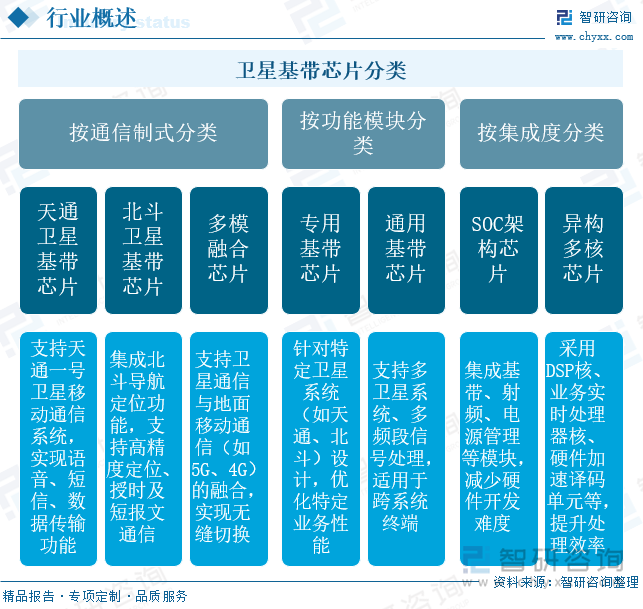
趋势研判!2025年中国卫星基带芯片行业产业链、发展现状、竞争格局及未来趋势分析:卫星基带芯片撬动空天经济新蓝海,开启6G时代万亿级市场机遇[图]
Chan Ye Xin Xi Wang· 2025-05-23 01:10
Core Insights - Satellite baseband chips are crucial for integrated air-ground communication, with market growth accelerated by the explosion of low-orbit constellations and the maturation of direct satellite connection technology [1][15] - Chinese companies, represented by Huawei HiSilicon and Unisoc, are making significant technological breakthroughs, laying the foundation for a self-controlled industrial chain [1][15] - By 2028, the Chinese satellite baseband chip market is expected to exceed 28 billion yuan, forming a tripartite structure among the vehicle networking, consumer electronics, and low-altitude economy sectors [1][15] Industry Overview - Satellite baseband chips are the core components of satellite communication systems, responsible for digital signal conversion, modulation, demodulation, protocol control, and data processing [2][4] - The industry has evolved from reliance on imports to achieving significant domestic innovation, with key milestones including the launch of the first fully autonomous "Navigation No. 1" chip in 2008 [6][8] Current Market Analysis - The penetration rate of smartphones supporting satellite communication is projected to rise from less than 10% in 2023 to over 30% by 2025 [1][15] - The demand for vehicle-mounted satellite communication chips is expected to maintain an annual growth rate of over 50% due to the rapid development of smart connected vehicles [1][15] - The market for satellite communication chips in the low-altitude economy is anticipated to surpass 10 billion yuan in the next three years [1][15] Competitive Landscape - The industry exhibits a "pyramid" competition structure, with leading companies like Huawei HiSilicon and Huali Chuantong at the top, followed by firms like Unisoc and Hezhong Star [17][19] - The overall landscape is characterized by military-driven innovation, civilian market expansion, and breakthroughs in technology, with a focus on high-reliability military chips and consumer applications [19] Future Trends - The industry is expected to undergo a transformation driven by technological autonomy, expanding application scenarios, and collaborative development across the supply chain [22][25] - Key advancements include the development of multi-mode compatible chips and quantum-safe encryption technologies, which will help break foreign technology monopolies [24][26] - The satellite baseband chip sector is becoming a core infrastructure of national digital economy strategy, with projections indicating a potential market impact exceeding 3 trillion yuan [27]