股票策略

Search documents
再增5家!百亿私募数量突破100大关!
私募排排网· 2025-10-23 03:33
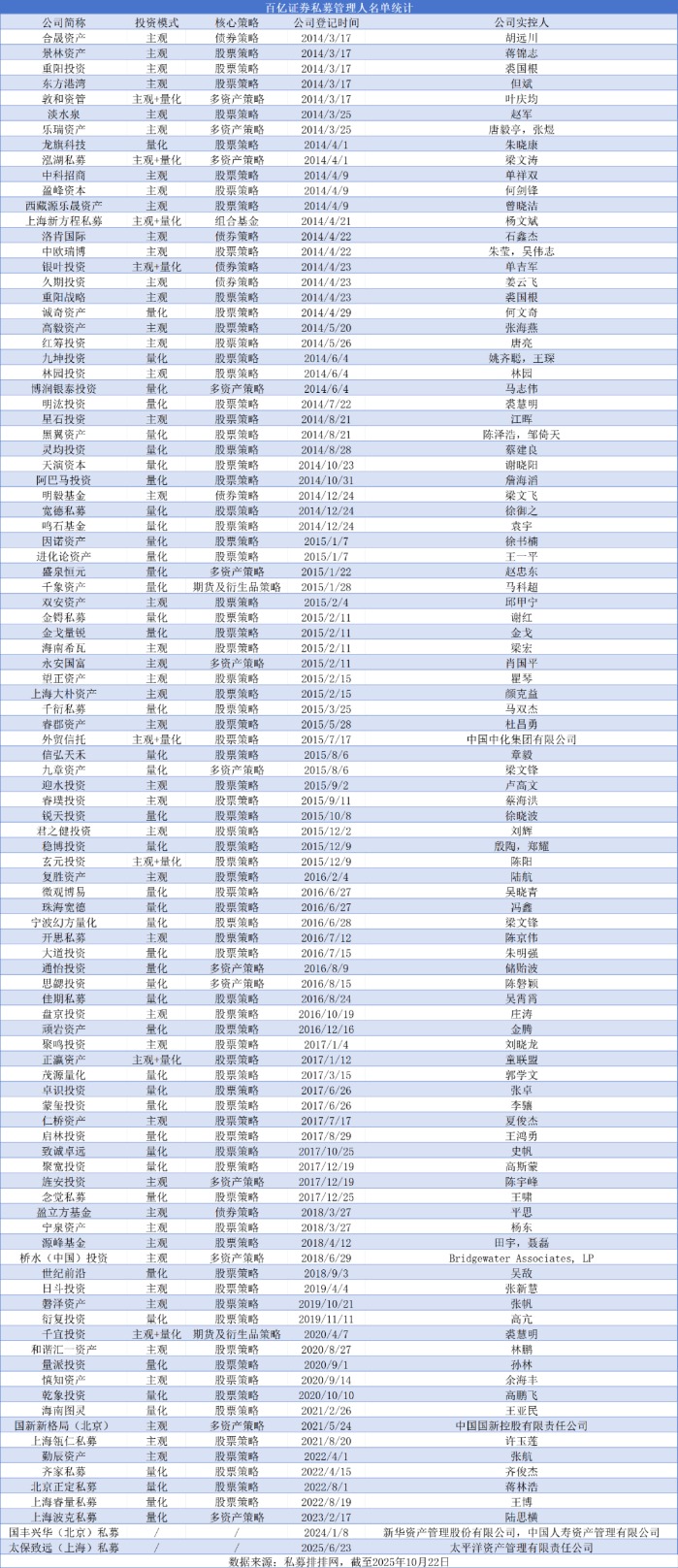
Core Insights - The number of billion-dollar private equity firms has surpassed 101 as of October 22, 2025, with an increase of 5 firms from September [1] - The growth in the number of billion-dollar private equity firms is attributed to the stabilization and recovery of the A-share market, leading to improved performance and scale of private equity products [6][7] - The majority of the new entrants in the billion-dollar category are subjective private equity firms, reflecting their flexibility in adapting to market conditions [7] Summary by Categories Number of Billion-Dollar Private Equity Firms - As of October 22, 2025, there are 101 billion-dollar private equity firms, up from 96 in September, with notable returns of familiar firms and one new entrant [1] - The new entrants include Shanghai New Equation, Wangzheng Asset, Jing'an Investment, and Hefei Investment, with Dadao Investment being a first-time entrant [1] Investment Strategy Distribution - Among the 101 billion-dollar private equity firms, quantitative firms lead with 47 firms (46.53%), followed closely by subjective firms with 44 firms (43.56%), and mixed strategy firms with 8 firms (7.92%) [2] - In the new entrants, subjective and quantitative strategies each account for 2 firms, while mixed strategy accounts for 1 firm [2] Core Strategy Analysis - The dominant core strategy among the billion-dollar private equity firms is stock strategy, with 77 firms (76.24%), followed by multi-asset strategy (13 firms, 12.87%) and bond strategy (6 firms, 5.94%) [5] - Among the new entrants, 3 firms focus on stock strategy, while 1 firm each focuses on multi-asset and combination fund strategies [5] Market Trends and Investor Behavior - The increase in billion-dollar private equity firms is driven by investor confidence in top firms, leading to a concentration of funds towards those with stable performance and mature strategies [6] - The "head effect" in the industry is strengthening, with resources increasingly directed towards high-quality private equity firms, accelerating the process of industry selection [6] Flexibility of Subjective Private Equity Firms - Subjective private equity firms are favored in the current complex market environment due to their ability to adjust positions and sector allocations in response to macroeconomic conditions and policy changes [7] - Experienced fund managers in subjective firms are better positioned to identify quality stocks, leading to superior performance and attracting continued capital inflow [7]


百亿私募数量突破100家 量化私募和主观私募占据绝大多数份额
Zhong Guo Ji Jin Bao· 2025-10-22 10:16
Core Insights - The number of private equity funds with over 10 billion yuan in assets has reached 100, marking a significant milestone in the industry as it reflects the recovery of the market and the growth of fund performance and scale [2][3]. Group 1: Growth of Private Equity Funds - As of October 22, 2025, the number of private equity funds exceeding 10 billion yuan has increased by 4 from the end of September, with notable new entrants including Dadao Investment and the return of Shanghai New Equation and Wangzheng Asset [2]. - The current distribution of the 100 funds shows that quantitative funds lead with 46, followed closely by subjective funds at 44, while mixed strategy funds account for 8 [2][3]. Group 2: Market Dynamics - The increase in the number of large private equity funds is attributed to the stabilization of the A-share market, which has improved returns on equity assets, leading to a rise in both fund performance and scale [3]. - There is a growing recognition of leading private equity firms, resulting in a concentration of funds towards those with stable performance and mature strategies, reinforcing the "head effect" in the industry [3]. Group 3: Investment Strategies - Stock strategies dominate the core strategies of the funds, with 76 out of 100 funds focusing on this area, reflecting the current market's favorable conditions for stock selection [4]. - The rise in multi-asset strategies indicates an increasing demand for risk diversification, as these strategies can mitigate the volatility of single assets and provide more stable returns [5].
百亿私募,突破100家!
Zhong Guo Ji Jin Bao· 2025-10-22 09:40
Core Insights - The number of private equity firms with over 10 billion yuan in assets has surpassed 100, marking a significant milestone in the industry, with a total of 100 firms as of October 22, 2025, an increase of 4 from the end of September [2][3] - Quantitative and subjective private equity firms dominate the market, collectively accounting for 90% of the total, indicating a solidified "dual giant" structure in the industry [2][3] Group 1: Market Trends - The increase in the number of billion-yuan private equity firms is attributed to the stabilization and recovery of the A-share market, which has improved the performance of equity assets [3] - Investors are increasingly recognizing leading private equity firms, leading to a concentration of funds towards those with stable performance and mature strategies [3] - The current market environment's complexity has favored subjective strategies, allowing for flexible adjustments based on macroeconomic conditions and policy changes [3] Group 2: Investment Strategies - Among the 100 billion-yuan private equity firms, 46 are quantitative, 44 are subjective, and 8 employ mixed strategies, with 2 firms not disclosing their investment models [2] - Stock strategies remain the dominant core strategy, utilized by 76 firms, while multi-asset strategies account for 13, and bond strategies for 6 [4][5] - The rise in multi-asset strategies reflects an increasing demand for risk diversification in a market characterized by rapid style rotation and heightened volatility [5]
百亿私募数量再次突破100家大关 量化和主观私募占比超九成
Zheng Quan Shi Bao Wang· 2025-10-22 07:12
Group 1 - The number of private equity firms with over 10 billion yuan in assets has surpassed 100, reaching 101 as of October 22, 2025, an increase of 5 from 96 at the end of September [1] - Among the 101 firms, quantitative private equity firms are the most numerous, with 47 firms accounting for 46.53%, followed by subjective private equity firms with 44 firms at 43.56%, and mixed strategy firms with 8 firms at 7.92% [1] - The new entrants in October include 2 subjective and 2 quantitative strategy firms, along with 1 mixed strategy firm [1] Group 2 - Stock strategies dominate the core strategies of the private equity firms, with 77 firms employing this strategy, representing 76.24% of the total [2] - Multi-asset strategies account for 12.87% with 13 firms, while bond strategies make up 5.94% with 6 firms [2] - The increase in the number of billion-yuan private equity firms is attributed to the stabilization of the A-share market, leading to improved performance and scale of private equity products [2] Group 3 - The expansion of private equity firms is primarily driven by subjective private equity firms due to their flexibility in adapting to market changes and macroeconomic conditions [3] - Some subjective private equity managers possess extensive investment experience and strong stock-picking abilities, which attract continuous capital inflow [3] - Market conditions are currently characterized by structural valuation concerns, with a focus on sectors like AI applications and cyclical industries nearing capacity clearance [3]
百亿元级私募阵营持续扩大
Zheng Quan Ri Bao· 2025-10-19 17:44
Group 1 - The number of domestic private equity firms with over 10 billion yuan in assets has increased to 96, with 5 new firms added in September 2025 [1] - Among the 96 firms, quantitative strategies dominate, with 45 firms (46.88%) employing this approach, followed closely by 42 firms using subjective strategies [1] - The trend of global expansion is evident, with 65 out of 96 firms (67.71%) obtaining Hong Kong's Type 9 license [1] Group 2 - Stock strategies remain the primary focus for 74 firms (77.08%), while multi-asset and bond strategies are used by 12 and 6 firms, respectively [2] - In the first three quarters of 2025, the average return for 62 reporting firms was 28.80%, with 98.39% of firms achieving positive returns [2] - The performance of quantitative private equity firms was particularly strong, with an average return of 31.90%, surpassing the 24.56% average return of subjective firms [2][3] Group 3 - Among the 32 firms with average returns exceeding 30%, 24 are quantitative firms, representing 75% of this group [3] - Factors contributing to the strong performance of quantitative firms include market style alignment, systematic operations reducing emotional interference, and ongoing strategy iteration and risk control upgrades [3]
私募备案量暴增近九成!前三季度,私募交出亮眼成绩单
券商中国· 2025-10-19 05:51
Core Viewpoint - The private equity fund market is experiencing a significant rebound, with new product issuances increasing and many funds surpassing the 10 billion yuan mark [1] Group 1: Market Growth and Product Issuance - In the first three quarters, a total of 8,935 private equity securities products were registered, representing a substantial year-on-year increase of 89.38% from 4,718 products [2][3] - The growth in registration numbers is attributed to three main factors: improved market conditions, regulatory guidance enhancing transparency and compliance, and active expansion by institutions [3] - Stock strategies remain the dominant force, with 5,849 products registered, accounting for 65.46% of the total, and showing a year-on-year growth of 99.35% [3] Group 2: Performance of Private Equity Funds - The average return for private equity funds in the first three quarters was 25%, significantly outperforming the Shanghai and Shenzhen 300 Index [2][5] - Among the five major strategies, stock strategies led with an average return of 31.19%, with 93.52% of the 5,976 funds achieving positive returns [5][6] - Quantitative long strategies showed exceptional performance, with an average return of 35.95% and a positive return rate of 96.71% [6] Group 3: Growth of Billion-Yuan Private Equity Funds - The average return for the 62 billion-yuan private equity funds reached 28.80%, with 98.39% of them reporting positive returns [7] - A total of 14 funds achieved returns exceeding 40%, while 18 funds had returns between 30% and 40%, indicating strong overall profitability [7] - The number of billion-yuan private equity funds increased to 96 by the end of September 2025, up from 91 at the end of August [8][9] Group 4: Industry Structure and Competition - The registration structure indicates a shift in the competitive landscape, with top quantitative private equity funds dominating the registration rankings [8] - Among the 26 private equity firms with at least 40 registered products, 23 are billion-yuan institutions, highlighting a significant head effect [8] - The industry is witnessing increased concentration, with leading firms expanding while smaller firms actively seek breakthroughs [8]

前三季度备案私募产品同比增长近90% 股票策略备案量占据主导地位
Zheng Quan Shi Bao Wang· 2025-10-17 09:45
Core Viewpoint - The private equity securities product registration market has significantly rebounded in 2025, with a total of 8,935 products registered in the first three quarters, representing a substantial increase of 89.38% compared to the same period last year [1] Group 1: Product Registration Overview - The stock strategy products dominate the market with 5,849 registrations, accounting for 65.46% of the total, and showing a year-on-year increase of 99.35% [1] - Multi-asset strategies follow with 1,278 registered products, making up 14.30% of the total, and experiencing an 84.68% year-on-year growth [1] - Futures and derivatives strategies have 913 registered products, representing 10.22% of the total, with a year-on-year increase of 66.00% [2] Group 2: Quantitative Private Equity Products - Quantitative private equity products have shown remarkable performance, with 3,958 products registered, accounting for 44.30% of all private equity securities products, and a year-on-year increase of 102.66% [2] - Within quantitative products, stock strategy quant products lead with 2,865 registrations, making up 72.39% of the total [2] - The quantitative CTA strategy has 509 registered products, representing 12.86% of the total, benefiting from favorable market trends [3]
年内私募分红逾140亿元,股票策略是主力军
Guo Ji Jin Rong Bao· 2025-10-15 13:59
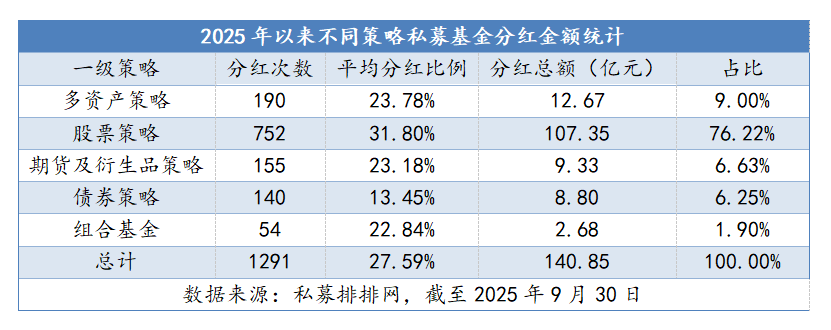
Core Insights - As of September 30, 2025, a total of 1,038 products have distributed dividends this year, with a total of 1,291 distributions amounting to 14.085 billion yuan and an average distribution ratio of 27.59% [1][2] Group 1: Dividend Distribution by Strategy - Stock strategy products are the main contributors to dividends, with 752 distributions, an average distribution ratio of 31.80%, and a total amount of 10.735 billion yuan, accounting for 76.22% of total distributions [2][3] - Multi-asset strategy products have distributed dividends 190 times, with an average distribution ratio of 23.78% and a total amount of 1.267 billion yuan, representing 9% of total distributions [2][3] - Futures and derivatives strategies and bond strategies have similar total distributions, with 155 and 140 distributions respectively, totaling 933 million yuan and 880 million yuan, accounting for 6.63% and 6.25% of total distributions [2][3] Group 2: Performance of Fund Sizes - Funds managed by firms with over 10 billion yuan in assets are the main drivers of dividend distributions, with 131 distributions, an average distribution ratio of 34.62%, and a total amount of 4.999 billion yuan, representing 35.49% of total distributions [3] - Funds with assets between 0 to 500 million yuan have made 667 distributions, leading in frequency, with a total amount of 2.918 billion yuan, accounting for 20.72% of total distributions despite a lower average distribution ratio of 25.97% [3] Group 3: Factors Influencing Dividend Behavior - The active dividend behavior of stock strategy products is driven by strong performance, with an average return of 31.19% and 93.52% of products showing positive returns, creating ample space for distributions [3][4] - Fund managers are intentionally using dividends to manage product scale, preventing dilution of existing holders' returns amid significant inflows, thereby maintaining optimal investment strategy performance [4]
1028只!9月私募备案大增171%
Shen Zhen Shang Bao· 2025-10-13 05:06
Group 1 - In September, the enthusiasm for new private equity products surged, with 1,028 private securities funds registered, a year-on-year increase of 171% [1] - Equity strategy private funds dominated the market, with 668 equity strategy products registered, accounting for over 60% of the total [1] - Quantitative products were particularly active, with 364 quantitative private funds registered, representing 35.4% of the total [1] Group 2 - Leading private equity firms maintained a significant advantage in product registration, with Shanghai Liwei leading with 23 products, followed by Maoyuan Quantitative and Shanghai Yinye Investment with 13 and 12 products respectively [2] - Among 27 private equity firms that registered at least 5 products, 16 had assets under management exceeding 100 billion, indicating a concentration of resources [2] - The performance of 57 billion-level private equity firms showed an average return of 24.99% in the first eight months of the year, significantly outperforming the CSI 300 index [3] Group 3 - The total number of billion-level private equity firms reached 94 by the end of September [3] - Institutional investors continue to dominate the influx of new capital into A-shares, with personal investors' demand for stock assets still accumulating [3] - There is an increasing interest from overseas funds in A-shares, although the overall allocation remains low [3]
同比激增171%!9月私募备案数据出炉,量化产品占比超三成!头部私募“强者恒强”
私募排排网· 2025-10-11 07:00
Core Insights - The article highlights a significant increase in the number of private equity securities products registered, with 1,028 products registered in September 2025, a 10.22% decrease from August but a 171.24% increase year-on-year compared to 379 products in September 2024 [1][3]. Strategy Distribution - Among the registered products, equity strategies dominate with 668 products, accounting for 64.98% of the total. Multi-asset strategies follow with 155 products (15.08%), while bond strategies (71 products, 6.91%) and futures and derivatives strategies (69 products, 6.71%) are nearly equal in size [1][3]. - Quantitative products showed strong performance in September, with 364 products registered, making up 35.41% of the total. Within this, quantitative long strategies contributed the most with 166 products (45.60%), and market-neutral strategies accounted for 69 products (18.96%) [3][4]. Manager Scale and Market Dynamics - The article notes a concentration of registration among leading private equity firms, with 20 out of 27 active managers having over 10 billion in assets under management, representing 74.07% of the total [5][7]. - The top private equity firms, such as Liwei Private Equity and Maoyuan Quantitative, are noted for their competitive edge in research capabilities, risk control systems, and brand reputation, which enhances their ability to attract funding and adapt to market changes [5][7]. Quantitative Strategy Insights - The article discusses the differentiation in quantitative strategies, reflecting a dual pursuit of "yield" and "stability" in the market. Quantitative long strategies effectively capture structural opportunities in a fluctuating market, while market-neutral strategies cater to low-volatility preferences [4][7]. - The article also mentions that the number of quantitative managers is close to 60%, indicating a strong presence of quantitative strategies in the market [6][7].