
资产冻结

Search documents
许家印前妻,突发
Zhong Guo Ji Jin Bao· 2025-11-26 13:41
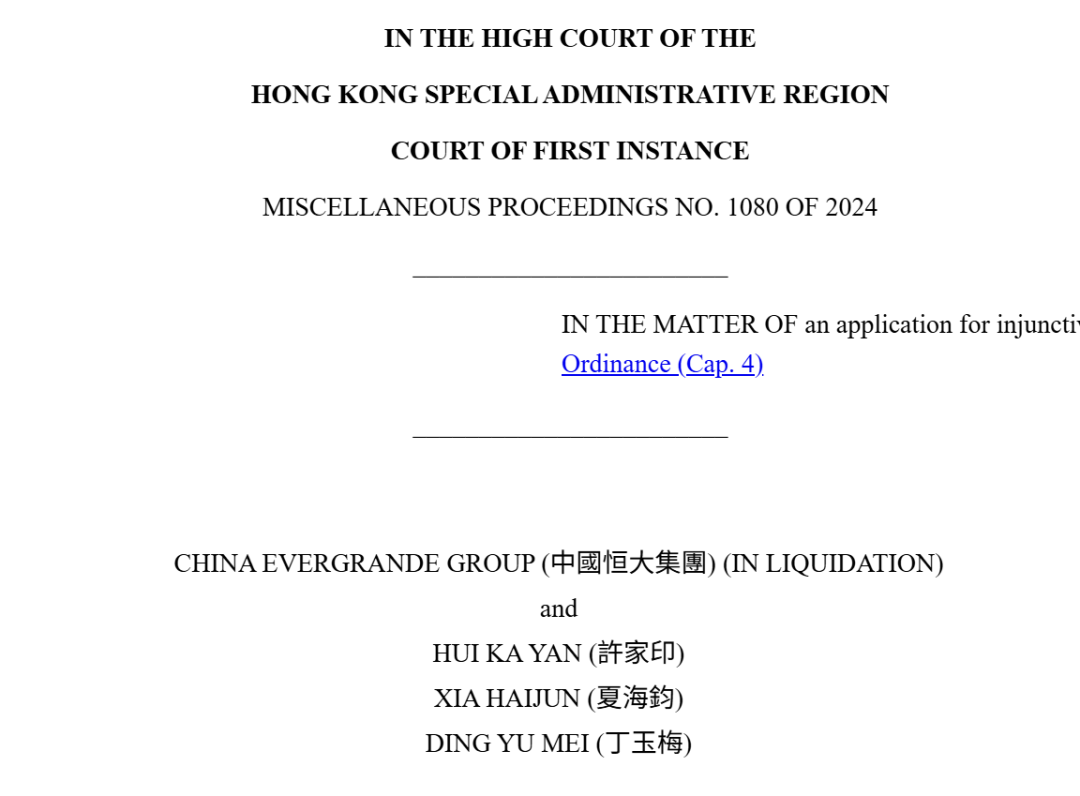
Core Viewpoint - The Hong Kong court has expanded the asset freeze on Ding Yumei, the ex-wife of Evergrande founder Xu Jiayin, encompassing approximately $220 million in assets across Canada, Gibraltar, Jersey, and Singapore, as part of efforts to recover around $6 billion in debts owed by the troubled real estate company [1][3]. Group 1: Asset Details - Ding Yumei holds approximately 137 million CAD in three Canadian bank accounts, with total assets exceeding $220 million across various jurisdictions [1]. - The assets include approximately 9 million CAD at Bank of Montreal, 28 million CAD at Canadian Imperial Bank of Commerce, and 100 million CAD at Royal Bank of Canada [4]. - In Gibraltar, she has assets valued at approximately $57.6 million at Bank J. Safra Sarasin, and in Singapore, about $71 million at Bank J. Sarasin Limited [4]. Group 2: Legal Proceedings - The Hong Kong High Court's ruling is seen as a procedural victory for the liquidators of Evergrande, allowing them greater scope to pursue asset recovery [3]. - Evergrande has previously obtained a global asset freeze order against Ding Yumei in Hong Kong, which was mirrored by a similar order in the UK [3]. - The court has permitted Evergrande to seek local court orders in Jersey, Gibraltar, Canada, and Singapore to enforce the asset freeze, while limiting the scope of these actions to asset preservation only [5].

许家印前妻,突发!
中国基金报· 2025-11-26 12:13
Group 1 - The Hong Kong court has expanded the asset freeze against Ding Yumei, the ex-wife of Evergrande founder Xu Jiayin, to include approximately $220 million in assets across Canada, Gibraltar, Jersey, and Singapore [2][5][6] - This ruling is seen as a procedural victory for the liquidators of Evergrande, who are pursuing around $6 billion in debts, although actual asset recovery and repayment to creditors remain slow [5][6] - Ding Yumei is required to disclose her asset situation, which includes significant holdings in various jurisdictions, with a total exceeding $220 million [6][8] Group 2 - The assets frozen include approximately 137 million Canadian dollars in three Canadian bank accounts, along with assets in Gibraltar, Jersey, and Singapore [2][7] - The Hong Kong High Court has previously issued a global asset freeze order against Ding Yumei, which was followed by a similar order from the UK court [6][8] - Evergrande has been authorized to seek local court orders in Jersey, Gibraltar, Canada, and Singapore to enforce the asset freeze, while Ding Yumei argues that facing multiple legal proceedings would impose significant pressure [8]

“太子集团”头目陈志被曝在新加坡遭“黑吃黑”:超3100万元被手下侵吞
Mei Ri Jing Ji Xin Wen· 2025-11-10 12:15
Core Viewpoint - The article discusses the legal and financial troubles surrounding Chen Zhi, founder of the "Prince Group" in Cambodia, and David Wong, who was previously in charge of a family office. Chen Zhi accused Wong of embezzling approximately 5.84 million Singapore dollars (around 31.91 million RMB) from his bank accounts, leading to multiple lawsuits and significant legal disputes between the two parties [1][2]. Group 1: Background and Initial Relationship - Chen Zhi and David Wong first met in 2017, with Chen already wealthy and seeking investment opportunities in Singapore for permanent residency [2] - In 2017, Chen Zhi purchased a luxury home for nearly 40 million Singapore dollars and subsequently established a family office named "DW Capital Holdings" with Wong's assistance [2] - Wong helped Chen Zhi expand his business, forming new companies and establishing relationships with over six major banks [2] Group 2: Legal Disputes and Financial Irregularities - In 2021, Chen Zhi decided to change the operational model of his family office, leading to a shared office arrangement with Wong's family office [3] - Chen's financial assistant discovered that Wong had not submitted critical business documents and that there were suspicious inter-company transfers, including a management fee exceeding 530,000 USD [3][5] - Following a series of events, including locked office access and the discovery of missing funds, Chen Zhi terminated Wong's position as the sole leader of the family office [5] Group 3: Legal Outcomes and Sanctions - In December 2022, the Singapore High Court ruled against Wong, ordering him and his associated companies to pay over 12 million Singapore dollars in debts [6] - Both Chen Zhi and his assistant have been sanctioned by the United States, and multiple countries have frozen assets linked to the Prince Group [7][8] - The Prince Group, which claims to be a multinational business entity, has been accused of running a telecom fraud operation, leading to significant legal actions and asset seizures in various jurisdictions [8][9] Group 4: Impact on Associated Companies - Chen Zhi is the majority shareholder of two publicly listed companies in Hong Kong, which continue to operate normally despite the surrounding controversies [10][11] - Recent resignations of executives from these companies indicate potential instability within their management structures [10] - Regulatory actions have been taken against companies associated with the Prince Group, including the suspension of licenses for investment and insurance firms linked to Chen Zhi [12][13]

许家印550亿元资产被冻结、接管,境外家族信托被击穿?
Hu Xiu· 2025-10-10 12:16
Core Viewpoint - The Hong Kong High Court has appointed the liquidator of China Evergrande Group as the receiver of assets related to Xu Jiayin's family, with a global injunction prohibiting the disposal of assets valued up to $7.7 billion (approximately RMB 55 billion) [1][4][5] Group 1: Asset Management - The liquidator is authorized to take control of 33 offshore companies owned by Xu Jiayin's family, along with seven bank accounts that have been frozen [4][5][10] - The frozen bank accounts include those held at Bank of China Hong Kong, HSBC, and DBS Bank, with some accounts held through offshore companies controlled by Xu Jiayin and his ex-wife Ding Yumei [6][10] - The assets under the liquidator's control include multiple properties located in Hong Kong, the UK, and the US, as well as luxury items such as private jets, yachts, and Rolls-Royce cars [7][9] Group 2: Legal Proceedings - The High Court previously ordered Xu Jiayin to disclose all assets valued over HKD 50,000, but he failed to comply, leading the liquidator to seek control over all related assets [11][12] - The court's decision may have implications for a family trust established by Xu Jiayin and his wife, which reportedly amounts to $2.3 billion (approximately RMB 16.38 billion) [14] - The court referenced a foreign case indicating that even if assets are placed in a discretionary trust, if the defendant can control the trust's operations, the court can still enforce asset freezing orders [15][16]
恒大退市倒计时10天,许家印夫妇400亿分红追讨悬顶
Sou Hu Cai Jing· 2025-08-13 01:36
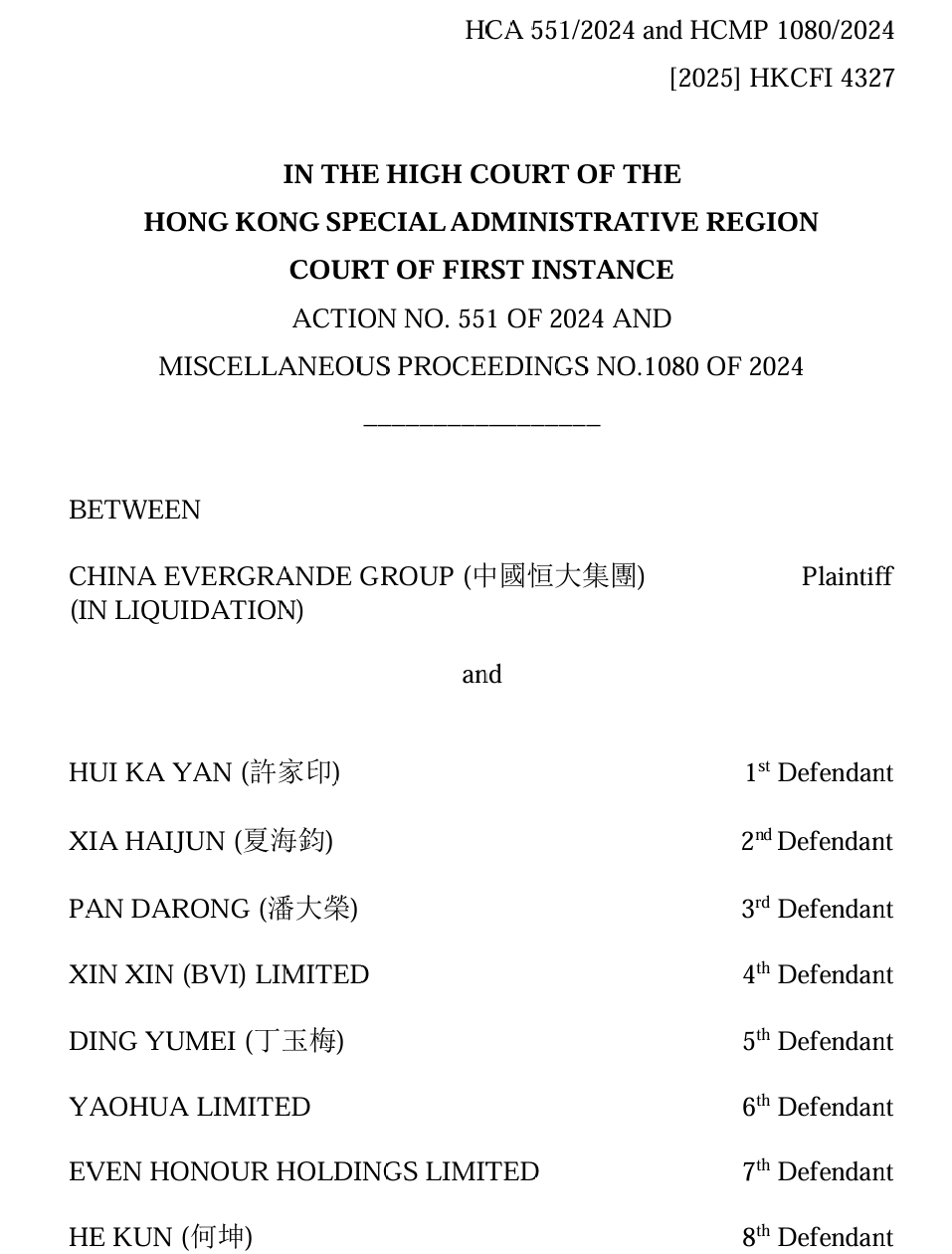
Core Viewpoint - Evergrande's delisting from the Hong Kong Stock Exchange marks a significant end to its once-prominent status in the real estate sector, highlighting the severe consequences of its financial mismanagement and the ongoing legal challenges faced by its executives [1][3]. Group 1: Delisting and Financial Consequences - Evergrande has officially given up on its efforts to reverse its delisting, acknowledging its fate without meeting any of the previously set conditions for resumption [3]. - The company has effectively closed off its financing avenues, with no access to capital markets, as only 24% of its domestic debt restructuring has been approved [3]. - The transition from a successful listing in 2009 to being the largest delisted real estate company in Hong Kong signifies a rapid decline in its market position [3]. Group 2: Legal and Financial Challenges - The Hong Kong court is pursuing 41.8 billion HKD in illegal dividends distributed during the debt crisis, which is seen as a method of extracting value from the company [4]. - The freezing of over 50 billion HKD in domestic assets is primarily a judicial measure to prevent asset transfer rather than a new discovery of hidden assets [4]. - The total liabilities of Evergrande amount to 2.4 trillion HKD, making the frozen assets insufficient to address its financial obligations [4]. Group 3: Ongoing Risks and Future Outlook - The appointment of liquidators by the Hong Kong court indicates that investigations into Evergrande's assets and potential cross-border claims are just beginning [5]. - The current approval rate for domestic debt restructuring is below 30%, and failure to achieve a successful restructuring could lead to a wave of lawsuits [5]. - Criminal accountability for the company's executives remains unresolved, with potential charges of financial fraud and misappropriation of funds looming [5]. Group 4: Lessons for Investors - The situation serves as a warning against high dividend payouts during cash flow crises, which may indicate asset stripping rather than financial health [6]. - The belief that large companies are too big to fail is challenged by Evergrande's collapse, emphasizing the risks of unchecked expansion [6]. - The essence of business success in the real estate sector ultimately relies on product quality rather than financial maneuvering [6].
德国总理默茨:俄罗斯国有资产将继续被冻结,作为对乌克兰贷款的担保。
news flash· 2025-07-10 12:18
Core Points - German Chancellor Merz stated that Russian state assets will continue to be frozen as collateral for loans to Ukraine [1] Group 1 - The freezing of Russian state assets is a measure taken in response to the ongoing conflict in Ukraine [1] - This action serves as a financial guarantee for the loans provided to Ukraine [1]
G7财长联合公报:在俄罗斯结束冲突之前,俄罗斯被冻结的资产将继续维持现状。
news flash· 2025-05-22 18:41
Core Points - The G7 finance ministers' joint statement emphasizes that frozen Russian assets will remain unchanged until the conflict in Russia concludes [1] Group 1 - The G7 finance ministers reaffirmed their commitment to maintaining the status of frozen Russian assets [1]
你们害怕的事
猫笔刀· 2024-06-14 14:25
今天刷到一条新闻,G7组织达成协议,要把冻结的俄罗斯央行海外资产,大概是3000亿美元左右,作为抵押品用来贷款500亿美元援助乌克兰。 这3000亿美元的冻结资产每年有30亿-50亿的收益,收益没收,用来偿还给乌克兰的贷款。 本金抵押,利润还贷。 这件事估计会触动到那些投资了美股的中国股民,很多人都留言问过我,假如未来有一天中美冲突升级,买的美股基金会不会被牵连? 从俄罗斯的情况来看,政府央行和国有资产是肯定会被冻结的,大机构以及部分富豪的个人资产也会被冻结,至于民间普通个人的私有资产暂时不受影 响。 不过姜萍的情况比较特殊,她的成绩可以上普高,但因为个人家庭原因去了涟水中专,在那里读服装专业,课余兴趣爱好自学高等数学。 俄罗斯乌克兰是2022年2月23日开战的,qiwi(俄罗斯本土的支付宝,美股上市)在2月25日就被停牌,一直至今。所以相关在美上市的股票,第一时间要 无脑抛,不抛就完犊子了。 另外就是开战后不久俄罗斯的银行就被剔除出swift国际资金结算系统,国际转账都被停了,就算海外账户有钱也无法转回俄罗斯国内,就很麻烦。 唯一无法制裁的领域是区块链,链上的资产依然可以自由流通,但是几个大的链下交易所迫于 ...