
防灾减灾救灾

Search documents
1.28亿元生活救助资金下拨
Xin Lang Cai Jing· 2026-01-13 19:50
防灾减灾救灾重在于防,我省针对救灾物资消耗大的实际情况,加大采购补充力度。省级生活救助物资 储备达到二级响应标准上限,储备方式更加多元,储备品类更加丰富,救灾物资保障能力进一步提升。 ■湖南日报全媒体记者 奉永成 通讯员 彭晓军 范警元 灾害导致部分地区房屋损毁,我省立即启动倒损住房核查工作和重建工作,运用原址重建、异地搬迁、 集中建房、购买商品住房补助等多种安置方式,确保受灾群众居有所住。目前,全省因灾倒损住房恢复 重建竣工率超95%、修缮完成率达99.6%。 在冬季来临时,省应急管理厅联合省财政厅等部门,开展冬春救助工作和冬春送温暖活动,全面摸底排 查,建立台账,确保"不落一户、不漏一人"。春节前,中央补助我省的3亿余元冬春临时性生活困难救 助资金将陆续发放到受灾生活困难群众手中。 三湘都市报1月13日讯 记者今天从省应急管理厅获悉,刚刚过去的2025年,受暴雨洪涝、台风、干旱等 灾害影响,我省一些地区不同程度受灾,全省应急管理系统及时下拨救灾资金物资、扎实推进重建保障 住房安全、开展冬春救助、足额储存救灾物资,全力保障受灾群众安全温暖过冬。 2025年中央和省级下拨1.28亿元生活救助资金已在第一时间分 ...
推动安全治理模式向事前预防转型,山东召开全省应急管理工作会议
Qi Lu Wan Bao· 2026-01-13 12:40
Core Points - The provincial emergency management meeting emphasized the need for high-quality development in emergency management, aiming for a significant reduction in accidents and fatalities by 2025, with targets of a 12.8% decrease in accidents and a 10.3% decrease in deaths compared to the previous year [1][2] - The meeting highlighted the importance of the year 2026 as a critical transition period for the "15th Five-Year Plan," focusing on safety management and the dual goals of reducing accident numbers and fatalities [1][2] Group 1 - The meeting called for a comprehensive approach to safety management, including major hazard identification and the implementation of four key rectifications across all industries and enterprises [2] - It stressed the need to enhance the effectiveness of safety production supervision and law enforcement, focusing on responsibility implementation and strict enforcement [2] - The meeting aimed to strengthen disaster prevention and response capabilities, establishing a coordinated command system for efficient disaster management [2] Group 2 - The meeting underscored the importance of solidifying the foundational support for emergency management, including the development of the "15th Five-Year" emergency management plan and improving legal frameworks [2] - It emphasized the need for a high-quality, professional emergency management workforce, focusing on political leadership and optimizing team structure [2] - The meeting was attended by key officials from the provincial emergency management department and local emergency management agencies, indicating a unified approach to emergency management [2]
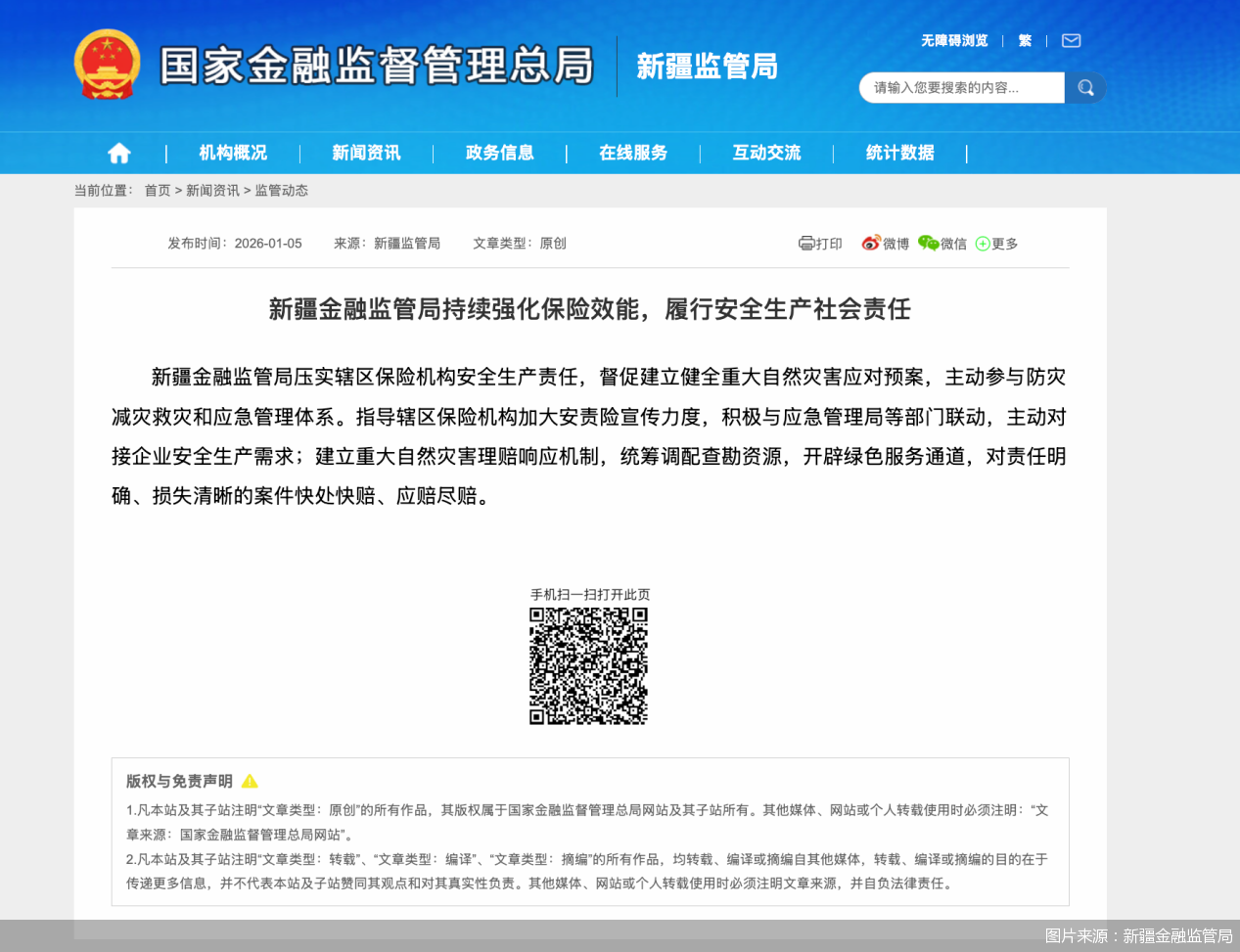
新疆金融监管局:建立重大自然灾害理赔响应机制,对责任明确、损失清晰的案件快处快赔、应赔尽赔
Bei Jing Shang Bao· 2026-01-05 10:04
Core Viewpoint - The Xinjiang Financial Regulatory Bureau is enhancing the effectiveness of insurance and fulfilling social responsibilities related to safety production [1] Group 1: Insurance Responsibility and Disaster Management - The Xinjiang Financial Regulatory Bureau is reinforcing the safety production responsibilities of insurance institutions within its jurisdiction [1] - It is urging the establishment of comprehensive response plans for major natural disasters and promoting active participation in disaster prevention, reduction, and emergency management systems [1] - The bureau is guiding insurance institutions to increase awareness of safety responsibility insurance and to collaborate with emergency management departments to meet the safety production needs of enterprises [1] Group 2: Claims Mechanism and Service Improvement - A mechanism for responding to claims related to major natural disasters has been established, which includes the coordination of investigation resources [1] - The bureau is creating a green service channel for claims processing, ensuring that cases with clear responsibilities and losses are settled quickly and comprehensively [1]

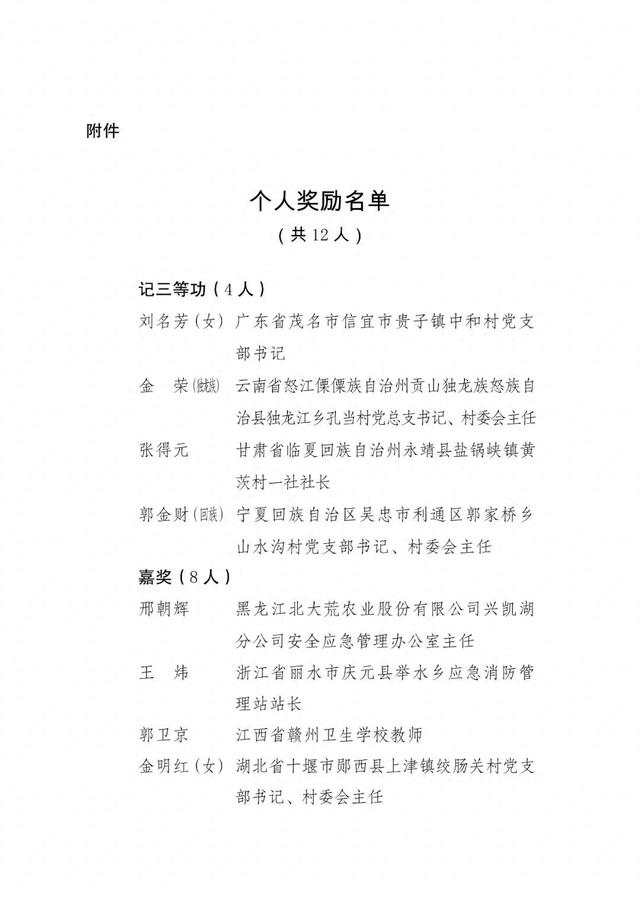
应急管理部:给予刘名芳等12名同志奖励
Xin Lang Cai Jing· 2026-01-04 05:31
Core Viewpoint - The Ministry of Emergency Management has recognized and rewarded 12 individuals for their outstanding contributions to grassroots disaster prevention and response efforts, emphasizing the importance of their roles in safeguarding public safety and promoting a proactive approach to emergency management [1][2]. Group 1: Recognition and Contributions - The awarded individuals have demonstrated a commitment to the principle of "people first, life first," effectively identifying risks and organizing evacuations during emergencies, thereby preventing casualties [2]. - The grassroots emergency management teams have successfully conducted over 500 emergency evacuations this year, showcasing their effectiveness in disaster risk management [1]. Group 2: Award Details - A total of 12 individuals received awards, including 8 commendations and 4 third-class merit awards, highlighting the diverse contributions from various regions and sectors [4][5]. - Notable awardees include Liu Mingfang, a village party secretary, and Jin Rong, a village committee director, among others, representing different provinces and roles within the emergency management framework [5][7].
2026年元旦档票房突破7亿元丨财经早餐
Xin Lang Cai Jing· 2026-01-03 23:23
Group 1 - The National Disaster Reduction and Relief Committee has issued a notice to enhance disaster prevention and response measures, ensuring the safety of people's lives and property during the winter-spring season [4] - As of January 3, the box office for the 2026 New Year holiday period has surpassed 700 million yuan, with films "Zootopia 2," "Avatar 3," and "Hidden Kill" leading the box office [6] - The China National Space Administration announced that the number of space launches in 2025 is expected to reach 92, setting a new historical record [7] Group 2 - In Norway, the market share of Chinese electric vehicles in the passenger car sector has continued to increase, with 24,524 units sold in 2025, accounting for 13.7% of the total new car sales, a rise of 3.3 percentage points from 2024 [10] - BYD reported that its sales of pure electric vehicles reached 2.25 million units in 2025, marking a 28% year-on-year increase, surpassing Tesla to become the world's largest seller [12] - The National Medical Products Administration announced that 76 innovative drugs were approved for market in 2025, significantly exceeding the 48 approved in 2024, setting a new historical high [16]

部署做好冬春季防减救灾重点工作
Xin Lang Cai Jing· 2026-01-03 21:17
Group 1 - The National Disaster Reduction Committee has issued a notice to enhance disaster prevention and response measures during the winter and spring seasons, focusing on ensuring public safety and social stability [1] - The analysis indicates that most regions in China will experience temperatures close to or above normal, with precipitation showing a "more in the north, less in the south" distribution, leading to higher risks of low-temperature freezing and snow disasters [1] - There are significant risks of forest fires in southern regions, and areas in East and South China may face drought conditions, while geological disaster risks are elevated in North, East, Central, Southwest, and Northwest China [1] Group 2 - The notice emphasizes the need to revise and improve emergency plans for low-temperature rain, snow, and freezing disasters, ensuring adequate preparation of rescue resources and materials [2] - Responsibilities for ice prevention must be clearly defined, with scientific management of ice prevention projects and enhanced monitoring of levees [2] - Comprehensive fire prevention measures for forests and grasslands are to be strengthened, with strict control over outdoor fire sources related to agricultural activities, rituals, and construction [2]
落实临灾预警叫应和反馈机制
Xin Lang Cai Jing· 2026-01-03 19:19
Core Viewpoint - The National Disaster Reduction Committee has issued a notice emphasizing the need for comprehensive disaster prevention and response measures in light of the upcoming winter and spring natural disaster risks, ensuring the safety of people's lives and property, as well as social stability [1] Group 1: Disaster Preparedness and Response - The notice calls for a strong bottom-line thinking and responsibility implementation, preparing for major disasters under the leadership of the Party and government, and ensuring a comprehensive response to all types of disasters [1] - It emphasizes the importance of risk identification and hidden danger investigation, with a focus on analyzing and forecasting the disaster situation for the winter and spring seasons [1] - The notice highlights the need to revise and improve emergency plans for low-temperature rain, snow, and ice disasters, and to ensure adequate emergency rescue materials are stored in advance [1] Group 2: Infrastructure and Public Safety - There is a directive to conduct risk assessments of major infrastructure and public service facilities, encouraging the public to report potential risks [1] - The notice stresses the importance of enhancing the effectiveness of forest and grassland fire prevention, including actions against illegal fire use and strict control of outdoor fire sources [1] - Measures are to be implemented to prevent geological disasters, particularly in risk-prone areas during the winter and spring seasons, with a focus on densely populated regions with poor geological conditions [1] Group 3: Support for Affected Populations - The notice outlines the need for precise and efficient disaster relief for affected populations, including orderly reconstruction of housing damaged by disasters [1] - It emphasizes the importance of targeted support for key regions and special assistance for vulnerable groups during the winter and spring relief efforts [1]
强化重特大灾害防范应对准备
Xin Lang Cai Jing· 2026-01-03 18:15
Core Viewpoint - The National Disaster Reduction Committee has issued a notice emphasizing the need for enhanced disaster prevention and response measures during the winter and spring seasons to ensure public safety and social stability [1][2]. Group 1: Disaster Risk Assessment - The assessment indicates that most regions in China will experience temperatures close to or above normal, with precipitation showing a "more in the north, less in the south" pattern [1]. - There is a high risk of low-temperature freezing and snow disasters, particularly in southern regions where forest fire risks are elevated [1]. - Specific areas such as Southeast China, Central South China, and Eastern South China face risks of consecutive droughts during winter and spring [1]. - Geological disaster risks are heightened in regions including North China, East China, Central South, Southwest, and Northwest [1]. Group 2: Emergency Preparedness Measures - The notice calls for timely revisions of emergency plans for low-temperature rain, snow, and freezing disasters, ensuring adequate preparation of rescue resources [2]. - Responsibilities for ice prevention must be clearly defined, with scientific management of ice prevention projects and enhanced inspections of levees [2]. - Comprehensive fire prevention measures for forests and grasslands are to be implemented, with strict control over outdoor fire sources related to agriculture, rituals, and construction [2]. - Areas prone to geological disasters must have preventive measures in place, particularly in densely populated regions with poor geological conditions [2].
国家防减救灾委部署做好冬春季防减救灾重点工作 强化重特大灾害防范应对准备
Xin Lang Cai Jing· 2026-01-03 18:14
Core Viewpoint - The National Disaster Reduction Committee has issued a notice emphasizing the need for enhanced disaster prevention and response measures during the winter and spring seasons to ensure public safety and social stability [1][2]. Group 1: Disaster Risk Assessment - The assessment indicates that most regions in China will experience temperatures close to or above normal, with precipitation showing a "more in the north, less in the south" distribution [1]. - There is a heightened risk of low-temperature freezing and snow disasters, particularly in southern regions where forest fire risks are elevated [1]. - Specific areas such as southeastern China, central-southeastern China, and eastern southern China face risks of consecutive droughts during winter and spring [1]. Group 2: Emergency Preparedness Measures - The notice calls for timely revisions of emergency plans for low-temperature rain, snow, and freezing disasters, ensuring adequate preparation of rescue resources and materials [2]. - Responsibilities for ice prevention must be clearly defined, with scientific management of ice prevention projects and enhanced monitoring of levees [2]. - Comprehensive fire prevention measures for forests and grasslands are to be implemented, with strict control over outdoor fire sources related to agricultural, religious, and construction activities [2].
国家防减救灾委部署做好冬春季防减救灾重点工作
Xin Hua She· 2026-01-03 05:33
Group 1 - The core message emphasizes the need for enhanced disaster prevention and response measures during the winter and spring seasons to ensure public safety and social stability [1][2] - The notification outlines the expected weather conditions, indicating higher than normal temperatures in most regions, with significant risks of low-temperature freezing and snow disasters, particularly in southern areas [1] - It highlights the importance of timely disaster warning information and the establishment of a feedback mechanism for disaster alerts, as well as the need for risk assessments of major infrastructure and public service facilities [1] Group 2 - The notification stresses the need for timely revisions of emergency plans for low-temperature, rain, snow, and ice disasters, and the importance of pre-coordinating rescue forces and ensuring adequate emergency supplies [2] - It calls for strict management of outdoor fire sources to prevent forest and grassland fires, particularly during agricultural, ceremonial, and construction activities [2] - The document emphasizes the implementation of preventive measures in geological disaster risk areas, especially in densely populated regions with poor geological conditions [2]