
寒潮

Search documents
中国将迎下半年首次寒潮过程 局地降温可达14℃
Zhong Guo Xin Wen Wang· 2025-11-13 10:57
Core Points - China is set to experience its first cold wave of the second half of the year, with localized temperature drops reaching up to 14°C [1][2] - The cold wave is expected to affect northern and central eastern regions from November 14 to 17, with widespread temperature decreases of 6 to 10°C [1] - Specific areas such as northwestern Xinjiang, central and western Inner Mongolia, and parts of Jiangnan and Sichuan will see temperature drops of 12 to 14°C, accompanied by strong winds [1][2] Weather Impact - The cold air mass is notably strong, arriving after a period of relatively warm temperatures in the central eastern regions [2] - There is a risk of high flu incidence due to the cold wave and strong winds, prompting public health advisories for protective measures [2] - Potential adverse effects on transportation due to slippery and icy roads are highlighted, necessitating caution during travel [2]
冷冬不能被预测,预计今冬偏暖但冷暖起伏大
Xin Hua Wang· 2025-10-24 22:20
Core Viewpoint - The article discusses the unpredictability of winter temperatures in China, highlighting that while this winter is expected to be warmer overall, significant fluctuations between cold and warm periods are anticipated [1][4]. Summary by Sections Winter Temperature Predictions - The classification of a winter as "cold" or "warm" is determined post-season based on average temperatures across various meteorological stations, with specific criteria for national, regional, and single-station assessments [2][3]. - The article notes that since the 1990s, China has experienced six cold winters, all occurring before 2012 [2]. Current Temperature Trends - Recent monitoring indicates that average temperatures in regions such as northern Xinjiang, Inner Mongolia, North China, Northeast China, Huanghuai, and Jianghan have been 1°C to 3°C lower than the same period in previous years, with some areas experiencing drops of 4°C to 5°C [3]. Influencing Factors - The article mentions that the current state of the equatorial eastern Pacific Ocean is cooler than usual, which may lead to a La Niña event, typically associated with lower temperatures in China during winter [4]. - However, the impact of global warming has led to instances of warmer winters even during La Niña years, indicating a complex interplay of factors affecting winter temperatures [4][6]. Extreme Weather Events - The article explains that despite the overall warming trend, extreme cold events can still occur due to changes in atmospheric circulation patterns, particularly the weakening of the westerly winds that usually contain polar air [5][6]. - This phenomenon suggests that global warming can coexist with severe cold spells, leading to more pronounced temperature fluctuations during winter [6].
河北省发布寒潮蓝色预警信号
Mei Ri Jing Ji Xin Wen· 2025-10-18 04:28
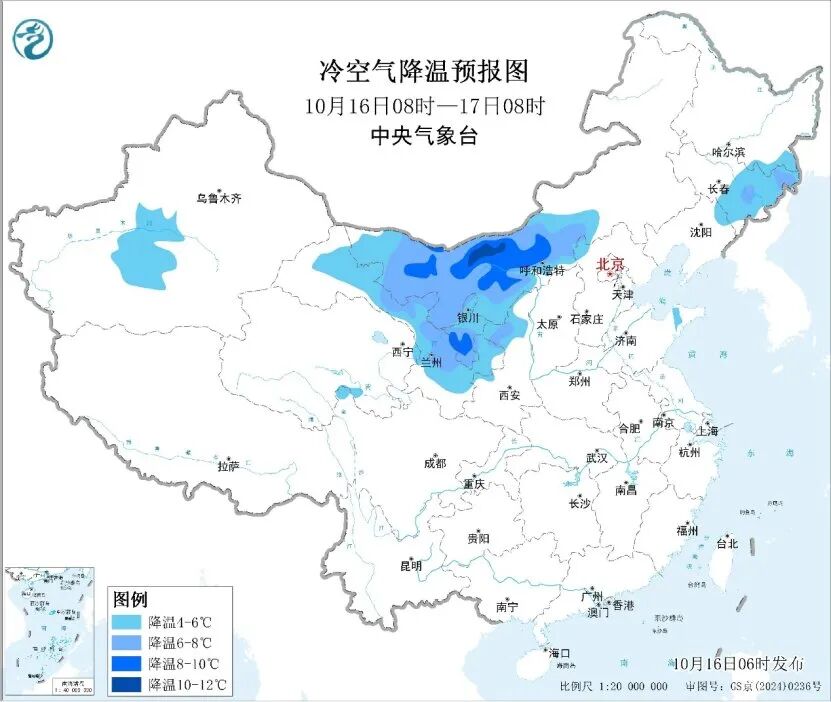
Group 1 - The core viewpoint of the article is the continuation of a blue cold wave warning issued by the Hebei Meteorological Observatory due to significant temperature drops across the province [1] - The temperature in Shijiazhuang, Cangzhou, and northern regions has decreased by 5 to 8 degrees Celsius compared to the morning of October 16, with some areas like Zhangjiakou, Chengde, and the northwestern part of Baoding experiencing drops of 8 to 12 degrees Celsius, and localized areas exceeding 14 degrees Celsius [1] - Other regions have seen a temperature decline of 2 to 4 degrees Celsius, with further decreases expected on the morning of October 19 in northern Zhangjiakou, Xingtai, and Handan by 2 to 5 degrees Celsius, and frost anticipated in Baoding and northern Langfang [1]
强冷空气来袭,北京或将提前入冬
Xin Hua She· 2025-10-17 09:00
Core Points - A strong cold air mass is expected to impact China from October 16 to 21, leading to the lowest temperatures of the second half of the year in most regions [1][3] - Beijing is forecasted to experience a significant drop in temperature, with nighttime temperatures falling to single digits starting from October 17, and potentially reaching around 2°C on the night of October 19 [1][3] - This cold air mass is considered the strongest of the second half of the year, with a prolonged impact and significant temperature drops [5] Summary by Sections Weather Forecast - The cold air mass is expected to lead to continuous average daily temperatures below 10°C in Beijing from October 18 to 24, indicating an early onset of winter [3] - The average winter onset date for Beijing is typically October 31, based on historical data from 1991 to 2020 [3] Temperature Impact - Northern regions will experience persistently low temperatures, with areas like North China and eastern Huanghuai expected to have average temperatures below 10°C for five consecutive days starting October 18 [5] - Initial frost is anticipated in northern China, including regions like Liaoning [5] Weather Warnings - Beijing's meteorological authority has issued blue alerts for cold waves and strong winds, warning of temperature drops of around 8°C and nighttime lows of about 4°C in plain areas [5] - Frost warnings have been issued for several districts, indicating potential agricultural impacts due to low temperatures [5] Health Advisory - The Beijing Center for Disease Control advises the public to take precautions against the cold, including wearing appropriate clothing and maintaining good hygiene practices to prevent respiratory illnesses during the flu season [6]


辽宁遇下半年以来最强冷空气 气温持续下探
Zhong Guo Xin Wen Wang· 2025-10-17 07:51
Core Points - Liaoning province is experiencing the coldest daytime temperatures since the beginning of autumn, with some areas seeing maximum temperatures drop to single digits [1] - The province officially entered meteorological winter on October 17, three days earlier than the average date of October 20 [1] Summary by Sections Weather Conditions - A strong cold air mass began affecting Liaoning on the night of October 16, leading to significant temperature drops [1] - From October 17 to 18, the eastern and northwestern regions of Liaoning are expected to see minimum temperatures decrease by 8 to 10 degrees Celsius, with localized drops reaching 10 to 14 degrees Celsius [1][2] - Most areas will experience temperature declines of 4 to 8 degrees Celsius [1] Temperature Forecast - On October 17, the majority of Liaoning will be under cloudy and rainy conditions, with maximum temperatures in cities like Shenyang, Tieling, and Fuxin falling to between 7 and 9 degrees Celsius [1] - The lowest temperatures of this cold wave are anticipated on the morning of October 19 to 20, with mountainous areas reaching -8 to -5 degrees Celsius, while other regions will generally be between -4 and 0 degrees Celsius [2] Weather Alerts - The Liaoning Meteorological Observatory issued blue alerts for cold waves and frost, indicating the potential for ground temperatures to fall below 0 degrees Celsius, leading to frost [2] - Strong winds are expected, with land-based north winds reaching 4 to 6 levels, and gusts up to 7 to 8 levels [2]
明天起,北京或将入冬
新华网财经· 2025-10-17 05:31
Core Viewpoint - A strong cold air mass is expected to significantly lower temperatures across China, with Beijing likely to experience its earliest winter onset in years, potentially starting on October 18, 2023 [4][8]. Summary by Sections Weather Impact - The cold air mass will affect most regions of China, bringing the lowest temperatures since the second half of 2023, with Beijing's temperatures expected to drop to single digits starting from October 17 [2][6]. - Continuous average temperatures below 10°C are forecasted for Beijing from October 18 to 24, indicating a high probability of winter onset [4][8]. Temperature Predictions - The average temperature in northern regions, including Beijing, is expected to remain below 10°C for at least five consecutive days starting October 18, which meets the criteria for winter [6][8]. - Initial frost conditions are anticipated in northern areas, including parts of Liaoning, during this period [6][8]. Weather Warnings - The Beijing Meteorological Station has issued blue alerts for cold waves and strong winds, predicting a temperature drop of around 8°C from October 16 to 18 [8]. - Specific regions in Beijing are under frost warnings, indicating potential agricultural impacts due to low temperatures [8]. Health Advisory - The Beijing Center for Disease Control advises residents to take precautions against the cold, including wearing appropriate clothing and maintaining hygiene to prevent respiratory illnesses during the flu season [9].

强冷空气来袭 北京发布寒潮、大风蓝色预警信号
Xin Hua She· 2025-10-16 11:39
Core Points - Beijing Meteorological Station issued a blue alert for cold wave due to strong cold air, predicting a temperature drop of around 8°C from the night of October 16 to the night of October 18, with minimum temperatures in the plains expected to reach around 4°C [1] - A blue alert for strong winds was also issued, forecasting north winds of 3 to 4 levels in most areas of Beijing from noon to night on October 17, with gusts in certain districts reaching around 7 levels [1] - On October 16, the weather was overcast with light rain, and the maximum temperature was around 15°C, with significant rainfall expected during the night [1] Weather Alerts - During the strong wind warning, it is advised to enhance outdoor activity safety management and suspend organized outdoor activities such as climbing, hiking, and cycling [2] - Public should pay attention to travel safety and avoid tall buildings and temporary structures during the wind alert [2] - During the cold wave alert, it is recommended for the public to dress warmly to prevent colds and cardiovascular diseases [2]
厚衣服穿起来!北京或提前入冬,明起最低气温跌至个位
Xin Jing Bao· 2025-10-16 09:34
Core Viewpoint - A strong cold air mass is affecting Beijing, leading to an early onset of winter, with temperatures expected to drop significantly starting October 17, 2023 [2][4][6]. Summary by Sections Weather Forecast - The cold air mass is the most extensive and intense affecting China this year, with temperatures expected to drop by 4°C to 8°C across most regions from October 15 to 19, 2023 [2][4]. - Beijing is predicted to experience a significant temperature drop, with nighttime temperatures falling to around 4°C from October 17 to 18, 2023 [4][6]. Winter Onset Criteria - According to national standards, winter is defined as the first occurrence of a continuous 5-day sliding average temperature below 10°C [7]. - Historically, the average winter onset date for Beijing from 1991 to 2020 was October 31, but this year it is expected to be significantly earlier, around October 18, 2023 [7][8]. Historical Context - The earliest recorded winter onset in Beijing was October 16, 2021, with the potential for this year to tie for the fourth earliest winter onset [8]. Health Implications - The drop in temperature can lead to various health risks, including respiratory issues, cardiovascular diseases, and exacerbation of chronic conditions [9][10][11]. - Recommendations for health management during this cold spell include maintaining warmth, hydration, regular health monitoring, moderate exercise, and a consistent sleep schedule [12][13][14][15].
周二起最高温回归“2”字头
Mei Ri Shang Bao· 2025-03-31 02:14
Group 1 - The recent cold wave has significantly impacted temperatures across Zhejiang, with the highest temperature in Hangzhou only reaching 11.2℃ and some areas experiencing single-digit highs [1] - The weather is expected to improve starting Monday, with temperatures gradually rising above 20℃ by Tuesday, allowing for outdoor activities [1] - Despite the warming trend, early morning temperatures will remain low, with minimums in the plains at 4-8℃ and in mountainous areas at 2-4℃, leading to a temperature difference of up to 15℃ between morning and afternoon [1] Group 2 - The recent temperature drop does not qualify as "late spring cold" according to Zhejiang's definition, which requires a sustained period of low average temperatures after early April [1] - Predictions indicate a shift in weather patterns around the Qingming Festival, with warmer air masses gaining dominance and a reduction in the likelihood of significant cold waves in the near future [2] - The upcoming weather is expected to feature more frequent warm temperatures in the north and increased rainfall in the south, although some cooling may still occur [2] Group 3 - As the weather improves, there is an increased fire risk, particularly with the approach of the Qingming Festival, highlighting the need for caution regarding fire and electrical safety [3]
多地气温“大跳水” 厚衣服快翻出来
Xin Hua Wang· 2025-03-26 10:02
Core Points - A significant temperature drop is expected across multiple regions in China following a period of warming, with forecasts indicating a decrease of 8°C to 14°C, and in some areas, over 20°C [1][2] - The cold wave is predicted to impact various regions including Xinjiang, Inner Mongolia, Heilongjiang, and parts of southern China, with the lowest temperatures expected on the night of March 29 to the early morning of March 30 [1][2] Summary by Sections - **Temperature Changes**: The Central Meteorological Observatory has issued warnings for cold waves, strong winds, fog, and sandstorms, forecasting a drastic temperature drop across northern and southern regions of China [1] - **Public Advisory**: Meteorological experts advise the public to adjust their clothing according to the fluctuating temperatures and to be cautious of strong winds and potential hazards from falling objects in northern areas, while southern regions should be aware of severe convective weather [2]