Agentic AI

Search documents
Kroger Scales Generative AI Strategy with Google Cloud to Drive Digital Growth and Personalization
Prnewswire· 2026-01-11 15:00
Core Insights - Kroger is expanding its partnership with Google Cloud to implement the Gemini Enterprise for Customer Experience (CX) platform, aiming to enhance customer shopping experiences through advanced technology [1][2] Group 1: Customer Experience Transformation - The rollout of Gemini Enterprise for CX will include an integrated Meal assistant and Shopping assistant, designed to simplify grocery planning and shopping while catering to individual customer preferences [2] - The Customer Experience Agent Studio will be utilized to analyze customer interactions, allowing Kroger to proactively address issues and improve associate productivity, thereby delivering a more seamless shopping experience [3] Group 2: Features of the Shopping Assistant - The Shopping assistant will streamline complex tasks, enabling customers to complete their shopping with minimal input, incorporating AI-enabled features for enhanced efficiency [6] - It will provide an "inspiration-to-cart" flow, allowing customers to convert requests into guided recipes with a single click, thus simplifying the shopping process [7] - Recommendations will be based on Kroger's proprietary data, ensuring that suggestions are relevant and actionable, enhancing the overall shopping experience for families [7]



The Home Depot and Google Cloud Launch Agentic AI Tools to Help Customers and Associates Bring Projects from 'How-to' to 'Done'
Prnewswire· 2026-01-11 14:59
Core Insights - The Home Depot and Google Cloud have expanded their partnership to enhance the retail experience through AI tools that provide real-time assistance to both homeowners and professional customers [1][2][4] AI Tools and Features - The Home Depot is deploying Google Cloud's AI to extend its home improvement expertise, introducing capabilities such as the Magic Apron assistant and AI-powered product list builders for professionals [2][5] - The Magic Apron has evolved into a conversational AI tool that offers personalized project recommendations and expert advice, allowing customers to describe their projects in plain language [5][6] - A new store experience integrates real-time local inventory and product locations, providing aisle-level precision and technical guidance to customers [6] Professional Customer Support - The Home Depot is launching an AI-powered materials list feature for professional customers, enabling them to quickly generate comprehensive lists based on project descriptions [7][8] - This feature aims to significantly accelerate the estimating and planning process, allowing professionals to generate accurate quotes more efficiently [8] Delivery and Customer Service Enhancements - The Home Depot has implemented AI-powered route intelligence to improve last-mile delivery, predicting potential delivery failures by analyzing customer-specific data and external factors [9] - A new conversational AI platform is redefining customer service by allowing natural language interactions across SMS, chat, and phone, enhancing engagement and resolution outcomes [10][11] Associate Empowerment - The Home Depot is equipping associates with Google Cloud's Gemini Enterprise to automate business processes, enabling them to focus on strategic tasks rather than routine execution [12]



券商首席带你看“科技界春晚”
中国基金报· 2026-01-11 13:07
Core Insights - The article highlights "Physical AI" as a significant trend at the 2026 CES, with a focus on robotics applications, indicating a consensus on the global development of robotics despite early-stage product challenges [2][3] - NVIDIA's CEO emphasized "Physical AI" during his keynote, shifting the company's focus towards building global AI infrastructure to integrate intelligent agents into the real world [2] - The article suggests that 2026 may mark the year for the realization of Agentic AI, supported by acquisitions and technological advancements in both software and hardware [4] Summary by Sections Physical AI Concept - "Physical AI" is defined as models that use motion skills to understand and interact with the real world, typically encapsulated in robots and autonomous vehicles [3] - A fundamental challenge in training such AI is enabling it to comprehend physical world commonalities, such as object permanence and causal relationships [3] - NVIDIA's solution includes a new computing architecture and open-source models to accelerate the development of autonomous driving and Physical AI [3] Future Trends and Opportunities - The article predicts that 2026 will be a pivotal year for consumer technology, driven by AI-enabled product innovations and potential valuation re-evaluations in the tech consumption sector [4] - AI applications in consumer scenarios, from indoor cleaning to smart wearables, are highlighted as key trends observed at CES [4] - Companies with comprehensive product portfolios and ecosystem integration capabilities are expected to gain market share rapidly, while some tech consumption firms may experience systematic valuation re-evaluations due to AI catalysts and performance confirmations [6]

券商首席带你看“科技界春晚”
Zhong Guo Ji Jin Bao· 2026-01-11 12:57
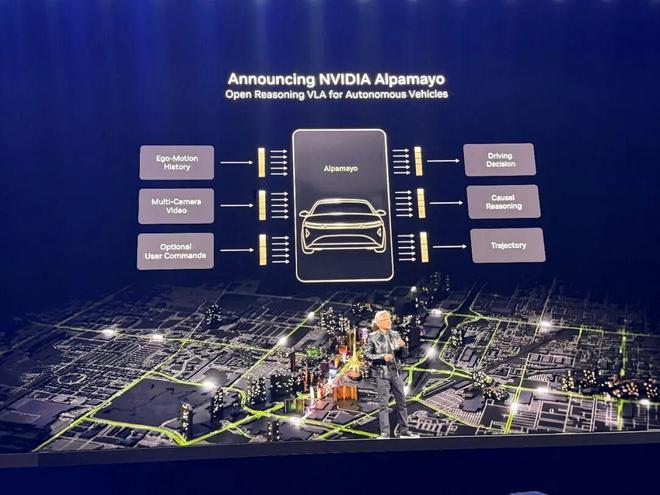
Core Insights - The main highlight of CES 2026 is "Physical AI," particularly applications involving robotics, which is seen as a potential turning point similar to the early days of autonomous driving [1][3] - NVIDIA's CEO emphasized "Physical AI" during his keynote, indicating a shift towards building global AI infrastructure that integrates intelligent agents into the physical world [1][3] Group 1: Definition and Challenges of Physical AI - "Physical AI" refers to models that use motion skills to understand and interact with the real world, typically encapsulated in autonomous machines like robots and self-driving cars [3][4] - A fundamental challenge in training such AI is enabling it to comprehend common physical world concepts, such as object permanence and causality, which are intuitive for humans but not for AI [4] Group 2: Technological Developments and Future Trends - NVIDIA's new computing architecture, Rubin, and the release of the open-source model Alpamayo aim to accelerate advancements in autonomous driving and Physical AI [4] - The year 2026 is anticipated to mark the emergence of Agentic AI, supported by acquisitions and deployments from companies like Meta and NVIDIA, which are enhancing AI training and large-scale reasoning capabilities [4] Group 3: Consumer Applications and Market Opportunities - The application of AI in consumer scenarios is a key focus of CES, with innovations in products ranging from indoor cleaning to smart wearables, indicating a significant acceleration in product development [4] - AI glasses are expected to enter a phase of widespread adoption, with notable products from Chinese companies like Alibaba and Rokid showcasing advanced features and ecosystem integration [5] - The technology consumer sector is projected to experience a new growth cycle driven by technological innovation and valuation reassessment, particularly for companies with strong ecosystem capabilities [5]
阿里云“杀入”AI硬件
财联社· 2026-01-10 10:25
Group 1 - The core viewpoint of the article emphasizes that major tech companies, including Alibaba Cloud, are aggressively entering the AI hardware market to capture the next generation of smart entry points and integrate "cloud-edge-end" solutions [3][31]. - Alibaba Cloud showcased its multi-modal interaction development kit at the AI hardware exhibition, integrating three foundational models for various AI hardware applications [3][4]. - The competition among tech giants in AI hardware is driven by the need to bridge the gap between cloud-based large models and physical applications, making AI hardware a crucial container for deploying these capabilities [3][31]. Group 2 - Various AI toys and robots powered by Alibaba's foundational models were prominently displayed at the exhibition, indicating a broad coverage of AI hardware categories [4][5]. - Companies like Ubiquiti and Shifeng Culture launched AI products that utilize Alibaba's models, showcasing capabilities such as emotional interaction and intelligent voice responses [5][7]. - The integration of Alibaba's models into products like AI glasses and smart toys highlights the trend towards creating emotionally engaging and interactive devices [11][19]. Group 3 - Alibaba Cloud's strategy involves collaborating closely with chip and module partners to enhance the capabilities of AI hardware, indicating a fragmented product landscape [26][25]. - The company is optimistic about the growth of smart hardware in 2026, predicting the emergence of new product categories beyond traditional devices [26]. - The exploration of embodied intelligence through multi-modal interaction and VLA models is a key focus for Alibaba Cloud, with expectations for significant advancements in the coming years [28][29]. Group 4 - The article discusses the parallel development of GUI and A2A paradigms in AI, with Alibaba Cloud actively engaging in both areas [29][30]. - The future of AI hardware is expected to shift from passive responses to proactive services, driven by advancements in multi-modal perception and agent memory technologies [32][31]. - The industry faces challenges in aligning user expectations with actual experiences, particularly in the AI toy sector, where high return rates indicate unmet consumer demands [31][32].

「AI 100」榜单启动招募,AI产品“年会”不能停丨量子位智库
量子位· 2026-01-10 03:07
Core Insights - The article discusses the emergence of numerous keywords in the AI product sector by 2025, highlighting transformative AI products that are leading the market [4] - The "AI 100" list by Quantum Bit Think Tank aims to evaluate and recognize the top AI products in China, reflecting the industry's evolution and future trends [4][12] Group 1: AI 100 List Overview - The "AI 100" list is divided into three main categories: "Flagship AI 100," "Innovative AI 100," and the top three products in ten popular sub-sectors [6] - The "Flagship AI 100" will focus on the strongest AI products of 2025, showcasing those that have achieved significant technological breakthroughs and practical application value [7] - The "Innovative AI 100" aims to identify products that are expected to emerge in 2026, representing cutting-edge AI technology and potential industry disruptors [8] Group 2: Sub-sector Focus - The ten hottest sub-sectors for the top three products include AI browsers, AI agents, AI smart assistants, AI workstations, AI creation, AI education, AI healthcare, AI entertainment, Vibe Coding, and AI consumer hardware [9] Group 3: Application and Evaluation Criteria - The evaluation of the "AI 100" list employs a dual assessment system combining quantitative and qualitative measures, focusing on user data and expert evaluations [13] - Quantitative metrics include user scale, growth, activity, and retention, while qualitative assessments consider long-term potential, technology, market space, and user experience [13]

A Look Ahead: Reaping the Supply Chain Lessons of 2025
Yahoo Finance· 2026-01-09 18:00
Core Insights - The supply chain has been significantly impacted by geopolitical pressures, tariffs, and export controls, highlighting its critical role in industry stability [2][3] Group 1: Supply Chain Disruptions - The U.S. has utilized tariffs in dealmaking, while China has tightened export controls, leading to various disruptions in the supply chain throughout the year [2] - Conflicts in regions such as East Asia, the Middle East, and Eastern Europe have further complicated supply chain operations [2] Group 2: Cybersecurity Concerns - High-profile cybersecurity incidents in 2025, such as attacks on Collins Aerospace and Jaguar Land Rover, have raised the importance of cybersecurity in supply chain management [3] Group 3: Trends for 2026 - Investment in new technologies, including digital-twin models and IoT sensors, is expected to rise, aiding in risk reduction and real-time tracking [5] - The development of AI tools, particularly GenAI and Agentic AI, will focus on creating orchestrators for managing automated processes and decision-making [5] - Emphasis on data quality will be crucial for businesses to leverage AI effectively, requiring investments in data governance and integration [5]
Will Demand for Agentic AI Evaluation Boost Innodata's 2026 Growth?
ZACKS· 2026-01-09 16:45
Core Insights - Innodata (INOD) is positioned to capitalize on the growing need for evaluating and governing agentic AI systems as enterprises adopt these technologies more widely [1][2][4][5] Group 1: Agentic AI Evaluation - The demand for evaluation frameworks for agentic AI is accelerating as these systems gain autonomy in complex workflows, with Innodata collaborating with leading tech firms to assess agent performance [2][6] - Innodata's expertise in data quality and large-scale annotation supports its development of diagnostic tools for fine-tuning autonomous agents, aligning with industry trends towards safer AI systems [3][6] Group 2: Revenue Growth Expectations - Innodata anticipates significant revenue growth from new initiatives, particularly in agentic AI evaluation, as major clients increase AI budgets and transition from pilot projects to full deployment [4][5] - The company expects that the demand for evaluation, safety, and governance services will rise alongside the complexity of AI models, positioning agentic AI evaluation as a key growth driver [4] Group 3: Competitive Landscape - Innodata faces competition from major players like Accenture and Cognizant Technology Solutions, which offer comprehensive AI governance and evaluation services [6][7] - Despite the competition, Innodata's focused approach and strengths in data quality and human judgment may provide a competitive edge in the agentic AI evaluation market [7][8] Group 4: Financial Performance - Innodata's shares have increased by 20.9% over the past six months, outperforming the Zacks Computer - Services industry and the broader Computer and Technology sector [9] - The company currently trades at a forward price-to-earnings ratio of 52.93, significantly higher than the industry average of 16.94, indicating strong market expectations [11]


「AI 100」榜单启动招募,AI产品“年会”不能停丨量子位智库
量子位· 2026-01-09 04:09
Core Insights - The article discusses the emergence of numerous keywords in the AI product sector in China by 2025, highlighting the rapid evolution and innovation in AI technologies [4] - The "AI 100" list by Quantum Bit Think Tank aims to evaluate and recognize the top AI products that represent China's AI capabilities [4][12] Group 1: AI 100 List Overview - The "AI 100" list is divided into three main categories: "Flagship AI 100," "Innovative AI 100," and the top three products in ten popular sub-sectors [6] - The "Flagship AI 100" will focus on the strongest AI products of 2025, showcasing those that have achieved significant technological breakthroughs and practical application value [7] - The "Innovative AI 100" aims to identify products that are expected to emerge in 2025 and have the potential to lead industry changes in 2026 [8] Group 2: Sub-sector Focus - The ten hottest sub-sectors for the top three products include AI browsers, AI agents, AI smart assistants, AI workstations, AI creation, AI education, AI healthcare, AI entertainment, Vibe Coding, and AI consumer hardware [9] Group 3: Application and Evaluation - The evaluation of the "AI 100" list employs a dual assessment system combining quantitative and qualitative measures, focusing on user data and expert evaluations [13] - Quantitative metrics include user scale, growth, activity, and retention, while qualitative assessments consider long-term potential, technology, market space, and user experience [13]

Google Claims Apple's Spot on Most-Valuable-Companies List
PYMNTS.com· 2026-01-08 21:48
Core Insights - Google has surpassed Apple to become the second-most valuable company by market capitalization, with a valuation of $3.92 trillion compared to Apple's $3.80 trillion [2][3] - This marks the first time since 2019 that Google has overtaken Apple in terms of value, with Nvidia still leading at $4.49 trillion [3] AI Developments - Google's advancements in artificial intelligence (AI) are highlighted as a significant factor in its increased valuation, indicating its success in the AI race [2] - The company is focusing on local execution as a core layer of AI infrastructure, moving away from reliance on cloud inference with innovations like FunctionGemma, which operates directly on mobile devices [4][5] Edge AI Strategy - Google's edge AI strategy includes the development of tools like Google Edge tooling and FunctionGemma, aimed at enabling local deployment of AI models across various devices [4][5] - This approach reflects a shift towards hybrid AI architectures that balance responsibilities between local and cloud systems [5] Retail and Consumer Insights - Google's role in transforming retail through AI is emphasized, with a focus on agentic AI that can understand context and make decisions similar to humans [6][7] - This evolution in AI technology is positioned as essential for enhancing discovery, personalization, and engagement in complex shopping journeys [7]