
零碳园区

Search documents
肥城经济开发区新兴产业园入围山东省零碳园区创建名单
Qi Lu Wan Bao Wang· 2025-10-13 08:05
Core Viewpoint - The article discusses the establishment of zero-carbon parks in Shandong Province, highlighting the selection of 18 parks that will undergo evaluation and certification by the end of 2027, aiming to promote sustainable development and reduce carbon emissions [4]. Summary by Categories Zero-Carbon Parks - Zero-carbon parks are defined as areas where carbon dioxide emissions from production and living activities are reduced to "near zero" levels, with the potential to achieve "net zero" conditions [4]. - The Shandong Provincial Government has introduced a "Shandong Province Zero-Carbon Park Construction Plan," outlining ten key aspects for the development of these parks [4]. Evaluation and Certification - The selected 18 parks will be subject to a mid-term evaluation by provincial authorities by the end of 2026, with formal certification as zero-carbon parks expected by the end of 2027 [4]. - The plan aims to establish around 15 provincial-level zero-carbon parks by 2027, with clear technical pathways and sound supporting systems [4]. Long-term Goals - By 2030, the initiative aims to create a number of provincial-level zero-carbon parks with improved technical equipment, policy frameworks, and support services, contributing to a gradual decline in carbon emissions after reaching peak levels [4].

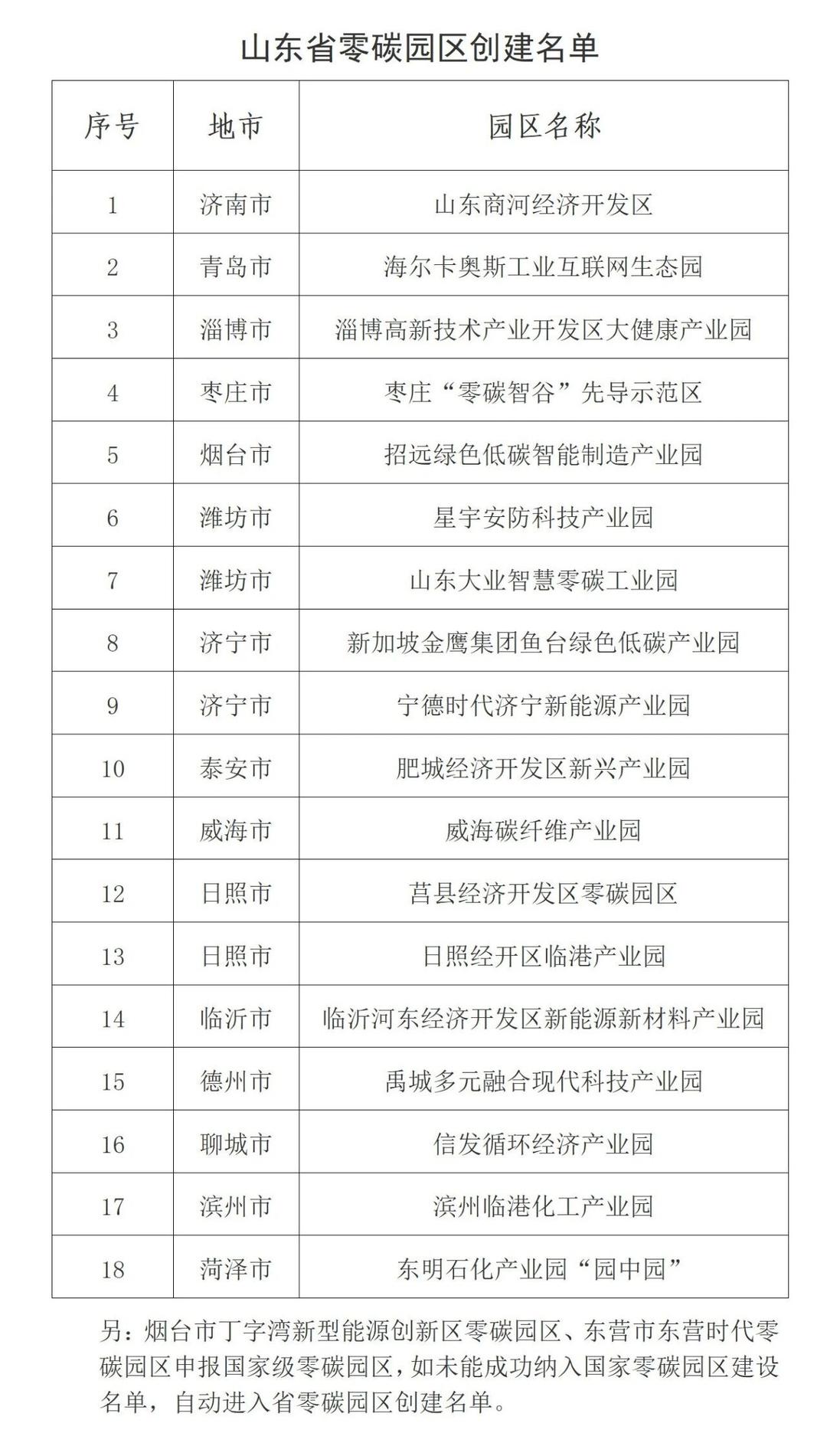
山东公布零碳园区创建名单
Zhong Guo Hua Gong Bao· 2025-10-13 07:24
《通知》要求,各市有关部门指导相关园区按照《山东省零碳园区建设方案》要求,科学推进零碳园区 建设工作。2026年底前,省有关部门将组织开展中期评估,2027年底前组织验收,通过验收的园区正式 公布为山东省零碳园区。 中化新网讯 近日,山东省发展和改革委员会、省工业和信息化厅、省能源局共同发布《关于公布山东 省零碳园区创建名单的通知》。 18家园区入选山东省零碳园区创建名单,分别为山东商河经济开发区、海尔卡奥斯工业互联网生态园、 淄博高新技术产业开发区大健康产业园、枣庄"零碳智谷"先导示范区、招远绿色低碳智能制造产业园、 星宇安防科技产业园、山东大业智慧零碳工业园、新加坡金鹰集团鱼台绿色低碳产业园、宁德时代 (300750)济宁新能源产业园、肥城经济开发区新兴产业园、威海碳纤维产业园、莒县经济开发区零碳 园区、日照经开区临港产业园、临沂河东经济开发区新能源新材料产业园、禹城多元融合现代科技产业 园、信发循环经济产业园、滨州临港化工产业园、东明石化产业园"园中园"。 《通知》强调,烟台市丁字湾新型能源创新区零碳园区、东营市东营时代零碳园区申报国家级零碳园 区,如未能成功纳入国家零碳园区建设名单,自动进入山东省零碳 ...

工业园区绿色转型路径更明晰
中国能源报· 2025-10-13 03:35
Core Viewpoint - The release of the "Guidelines for High-Quality Development of Industrial Parks" aims to promote renewable energy consumption, build green supply chains, and enhance the production of green products, ultimately driving regional economic development and guiding industrial upgrades [1][3]. Group 1: Policy and Framework - Over 70% of industrial output and 60% of energy consumption in China are concentrated in industrial parks, making them key areas for achieving carbon neutrality and new industrialization [3]. - The "Guidelines" provide a systematic approach for industrial parks to transition from rapid quantitative growth to effective qualitative improvement, focusing on five major directions: specialization, intensification, digitalization, greening, and standardization [3][4]. Group 2: Low-Carbon Transition - The guidelines represent a shift from pilot explorations to a comprehensive perspective on low-carbon transformation, emphasizing the need for optimizing industrial structure, enhancing supply chains, and ensuring safety in production [5]. - Industrial parks are expected to play a significant role in the construction of "zero-carbon parks," particularly in sectors like wind power, photovoltaics, and battery manufacturing [5][6]. Group 3: Infrastructure Development - The guidelines stress the importance of developing renewable energy infrastructure, such as rooftop photovoltaics, decentralized wind power, and energy storage systems, to support green industrial parks [7][8]. - A tailored approach to green infrastructure development is recommended, taking into account local resources, industrial characteristics, and spatial constraints [7][8]. Group 4: Data Sharing and Digitalization - The guidelines advocate for the enhancement of new information infrastructure, including the deployment of 5G and industrial internet technologies, to facilitate digital transformation in industrial parks [10]. - Addressing the challenges of energy data sharing is crucial, with suggestions for innovative data-sharing techniques that protect corporate data while promoting transparency in carbon emissions [10][11].
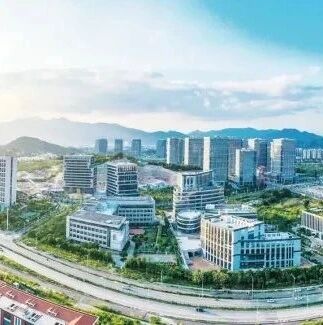
培育壮大绿色生产力 零碳园区建设驶入“快车道”
Jin Rong Shi Bao· 2025-10-13 01:34
当前,绿色低碳发展竞合博弈日趋复杂。我国能源需求和碳排放刚性增长压力大,高质量发展面临 的风险挑战增多。在此背景下,我国部署谋划开展零碳园区建设,彰显了我国坚定走绿色转型之路的战 略定力,体现了应对气候变化的信心和行动。 我国工业园区、经济技术开发区、城市建成区等数量众多,既是集聚要素资源推动经济增长的主要 载体,也是能源活动和碳排放的重要来源。推动各类园区实现由高碳到低碳零碳转型发展,事关高质量 发展和"双碳"工作全局。 今年以来,零碳园区建设驶入"快车道"。7月,国家发展改革委等部门发布《关于开展零碳园区建 设的通知》(以下简称《通知》),明确支持有条件的地区率先建成一批零碳园区,有计划、分步骤推 进各类园区低碳化零碳化改造;9月,工业和信息化部和国家发展改革委发布《工业园区高质量发展指 引》,要求加快园区绿色设施建设,探索建设零碳园区。 "当前,绿色低碳发展竞合博弈日趋复杂。我国能源需求和碳排放刚性增长压力大,高质量发展面 临的风险挑战增多。"国家发展改革委能源研究所副所长、研究员李忠认为,在此背景下,我国部署谋 划开展零碳园区建设,彰显了我国坚定走绿色转型之路的战略定力,体现了应对气候变化的信心和行 ...
山东公布省级零碳园区创建名单
Da Zhong Ri Bao· 2025-10-13 01:04
Core Insights - Shandong Province has announced a list of 18 zero-carbon parks, with Yantai Dingzi Bay New Energy Innovation Zone and Dongying Times Zero Carbon Park applying for national-level recognition [1][2] - Zero-carbon parks aim to reduce carbon dioxide emissions from production and living activities to "near zero" levels, with the potential to achieve "net zero" conditions [1] - The provincial government plans to conduct mid-term evaluations by the end of 2026 and finalize the recognition of zero-carbon parks by the end of 2027 [1] Group 1 - The 18 parks include Shandong Shanghe Economic Development Zone, Haier Kaos Industrial Internet Ecological Park, and Zibo High-tech Industrial Development Zone Health Industry Park [1] - The Shandong Zero Carbon Park Construction Plan emphasizes a "high standard, few but refined" approach, aiming to establish around 15 provincial-level zero-carbon parks by 2027 [2] - By 2030, Shandong aims to have a batch of provincial-level zero-carbon parks with improved technical equipment, policies, and supporting services to facilitate a stable decline in carbon emissions after reaching peak levels [2]
南网能源发布零碳园区产品体系 提供多场景定制化解决方案
Zheng Quan Ri Bao· 2025-10-12 09:36
Core Insights - The article discusses the launch of a comprehensive zero-carbon solution by Southern Power Grid Comprehensive Energy Co., Ltd. (referred to as "Southern Energy") aimed at supporting various parks in achieving a replicable zero-carbon path from planning to operation and carbon asset development [2][3] - Southern Energy emphasizes its commitment to national green transformation and energy structure optimization, with a strategic focus on "lean investment and high-end services" to enhance its diversified business layout [2] - The zero-carbon product system includes six series of 40 products, addressing the urgent demand for carbon constraint and covering the entire chain from planning to carbon services [2][3] Product and Service Offerings - Southern Energy launched five core products centered around "calculate carbon - reduce carbon - manage carbon - facilitate carbon - carbon+" that encompass all aspects of energy integration and efficiency improvement [3] - The company has implemented over 1,550 energy-saving and carbon reduction projects, resulting in an annual carbon reduction of 2.64 million tons, showcasing its extensive experience and understanding of user needs [3] - The solutions have been validated by benchmark projects such as the Southern Power Grid production research base and Guangzhou Shipyard International Park, demonstrating adaptability to various scenarios [3] Collaboration and Future Plans - Southern Energy collaborates with partners in energy technology and architectural design to enhance its offerings, indicating a commitment to ecological cooperation [3] - The launch event, which combined offline and online participation, attracted nearly 200 attendees on-site and over 12,000 online viewers, highlighting the interest in zero-carbon initiatives [3]
跨国赋能!中国—东盟零碳园区首训启动
中国能源报· 2025-10-11 04:06
「READING」 近日,《2025年亚太地区能源可持续发展区域趋势报告》在联合国亚太经社会"亚太能源周"上发 布。报告围绕可持续发展目标7(SDG7)落实情况,从电力可及性、用于烹饪的清洁燃料和技术、 可再生能源占比、能源利用效率等维度,系统分析了地区能源转型进展、挑战及路径,提出针对性 转型建议。 报告指出亚太地区作是全球能源消耗最大的区域,化石能源(包括石油、天然气和煤炭)占比仍高 达85%,该区域也是全球碳排放的主要来源(占到了60%),碳排放强度(carbon intensity)高于 其他区域,也正深刻影响着全球气候治理进程。 报告原文 ESCAP 2025 Transforming energy systems low carbon future AP 在10月即将举办的首届中国-东盟绿色能源转型与零碳园区能力建设培训中,这些议题都将通过讲 师授课、互动交流和实地参访等形式逐一展开。通过五天的共同学习,链接与东盟各国的长期合 作。 扫码报名 议程海报 图 图 前景展 TENI Capacity-building Training on China-ASEAN Green Energy Trans ...

南网能源发布零碳园区产品体系 提供多场景解决方案
Zhong Zheng Wang· 2025-10-10 13:12
Core Viewpoint - The company South Grid Energy aims to provide a comprehensive zero-carbon solution for various parks, focusing on planning, construction, operation, and carbon asset development, aligning with China's dual carbon goals [1][2] Group 1: Company Strategy and Offerings - South Grid Energy has developed a one-stop solution for zero-carbon parks, emphasizing a modular and standardized approach to its diverse business layout, which includes investment, services, and products [1] - The company has created a product system consisting of 6 series and 40 products, covering the entire process of zero-carbon implementation, focusing on five key areas: carbon calculation, reduction, management, ease of transition, and carbon enhancement [2] - The company has implemented over 1,550 energy-saving and carbon reduction projects, achieving an annual carbon reduction capacity of 2.64 million tons [2] Group 2: Industry Context and Collaboration - The current national policy is shifting from top-level design to practical implementation, with a focus on energy structure transformation, full-chain carbon reduction in key areas, and commercialization of technological innovations [1] - South Grid Energy is expanding its cooperation boundaries by offering various collaboration models such as BOT, BOO, EMC, and BT, and is forming localized service networks through its regional companies [3] - Successful case studies, such as the near-zero carbon demonstration at the State-owned Enterprise Headquarters and the zero-carbon factory by GAC Aion, showcase the adaptability and scalability of the company's solutions across different industries [3] Group 3: Future Directions - The company plans to optimize its product system and deepen cross-industry collaboration, aiming to make zero-carbon parks a necessity rather than an option, contributing to the green transition [4]
南网能源公司发布零碳园区产品体系——为零碳园区提供多场景、高端化、定制化解决方案
Zheng Quan Shi Bao Wang· 2025-10-10 11:55
Core Viewpoint - The Southern Power Grid Comprehensive Energy Co., Ltd. (referred to as "Southern Energy Company") launched a one-stop overall solution for zero-carbon parks, aiming to provide a replicable path for various parks from planning, construction, operation to carbon asset development, in line with China's "dual carbon" goals [2][3]. Group 1: Zero-Carbon Parks as a Key Pathway - The current push for green transformation in China is driven by the "dual carbon" goals, with a focus on systemic energy structure reshaping, full-chain carbon reduction in key areas, and commercialization of technological innovations [3]. - Southern Energy Company emphasizes the urgency for enterprises to seek sustainable zero-carbon development pathways, extending its services from energy-saving to a full-chain approach including planning, design, construction, operation, and carbon services [3]. Group 2: Commercial Model for Zero-Carbon Parks - Southern Energy Company has developed a product system covering the entire process of zero-carbon implementation, showcasing five core products at the launch event [4]. - The core products include planning and design with BIM integration, multi-energy collaborative smart energy systems, deep energy-saving solutions, a comprehensive energy-carbon digital management platform, and integrated smart operation services [5]. Group 3: Successful Case Studies - The solutions have been validated through several benchmark projects, including the near-zero carbon demonstration at the Southern Power Grid headquarters and the energy efficiency benchmark in the shipbuilding industry [6]. - The successful cases demonstrate the adaptability and scalability of the solutions across various sectors, including office, industrial, and manufacturing [6]. Group 4: Collaborative Partnerships - Southern Energy Company collaborates with partners in energy technology, building design, new energy, storage, and digital solutions to advance zero-carbon park construction [7]. - The partnership with Huawei Cloud aims to combine expertise in energy management and digital platforms to create smarter and more efficient zero-carbon park solutions [7]. Group 5: Event Participation - The launch event attracted nearly 200 participants from government departments, power companies, industry associations, financial institutions, key clients, and media, with over 12,000 online views [8].
协鑫能科已在全国落地超过15个电网侧储能项目 投运规模突破1000MW
Zheng Quan Shi Bao Wang· 2025-10-10 11:20
Core Insights - The SNEC ES+2025 International Energy Storage Technology Conference and Exhibition showcased GCL-Poly Energy Technology's advancements in energy storage and AI solutions, emphasizing its strategic positioning in the energy sector [1][2] Group 1: Energy Storage Developments - GCL-Poly has implemented over 15 grid-side energy storage projects across China, with a total operational capacity exceeding 1000 MW, serving as a stabilizing force for regional grids and supporting peak power regulation [1] - The company is actively expanding its technology portfolio beyond lithium batteries to include sodium-ion and all-vanadium flow batteries, providing tailored energy storage systems for industrial enterprises and parks [1] Group 2: Zero-Carbon Initiatives - GCL-Poly has established over 40 zero-carbon demonstration projects nationwide, including factories, parks, hospitals, and schools, contributing to the development of replicable pathways for a zero-carbon society [2] - The company introduced a comprehensive zero-carbon park solution at the exhibition, integrating a smart platform that encompasses green energy, transportation, buildings, ecological operations, and infrastructure [1] Group 3: Virtual Power Plant and Digital Innovations - The virtual power plant (VPP) initiative is a key focus for GCL-Poly, complementing energy storage systems to address the challenges posed by the integration of renewable energy sources [2] - The AIVP virtual power plant platform has been deployed in nearly 10 provinces, with an adjustable capacity close to 1 million kW, demonstrating its technical maturity and market credibility [2] - GCL-Poly, in collaboration with Ant Group, unveiled the EnergyTS power time series model, designed to enhance predictive and decision-making capabilities in the energy sector through advanced data analysis [2]
