
医药工业数智化转型

Search documents
21健讯Daily | 七部门:开展“人工智能赋能医药全产业链”应用试点;万泰生物第一季度净亏损5277.69万元
2 1 Shi Ji Jing Ji Bao Dao· 2025-04-25 01:10
Policy Developments - Seven departments, including the Ministry of Industry and Information Technology, issued the "Implementation Plan for the Digital Transformation of the Pharmaceutical Industry (2025-2030)", emphasizing the integration of artificial intelligence across the pharmaceutical supply chain [1] Drug and Device Approvals - Kangtai Biological announced that its subsidiary Minhai Biological's application for the marketing authorization of an adsorbed tetanus vaccine has been accepted by the National Medical Products Administration [2] - Hendi Pharmaceutical received approval for the marketing application of arginine ibuprofen, a non-steroidal anti-inflammatory drug with superior solubility and faster absorption compared to regular ibuprofen [3] - Tianyao Pharmaceutical's subsidiary obtained a drug registration certificate for injectable hydrocortisone sodium succinate, used for critical conditions such as allergic shock and severe adrenal insufficiency [4] Financial Reports - Wantai Biological reported a net loss of 52.78 million yuan in Q1 2025, with revenue of 401 million yuan, a year-on-year decline of 46.76%, primarily due to market adjustments and government procurement impacts [5] - Heng Rui Pharmaceutical's Q1 2025 report showed a revenue of 7.206 billion yuan, a year-on-year increase of 20.14%, and a net profit of 1.874 billion yuan, up 36.9%, largely due to a licensing payment from IDEAYA [6] - Kingstone Pharma reported a revenue of 291 million yuan in Q1 2025, down 19.65%, with a net profit of 62.85 million yuan, a decrease of 30.02% [8] - Baijun Medical achieved a revenue of 100 million yuan in Q1 2025, a 31.3% increase, with a net profit of 32.50 million yuan, up 290.69%, driven by stable sales of existing products and successful new product launches [9] Capital Market Activities - Tonghe Pharmaceutical plans to invest 11 million yuan to increase its stake in Hangzhou Boya Biomedical Co., Ltd., raising its ownership from 16.34% to 24.93% [10] - Chengyuan Biotechnology announced the completion of several million yuan in equity financing, aimed at upgrading its gene synthesis technology platform [11] Industry Developments - Zhang Wenhong's team announced significant progress in developing a broad-spectrum antiviral drug for monkeypox, which is set to enter clinical approval stages [12] - Qianxin Biotechnology signed a licensing agreement with Caldera Therapeutics for its long-acting dual antibody QX030N, granting global exclusive rights for development and commercialization [13] Public Sentiment Alerts - Weiming Pharmaceutical announced that its important subsidiary, Tianjin Weiming, was suspended from production and sales, which could trigger further risk warnings if production does not resume within three months [14]






港股概念追踪 | 七部门发文推进医药工业数智化转型 AI制药展现较大潜力(附概念股)
智通财经网· 2025-04-24 23:22
Group 1 - The core viewpoint of the news is that the implementation plan for the digital transformation of the pharmaceutical industry in China aims to achieve comprehensive digitalization by 2030, enhancing innovation capabilities and establishing a complete industrial ecosystem [1][2] - The plan includes four major actions: empowering digital technology, promoting digital transformation, building a digital service system, and enhancing digital regulation, with 14 key tasks to improve the overall capability of the pharmaceutical industry's digital transformation [1][2] - The focus areas of the plan include pharmaceutical research and development, production, management decision-making, quality assurance, circulation and traceability, and contract research and production services, providing a clear pathway for collaboration between pharmaceutical companies and IT service providers [1][2] Group 2 - The release of the plan signifies a new phase of high-quality development driven by data and intelligent empowerment in the pharmaceutical industry, which is expected to reshape the industry landscape through technologies like AI in drug development and smart manufacturing [2] - The AI pharmaceutical market is projected to grow significantly, from $1.38 billion in 2023 to $2.994 billion by 2026, with a compound annual growth rate of 30.47% from 2021 to 2026 [3] - Major pharmaceutical companies are expected to enhance drug discovery efficiency by over 50% through AI integration, which will lead to better resource allocation in research and healthcare [3] Group 3 - Notable companies in the sector include WuXi AppTec, which is projected to achieve a revenue of 39.241 billion yuan in 2024, with a 5.2% year-on-year growth excluding COVID-19 projects [4] - Kanglong Chemical is expected to report a revenue of 12.276 billion yuan in 2024, reflecting a 6.39% year-on-year increase, while its net profit is anticipated to grow by 12.01% [4] - Yidu Technology focuses on AI in healthcare, providing innovative solutions across various fields, including public health and new drug development [4]



【新华解读】医药工业以数智化破解研发、生产等环节堵点
Zhong Guo Jin Rong Xin Xi Wang· 2025-04-24 13:58
Core Viewpoint - The "Implementation Plan for the Digital and Intelligent Transformation of the Pharmaceutical Industry (2025-2030)" aims to enhance the efficiency, quality, and innovation capabilities of the pharmaceutical industry through digital transformation and the application of technologies like artificial intelligence [1][2]. Group 1: Transformation Goals - By 2027, the plan targets breakthroughs in key technologies, the establishment of over 30 technical standards, and the development of more than 100 high-performance products in smart pharmaceutical equipment and software [2]. - The plan aims for full coverage of digital transformation among large-scale pharmaceutical enterprises by 2030 [2]. Group 2: Key Actions - The plan outlines four main action areas: empowering with digital technology, promoting digital transformation, building a supportive service system, and enhancing regulatory capabilities [3][4][5][6]. - Specific tasks include developing exemplary application scenarios, fostering leading enterprises, and establishing innovation platforms [2][6]. Group 3: Industry Impact - The digital transformation is expected to accelerate the entire pharmaceutical supply chain, improving collaboration and operational efficiency from raw material suppliers to healthcare institutions [7]. - AI-driven platforms are anticipated to significantly reduce drug development cycles and costs, facilitating faster market entry for new drugs [8][10]. Group 4: Traditional Medicine Modernization - The digital transformation will also support the modernization and internationalization of traditional Chinese medicine, enhancing its quality and consistency through automated production processes [8][10]. - AI technologies are being utilized to optimize traditional medicine formulations and predict new indications, thereby streamlining the research and development process [8][10].
到2030年规上医药工业企业将基本实现数智化转型全覆盖
Xin Hua She· 2025-04-24 13:37
Core Viewpoint - The "Implementation Plan for the Digital and Intelligent Transformation of the Pharmaceutical Industry (2025-2030)" aims for comprehensive digital transformation of large-scale pharmaceutical enterprises by 2030, enhancing competitiveness and ensuring drug quality and supply security [1][2] Group 1: Development Goals - By 2027, significant progress in digital transformation is expected, including breakthroughs in key technologies and the development of over 100 high-performance products in smart pharmaceutical equipment and software [1] - More than 100 intelligent pharmaceutical factories and over 10 innovation platforms for pharmaceutical models and technology applications are to be established by 2027 [1] - By 2030, large-scale pharmaceutical enterprises are expected to achieve full coverage of digital transformation, with enhanced innovation capabilities and a more complete data system across the pharmaceutical industry [1] Group 2: Specific Actions - The plan outlines 14 specific tasks focusing on four main areas: empowering actions through digital technology, promoting digital transformation, building a digital service system, and enhancing digital supervision [2] - It encourages collaboration among pharmaceutical companies, medical institutions, and research institutes to build a pharmaceutical big data platform for high-quality data collection across various fields [2] - The establishment of high-performance cloud computing platforms, blockchain, data centers, and other information infrastructure is encouraged to support the digital transformation of pharmaceutical enterprises [2] Group 3: Policy Support - The Ministry of Industry and Information Technology will strengthen policy coordination and increase support for the digital transformation of the pharmaceutical industry through national science and technology projects [2] - Local governments are encouraged to enhance resource support and promote cross-regional cooperation among pharmaceutical enterprises and their supply chains [2] - The plan also aims to align domestic and international regulations, standards, and technical exchanges in the field of pharmaceutical digitalization [2]
4月24日ETF晚报丨多只创新药主题ETF涨超1%;一季度末公募股票ETF持有A股市值27745.72亿元
2 1 Shi Ji Jing Ji Bao Dao· 2025-04-24 09:21
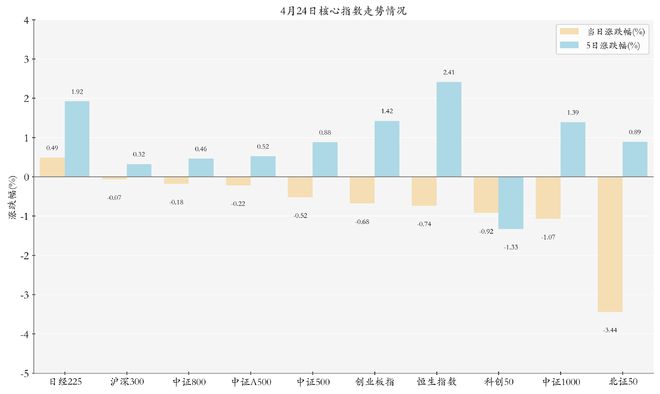
ETF Industry News Summary Core Insights - The ETF market is experiencing mixed performance, with several innovative drug-themed ETFs showing gains while others in the fintech sector are declining [1][2][5]. Market Performance - Major indices showed varied results, with the Shanghai Composite Index up by 0.03%, while the Shenzhen Component and ChiNext indices fell by 0.58% and 0.68%, respectively [5]. - The average position of newly listed stock ETFs in April is 17.05%, with the highest being 50.02% for the Bosera National Index Large Cap Value ETF [4]. Investment Trends - The Ministry of Industry and Information Technology has issued a plan for the digital transformation of the pharmaceutical industry, emphasizing AI applications and collaboration among leading pharmaceutical companies [2]. - Guotai Junan Securities highlights two key investment themes for 2025: the export of high-quality innovative drugs and the valuation recovery of left-side assets in the pharmaceutical sector [2]. ETF Holdings and Growth - As of the end of Q1 2025, public equity ETFs held a market value of 27,745.72 billion yuan, representing 3.78% of the A-share market's circulating value, a significant increase from 0.37% in June 2015 [3]. - The average fundraising for newly listed ETFs in April was 5.43 million shares, with the largest being the Ping An CSI A500 ETF at 20.27 million shares [4]. Sector Performance - The beauty care, banking, and public utilities sectors performed well today, while the computer, communication, and electronics sectors lagged [7]. - Among different ETF categories, commodity ETFs showed the best average performance with a gain of 0.80%, while cross-border ETFs had the worst performance with a decline of 0.78% [10]. Top Performing ETFs - The top-performing stock ETFs today included the Low Volatility 100 ETF, the CSI 2000 Enhanced ETF, and the Innovative Drug ETF, with gains of 1.81%, 1.57%, and 1.48%, respectively [12][13].
工信部等七部门:加强医药工业数智产品研发应用
news flash· 2025-04-24 08:12
Group 1 - The core viewpoint of the article emphasizes the strengthening of research and application of intelligent products in the pharmaceutical industry as outlined in the "Implementation Plan for the Digital Transformation of the Pharmaceutical Industry (2025-2030)" issued by the Ministry of Industry and Information Technology and six other departments [1] - The plan includes organizing "challenge" initiatives for pharmaceutical digital solutions and technology products, targeting the production characteristics of various sub-sectors such as chemical drugs, traditional Chinese medicine, biological products, and medical devices [1] - The initiative aims to develop a series of intelligent pharmaceutical equipment and testing devices, as well as to create "small, fast, light, and precise" pharmaceutical industrial software or systems that comply with the Good Practice (GXP) quality management system [1]
七部门:到2027年,制修订30项以上医药工业数智技术标准
news flash· 2025-04-24 08:10
Core Viewpoint - The Ministry of Industry and Information Technology, along with six other departments, has issued a notice regarding the implementation plan for the digital and intelligent transformation of the pharmaceutical industry from 2025 to 2030, aiming for significant advancements by 2027 in competitiveness and quality management across the entire pharmaceutical supply chain [1] Group 1 - By 2027, the pharmaceutical industry is expected to achieve important progress in digital and intelligent transformation [1] - The transformation will be driven by digital technologies, enhancing the competitiveness of the entire pharmaceutical industry chain [1] - There will be a notable improvement in lifecycle quality management levels within the pharmaceutical sector [1]