医药工业

Search documents
上海医药:2025年净利润同比增长25.74% 持续优化创新资源配置
Zhong Zheng Wang· 2026-03-31 06:05
Core Viewpoint - Shanghai Pharmaceuticals reported a revenue of 283.58 billion yuan for 2025, marking a year-on-year growth of 3.03%, and a net profit attributable to shareholders of 5.725 billion yuan, reflecting a 25.74% increase [1] Group 1: Financial Performance - The company achieved a net cash inflow from operating activities of 6.154 billion yuan, up 5.61% year-on-year [1] - The pharmaceutical industrial sector showed significant improvements in quality and efficiency, with a milestone in innovative research and development [1] Group 2: Innovation and R&D - The company’s first-class innovative drug, Apixaban, received market approval, and the new drug pipeline reached 59 projects, with 6 innovative drugs entering Phase III clinical trials [1] - Key projects such as Renqi Shurong Wan and SHPL-49 showed promising progress [1] Group 3: Production and Cost Management - The company deepened its digital transformation in production, achieving a 22% reduction in comprehensive energy consumption per unit product [2] - Cost management initiatives resulted in savings exceeding 40 million yuan [1][2] Group 4: Marketing and Sales - The company had 40 products with sales exceeding 100 million yuan, with 60 key varieties generating sales of 13.443 billion yuan [1] - The launch of the first improved new drug, Amisulpride orally disintegrating tablets, was successful, and the OTC and health business accelerated to become a second growth curve [1] Group 5: Commercial Sector and Strategic Initiatives - The pharmaceutical commercial sector maintained industry leadership, with core and innovative businesses growing simultaneously [2] - The CSO business surpassed 10 billion yuan in scale, and innovative drug service sales reached 53.7 billion yuan [2] Group 6: Digital Transformation - The company emphasized digital transformation as a key development strategy, integrating technology with core business operations [2] - Over 30 "AI+" projects were implemented, and two core data products were listed on the Shenzhen Data Exchange [2] Group 7: Future Outlook - For 2026, the company plans to adjust market strategies, accelerate international expansion, and optimize innovation resource allocation [3] - The company aims to become a leading enterprise in the pharmaceutical industry through robust operational strategies and a commitment to innovation [3]

天士力(600535) - 天士力关于公司2025年年报主要经营数据的公告
2026-03-19 10:00
单位:元 币种:人民币 | 行业 | 主营业务收入 | | | | 主营业务成本 | | | 毛利率(%) | | | --- | --- | --- | --- | --- | --- | --- | --- | --- | --- | | | 本期累计 | 上年同期累计 | 增长率 | 本期累计 | 上年同期累计 | 增长率 | 本年 | 上年同 | 增长 | | | | | (%) | | | (%) | 累计 | 期累计 | 率 | | 医药 工业 | 7,381,624,148.65 | 7,573,786,861.45 | -2.54 | 2,187,149,523.81 | 2,189,967,782.63 | -0.13 | 70.37 | 71.08 | -0.71 | | 医药 商业 | 765,756,700.22 | 894,545,470.26 | -14.40 | 521,838,976.61 | 590,893,634.83 | -11.69 | 31.85 | 33.94 | -2.09 | | 合计 | 8,147,380,848.87 | 8,468,332,331.71 ...

华创医药投资观点&研究专题周周谈 · 第164期:海外CXO2025财报总结&2026年展望
Huachuang Securities· 2026-03-01 00:25
Investment Rating - The report does not explicitly state an investment rating for the industry or specific companies Core Insights - The report highlights that China's innovative drug development is experiencing high-quality growth, significantly outpacing the global average, establishing China as a key player in global innovative drug research and development [11] - The medical device sector is seeing a recovery in bidding scale, with a positive outlook for domestic companies as they expand internationally [11] - The CXO and raw material drug sectors are expected to benefit from a recovering financing environment and increasing demand, indicating a potential new wave of growth in the innovative drug supply chain [11] - The report emphasizes the importance of AI and brain-machine interface technologies in driving industry transformation [11] Market Review - The report notes that the CITIC pharmaceutical index rose by 0.41%, underperforming the CSI 300 index by 0.67 percentage points, ranking 24th among 30 primary industries [8] - The top ten stocks by growth this week include Aidi Te, Koyuan Pharmaceutical, and Duorui Pharmaceutical, while the bottom ten include Zexing Pharmaceutical and Meihua Medical [8] Industry and Stock Events - The report discusses the strong performance of innovative drugs, medical devices, and the CXO sector, suggesting a focus on companies like Bai Li Tianheng, Bai Ji Shen Zhou, and Hengrui Medicine for potential investment opportunities [11] - It also highlights the recovery of the blood products industry, with a clear growth path expected during the 14th Five-Year Plan period [11] Company-Specific Insights - Lonza is projected to achieve a revenue growth of 11%-12% in 2026, with a strong performance in its CDMO business [14] - Samsung Biologics anticipates a revenue growth of 15%-20% for 2026, driven by strong demand and new contracts [41] - Medpace expects its revenue to grow by 8.9%-12.8% in 2026, focusing on biotech clients [100]
新里程健康科技集团股份有限公司第七届董事会第五次会议决议公告
Shang Hai Zheng Quan Bao· 2026-02-27 21:27
Core Viewpoint - The company has approved a capital increase for its wholly-owned subsidiary, Beijing New Mileage Intelligent Robot Co., Ltd., to support its strategic development and operational needs, with the aim of enhancing long-term growth and corporate benefits [3][13]. Group 1: Board Meeting Overview - The seventh board meeting was held on February 27, 2026, with all 11 directors present, and the resolutions made were in compliance with relevant laws and the company's articles of association [1][2]. - The board unanimously approved the proposal to increase the registered capital of the subsidiary by 100 million yuan, raising its total registered capital to 200 million yuan [3][5]. Group 2: Capital Increase Details - The capital increase is intended to support the subsidiary's future operations in the fields of medical, nursing, rehabilitation, and elderly care intelligent robotics, aligning with the company's strategic planning [3][15]. - The funding for this capital increase will come from the company's own funds, which amounted to approximately 307.82 million yuan as of September 30, 2025, and the plan is to gradually invest this amount over three years [13][15]. Group 3: Appointment of Vice President - The board has approved the appointment of Mr. Guan Hengye as the Vice President of the company, effective from the date of the board's approval until the end of the current board's term [7][21]. - Mr. Guan has a background in law and has held various positions, including Vice President of New Mileage Health Group, and currently holds 1 million shares in the company, representing 0.03% of total shares [21][22].

投资观点&研究专题周周谈第163期:血制品2025年行业总结及2026年展望-20260223
Huachuang Securities· 2026-02-23 07:59
Investment Rating - The report maintains a positive outlook on the blood products industry, suggesting that the sector has clear long-term growth potential due to increasing supply and demand elasticity [12][19][36]. Core Insights - The blood products industry is expected to benefit from a more relaxed approval process for plasma collection stations during the 14th Five-Year Plan, leading to increased production capacity and a diverse range of products [12][19]. - The report highlights a significant shift in the industry from a supply surplus to a supply-demand balance, with expectations for improved performance in 2026 as supply constraints tighten and demand remains stable [36][34]. - Key companies to watch include TianTan Biotech, BoYa Bio, and HuaLan Bio, which are expected to see performance improvements as the market stabilizes [12][36]. Summary by Sections Market Review - The report notes that the CITIC pharmaceutical index fell by 0.85%, underperforming the CSI 300 index by 1.22 percentage points, ranking 21st among 30 primary industries [6]. - The top-performing stocks in the sector included AidiTe and ZhenDe Medical, while stocks like BeiXin Life and HuaYuan Bio faced significant declines [6][12]. Industry and Stock Events - The blood products sector has experienced a prolonged adjustment period, with a cumulative decline of 18.1% since early 2025, significantly underperforming the broader pharmaceutical sector [16]. - The report indicates that the performance of major blood product companies has varied, with some like WeiGuang Bio and HuaLan Bio performing better than the sector average [16]. Overall Perspective and Investment Themes - The report emphasizes the transition from a quantity-driven to a quality-driven approach in the innovative drug sector, suggesting a focus on differentiated products and international expansion [10]. - In the medical device sector, there is a notable recovery in bidding volumes for imaging equipment, with companies like MaiRui and LianYing expected to benefit from ongoing upgrades [10]. - The report also highlights the importance of the CXO and life sciences services sectors, predicting a recovery in domestic investment and a return to high growth rates [10]. Blood Products - The blood products industry is characterized by a clear growth trajectory, with both supply and demand expected to show significant elasticity [12][19]. - The report suggests that the industry will see improved performance due to a combination of increased plasma collection and a tightening supply situation, which is expected to stabilize prices and enhance profitability for key players [36][34].
广东发布财政金融协同惠企利民一揽子政策指引
Xin Lang Cai Jing· 2026-02-03 12:52
Group 1 - The Guangdong Provincial Strategic Emerging Industry Investment Fund has a total scale of 100 billion yuan, with an initial scale of 50 billion yuan, aimed at leveraging social capital to form a fund cluster exceeding one trillion yuan [1][75]. - The fund operates under a three-tier structure of "guiding fund - mother fund - sub-fund," enhancing the leverage effect of fiscal funds and attracting private investment [2][76]. - The fund will primarily invest in strategic emerging industries, future industries, and the upgrading of traditional industries, supporting key provincial initiatives [3][77]. Group 2 - The guiding fund is designed for long-term operation without a fixed duration, establishing a stable investment mechanism to support the modernization of the industrial system [2][76]. - The fund's management includes ten innovative mechanisms, such as performance evaluation and resource sharing, to encourage early and long-term investments in hard technology [2][76]. - The fund aims to attract leading enterprises and establish industry ecological funds, focusing on unicorns and specialized enterprises [3][77]. Group 3 - The loan interest subsidy policy for manufacturing and high-tech enterprises allows for a subsidy of up to 35% of the bank loan interest rate, with a maximum annual subsidy of 20 million yuan per enterprise [8][81]. - The total scale of the annual loan interest subsidy is capped at 200 billion yuan, with a three-year total limit of 600 billion yuan [8][81]. - The policy is effective from May 1, 2025, to December 31, 2027 [8][82]. Group 4 - The personal consumption loan interest subsidy policy provides a 1% annual subsidy on eligible personal loans, with a maximum of 3,000 yuan per borrower per year [10][85]. - The policy is valid from September 1, 2025, to December 31, 2026, with potential extensions based on implementation results [10][86]. - The service industry loan interest subsidy policy supports loans for various service sectors, with a maximum subsidy of 1% on loan principal [10][91].
转型攻坚 海王生物穿越行业调整蓄力长期增长
Cai Fu Zai Xian· 2026-01-30 12:01
Group 1: Company Performance - Haiwang Bio (code: 000078.SZ) expects a net loss attributable to shareholders of 490 million to 600 million yuan for the year 2025, compared to a loss of 1.19 billion yuan in the previous year, indicating a continuous narrowing of losses for two consecutive years [1] - The company plans to focus on core business and asset integration by divesting 24 long-term loss-making subsidiaries, which is expected to impact net profit by 110 million to 150 million yuan this period [3] - The company anticipates goodwill impairment of 120 million to 150 million yuan, significantly lower than previous periods, indicating a gradual release of prior goodwill risks [3] Group 2: Industry Overview - The pharmaceutical distribution industry is undergoing a deep adjustment, with a decline in hospital and pharmacy terminal sales by 5.7% and 0.4% respectively in the first half of 2025 [2] - The new stage of centralized procurement emphasizes "stabilizing clinical use, ensuring quality, and countering internal competition," leading to structural adjustments in the procurement mechanism [2] Group 3: Strategic Transformation - 2025 is a critical year for Haiwang Bio's strategic transformation, with short-term business structure optimization and cost control pressures affecting performance [3] - The company is enhancing its core capabilities through collaboration with leading brands in the medical device sector and expanding value-added services [4] - The focus on high-margin industrial products and innovative research and development is expected to drive long-term growth, with a shift towards a "product + service" integrated business model [4][5] Group 4: Future Outlook - The company is expected to benefit from industry policy dividends and the implementation of its strategic initiatives, with a potential performance inflection point in 2026 [5] - The medical device sector will continue to deepen partnerships with top brands, aiming to expand its commercial platform to a "billion-level" target [5] - The company plans to accelerate the development of core pipelines and expand its matrix of products undergoing consistency evaluation, aiming to cultivate new profit growth points [7]

阳光诺和收购同一标的两次失败 国联民生证券开年三连阻 | A股融资快报
Quan Jing Wang· 2026-01-29 12:09
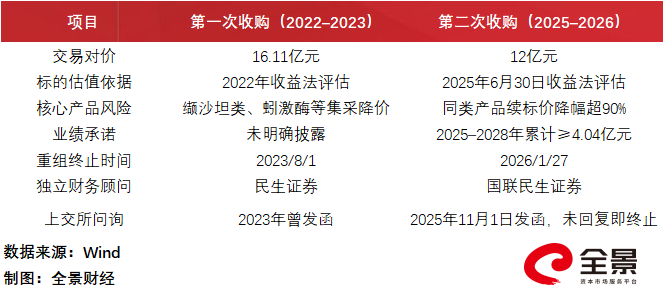
Core Viewpoint - Sunshine Nuohuo (688621.SH) has officially terminated its plan to acquire 100% equity of Langyan Life, marking the second failed attempt since 2022, amid challenges from policy changes and valuation disputes [1][3]. Group 1: Acquisition Attempts - The first acquisition attempt in 2022 was priced at 1.611 billion yuan, while the second attempt in 2025 was reduced to 1.2 billion yuan, a 25.5% decrease [2][4]. - The core products of Langyan Life, including Valsartan and Entecavir, faced significant price reductions due to centralized procurement, impacting revenue and profit forecasts [3][4]. - The termination of the first acquisition occurred on August 1, 2023, and the second on January 27, 2026, with both attempts facing scrutiny from the Shanghai Stock Exchange [2][5]. Group 2: Financial Performance and Market Conditions - Langyan Life's revenue dropped from 617 million yuan in 2022 to 465 million yuan in 2023, with net profit falling from approximately 80 million yuan to 36.71 million yuan [3][4]. - The company set a performance commitment for the second acquisition, requiring a cumulative net profit of at least 404 million yuan from 2025 to 2028 [2][4]. - Despite a report suggesting opportunities from a shift towards quality in procurement policies, market skepticism regarding the sustainability of Langyan Life's profitability persisted [5][6]. Group 3: Regulatory and Advisory Context - Guolian Minsheng Securities served as the independent financial advisor for both acquisition attempts, facing challenges in transaction structuring and compliance due to market conditions [6][8]. - The Shanghai Stock Exchange raised multiple inquiries regarding the fairness of pricing and the feasibility of performance commitments during the second acquisition attempt [4][5]. - Sunshine Nuohuo stated that the termination of the acquisition would not significantly impact its operational and financial status, projecting a revenue increase of 10.57% to 27.15% for 2025 [7][8].


财政部等五部门:实施中小微企业贷款贴息政策|营商环境周报
2 1 Shi Ji Jing Ji Bao Dao· 2026-01-27 09:06
Group 1: Support for SMEs - The Ministry of Finance and five other departments issued a notification to support small and micro enterprises in increasing investment and expanding production, providing a 1.5% annual interest subsidy for eligible enterprises [1] - The policy focuses on key industries such as new energy vehicles, industrial machinery, pharmaceuticals, medical equipment, and emerging fields like artificial intelligence [1] - The subsidy applies to fixed asset loans and new policy financial tools for eligible small and micro enterprises, with a maximum loan subsidy limit of 50 million yuan per enterprise [1] Group 2: National Emerging Industry Innovation Centers - The National Development and Reform Commission released a management method for national emerging industry innovation centers, aiming to promote the integration of technological and industrial innovation [3] - These centers will be led by industry leaders and will collaborate with upstream and downstream resources, focusing on key and frontier technologies [3] - The centers are expected to operate as independent corporate entities with diverse ownership structures and will utilize venture capital to support technology transfer and incubation [4] Group 3: Logistics and Supply Chain Development - The Ministry of Transport and seven other departments issued an action plan to enhance the service capacity of supply chains, aiming to create around 100 comprehensive logistics integrators by 2030 [5] - The plan encourages the establishment of a unified transportation market and supports the integration of logistics services across different modes of transport [5][6] - It promotes collaboration between logistics companies and upstream enterprises to improve efficiency and reduce costs in transportation logistics [6] Group 4: Regional Economic Development Initiatives - Yunnan Province introduced an action plan to develop its park economy, targeting a GDP contribution of over 25% from park areas by 2028 [7] - The plan emphasizes upgrading existing parks, focusing on manufacturing, and fostering high-tech enterprises [7][8] - It encourages collaboration among neighboring parks to enhance industrial development and resource sharing [8] Group 5: Business Environment Improvement - Jinshan District in Shanghai launched an action plan to enhance its business environment, focusing on high-quality development and streamlined project approval processes [9] - The plan includes personalized support for key projects and aims to reduce the administrative burden on enterprises [9] - It also emphasizes the creation of service brands tailored to specific industries, such as smart vehicles and advanced materials [9] Group 6: Innovative Approval Services - Beijing Economic-Technological Development Area introduced a new licensing model for the co-production of regular and health foods to reduce costs and improve efficiency [10][11] - The model allows for customized review processes and collaborative risk assessments to ensure compliance with safety standards [11] - This approach has led to significant cost savings and increased production capacity for participating companies, exemplifying a replicable model for other regions [11]
【招银研究|政策】政策协同发力,着力扩大内需——2026年1月20日财政新闻发布会点评
招商银行研究· 2026-01-23 10:59
Core Viewpoint - The article discusses six fiscal and financial support policies aimed at stimulating private investment and promoting consumer spending, utilizing tools such as fiscal interest subsidies, financing guarantees, and risk-sharing mechanisms to lower financing costs for enterprises and reduce the consumption burden on residents [1][2]. Policy Content: Three Additions and Three Optimizations - Three new policies include: - Implementation of interest subsidy policy for loans to small and micro enterprises, with a 1.5% annualized subsidy for fixed asset loans, capped at 50 million per entity, focusing on key industries such as new energy vehicles and pharmaceuticals [2]. - Establishment of a special guarantee plan for private investment, with a total amount of 500 billion over two years, supporting loans for equipment purchases and business upgrades, including mid-sized enterprises for the first time [2]. - Creation of a risk-sharing mechanism for private enterprise bonds, providing credit enhancement support and loss compensation for bond issuances [3]. - Three optimized policies include: - Expansion of the equipment update loan interest subsidy policy to include more sectors and extend the support period, maintaining a 1.5% subsidy [4]. - Extension of the service industry loan interest subsidy policy until December 31, 2026, increasing the loan cap from 1 million to 10 million [4]. - Optimization of personal consumption loan interest subsidy policy, extending the support period and including credit card installment payments, with a 1% subsidy rate [4]. Policy Effectiveness: Expanding Demand and Credit Expansion - The fiscal interest subsidies are expected to significantly increase in scale from 60-90 billion in 2025 to 1,000-1,300 billion in 2026, with specific allocations for small and micro enterprises, equipment updates, service industry loans, and personal consumption loans [6][8]. - The combination of fiscal interest subsidies and fiscal subsidies is anticipated to effectively stimulate investment and consumption, with a notable impact on sectors like equipment upgrades and durable consumer goods [7][8]. Credit Impact: Demand Release and Differentiated Effects - The policy is expected to improve financing willingness and release credit demand, with differing effects between enterprises and residents [9]. - For enterprises, the policy is projected to significantly boost medium and long-term loans, with estimated savings of 1.75% in financing costs due to combined interest subsidies and structural policy rate cuts [10]. - For residents, despite the expanded support for non-housing consumption loans, conservative financial behavior may limit the effectiveness of the policy, leading to a focus on refinancing existing high-interest loans rather than increasing new loans [10].