
Deglobalization

Search documents
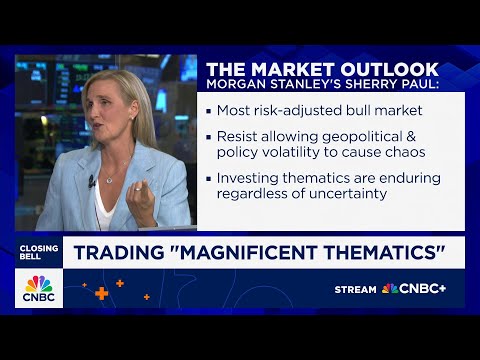
Morgan Stanley's Sherry Paul: Next leg of bull market will come from broadening out beyond AI story
CNBC Television· 2025-08-05 19:59
Market Outlook & Investment Themes - The bull market is expected to continue, driven by a broadening beyond just AI into deglobalization, longevity, and deregulation, all interacting and accelerating simultaneously [2] - The market is forward-thinking, and opportunities exist for investors who may have missed the initial AI-driven gains [4] - A diversified portfolio is recommended to capitalize on these themes, including sectors like materials and industrials, which benefit from deglobalization and increased defense spending [7] AI & Technological Advancements - The current phase is likened to a "candlesticks to light bulbs" moment, emphasizing the ability to scale, implement, and download AI technology to produce earnings power across various business models [5] - The focus is shifting towards tangible returns on significant capital expenditures in AI, with confidence that these returns will materialize [5] - AI is seen as a cost-saving and productivity-enhancing engine that will continue to lead the market [4] Interest Rates & Monetary Policy - Interest rates are anticipated to decrease, potentially impacting investors overweight in cash, who may experience a "pay cut" [10] - The market typically anticipates interest rate changes 6 to 12 months in advance [11] - Morgan Stanley's interest rate team projects a couple of rate cuts this year plus five more next year, contingent on data [12] Sector Opportunities - Utilities and power companies, traditionally valued for dividends and defensive characteristics, are emerging as new growth stocks [14] - Industrials are highlighted as a strong performing sector with continued potential [8] - Investing in sectors with quantifiable merit and opportunistic potential is encouraged, even if not completely proven [9]


BERNSTEIN:美国考虑取消对在华设有实验室的跨国企业的中国半导体设备许可证豁免
2025-06-27 02:04
Summary of Key Points from the Conference Call on Global Semiconductors and Semiconductor Capital Equipment Industry Overview - The focus is on the **Global Semiconductor Capital Equipment** industry, particularly the implications of potential changes in U.S. export controls affecting shipments to China [1][2][3]. Core Insights and Arguments - **Export Control Waivers**: Since October 2022, U.S. semiconductor capital equipment (semicap) companies have faced increasing restrictions on shipments to China. Non-Chinese customers with fabs in China have been receiving waivers, but the U.S. Commerce Department is considering canceling these waivers, which would require licenses for shipments [2][3]. - **Impact on Multinational Companies**: Major multinationals with significant capacity in China include **Samsung**, **SK hynix**, **TSMC**, and **UMC**. For instance, SK hynix has 35% of its DRAM capacity in China, while Samsung has 30% of its NAND capacity there [4][5]. - **WFE Spending**: The total WFE (Wafer Fabrication Equipment) spending by non-Chinese companies in China is projected to be around **$2 billion** in 2024, which is only about **4%** of the total WFE deployed in China and less than **2%** of the global WFE market estimated at **$108 billion** [5][6][33][37]. - **Memory Chip Exposure**: Memory chips are seen as the most exposed segment, with China-based fabs accounting for **10%** of global DRAM and **15%** of NAND capacity. However, case-by-case approvals for licenses may mitigate immediate impacts [6][39]. Additional Important Insights - **Deglobalization Trends**: Japanese semiconductor capital equipment companies are expected to benefit from deglobalization trends, as they can serve both U.S. and Chinese markets. Companies like **Tokyo Electron** and **Kokusai** may gain from increased demand for etching and deposition equipment [7]. - **Investment Implications**: - **AMAT (Applied Materials)**: Rated as Outperform with a target price of **$210.00**, driven by secular WFE growth and capital return strategies [10]. - **LRCX (Lam Research)**: Also rated Outperform with a target of **$95.00**, supported by a potential NAND upgrade cycle [10]. - **Tokyo Electron**: Rated Outperform with a target of **¥33,800**, expected to gain market share due to competitive pricing [11]. - **ASML**: Rated Market-Perform with a target of **€700.00**, reflecting a cautious outlook on growth relative to consensus estimates [14]. - **Domestic Chinese Companies**: Companies like **NAURA**, **AMEC**, and **Piotech** are rated Outperform, benefiting from domestic WFE substitution trends in China [15][16][17]. Conclusion - The semiconductor capital equipment industry is facing significant regulatory changes that could impact multinational companies operating in China. While immediate effects may be limited, the long-term implications of export controls and deglobalization trends will shape the competitive landscape. Investment opportunities exist in both established players and emerging domestic companies in China.


T. ROWE PRICE RELEASES 2025 MIDYEAR INVESTMENT OUTLOOK
Prnewswire· 2025-06-09 17:00
Core Viewpoint - The midyear outlook for global financial markets indicates a shift towards deglobalization, a reconfiguration of global trade due to tariffs, and an expansion of stock market opportunities beyond U.S. equities and mega-cap tech stocks, alongside a bond market regime change driven by trade policy and German fiscal expansion [1][2]. Economic Outlook - The global economy is facing pressures from trade war fallout, which could slow growth, with U.S. fiscal and tax policy expected to be significant in the latter half of the year [6]. - The likelihood of a global recession has increased, particularly with the U.S. leading the downturn, resulting in a longer period of subpar growth characterized by higher unemployment and inflation [5][7]. Equity Market Insights - There is an anticipated broadening of equity markets, reducing the concentration on U.S. and mega-cap stocks, favoring value stocks and select emerging markets [4][6]. - Active management is expected to outperform in the current challenging market environment, which includes higher interest rates and increased volatility [2]. Fixed Income Landscape - The U.S. tariffs and significant German fiscal expansion have altered the global fixed income landscape, leading to a weaker outlook for developed market sovereign bonds while improving prospects for credit and some emerging markets [5][6]. - Above-target inflation is noted in some developed markets, particularly the U.S., affecting corporate bonds which are entering an economic downturn with historically high credit quality [6]. Multi-Asset Strategy - T. Rowe Price emphasizes inflation protection and equity diversification in its multi-asset portfolios, suggesting that inflation-protected bonds and real assets can serve as effective hedges against expected inflation [6]. - More attractive valuations are leading to a preference for international and value equities in multi-asset portfolio allocations [6].


TripAdvisor(TRIP) - 2025 FY - Earnings Call Transcript
2025-05-29 13:00
Financial Data and Key Metrics Changes - The company reported a good quarter with durable travel consumer intent observed until early May [4][5] - There is a focus on long-term growth in travel despite macroeconomic volatility [4][5] - The company is monitoring cancellations and pricing closely, with no significant changes noted up to the reporting date [8][10] Business Line Data and Key Metrics Changes - The experiences category remains a mainstay of travel budgets, with a bifurcation observed between upper and lower-end consumers [6][7] - The meta business has shown strong pricing performance, indicating resilience even in choppy market conditions [12][14] - The company is combining meta with booking in its app, which is expected to enhance user engagement and monetization [14][15] Market Data and Key Metrics Changes - The company is well-positioned to serve both domestic and international travelers, adapting to changing consumer preferences [22][23] - There is a diversification in inventory, particularly in the experiences space, which is crucial for catering to various traveler mindsets [22][24] Company Strategy and Development Direction - The company aims to be the most trusted source for travel and experiences, focusing on authenticity and trust in an AI-driven world [26][27] - Each business segment has its own distinct strategy, with a focus on engagement and monetization [27][30] - The company is investing in marketing and product development to stabilize the hotel category and accelerate experiences [20][21][30] Management's Comments on Operating Environment and Future Outlook - Management acknowledges the uncertainties in the macro environment but remains optimistic about the travel sector's growth [4][10] - The company is focused on leveraging AI to enhance user experience and engagement, which is expected to drive higher conversion rates [55][56] - There is confidence in the potential for TripAdvisor to stabilize and return to modest growth by 2026 [101][102] Other Important Information - The company is exploring partnerships and collaborations to enhance its offerings and market presence [41][43] - The Fork, a subsidiary, is experiencing double-digit growth and is positioned strongly in the European dining market [84][86] Q&A Session Summary Question: How does the company view the impact of macroeconomic factors on travel? - The company closely tracks macroeconomic uncertainty and focuses on long-term growth, noting that travel intent remains strong despite volatility [4][5] Question: What is the strategy regarding direct booking within the app? - The company finds direct booking and meta products to be complementary, aiming to enhance user experience across categories [16][17] Question: How does the company plan to leverage AI in its offerings? - The company is developing an AI-led travel planner that utilizes user-generated content and first-party data to enhance recommendations and user engagement [54][56] Question: What is the outlook for the experiences category amid increasing competition? - The company views the interest from competitors as validation of the category's potential and believes there is room for multiple players [74][75] Question: What is the strategy for The Fork in the European market? - The Fork is focused on growing its presence in Europe, leveraging technology to enhance both B2C and B2B offerings [80][84]

摩根士丹利:软件、云服务及超大规模云服务提供商在不同地区的风险暴露程度如何
摩根· 2025-05-12 01:48
Investment Rating - The report does not explicitly provide an investment rating for the industry or specific companies covered. Core Insights - The report highlights the global distribution of enterprise software spending, indicating that the US accounts for approximately 56% of sales, with Western Europe at 23% in CY24, showing minimal change from CY20 [15] - The exposure of software and cloud companies to China is relatively low, with the report suggesting that tariffs or actions on software will not have a significant impact [14][12] - The report expresses concerns about deglobalization, noting that regions like the EU may attempt to promote local software industries through regulations and tariffs [14][12] Summary by Sections Global Exposure of Enterprise Software - Enterprise software spending has remained stable globally from CY20 to CY24, with most companies generating more revenue outside North America [2] - The US market is the largest revenue driver for most companies, except for SAP, which has similar revenue exposure in Western Europe and North America [14][12] Microsoft and Oracle Exposure - Microsoft has a 22% exposure to Western Europe and 11% to Asia/Pacific, with China accounting for only 1.8% of Azure revenue [22][28] - Oracle's global exposure mirrors that of enterprise software, with 21% in Western Europe and 10% in Asia/Pacific [33][35] SAP and Adobe Global Presence - SAP has equal revenue exposure to the US and Western Europe, with 37% in North America and 37% in Western Europe [40][41] - Adobe has become more global over the past four years, with a revenue mix of 56% in North America and 23% in Western Europe by CY24 [42][45] Salesforce and Workday International Growth - Salesforce has increased its international revenue percentage from CY20 to CY24, now at 64% in North America and 20% in Western Europe [46][48] - Workday remains predominantly North American, generating 77% of its revenue in North America in CY24, although it is working to expand its international presence [51][54]



Got $1,000 to Invest? This Top High-Yield Dividend Stock Is a No-Brainer Buy Amid Current Uncertainty.
The Motley Fool· 2025-05-06 08:35
That was evident in the company's recent first-quarter earnings report. Brookfield generated $646 million of FFO, a 5% increase from the prior-year period. It benefited from strong inflation indexation, higher revenue across its critical infrastructure network, completing over $1.3 billion of expansion projects, and the impact of closing several smaller tuck-in acquisitions. Those growth drivers offset the impact of foreign exchange fluctuations, higher borrowing costs due to rising interest rates, and the ...


Rimini Street(RMNI) - 2025 Q1 - Earnings Call Transcript
2025-05-01 22:02
Financial Data and Key Metrics Changes - Revenue for Q1 2025 was $104.2 million, a year-over-year decrease of 2.4% [18] - Annualized recurring revenue was $396.2 million, a year-over-year decrease of 4.7% [18] - Billings for Q1 were $79.4 million, up 7.2% year-over-year [19] - Gross margin for Q1 was 61% of revenue, compared to 59.8% for the prior year [19] - Net income attributable to shareholders for Q1 was $3.4 million, or $0.04 per diluted share, compared to $0.01 per diluted share in the prior year [22] Business Line Data and Key Metrics Changes - Operating expenses as a percentage of revenue declined by 5.8% year-over-year due to cost optimization efforts [8] - Professional fees and other litigation costs were $1.9 million for Q1, down from $2.9 million in the prior year [22] - PeopleSoft revenue was approximately $7 million, or 7% of revenue, down from $8.2 million, or 8% of revenue, in the prior year [26] Market Data and Key Metrics Changes - Clients in the United States represented 48% of total revenue, while international clients represented 52% [18] - The EMEA and Asia Pacific regions led geographically in billings growth [8] Company Strategy and Development Direction - The company is focused on expanding global alliances and partnerships to drive sales leverage [9] - New partnerships with ServiceNow, Workday, and T Systems North America were announced to enhance service offerings [10][11] - The company is continuing to wind down services for Oracle's PeopleSoft product, with a significant reduction in related clients and revenue [25] Management's Comments on Operating Environment and Future Outlook - Management believes that the current macroeconomic environment, including deglobalization trends, will ultimately benefit the business [16] - The company is confident in its ability to reaccelerate growth and improve profitability despite ongoing litigation with Oracle [17] - Management has suspended guidance until there is more clarity regarding the impacts of current litigation activity [26] Other Important Information - The company ended Q1 2025 with a cash balance and short-term investments of $122.6 million, down from $129 million in the prior year [24] - Deferred revenue as of March 31, 2025, was $256.4 million, compared to $254.3 million in the prior year [24] Q&A Session Summary Question: Which of the three partnerships discussed has the largest long-term potential? - Management indicated that the ServiceNow partnership has substantial global potential and is expected to have a meaningful impact by 2026 [29][32] Question: Can you size the maintenance from Oracle and SAP generated from the federal government? - Management stated that the opportunity in the U.S. Federal Government is significant, potentially in the billions of dollars annually [34][36] Question: Is the company confident in crossing the year-over-year growth mark this year, excluding PeopleSoft impacts? - Management expressed confidence in achieving positive revenue growth despite the headwinds from the PeopleSoft wind down [37][40] Question: What areas will the continued cost-saving measures come from? - Management confirmed that cost-saving measures will focus on streamlining internal operations and reducing administrative costs [44][46] Question: Are there any macroeconomic factors that could negatively impact growth? - Management noted that while there are potential cost pressures, the overall macro environment is seen as a net positive for the business [48][51]

Rimini Street(RMNI) - 2025 Q1 - Earnings Call Transcript
2025-05-01 21:00
Financial Data and Key Metrics Changes - Revenue for Q1 2025 was $104.2 million, a year-over-year decrease of 2.4% [17] - Annualized recurring revenue was $396.2 million, a year-over-year decrease of 4.7% [17] - Billings for Q1 were $79.4 million, up 7.2% year-over-year [18] - Gross margin for Q1 was 61% of revenue, compared to 59.8% for the prior year [18] - Net income attributable to shareholders for Q1 was $3.4 million, or $0.04 per diluted share, compared to $0.01 per diluted share in the prior year [21] Business Line Data and Key Metrics Changes - Operating expenses and cost of revenue as a percentage of revenue declined by 5.8% year-over-year due to cost optimization [8] - Professional fees and other costs of litigation were $1.9 million for Q1, down from $2.9 million in the prior year [21] - PeopleSoft revenue was approximately $7 million, or 7% of revenue, down from $8.2 million, or 8% of revenue, in the prior year [25] Market Data and Key Metrics Changes - Clients within the United States represented 48% of total revenue, while international clients represented 52% [17] - The EMEA and Asia Pacific regions led geographically in billings growth [8] Company Strategy and Development Direction - The company is focused on expanding global alliances, partnerships, and channels to drive sales leverage [9] - New partnerships with ServiceNow, Workday, and T Systems North America aim to enhance service offerings and market reach [10][11] - The company is continuing to wind down services for Oracle's PeopleSoft product, with a significant reduction in related clients and revenue [24] Management's Comments on Operating Environment and Future Outlook - Management believes that deglobalization trends and global trade policy shifts will ultimately benefit the business [15] - The company is confident in its ability to reaccelerate growth and improve profitability despite ongoing litigation with Oracle [16] - Management expects to incur additional reorganization costs in 2025 as part of cost structure optimization [20] Other Important Information - The company ended Q1 2025 with a cash balance and short-term investments of $122.6 million, down from $129 million in the prior year [22] - Deferred revenue as of March 31, 2025, was $256.4 million, compared to $254.3 million in the prior year [22] Q&A Session Summary Question: Which of the three partnerships discussed has the largest long-term potential? - Management indicated that the ServiceNow partnership has substantial global potential and is expected to yield significant opportunities [28] Question: What is the expected timeframe for the ServiceNow partnership to become meaningful? - Management anticipates meaningful revenue impact from the ServiceNow partnership in 2026, with ramping in the latter half of 2025 [32] Question: Can you size the maintenance from Oracle and SAP generated from the federal government? - Management estimates the opportunity in the federal government to be in the billions of dollars annually for software support and upgrades [36] Question: Is deferred revenue up for the first time in several years, and what does this indicate? - Management expressed confidence that despite the headwinds from the PeopleSoft wind down, there are larger growth opportunities that will lead to positive revenue growth [39] Question: Will continued cost-saving measures come from go-to-market or other areas? - Management confirmed that cost-saving measures include streamlining internal operations and reducing headcount, with a focus on efficiency [44] Question: What are the macroeconomic factors affecting growth? - Management noted that while there are pressures on IT budgets, their methodology allows for cost reduction and innovation funding, positioning the company favorably in the current environment [50]
美国综合零售和耐用消费品零售 - 零售业的未来以及谁已做好准备
2025-03-23 15:39
Summary of US Retailing Broadlines & Hardlines Conference Call Industry Overview - The report focuses on the US retailing broadlines and hardlines sector, analyzing future consumer shopping trends and identifying potential winners among retailers [1][12]. Key Insights E-commerce Growth - US e-commerce sales have reached $1.2 trillion annually, accounting for approximately 16% of total retail sales [2][24]. - E-commerce has gained an average of 60 basis points (bps) market share per year since 1993, accelerating to 107 bps per year over the last decade [14][18]. - Discretionary categories are expected to lead in e-commerce penetration, while food and beverage categories lag behind [22][27]. Retailer Performance - Walmart (WMT) is viewed as a structural winner due to its scale and investment in automation, which supports profitability improvements [2]. - Target (TGT) faces challenges due to its smaller scale and limited investments, leading to persistent margin headwinds in e-commerce [2][40]. - Costco (COST) is selective in its e-commerce efforts, focusing on partnerships for same-day delivery rather than in-house fulfillment [38]. Retail Media Opportunities - The retail media market could grow to $100 billion by 2028, representing about 19% of total media ad spend [3][74]. - Walmart's retail media could become a $10 billion business, while Target's Roundel is already a $2 billion business [3][72]. Labor Market Challenges - Inflationary pressures and tightening immigration policies may increase labor costs, with dollar retailers being the most vulnerable due to their low pay models [5][60]. Supply Chain and Global Sourcing - Retailers manage complex supply chains with up to 50% of cost of goods sold (COGS) coming from imports [4][88]. - Target and Dollar Tree are most exposed to tariff risks due to their higher discretionary exposure [4][86]. Consumer Behavior Trends - The pandemic shifted consumer preferences towards "do it for me" (DIFM) services, but there is potential for a rebound in DIY home improvement projects among younger homeowners [6][12]. - Millennials and Gen-Z are expected to show a greater propensity for DIY compared to older generations [6]. AI and Future Retail Landscape - The rise of AI agents poses a potential threat to traditional retail models by automating shopping decisions [79]. - Despite this, physical retail remains relevant, especially for grocery offerings, as consumers still prefer in-store shopping for certain products [82]. Investment Implications - Ratings for key retailers include: - Costco (COST): Outperform, Target Price (TP): $1,177 - Walmart (WMT): Outperform, TP: $113 - Dollar General (DG): Outperform, TP: $95 - Lowe's (LOW): Outperform, TP: $289 - Target (TGT): Market-Perform, TP: $124 - Dollar Tree (DLTR): Market-Perform, TP: $80 - Home Depot (HD): Market-Perform, TP: $421 [9]. Additional Considerations - The report emphasizes the importance of scale in retail as a defense against competition from e-commerce and AI [84]. - The potential for deglobalization to impact sourcing strategies and cost structures is highlighted, particularly for retailers heavily reliant on imports [100].


