Export controls

Search documents
Nvidia says complies with law after China antitrust finding
TechXplore· 2025-09-16 08:30
Core Viewpoint - Nvidia asserts compliance with laws following a Chinese investigation that found the company in breach of antitrust rules, highlighting the ongoing tech rivalry between China and the United States [1][4]. Group 1: Nvidia's Compliance and Investigations - Nvidia stated it complies with all laws in response to the Chinese investigation into its antitrust practices [1][2]. - China's market watchdog opened an investigation into Nvidia in December, concluding that the company violated anti-monopoly laws based on preliminary findings [4]. Group 2: US-China Tech Competition - The competition between the US and China in the semiconductor industry is intensifying, with Nvidia caught in the middle [2]. - Washington has restricted Nvidia from exporting its most advanced products to China and mandated that the company pay 15% of revenue from certain AI chip sales to the US government [3]. Group 3: Responses and Future Implications - In response to the investigation, China has expressed national security concerns regarding Nvidia chips and is encouraging local businesses to rely on domestic semiconductor suppliers [3]. - The announcement of the investigation coincided with trade talks between US and Chinese officials, indicating the broader implications of the tech rivalry [4][5].


Chip Giant TSMC Shares Drop 2% After US Revokes Waiver For China Shipments
Forbes· 2025-09-02 15:35
Core Insights - The U.S. has revoked the validated end user (VEU) status for Taiwan Semiconductor Manufacturing Company (TSMC), impacting its ability to ship to its China-based facilities freely, leading to a drop in TSMC's shares by over 2% [1][2] - This decision follows similar actions taken against other semiconductor companies, including Samsung, SK Hynix, and Intel, indicating a broader trend in U.S. export controls on semiconductor technology [5][6] Company Impact - TSMC's production may be disrupted as suppliers will now need to apply for export licenses for each shipment of manufacturing gear, spare parts, or chemicals [3] - The company is currently evaluating the situation and is in communication with the U.S. government regarding the implications of this revocation [3] Market Position - TSMC is the world's largest semiconductor firm by market value, with a market capitalization of $1.1 trillion, ranking it as the ninth-largest company globally [5] - The company has seen significant growth due to the semiconductor and AI sectors, producing chips for major clients like Nvidia, Apple, and AMD [5] Historical Context - The revocation of TSMC's VEU status aligns with the U.S. government's tightening of export controls on semiconductor shipments to China, which has been a trend throughout the year [6] - Previous actions included a temporary ban on Nvidia's H20 processors to China, highlighting ongoing national security concerns related to semiconductor technology [6]

X @The Economist
The Economist· 2025-08-15 21:20
The China-plus-one strategy—which led firms to build production hubs outside China—is not just a way to dodge tariffs. It is also a way to avoid rising labour costs, political crackdowns and American export controls https://t.co/g7TgJcZQpt ...
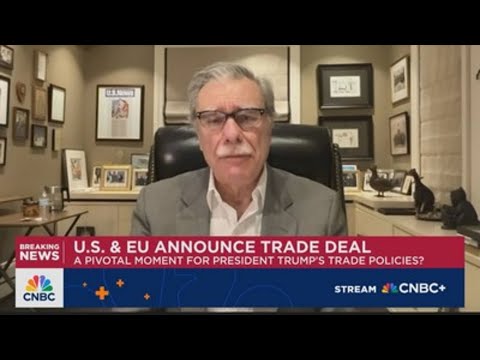
Gutierrez: This deal is a big win for the U.S., but negotiations with Europe continue
CNBC Television· 2025-07-28 11:17
All right, 15% tariffs on our biggest trading partner. Um, I was at the New York Stock Exchange in recent weeks. A lot of people were saying to me essentially 15%, that's the new zero. It seems to be a number that's palatable to the market.Do you agree with this idea that the market can continue to move higher and that businesses can move with a certain degree of certainty with 15% tariffs. >> That's the big question. Uh, 15% looks like the baseline.Um, and that's that's the big question. Have we reached th ...
Nvidia AI chips worth $1B smuggled into China after Trump imposed US export controls: report
New York Post· 2025-07-24 17:03
Core Insights - At least $1 billion worth of Nvidia computer chips were smuggled into China following the imposition of export controls by the Trump administration [1] - The B200 chip, favored by major US tech firms for AI applications, is banned for sale to China due to performance threshold regulations [1][5] - Chinese suppliers continued to sell Nvidia chips, including the B200, to data center operators supporting local tech firms despite the export restrictions [2][6] Group 1 - A Chinese data center operator indicated that export controls have not effectively prevented advanced Nvidia products from entering China, instead creating inefficiencies and profits for middlemen [3] - The Trump administration had previously banned Nvidia from selling the less powerful H20 chips, which were designed to comply with earlier export controls [3] - Nvidia's CEO revealed that Trump reversed the ban on H20 chip sales to China, leading to speculation about Chinese companies circumventing export controls [4][7] Group 2 - Evidence reviewed by the Financial Times indicated that Chinese distributors in Guangdong, Zhejiang, and Anhui provinces sold restricted Nvidia chips, including the B200, H100, and H200 [6] - There is no evidence that Nvidia was involved in or aware of the illicit sales to Chinese entities, as the company maintains compliance with US laws [6] - Nvidia stated that assembling data centers from smuggled products is technically and economically unfeasible, emphasizing the need for authorized products and support [8]
X @The Wall Street Journal
The Wall Street Journal· 2025-07-20 04:00
Rare Earth Magnet Exports - China's rare-earth magnet exports nearly tripled month-over-month [1] - Export increase followed the lifting of some export controls after a deal with the U S [1] Geopolitical Factors - The U S deal influenced China's decision to lift export controls [1]
高盛:英伟达-关于对中国出口 H20 管制潜在放宽的初步看法
Goldman Sachs· 2025-07-16 15:25
Investment Rating - The report maintains a "Buy" rating for Nvidia Corp. (NVDA) with a 12-month price target of $185, indicating an upside potential of 8.4% from the current price of $170.70 [10]. Core Insights - Nvidia has received assurances from the U.S. government to provide the necessary licenses to sell its Hopper (H20) GPUs in China, reversing a previous export ban. This development is viewed positively, although there are concerns about the potential for future reversals and the stock's recent price run-up suggesting that this outcome may already be partially priced in [1][2]. - The expected reversal of the ban could add significant revenue and earnings per share (EPS) upside in the Bull scenarios for CY2026, with estimates suggesting an increase of $12 billion to $17.5 billion in revenue and $0.30 to $0.45 in non-GAAP EPS [6][9]. Summary by Sections Company Overview - Nvidia announced a $4.5 billion charge related to H20 inventory write-downs and purchase obligations due to the previous export ban, which also impacted revenue by $2.5 billion in FY1Q'26 [2]. Market Dynamics - The demand signals from China are still being evaluated, as potential customers are considering local alternatives. The company is in discussions with the U.S. government regarding potential customers in China [5]. Financial Projections - The report outlines potential upside scenarios for non-GAAP EPS in CY2026, estimating $0.30 in the Bull 1 scenario and $0.45 in the Bull 2 scenario, reflecting the anticipated revenue contributions from the reversal of the export ban [6][9]. Valuation Metrics - The report projects Nvidia's revenue to grow significantly, with estimates of $130.5 billion in revenue for FY2026, increasing to $295.5 billion by FY2028 [10].
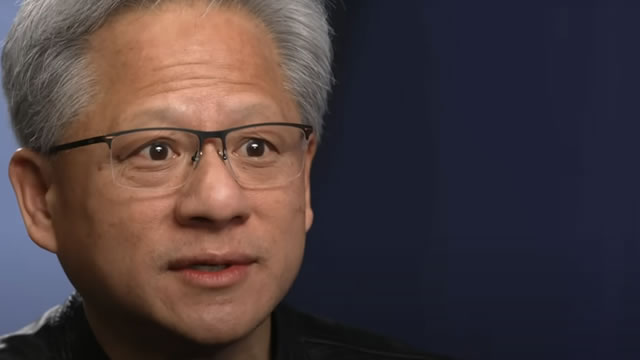
Nvidia's Jensen Huang: China Doesn't Need US Chips
Benzinga· 2025-07-14 16:15
Core Viewpoint - Nvidia CEO Jensen Huang stated that the Chinese military is not utilizing Nvidia's chips due to U.S. export controls and the ongoing tensions between the U.S. and China [1][2]. Group 1: Export Controls and Military Implications - Huang emphasized that China cannot rely on U.S.-made technology for military purposes, as access could be restricted at any time [1]. - He noted that China has sufficient computing capacity and does not need Nvidia's chips or American technology stacks to build its military [2]. - Huang criticized the export restrictions, arguing they are counterproductive to the U.S. goal of maintaining technological leadership [3]. Group 2: Industry Dynamics and Strategic Positioning - Industry analysts suggest that Huang is navigating a delicate balance between U.S. and Chinese relations to position Nvidia for future opportunities in China while avoiding conflict with U.S. policymakers [4]. - A senior U.S. official indicated that Chinese AI firm DeepSeek is actively supporting military and intelligence agencies while attempting to bypass U.S. restrictions on semiconductor exports [5]. Group 3: DeepSeek and Export Workarounds - DeepSeek is reported to have used shell companies in Southeast Asia to acquire large quantities of Nvidia's H100 chips, which are under strict export controls [6]. - Huang is preparing for a second trip to China this year as Nvidia develops a new chip that complies with the latest export regulations [6]. Group 4: Market Reaction - Nvidia shares experienced a slight increase of 0.12%, reaching $165.12 on Monday [7].
Nvidia CEO downplays U.S. fears that China's military will use his firm's chips
CNBC· 2025-07-14 04:54
Group 1 - Nvidia CEO Jensen Huang downplayed U.S. concerns regarding the use of Nvidia chips by the Chinese military, stating that China cannot rely on U.S. technology for military purposes [1][2] - Huang criticized U.S. export control policies, arguing they are counterproductive to U.S. tech leadership and that American technology should be available in all markets, including China, to maintain global AI leadership [2][3] - Recent U.S. restrictions on Nvidia's sales to China are expected to result in significant financial losses, with Nvidia's market share in China reportedly cut nearly in half due to these restrictions [4] Group 2 - Huang's upcoming trip to China is his second this year, and Nvidia is reportedly developing a new chip that complies with the latest export controls [4] - The CEO's meeting with U.S. President Donald Trump highlighted the delicate balance Nvidia must maintain between U.S. regulations and potential market access in China [5][6] - Concerns were raised about the use of Nvidia technology in China's military applications, particularly regarding the DeepSeek startup, although Huang stated there is no evidence of immediate danger [7][8]

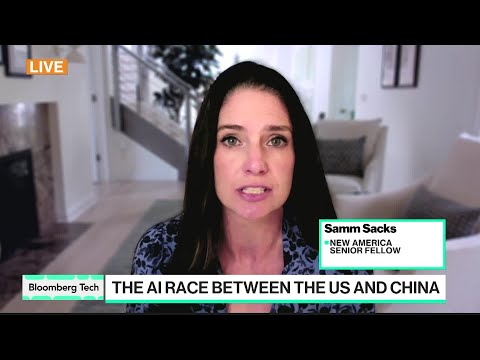
The US, China Race for AI Supremacy
Bloomberg Technology· 2025-07-09 19:09
US-China Tech Competition & Trade Negotiations - Both the US and China are heavily investing in infrastructure (data, energy computation, and human capital) to lead in AI [1][2][4] - The US technology industry seeks a conducive environment for domestic investment, exemplified by projects like Stargate and significant investments from companies like Apple ($500 billion) and IBM ($150 billion), totaling over $2 trillion [4][5] - Trade negotiations with China involve potential loosening of export controls on semiconductors as a bargaining chip [6][8] - A year ago, China was unwilling to negotiate with the US unless export controls were lifted, but export controls are now part of the discussions [7][8] Semiconductor Industry & Export Controls - The Trump administration placed 22 chips on the export control list in April, designed to comply with China's market [9] - There's uncertainty regarding whether the Trump administration will lift these controls or further unwind Biden administration controls on advanced semiconductor equipment [9][10] - Companies like AMD and Nvidia desire continued access to the Chinese market, balancing national security interests with economic interests [11] Rare Earth Elements & Supply Chain - China uses its dominance in rare earth elements as leverage in negotiations with the US [16] - China is loosening controls on rare earth approvals but only granting licenses for six months, retaining leverage [19] - US companies applying for rare earth approvals in China face invasive questions about sensitive business information [19] Talent & AI Development - China is rapidly deploying AI talent, prompting the US to launch AI education initiatives to develop homegrown talent and attract international experts [20][21] - The US needs to attract and retain AI talent, especially first or second-generation immigrants who often start technology companies [21]