出口管制

Search documents
商务部回应美将多家中国实体列入出口管制“实体清单”
Zhong Guo Xin Wen Wang· 2025-09-13 14:14
Core Viewpoint - The Chinese Ministry of Commerce criticizes the U.S. for adding multiple Chinese entities to the export control "entity list," claiming it acts unilaterally under the guise of maintaining international order and national security [1]. Group 1: U.S. Actions - On September 12, the U.S. Department of Commerce announced the inclusion of several Chinese entities in the export control "entity list" [1]. - The U.S. is accused of broadening the definition of national security and misusing export controls against Chinese entities in sectors such as semiconductors, biotechnology, aerospace, and logistics [1]. Group 2: Chinese Response - The Chinese spokesperson emphasized that the U.S. actions prioritize its own interests over the development rights of other countries, undermining normal business exchanges and distorting the global market [1]. - The Chinese government firmly opposes these actions, stating they harm legitimate rights of enterprises and disrupt the stability of global supply chains [1]. Group 3: Upcoming Talks - A trade meeting between China and the U.S. is scheduled to take place in Spain on September 14, raising questions about the timing of the U.S. sanctions against Chinese companies [1]. - China urges the U.S. to correct its actions and cease the unreasonable suppression of Chinese enterprises, indicating that necessary measures will be taken to protect their legitimate rights [1].
商务部:美方会谈前制裁中国企业意欲何为
Sou Hu Cai Jing· 2025-09-13 13:44
Core Viewpoint - The Chinese government strongly opposes the U.S. Department of Commerce's decision to place multiple Chinese entities on the export control "entity list," viewing it as an abuse of power and a distortion of global markets [1]. Group 1: U.S. Actions - The U.S. has generalized national security concerns and misused export controls against Chinese entities in sectors such as semiconductors, biotechnology, aerospace, and logistics [1]. - The timing of the U.S. sanctions coincides with upcoming U.S.-China economic talks in Spain, raising questions about the U.S. intentions [1]. Group 2: Chinese Response - The Chinese government urges the U.S. to correct its actions and stop the unreasonable suppression of Chinese enterprises [1]. - China is prepared to take necessary measures to firmly protect the legitimate rights and interests of its companies [1].

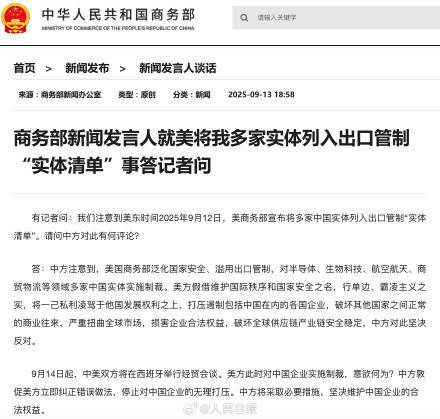
美将我多家实体列入出口管制“实体清单”,商务部:停止对中国企业无理打压
Di Yi Cai Jing· 2025-09-13 13:29
Group 1 - The core viewpoint of the articles highlights the ongoing tensions between the US and China regarding trade and export controls, particularly focusing on the recent sanctions imposed by the US on several Chinese entities [1][2] - The Chinese Ministry of Commerce has expressed strong opposition to the US's unilateral actions, claiming they distort the global market and harm legitimate business interests [1] - The upcoming US-China economic talks in Spain, scheduled for September 14-17, will address issues such as unilateral tariffs, export control abuses, and the TikTok situation [1][2] Group 2 - The Chinese government maintains a firm stance on protecting the rights of its companies, particularly regarding the TikTok issue, emphasizing its commitment to data privacy and security [2] - The Chinese side urges the US to engage in dialogue based on mutual respect and equality to resolve concerns and create a fair business environment for Chinese companies operating in the US [2]
商务部:中方敦促美方停止对中国企业无理打压
Xin Hua Wang· 2025-09-13 12:44
Core Viewpoint - The Chinese government is urging the U.S. to correct its actions and stop the unreasonable suppression of Chinese enterprises, especially in light of recent sanctions imposed by the U.S. on multiple Chinese entities [1]. Group 1: U.S.-China Trade Talks - U.S. and China will hold economic and trade talks in Spain starting September 14 [1]. - The timing of these talks coincides with the U.S. imposing sanctions on Chinese companies, raising questions about the U.S. intentions [1]. Group 2: U.S. Sanctions on Chinese Entities - The U.S. Department of Commerce has added several Chinese entities to its export control "entity list" as of September 12, 2025 [1]. - The Chinese government criticizes the U.S. for misusing national security as a pretext for unilateral and bullying actions against Chinese companies [1]. Group 3: Impact on Global Market - The sanctions are seen as damaging to normal business exchanges between countries, distorting the global market, and harming the legitimate rights of enterprises [1]. - The Chinese government emphasizes that these actions threaten the safety and stability of global supply chains and industrial chains [1].
美将多家中国实体列入出口管制“实体清单”,商务部回应!
Sou Hu Cai Jing· 2025-09-13 12:43
Core Viewpoint - The Chinese Ministry of Commerce criticizes the U.S. for adding multiple Chinese entities to its export control "entity list," claiming it is an abuse of national security and unilateralism that harms global trade and supply chains [1]. Group 1: U.S. Actions - The U.S. Department of Commerce announced on September 12, 2025, that several Chinese entities would be added to the export control "entity list" [1]. - The U.S. is accused of using national security as a pretext to impose sanctions on Chinese entities in sectors such as semiconductors, biotechnology, aerospace, and logistics [1]. Group 2: Chinese Response - The Chinese government firmly opposes the U.S. actions, stating that they undermine the legitimate rights of enterprises and disrupt normal business exchanges between countries [1]. - China urges the U.S. to correct its actions and stop the unreasonable suppression of Chinese companies [1]. - The Chinese government plans to take necessary measures to protect the legitimate rights of its enterprises [1]. Group 3: Upcoming Talks - Economic and trade talks between China and the U.S. are scheduled to take place in Spain starting September 14 [1].
芯片突发!商务部发声!
Zheng Quan Shi Bao· 2025-09-13 12:15
Group 1 - The Ministry of Commerce has initiated an anti-dumping investigation into imported analog chips originating from the United States, following a formal application from the Jiangsu Semiconductor Industry Association on July 23, 2025 [2] - The investigation is based on the compliance of the applicant's total production with the relevant regulations of the Anti-Dumping Law of the People's Republic of China, and the application includes necessary evidence as per the law [2] - The investigation will officially commence on September 13, 2025, as per the Ministry's decision [2] Group 2 - On September 12, 2025, the U.S. Department of Commerce added several Chinese entities to its export control "entity list," prompting a response from the Ministry of Commerce, which condemned the U.S. actions as unilateral and bullying [2][3] - The Ministry emphasized that the U.S. is distorting the global market and damaging legitimate business rights, while also threatening the stability of global supply chains [2] - The Chinese side has urged the U.S. to correct its actions and stop the unreasonable suppression of Chinese enterprises, indicating that necessary measures will be taken to protect their legitimate rights [3]
刚刚回应:中方对此坚决反对!
Zhong Guo Ji Jin Bao· 2025-09-13 12:14
Group 1 - The U.S. Department of Commerce has added multiple Chinese entities to its export control "entity list," which has been met with strong opposition from China [1] - China accuses the U.S. of abusing export controls under the guise of national security, impacting sectors such as semiconductors, biotechnology, aerospace, and logistics [1] - The Chinese government claims that U.S. actions distort the global market, harm legitimate business rights, and disrupt the stability of global supply chains [1] Group 2 - A trade meeting between China and the U.S. is scheduled to take place in Spain on September 14, raising questions about the timing of U.S. sanctions against Chinese companies [1] - China urges the U.S. to correct its actions and cease the unreasonable suppression of Chinese enterprises, indicating potential retaliatory measures [1]
芯片突发!商务部发声!
证券时报· 2025-09-13 12:12
Group 1 - The Ministry of Commerce has initiated an anti-dumping investigation into imported analog chips originating from the United States, following a formal request from the Jiangsu Semiconductor Industry Association on July 23, 2025 [2] - The investigation was based on the compliance of the applicant's production volume with the relevant regulations of the Anti-Dumping Regulations of the People's Republic of China, and the application included necessary evidence as stipulated in the regulations [2] - The investigation will officially commence on September 13, 2025, as per the decision made by the Ministry of Commerce [2] Group 2 - On September 12, 2025, the U.S. Department of Commerce announced the inclusion of multiple Chinese entities on its export control "entity list," prompting a response from the Ministry of Commerce [3] - The Chinese side criticized the U.S. for abusing export controls under the guise of national security, asserting that such actions distort the global market and harm legitimate business rights [3] - The Chinese government plans to take necessary measures to protect the legitimate rights and interests of Chinese enterprises in response to these sanctions [3]
刚刚回应:中方对此坚决反对!
中国基金报· 2025-09-13 12:06
Group 1 - The U.S. Department of Commerce has added multiple Chinese entities to its export control "entity list," which is seen as an abuse of export controls under the guise of national security [3] - The Chinese government criticizes the U.S. for its unilateral and bullying practices, claiming that these actions harm the legitimate rights of enterprises and disrupt global supply chains [3] - A bilateral economic and trade meeting is scheduled to take place in Spain on September 14, raising questions about the timing of the U.S. sanctions against Chinese companies [3] Group 2 - The Chinese government urges the U.S. to correct its actions and stop the unreasonable suppression of Chinese enterprises, indicating potential retaliatory measures to protect their rights [3]
美将多家中国实体列入出口管制“实体清单”,商务部回应
21世纪经济报道· 2025-09-13 12:05
Core Viewpoint - The article discusses the recent U.S. Department of Commerce decision to place multiple Chinese entities on the export control "entity list," highlighting China's strong opposition to what it perceives as U.S. unilateralism and bullying tactics in international trade [1]. Group 1: U.S. Export Controls - The U.S. has generalized national security concerns and misused export controls against several Chinese entities in sectors such as semiconductors, biotechnology, aerospace, and logistics [1]. - The U.S. actions are seen as prioritizing its own interests over the development rights of other countries, particularly China, thereby distorting global markets and harming legitimate business operations [1]. Group 2: Impact on Global Supply Chains - The sanctions are viewed as damaging to the stability and security of global supply chains and industrial chains, which could have far-reaching implications for international trade [1]. Group 3: Upcoming U.S.-China Economic Talks - The timing of the U.S. sanctions, just before the scheduled economic talks in Spain on September 14, raises questions about the U.S. intentions and strategy in its dealings with China [1]. - China urges the U.S. to correct its actions and cease the unreasonable suppression of Chinese enterprises, indicating a potential for retaliatory measures to protect its companies' rights [1].