
Monetary Policy

Search documents
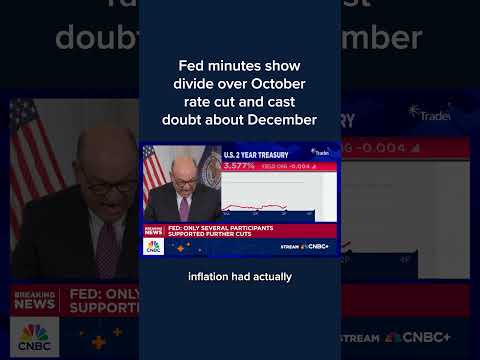
Fed minutes show divide over October rate cut and cast doubt about December
CNBC Television· 2025-11-19 20:00
Monetary Policy Debate - The market initially anticipated a more dovish stance, but the October meeting minutes revealed a potentially more hawkish sentiment from the Federal Reserve [1] - A significant debate occurred regarding the October rate cut and potential December cuts, indicating internal disagreement within the Federal Reserve [1][5] - Many participants suggested maintaining the funds rate unchanged for the remainder of the year, while only a few supported further rate cuts [1] Inflation and Employment Concerns - Most participants were concerned that rate cuts could exacerbate the risk of entrenched higher inflation [2] - There was general agreement that upside risks to inflation were elevated, and downside risks to employment were also elevated [2] - Some favored lowering the target due to downside risks to employment and little change or diminishing inflation [3] Economic Assessment - Some participants believed that progress toward the 2% inflation target had stalled, or that inflation had actually increased, leading to a lack of confidence in achieving the target [4] - The Federal Reserve debated the restrictiveness of the current policy relative to the neutral rate, with some arguing it remained restrictive even after a 0.25% point cut [4] - Others viewed the economy as resilient, with supportive financial market conditions and no clear indication that the Federal Reserve's policy was restrictive [5]

X @Bloomberg
Bloomberg· 2025-11-19 15:17
Neil Dutta Says the Fed Is Committing Monetary Malpractice https://t.co/XwaPL6aDto ...
Bitcoin and Main Street
Benjamin Cowen· 2025-11-19 00:15
Market Analysis - Bitcoin's major peaks have historically corresponded with peaks in the ISM (Institute for Supply Management) [6] - The current cycle feels different due to Main Street's economic struggles, leading to a lack of retail investor involvement and euphoria [6] - Social interest in Bitcoin is at levels similar to 2019 because Main Street is hurting [17] Economic Factors - The ISM Manufacturing PMI (Purchasing Managers Index) is a key indicator; above 50 indicates expansion, below 50 indicates contraction [5] - The Fed funds rate, currently at 4%, may be higher than the neutral rate, potentially impacting economic conditions [7] - A 50 basis points cut by the Federal Reserve could potentially bring the rate below the neutral rate, but this is not expected [8] Monetary Policy and Future Outlook - The market may experience waning interest in early 2026 until interest rates decrease and monetary policy shifts [13] - Lower rates are needed to alleviate Main Street's concerns about the labor market and inflation [17] - Over time, politicians tend to resort to printing more money to solve economic issues [18] - Cycles like the current one emphasize the importance of sound investment principles [18][19]

Fed's Barkin looks forward to more economic clarity as data flow resumes
Reuters· 2025-11-18 16:07
Core Viewpoint - Richmond Federal Reserve President Thomas Barkin emphasizes the need for upcoming data and community interviews to clarify the economic outlook, highlighting the ongoing tension between inflation and employment goals among U.S. central bank policymakers [1] Group 1 - The U.S. central bank policymakers are currently divided regarding the direction of monetary policy [1]

X @Bloomberg
Bloomberg· 2025-11-18 00:38
Australia’s central bank board members discussed a recent spike in inflation, the outlook for the labor market and whether monetary policy was still restrictive when deciding to leave interest-rate settings unchanged this month https://t.co/Vtm9NIYowy ...
Fed's Jefferson Says Fed Should ‘Proceed Slowly' With Any Further Easing
WSJ· 2025-11-17 15:10
Core Viewpoint - The Federal Reserve's current policy stance is described as "still somewhat restrictive," but it has been adjusted closer to a neutral level that neither restricts nor stimulates the economy [1] Summary by Relevant Sections - **Federal Reserve Policy Changes** - The Fed has implemented two quarter-point rate reductions in 2025 [1] - The adjustments aim to bring the policy stance closer to a neutral level [1]

Gold Is Better Fiat Hedge Than Bitcoin: 3-Minutes MLIV
Youtube· 2025-11-17 09:53
Core Viewpoint - The correlation between the cryptocurrency market and technology stocks is expected to continue, with ongoing negativity in the crypto space impacting tech sentiment and leading to a rotation in investment strategies [1][2][3]. Cryptocurrency Market - The cryptocurrency market is experiencing a downturn, which is anticipated to persist due to negative sentiment and the impact of digital asset treasury companies [2][3]. - Bitcoin is seen as a leading indicator for retail sentiment, reflecting the struggles of the US consumer amid inflation and rising unemployment [3]. Technology Sector - The technology sector is facing challenges as a result of the negative sentiment in the crypto market, with favored tech stocks also experiencing sell-offs [3][4]. - There is an expectation of continued rotation away from popular tech names towards a broader stock market, influenced by macroeconomic data and market conditions [4]. Monetary Policy - Recent hawkish statements from the Federal Reserve have contributed to the volatility in the equity market, particularly affecting tech stocks [5][6]. - The expectations for Fed rate cuts have diminished, creating uncertainty in the market, although this is not seen as the primary driver of current trends [6][8]. Funding Concerns - Funding issues have emerged as a negative factor impacting the market, particularly as the end of the quarter and year approaches [7]. - Concerns about rising US yields and fiscal issues are expected to weigh on stock performance, including tech stocks [8]. Precious Metals - Gold is projected to continue outperforming Bitcoin, as both are viewed as anti-fiat assets amid global fiscal concerns [9][10]. - While gold is expected to bounce back quickly, it may also face significant liquidation during market panic, indicating a complex relationship with market dynamics [10][11].

印度经济_通胀处于历史低位,但这是否足以让印度储备银行进一步宽松
2025-11-16 15:36
Summary of Key Points from the Conference Call Industry Overview - The report focuses on the Indian economy, specifically analyzing inflation trends and the implications for the Reserve Bank of India (RBI) [1][4][18]. Core Insights and Arguments - **Headline Inflation Decline**: Headline inflation fell to an all-time low of 0.25% YoY in October 2025, down from a revised 1.44% in September 2025. This decline is attributed to favorable base effects, subdued food prices, and GST cuts [1][4][18]. - **Core Inflation Trends**: Core inflation rose by 13 basis points to 4.4% YoY in October 2025, primarily driven by a spike in gold prices. The core CPI excluding petrol and diesel fell to a new low of 2.8% YoY [4][13][19]. - **Impact of GST Cuts**: GST rate cuts are estimated to have reduced headline inflation by 15-20 basis points and core inflation by approximately 35 basis points in October 2025. The largest impact was observed in CPI passenger cars, which saw a 6.4% decrease [12][14][19]. - **Vegetable Prices**: Vegetable inflation reached -28% YoY in October 2025, the lowest since the series began in 2013, driven by subdued prices of tomatoes, onions, and potatoes [5][10][19]. - **Food and Beverage Inflation**: Excluding vegetable inflation, food and beverage inflation is at a 6.5-year low of 1.6% YoY in October 2025 [10][12]. Additional Important Insights - **Revised Inflation Forecasts**: The average FY26 headline inflation forecast has been revised down to 2.0% YoY from 2.3% earlier, with expectations of 1.8% YoY for 2HFY26 [18][19]. - **RBI's Rate Cut Considerations**: There is an 80-100 basis points downside risk to RBI's inflation forecasts for 2HFY26 (2.9%) and 1HFY27 (4.5%). Despite this, the RBI may prefer to maintain a dovish stance rather than implement immediate rate cuts due to resilient economic activity [19][21]. - **Future Economic Indicators**: The upcoming 2QFY26 GDP data is expected to exceed 7%, which may prompt the RBI to revise its full-year GDP growth forecast upward [19][21]. Conclusion - The Indian economy is experiencing historically low inflation rates, influenced by various factors including GST cuts and subdued food prices. The RBI faces a complex decision-making environment regarding potential rate cuts, balancing inflation risks with ongoing economic resilience.

全球经济展望月报_经济体对美国关税和地缘政治展现出显著的灵活性与韧性,人工智能引领的投资无疑起到了推动作用,但前路仍有诸多隐患
2025-11-16 15:36
Summary of Key Points from the Conference Call Industry Overview - The conference call discusses the global economic outlook, focusing on various regions including the United States, Canada, Euro area, and Asia-Pacific countries, particularly China and Japan. Core Insights and Arguments 1. **U.S. Economic Outlook** - The Federal Reserve is expected to maintain current interest rates in December, with a potential shift in leadership in 2026 leading to three rate cuts in that year [2][13][23] - The labor market shows signs of deterioration, with less inflation pressure than previously feared [13] - The U.S. economy is projected to grow at 2.0% in 2025, with inflation expected to stabilize around 2.8% [9] 2. **Canada's Economic Situation** - The Bank of Canada (BoC) has likely completed its easing cycle, with a terminal rate of 2.25% [23][24] - Economic growth remains weak due to trade disruptions, but labor markets are gradually recovering [24][26] - Inflation pressures are expected to decrease due to lower energy prices and a reduction in immigration targets [25][26] 3. **Euro Area Insights** - The European Central Bank (ECB) is expected to have finished its cutting cycle, with GDP growth anticipated to accelerate [13] - Inflation is projected to return to target levels by 2026, despite current pressures [13] - Germany's relaxed fiscal rules are expected to support stronger growth in the Euro area [3] 4. **Asia-Pacific Economic Dynamics** - China's export growth turned negative in October, with a weak outlook for exports beyond technology [4] - The Chinese government is likely to implement fiscal stimulus and rate cuts to support domestic demand [4][13] - Japan's Bank of Japan (BOJ) is expected to maintain its policy rate, with a potential hike in January 2026 [13][18] 5. **Emerging Markets and Other Regions** - Emerging markets are projected to grow at 4.3% in 2025, with inflation pressures varying across countries [9] - India faces growth challenges due to high tariffs, while Indonesia's new government policies raise fiscal risks [13][24] Additional Important Insights - The global economic outlook remains cautious, with potential risks from trade tensions and geopolitical issues [1][13] - The labor market dynamics in various regions indicate a shift towards weaker growth, which could impact monetary policy decisions [13][24] - The divergence in economic performance between technology and non-technology sectors is expected to continue, favoring countries like Taiwan and Korea over others like Thailand and Indonesia [13] This summary encapsulates the key points discussed in the conference call, providing a comprehensive overview of the economic outlook across different regions and sectors.